
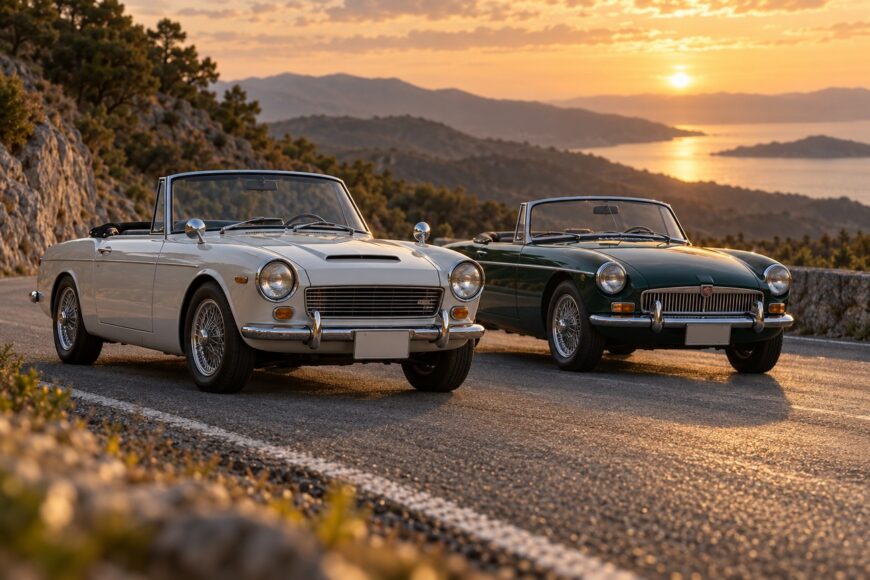
The Datsun Fairlady 2000 beat the MGB—provided “beat” refers to acceleration, top speed, and racing reputation rather than sales. The SR311/SRL311 brought a high-revving twin-cam engine, a five-speed manual transmission, and a performance focus that made it one of the quickest Japanese roadsters of its era.
That advantage came with a cost. Produced from 1967 to 1970, the Fairlady 2000 is rarer than an MGB, harder to support, and often more expensive to restore. Rust, missing trim, improvised repairs, and years of storage can erase the value of a strong engine surprisingly quickly.
The result is a classic with a clear ownership tension: technically compelling and genuinely fast for its period, yet demanding a more careful purchase. A sound, documented Fairlady can be an exceptional driver’s car. A cheap example that merely runs can become a body restoration disguised as a bargain.
- What “Beat the MGB” Really Means
- The U20 Engine and the Five-Speed Advantage
- Fairlady 2000 vs. MGB: The Performance Case
- Chassis, Handling, and the Limits of the Formula
- Buying One: Why the Body Matters More Than the Engine
- Ownership Reality: Parts, Tuning, and Long-Term Storage
- Originality, Rarity, and the Restoration Trap
- The Verdict: A Better Performer, Not an Easier Classic
- Frequently asked questions
- How much horsepower did a Datsun Roadster 2000 have?
- How much is a Datsun Fairlady 2000 worth?
- What is the fastest Datsun car in the world?
- What do the SR311 and SRL311 designations mean?
What “Beat the MGB” Really Means
The phrase usually describes a performance comparison. The Fairlady 2000’s U20 engine, five-speed gearing, and favorable power-to-weight character gave it a stronger reputation for acceleration and top-speed potential than the MGB. Period road tests commonly placed its maximum speed at approximately 190–200 km/h, depending on test conditions, vehicle condition, and tires.
Motorsport history reinforced that impression. The Fairlady was regularly regarded as a better-prepared competition roadster, with an eager engine and gearing suited to sustained speed. That reputation helped establish the idea that the Japanese car had defeated its British rival, even though the claim concerned dynamics and racing performance rather than a universal victory in every category.
Commercial success followed a different path. The MGB was produced in much larger numbers, remains easier to find, and generally benefits from broader parts support. That makes it simpler to maintain, restore, and return to the road, especially for an owner working without specialist access to rare Japanese-market components.
Rarity also changes the buying calculation. Good original Fairlady 2000 examples are substantially rarer than MGBs, yet rarity does not guarantee easy resale or low restoration costs. The car can be the more exciting performer while remaining the less practical classic for routine ownership.
The U20 Engine and the Five-Speed Advantage
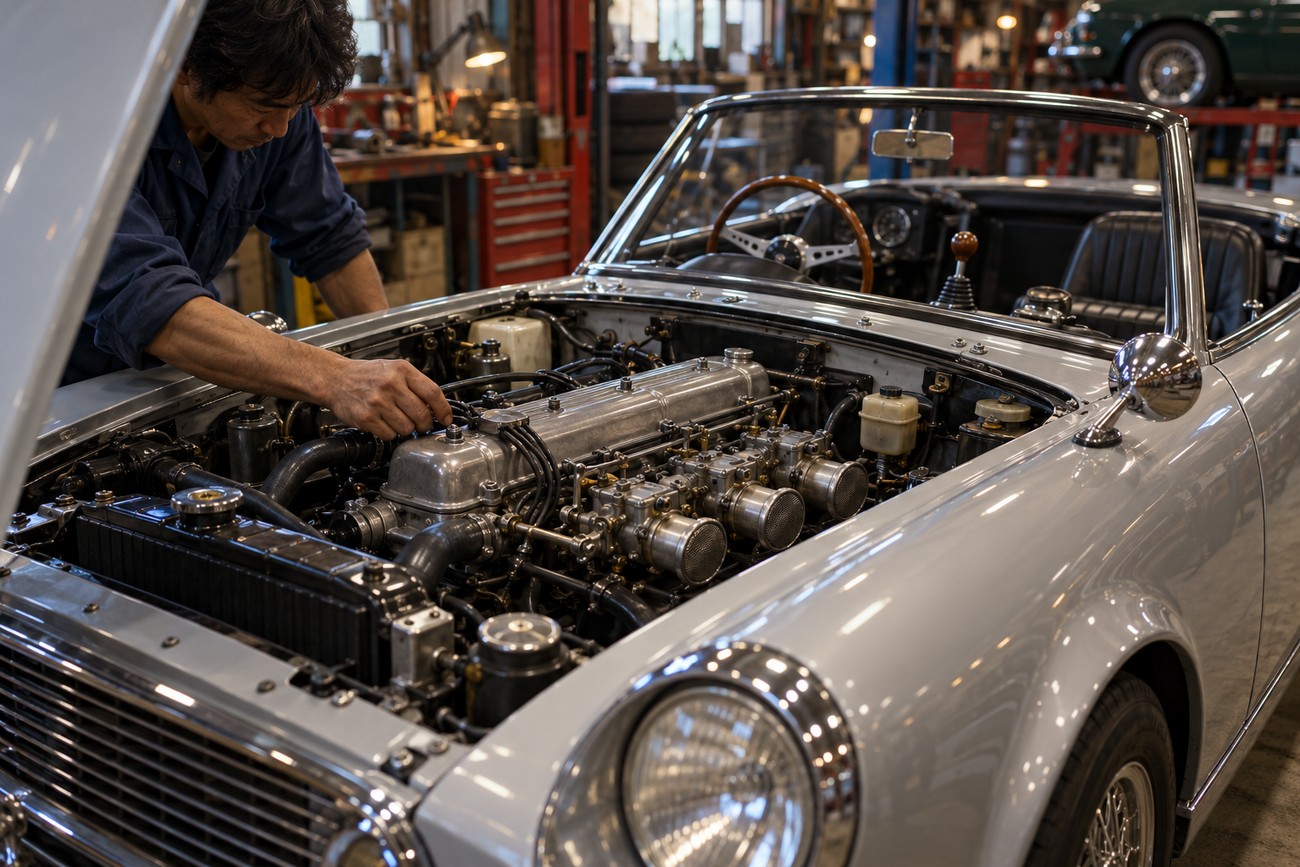
The U20 is a 1,982 cc, four-cylinder, DOHC engine with a character that rewards revs. Its commonly cited output is about 135 hp SAE gross, although published figures vary by market and measurement method. That distinction matters when comparing period brochures, road tests, and modern references, because the numbers may describe different specifications or testing standards.
In good condition, the engine feels more purposeful than its age and displacement suggest. Throttle response, camshaft character, and the willingness to keep pulling at higher engine speeds create the Fairlady’s distinctly mechanical personality. A tired example with poor compression, incorrect adjustment, or an unsuitable replacement component can give a very different impression.
The five-speed manual transmission was a major advantage for the class. It allowed closer control of the engine’s useful rev range and gave the roadster a better chance of combining brisk acceleration with relaxed high-speed cruising. Many period competitors offered fewer ratios, so the Fairlady’s gearbox contributed as much to its road behavior as the headline horsepower figure.
Carburetors and ignition must be correctly set for the U20 to deliver that experience. Age, worn linkage, vacuum leaks, poor synchronization, and incorrect timing can produce rough running that is sometimes blamed on the engine’s design. A test drive should therefore include cold starting, steady cruising, throttle response, and behavior under load rather than a brief demonstration after the engine has been warmed for the buyer.
Fairlady 2000 vs. MGB: The Performance Case
The comparison is strongest when the specifications are read as a connected package. The Fairlady’s engine, gearbox, and period road-test performance explain its advantage, while the chassis layout shows why the car still required compromises familiar to its era.
| Area | Datsun Fairlady 2000 | MGB context | Practical significance |
|---|---|---|---|
| Engine layout | U20, 1,982 cc, four-cylinder, DOHC | Less highly specified four-cylinder roadster engine architecture in typical MGB form | The Fairlady’s twin-cam layout and rev-happy character supported stronger performance potential. |
| Typical power | About 135 hp SAE gross; figures vary by market and measurement method | Output varies by MGB version and measurement standard | Period numbers must be compared on a consistent basis; the Fairlady generally delivered the stronger performance impression. |
| Transmission | Five-speed manual | Typically fewer forward ratios in comparable period versions | The extra ratio improved acceleration spacing and high-speed usability. |
| Period top-speed range | Approximately 190–200 km/h | Generally lower in comparable road tests | The Fairlady had greater top-speed potential, although tires, setup, and mechanical condition affected the result. |
| Front suspension | Independent front suspension | Independent front suspension | Both used a familiar sports-car layout at the front, so the Fairlady’s engine and gearing were central to its performance advantage. |
| Rear suspension | Live axle on leaf springs | Live axle with leaf springs | The shared basic arrangement was durable and simple, though neither car offered modern ride and wheel-control refinement. |
| Ownership meaning | Faster, rarer, and more difficult to source parts for | More common, with broader support and easier parts access | The Fairlady wins the performance argument more clearly than the ownership argument. |
The Fairlady’s advantage came from the combination of power, engine character, and gearing rather than from one isolated specification. A five-speed gearbox kept the U20 in a useful part of its rev range, while the engine’s twin-cam design gave the car a more urgent feel than many drivers expect from a 1960s Japanese roadster.
Top-speed figures require restraint. A period result near 190–200 km/h describes a particular car on particular tires, with a particular state of tune and test method. A worn engine, incorrect carburetor setup, poor alignment, or unsuitable tires can make a nominally identical car feel substantially slower.
The same applies to acceleration. Launch technique, clutch condition, rear-axle health, and the driver’s ability to use the engine’s rev range all affect the outcome. A mechanically sound Fairlady can feel decisively quicker than an MGB, while a neglected example may deliver little of the advantage suggested by its specifications.
These differences explain the Fairlady’s racing reputation without turning it into a universal winner. The MGB’s greater availability, simpler parts access, and familiar service requirements remain meaningful advantages for an owner who values easy maintenance over maximum period performance.
Chassis, Handling, and the Limits of the Formula
The Fairlady uses independent front suspension and a rear live axle on leaf springs. The layout is straightforward, strong, and comparatively easy to repair, which suits a roadster intended for spirited driving and occasional competition. It also means that the car’s behavior depends heavily on bushing condition, spring health, alignment, and the quality of previous repairs.
On a good road, the chassis can feel direct and communicative. The driver receives clear feedback through the steering and seat, while the U20 supplies the urgency that makes the car feel more serious than its simple construction suggests. Its strengths are most apparent when the suspension is correctly assembled and the tires are appropriate for the chassis.
Modern drivers should expect period limitations. Original brakes, damping, and body control can feel dated beside a contemporary sports car, particularly during repeated hard stops or on uneven pavement. Correct maintenance is essential, and discreet upgrades may improve usability, although modifications can affect originality and collector appeal.
The rear leaf springs are durable, yet they do not provide the wheel control of a modern independent rear suspension. Worn bushes, tired springs, or uneven ride height can make the car nervous and obscure its intended balance. A Fairlady that pulls, wanders, or feels reluctant to settle deserves a suspension and geometry inspection before the engine receives attention.
Buying One: Why the Body Matters More Than the Engine
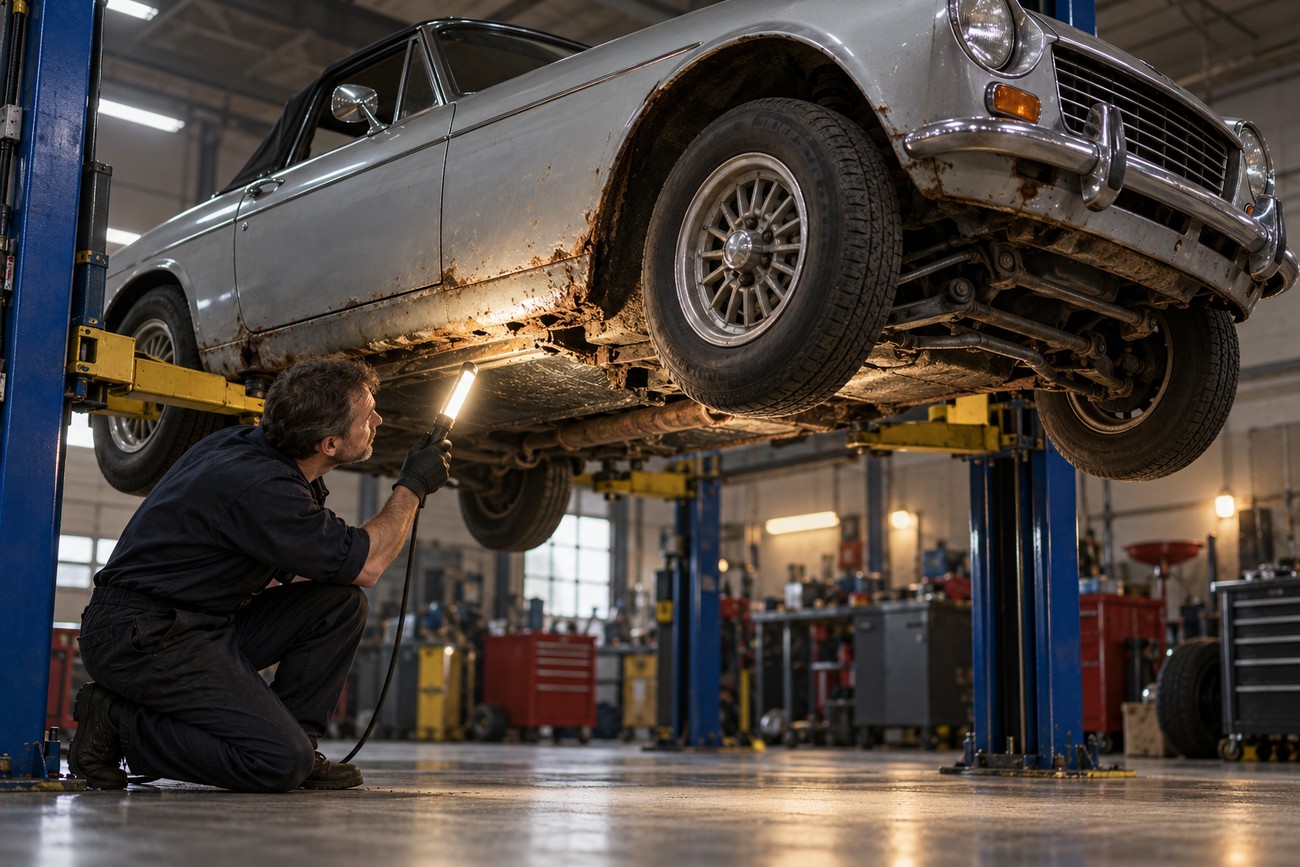
Structural body condition should lead every inspection. Check the floor panels, frame rails, wheel arches, suspension mounts, and the areas where corrosion can compromise the relationship between the body and chassis. A clean engine bay is useful evidence of care, yet it cannot compensate for a shell that requires extensive cutting, fabrication, and alignment work.
Cosmetic restoration can hide serious corrosion. Fresh paint, underseal, and tidy seam work may conceal thin metal, overlapping patches, or repairs that were completed without restoring the original geometry. Inspect the underside, inner panels, welds, door gaps, and suspension pickup points, and compare the car’s current appearance with photographs or invoices from earlier work.
Small trim pieces and emblems deserve an availability check before dismantling begins, because good reproductions are particularly scarce. A missing badge may be easier to identify than to replace correctly once a restoration is underway.
Accident history matters as much as rust. Uneven gaps, mismatched panel contours, signs of chassis straightening, and inconsistent welding can indicate an earlier impact or a long sequence of partial repairs. The inspection should include geometry and restoration history, not merely a compression test and a look at the paint.
A running project can still require a complete mechanical recommissioning. Fuel lines, pumps, cooling components, seals, brakes, wiring, and suspension joints may all need attention after years of neglect. The most sensible purchase is usually the structurally strongest car with the clearest history, even if its engine bay is less attractive on the day of inspection.
Ownership Reality: Parts, Tuning, and Long-Term Storage
The Fairlady’s mechanical simplicity does not make ownership effortless. Carburetors and ignition systems may need regular adjustment, particularly when components have been replaced, rebuilt inconsistently, or set up without reference to the complete engine and exhaust combination. Rough running is often a maintenance problem rather than proof that the U20 is inherently temperamental.
Long storage creates a separate set of risks. Cars returning to the road commonly need inspection of the fuel system, hoses, rubber components, and pumps before regular driving begins. Old fuel, blocked passages, deteriorated seals, and weakened cooling-system parts can turn an apparently successful start-up into a series of failures once the car is driven under load.
Electrical faults can be equally frustrating. Age-related wiring damage, poor grounds, corroded connections, and previous owner modifications may produce intermittent lights, gauges, charging problems, or ignition faults. A methodical inspection of the harness and grounding points is more productive than replacing parts at random.
Parts sourcing requires patience and international reach. Mechanical items may be manageable through specialist networks, while original chrome, interior fittings, emblems, and small trim pieces can be scarce and expensive. The difficulty is especially apparent when a restoration needs several minor pieces that are individually uncommon and poorly served by reproduction suppliers.
A sensible owner documents every component before disassembly and separates repairable originals from items that must be replaced. This avoids discarding rare trim too early and helps preserve the car’s identity. It also exposes the true scope of the project before money is committed to paint or engine work.
Originality, Rarity, and the Restoration Trap
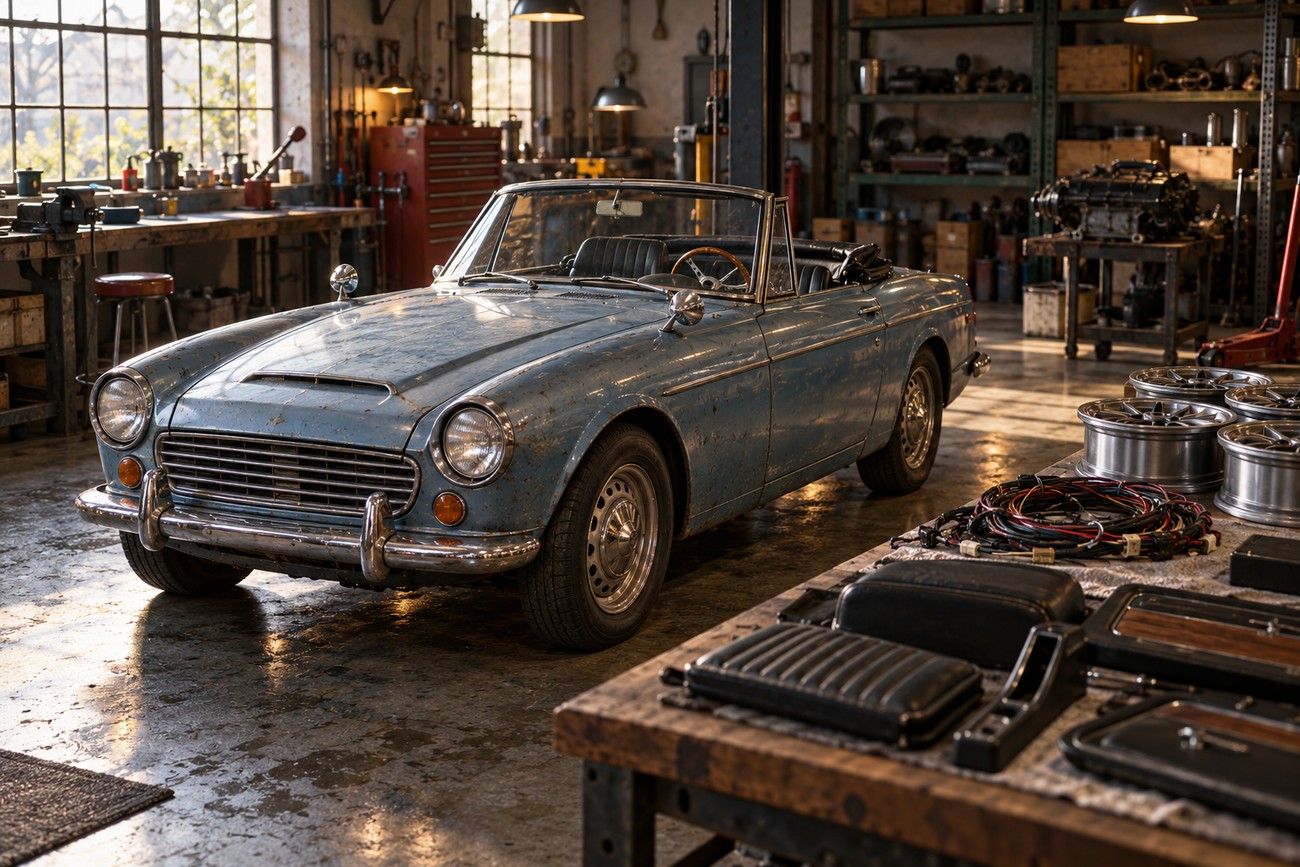
Good original Fairlady 2000 examples are rarer than MGBs, which gives the model genuine collector interest. Rarity can also create confusion during a purchase, because an unusual car may appear more valuable simply because it is difficult to compare with other examples. Condition, specification, and documentation remain more important than scarcity alone.
Many cars have acquired non-original modifications or replacement components over the decades. Changes to the engine, carburetors, wheels, wiring, interior, or trim may improve usability, yet they can reduce originality and complicate future restoration. Buyers should establish which parts belong to the stated model and which were fitted later.
Incomplete restorations deserve particular caution. A disassembled shell may come with boxes of parts, but those parts may be mixed, damaged, or missing key fasteners and trim. Without a clear inventory and a realistic plan for sourcing replacements, the apparent head start can become a long search for small items that determine whether the finished car feels correct.
High-quality restoration spending may not be recovered on resale, especially when the shell began with severe corrosion. A rare badge cannot repair poor structure, and a beautiful engine cannot remove the cost of correcting bad geometry. The economics work best when the buyer starts with a sound body and treats originality as something to verify rather than assume.
The Verdict: A Better Performer, Not an Easier Classic
The Datsun Fairlady 2000 can fairly be called the better performer against the MGB in the areas that shaped its reputation: acceleration, top-speed potential, engine character, and period racing credibility. Its U20 engine and five-speed transmission give the roadster a more focused, energetic personality than many owners expect from a 1960s Japanese car.
The MGB usually remains the easier classic to own. Greater availability, broader parts access, and a larger support base make routine maintenance and restoration more predictable. That practical advantage matters whenever a car needs trim, interior components, or a repair that cannot be solved with ordinary workshop parts.
Nationality is a poor substitute for inspection. British or Japanese origin does not determine whether a particular roadster is reliable, original, or financially sensible after decades of use. A rare Fairlady with hidden rust and undocumented modifications can be a worse purchase than a well-maintained, thoroughly documented MGB.
The best Fairlady 2000 purchase is a structurally sound, properly documented example with a coherent specification. Buy the body first, confirm the history, and judge the engine as a repairable component. That approach preserves the car’s real advantage: an unusually engaging roadster that earned its performance reputation without requiring the legend to do the driving.
Frequently asked questions
The Fairlady 2000 is easiest to understand when period specifications are separated from modern assumptions. Market, measurement method, originality, and structural condition all affect the answer.
How much horsepower did a Datsun Roadster 2000 have?
The commonly cited figure is about 135 hp SAE gross from the 1,982 cc U20 four-cylinder DOHC engine. Published figures can differ because markets used different specifications and because SAE gross ratings are not directly equivalent to later net or modern measurement methods.
Engine condition also changes the practical result. Carburetor synchronization, ignition timing, compression, exhaust condition, and general tune determine how much of the original output reaches the road. The period figure is therefore best treated as a qualified reference point rather than a universal rating for every surviving car.
How much is a Datsun Fairlady 2000 worth?
There is no single reliable value for every Fairlady 2000. The strongest valuation factors are shell condition, structural rust, originality, documentation, completeness, and the quality of any restoration. A sound, correctly identified car with a coherent history can command far more interest than a running project with hidden corrosion.
Restoration completeness also matters. A finished car with poor welding or mixed components may be less desirable than an honest, solid original example, while an incomplete project can carry substantial costs for trim, chrome, interior parts, and mechanical recommissioning. Asking price should therefore be judged against inspection evidence rather than rarity alone.
What is the fastest Datsun car in the world?
The answer depends on the category. Production road cars, modified street cars, racing cars, and formal record attempts are measured under different conditions, so a single title can be misleading.
The Fairlady 2000 earned a strong reputation as a fast roadster for its period, with typical period top-speed claims around 190–200 km/h. That does not make it the fastest Datsun in every category, especially when later production models, competition cars, and heavily modified vehicles are included.
What do the SR311 and SRL311 designations mean?
SR311 and SRL311 are commonly used designations for the Datsun Fairlady 2000. Buyers should still verify the car’s market specification, engine, transmission, chassis details, and history instead of assuming that every Datsun 2000 carries identical equipment.
Decades of replacement parts and modifications can blur the original specification. A matching identity, documented history, and consistent components provide stronger evidence than a badge or a seller’s description alone.







