
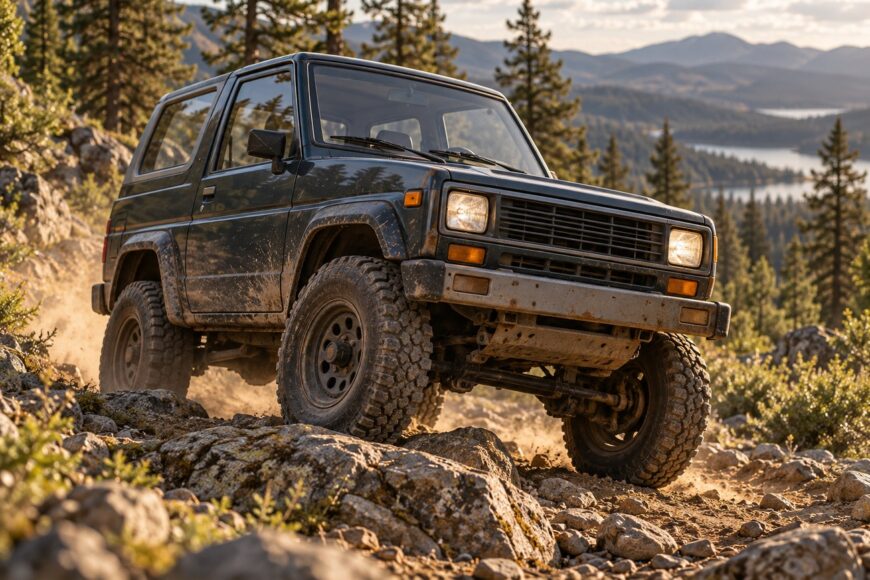
A small, genuine 4×4 that disappeared from American showrooms has an obvious appeal. The Daihatsu Rocky is compact, light, and built around the sort of simple off-road hardware that makes a rough trail feel manageable. Its short dimensions can be useful where a larger SUV runs out of room or digs itself deeper.
That appeal needs to be balanced against age, scarcity, and limited road manners. A Rocky today is an old, low-volume vehicle with possible corrosion, tired rubber, incomplete maintenance records, and difficult-to-source trim. Before judging one by its nostalgic shape or low odometer reading, identify which Rocky America actually received and assess the individual vehicle underneath.
- Which Rocky Came to America—and When Did It Leave?
- Why This Small Rocky Is a Real 4×4
- The Trail Advantage Has an On-Road Price
- Inspect the Frame Before You Trust the Odometer
- Parts and Repairs: The Cost of Rarity
- Who Should Buy a Rocky Now?
- Frequently asked questions
- How should you store a Rocky that is driven only occasionally?
- Was the Daihatsu Rocky sold in the US?
- What is the smallest 4-wheel drive car in the USA?
- Was Daihatsu ever sold in the USA?
Which Rocky Came to America—and When Did It Leave?
The Rocky name has been used for different vehicles across markets and periods. The U. S.-market Daihatsu Rocky was a compact 4×4 sold in America in the 1980s and early 1990s. A later Asian-market mini-SUV carrying the same name should not be assumed to share its chassis, drivetrain, parts, or dimensions.
American buyers received a niche, traditional off-roader rather than a soft-roading urban SUV. It was aimed at people who wanted a small vehicle with genuine four-wheel-drive hardware, even though its low sales limited its visibility compared with better-known Japanese and American 4x4s.
Daihatsu withdrew from the U. S. market in 1992. The Rocky’s sales were low, yet the available facts do not establish one proven reason for the company’s withdrawal. A small customer base, an aging product, and the difficulty of sustaining a separate market presence provide context, but none should be treated as the confirmed sole cause.
This distinction matters when researching a prospective purchase. Advertisements, owner forums, and parts listings may use “Rocky” loosely, so confirm the vehicle identification number, model year, market, engine, and transmission before ordering parts or comparing specifications.
Why This Small Rocky Is a Real 4×4
The U. S.-market Rocky uses body-on-frame construction. Its body sits on a separate frame, giving the vehicle a more conventional off-road layout than a modern unibody crossover. That structure does not make every old example strong today, since corrosion can weaken the frame and its attachment points.
Its four-wheel drive is part-time, with low-range gearing. In practical terms, the driver selects two-wheel drive for ordinary firm surfaces and engages four-wheel drive when traction and control on loose or difficult ground require it. Low range gives the driver more control at slow speeds, helping with steep, uneven, or slippery sections.
Low weight and compact dimensions are useful advantages on a trail. The Rocky can maneuver between trees, place its wheels accurately, and avoid burying itself as quickly as a heavier SUV in some muddy conditions. Capability still depends on tires, ground clearance, terrain, driver judgment, and the condition of the suspension and drivetrain.
Part-time 4WD should not be used routinely on dry pavement. Running 4H or 4L on a high-grip surface can create drivetrain wind-up because the front and rear axles cannot freely accommodate different turning speeds. If the system resists disengagement or behaves harshly, treat that as a fault to investigate rather than forcing the controls.
The Trail Advantage Has an On-Road Price

The same compact layout that helps on narrow trails limits the Rocky on ordinary roads. Cabin space is modest, the rear area is quickly filled by luggage, and adults may find longer journeys tiring. It works more naturally as a second vehicle for short recreational trips than as a family SUV.
Highway noise and vibration are part of the ownership equation. An old Rocky can feel busy at speed, with limited sound insulation and a driving position that does little to disguise its age. Long highway runs, especially after a full day on a trail, may expose weaknesses that a short local trip never reveals.
Passive safety is also dated by modern standards. The Rocky lacks the structural refinement, restraint systems, driver assistance, and crash protection expected from a current SUV. A careful buyer should therefore consider how often the vehicle will mix with fast traffic, rather than evaluating it only by its off-road ability.
These compromises explain the Rocky’s best use case. A sound example can serve well for a cabin, fishing access, hunting roads, or light trail work, provided another vehicle handles family transport and long-distance travel. Using it as an effortless daily driver can turn its charm into constant irritation.
Inspect the Frame Before You Trust the Odometer
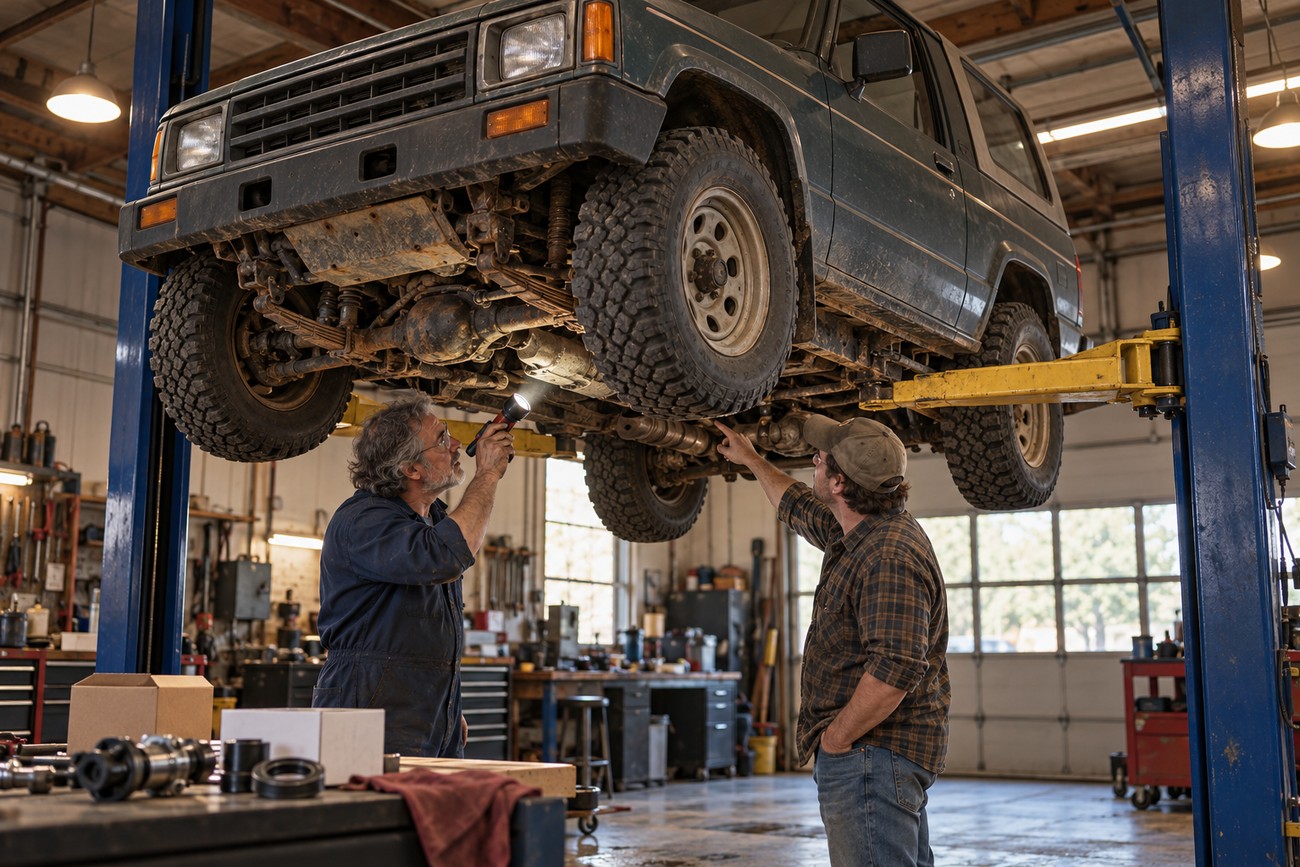
Start underneath, preferably with the vehicle lifted safely and with enough lighting to see the metal rather than just the paint. Inspect the frame rails, body mounting points, floors, sills, and suspension attachment areas for corrosion, repairs, distortion, or patchwork. Surface rust is one issue; weakened structural metal is a different purchase decision.
Move from the structure to the systems that suffer during long storage and irregular maintenance. Check the cooling system for leaks or signs of overheating, and examine brake lines, hoses, fuel lines, steering components, and suspension rubber. A Rocky that runs during a short test drive may still need substantial age-related renewal before it is ready for reliable use.
Electrical faults often begin with corroded grounds, aging connectors, or damaged wiring rather than a dramatic component failure. Test the lights, gauges, charging system, wipers, and four-wheel-drive controls. During the road test, listen for drivetrain noise, check clutch or automatic-transmission operation as applicable, and confirm that 4WD engages and disengages correctly.
Judge mileage alongside service history, never in isolation. New tires and polished paint can improve presentation while saying little about cooling, brakes, seals, or transmission wear. A well-documented high-mileage vehicle with a solid structure may be a better starting point than a low-mileage example that spent years outside or received cosmetic preparation before sale.
Parts and Repairs: The Cost of Rarity
Routine servicing is usually easier than restoring a neglected Rocky. Fluids, filters, belts, brake work, and general mechanical repairs can often be handled by experienced independent shops with careful parts research. The harder task is finding model-specific body panels, exterior trim, interior pieces, seals, and small fittings for a vehicle that left a low-volume market decades ago.
The Rocky’s U. S. service and parts network is limited. Owners’ clubs, dismantles, specialist listings, and used-parts networks can become essential sources, especially for cosmetic or interior items. That process takes time, and the part that appears correct in a photograph may still differ in mounting points, connectors, or dimensions.
Compatibility with another Daihatsu model, a different market, or a donor vehicle must be confirmed for the particular year and specification. A shared badge does not guarantee a match. Check part numbers, measurements, connector arrangements, and installation references before buying several components on the assumption that interchangeability is universal.
This is where a repair plan matters more than a purchase price. A buyer who can fabricate a bracket or wait for a used component has more flexibility than someone who needs every repair completed immediately through ordinary retail channels. Budget time for research, and keep the vehicle’s original parts when they may be repairable or useful as patterns.
Who Should Buy a Rocky Now?
The right buyer is patient, mechanically informed, and interested in a small recreational 4×4. That person can appreciate the Rocky’s light weight, maneuverability, and low-range capability while accepting noise, limited cargo space, dated safety, and the possibility of parts delays. The vehicle is most convincing when its role is specific rather than general.
A dependable, comfortable sole vehicle is a poor fit. Parts scarcity can turn a minor body or interior problem into a long search, while highway comfort falls short of modern SUV expectations. Age-related failures may also appear even after a vehicle has been driven gently, because rubber, seals, hoses, wiring, and brake components deteriorate with time.
The purchase rule is straightforward: choose structure and history before appearance. A sound frame, healthy body mounting areas, documented upkeep, and functioning four-wheel drive deserve priority over a low asking price, fresh tires, or attractive paint. A pre-purchase inspection by someone comfortable with old 4x4s can prevent an expensive mistake.
The Rocky is rewarding when its limitations are part of the plan. It can be an engaging second vehicle for trails and rural access, yet its rarity means ownership requires preparation. If there is no realistic way to source specialist parts or address corrosion, a more common 4×4 will usually make the better practical choice.
Frequently asked questions
The Rocky’s age and unusual market history make basic ownership questions worth checking before purchase. Local registration, insurance, emissions, and inspection rules can vary, so confirm those requirements with the relevant authority or provider for the vehicle’s location.
How should you store a Rocky that is driven only occasionally?
Store it dry and ventilated, keep the battery maintained with a suitable charger or disconnecting arrangement, and avoid leaving old fuel in the system for long periods. Follow the vehicle’s service guidance for fuel treatment, and inspect for moisture, rodent damage, and fluid leaks before returning it to regular use.
Check tire pressure during storage and before every drive. After a long gap, test the brakes at low speed in a safe area and look for seized components, leaks, or a soft pedal. Occasional use still requires periodic engine, brake, hose, and battery checks; inactivity does not preserve an old Rocky indefinitely.
Was the Daihatsu Rocky sold in the US?
Yes. Daihatsu sold the U. S.-market Rocky as a compact 4×4 before withdrawing from the U. S. market in 1992. The American model should be identified by its market and vehicle details, since other vehicles called Rocky are not automatically the same design.
What is the smallest 4-wheel drive car in the USA?
There is no single universal answer because “smallest” can refer to length, width, weight, or a particular model year. The U. S.-market Daihatsu Rocky is among the compact traditional 4x4s sold in America, with body-on-frame construction, part-time 4WD, and low-range gearing.
Before making a comparison, define the period and drivetrain requirement. A small crossover with electronic traction aids is a different category from a body-on-frame vehicle with a transfer case, even if both are marketed as four-wheel drive.
Was Daihatsu ever sold in the USA?
Yes. Daihatsu sold vehicles in the United States, including the Rocky, and withdrew from the market in 1992. Because the brand has been absent from the U. S. market for decades, current parts and service support should be checked locally rather than assumed.
For a specific vehicle, verify registration, insurance, emissions, and inspection requirements with the local authority and insurer. Those rules can depend on location, model year, and the vehicle’s present condition.







