
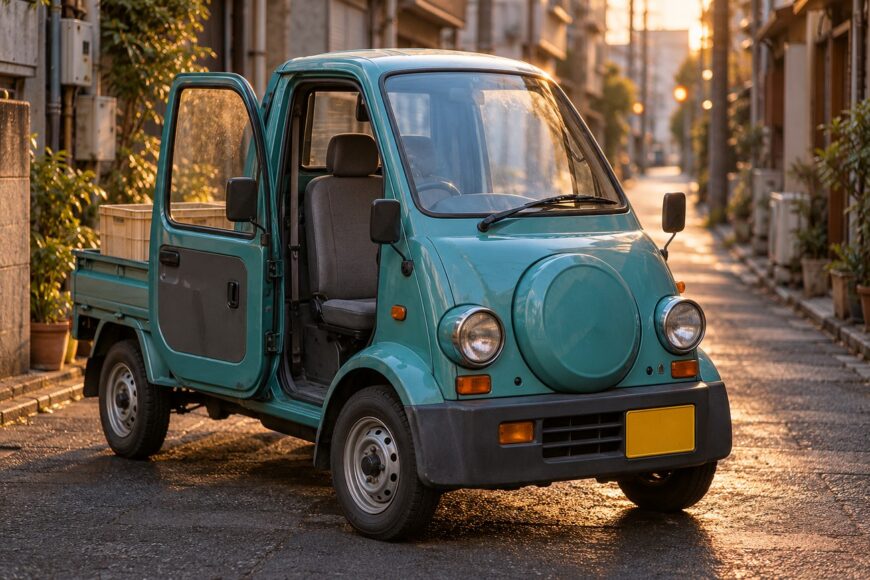
The Daihatsu Midget II has charming proportions and a genuinely industrial driving experience. Its tiny body is useful on narrow streets, yet the close-set cabin, engine noise, and modest performance make it feel more like a working vehicle than a conventional small car. The appeal is real, provided the job is specific.
Built around one-seat and other 1–2-seat layouts, the Midget II is a highly specialized city utility. Its 31–33 hp can handle short urban trips, while hills, faster roads, and cargo expose its limits. Pickup and enclosed versions also solve different problems, so buying whichever looks cutest can leave you with the wrong vehicle.
- What the Daihatsu Midget II Actually Is
- The Specifications That Matter in Daily Use
- Why It Works in Narrow Streets—and Struggles Elsewhere
- The Ownership Traps Hidden Behind the Cute Styling
- Pickup or Hatchback: Choose the Job Before the Car
- How to Inspect a Midget II Before Buying
- Who Should—and Should Not—Own One?
- Frequently asked questions
- What is the average price of a Daihatsu Midget II?
- How fast does a Daihatsu Midget II go?
- Which Midget II version is easier to live with, the pickup or the hatchback?
What the Daihatsu Midget II Actually Is
Produced from 1996–2001, the Daihatsu Midget II was designed as a very small kei utility for narrow streets and short-distance work. It is a poor substitute for a family car, even if its dimensions make it seem easy to own. Seating, cargo space, and comfort were shaped around a narrow task rather than broad everyday versatility.
“One-seat kei truck” describes part of the range, not every Midget II. Daihatsu’s concept included a family of 1–2-seat layouts, including one-seat variants. Check the actual cabin before assuming a listing can carry a passenger, and do not treat a second seat as evidence of normal two-person comfort.
Japanese-market and used-car catalogs show pickup and 3-door hatchback/microvan body styles. The pickup favors access to an open load area; the enclosed body protects cargo from weather but changes how you load it and use the limited interior. Listings may also differ in equipment and intended use, so the model name alone does not identify the configuration.
The semi-cab layout places the engine beneath the driver’s seat, with rear-wheel drive. That arrangement helps package a working vehicle into a small footprint while putting mechanical sound and heat close to the occupant. It also makes seat-area access part of a routine mechanical inspection rather than a detail to discover after purchase.
The Specifications That Matter in Daily Use
These figures describe the Midget II range; confirm the exact vehicle against its documents and physical configuration.
| Item | Midget II specification or caveat |
|---|---|
| Production | 1996–2001 |
| Engine | Three-cylinder petrol engine, listed as 659–660 cm³ |
| Output | 31–33 hp, depending on version and market catalog |
| Transmissions | Reported four-speed manual and three-speed automatic options |
| Drivetrain | Rear-wheel drive |
| Official claimed fuel economy | 24.5 km/l |
| Seating | A family of 1–2-seat layouts, including one-seat variants |
| Body styles | Pickup and 3-door hatchback/microvan styles appear in Japanese-market and used-car catalogs |
| Turning radius | Often quoted as 3.6 m in unofficial catalogs; not confirmed here as a universal factory specification |
The three-cylinder engine’s listed 659–660 cm³ displacement and 31–33 hp output tell you more about the intended workload than its size alone. It can be workable in town, where trips are short and speeds are modest. A loaded vehicle climbing a grade makes the limited reserve of power much more apparent.
Reported four-speed manual and three-speed automatic options deserve attention during a test drive. Check which transmission the vehicle actually has, how it behaves from cold, and whether it suits your route. Catalog entries from different markets or modifications can mix details, so a specification copied from another listing is weak evidence for the vehicle in front of you.
Daihatsu’s official claimed economy was 24.5 km/l. Treat that as a period claim, not a promise for an aging example in traffic, particularly one with unresolved fuel-system or running-gear issues. Likewise, the frequently repeated 3.6 m turning-radius figure comes from unofficial catalogs and should not be presented as a universal factory specification.
A compact footprint still requires a proper maneuvering check. Tires, steering condition, and the driver’s view from the specific cabin affect how confidently the Midget II parks and turns. If those parts are worn, its small size will not make the vehicle pleasant to place in a tight space.
Why It Works in Narrow Streets—and Struggles Elsewhere
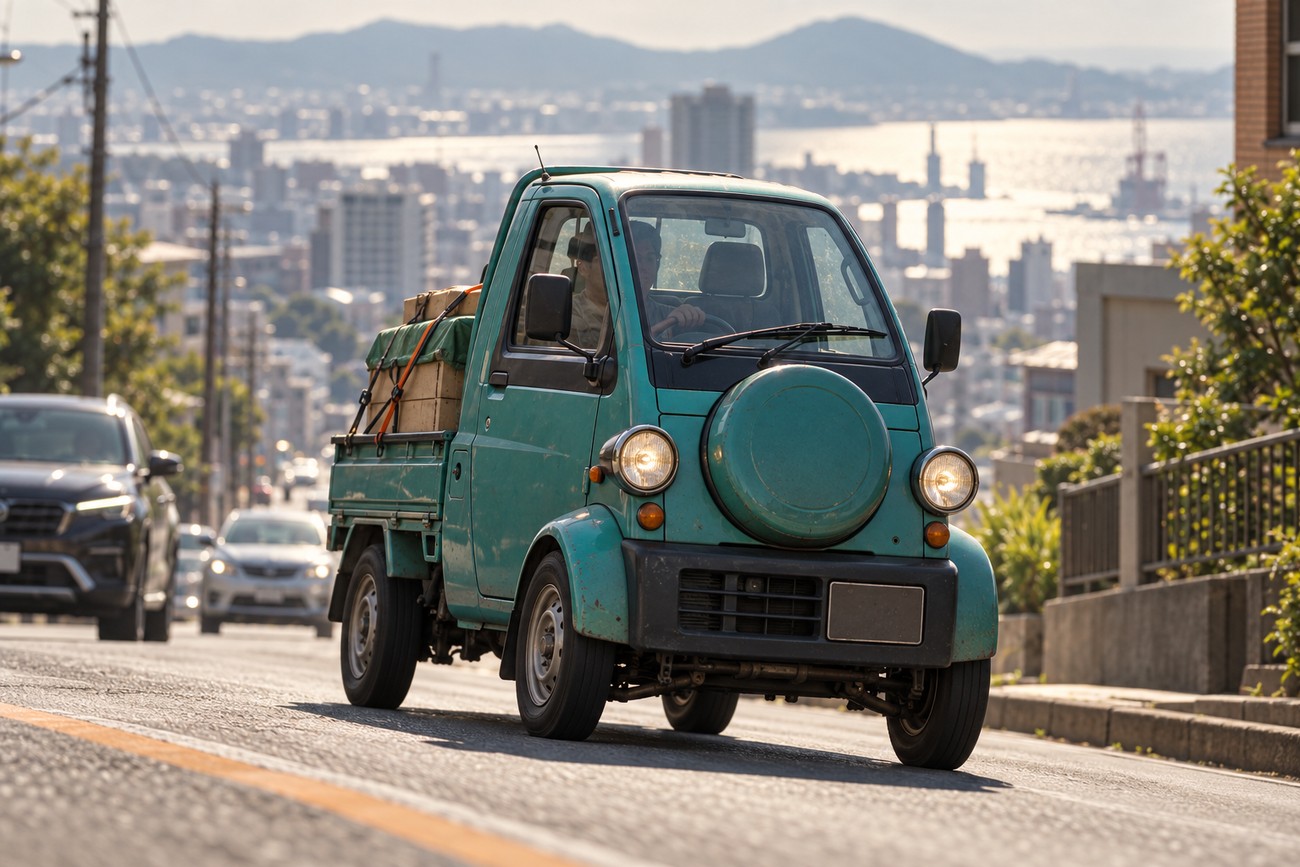
The Midget II’s body was intended for streets where a larger utility vehicle takes up too much room. For a short delivery or a local errand, easy physical access can matter more than cruising performance. That advantage fades when the route routinely demands sustained speed.
With 31–33 hp, depending on version and market catalog, the engine has little spare performance for a substantial load or an incline. Highway driving can feel slow and exposed, and mechanical condition further affects how well the vehicle maintains speed. There is no verified universal factory top-speed figure here that would usefully settle whether it suits your route.
Noise and vibration are part of the compact architecture. The engine’s position beneath the driver’s seat brings sound and heat close to the cabin, while the small vehicle has limited space to separate occupants from mechanical activity. Maintenance can improve a tired example, but it cannot turn the basic layout into a quiet modern car.
The seating position needs an in-person trial, especially for a taller driver. Shoulder room and seat adjustment can make a brief drive tolerable while a longer one becomes tiring. Check entry, driving posture, and control reach before deciding that a short urban route will make the tight cabin irrelevant.
Semi-cab packaging has a workshop consequence as well: work around the engine requires access beneath the seat, and the layout concentrates mechanical weight within a short vehicle. Ask to see how the seat area opens and inspect it for neglected maintenance. A simple engine is less reassuring if access has discouraged routine care.
The Ownership Traps Hidden Behind the Cute Styling
Most Midget IIs are now old enough that condition outweighs their reputation for simple Japanese engineering. Rubber components, suspension parts, brakes, and the carburetor or fuel system may need attention. A vehicle that starts and moves can still require substantial work before it is dependable.
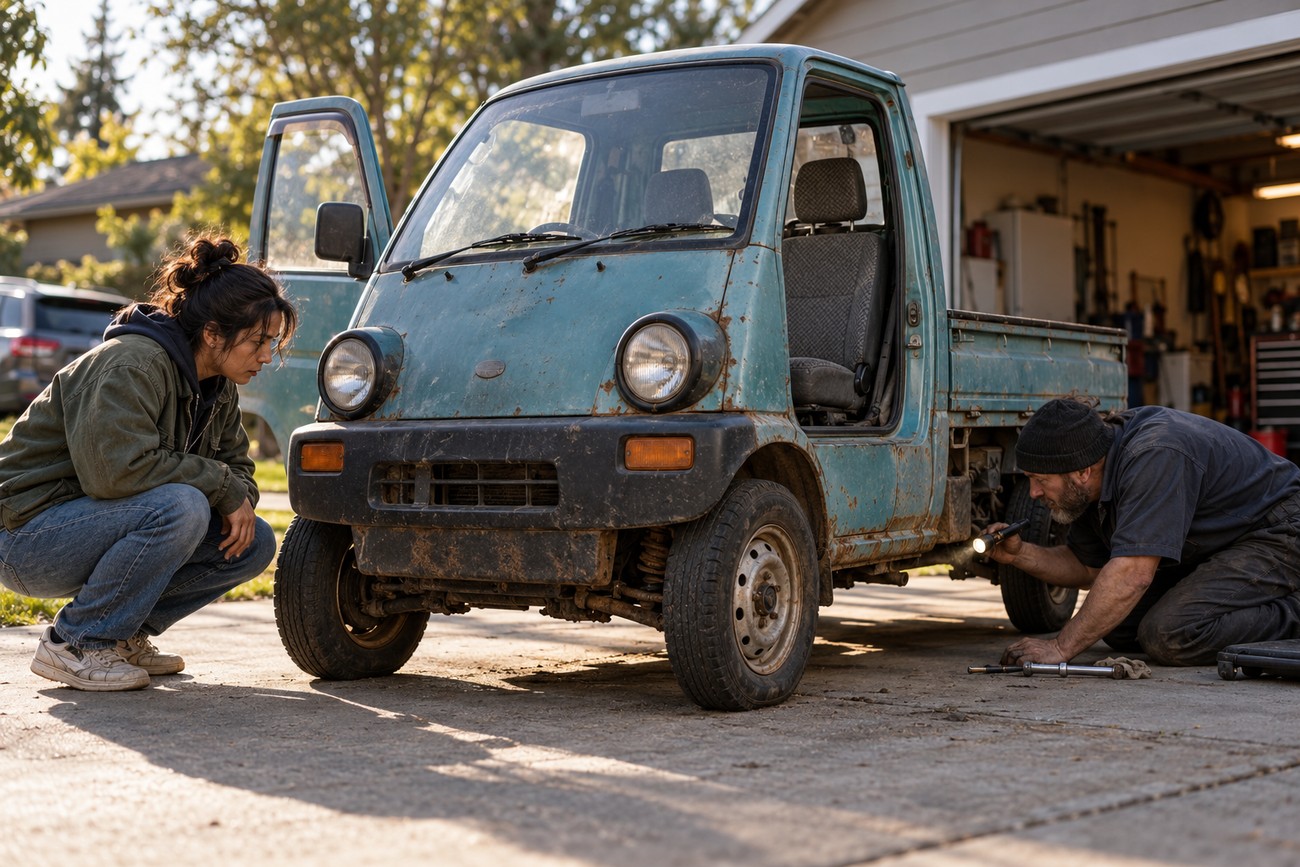
Corrosion deserves more than a glance at the visible body panels. Inspect underneath and around structural and suspension areas, because a small work vehicle may have carried loads through years of use. Repair costs and feasibility depend on what has deteriorated, not on how little metal the vehicle appears to contain.
Parts support is another ownership cost that a basic mechanical specification can hide. Body panels, interior pieces, and small Midget II-specific parts may be difficult to source outside Japan. An incomplete cabin or damaged trim can therefore be a more stubborn problem than its appearance suggests.
Comfort complaints also need separating from faults. Fresh mounts, sound components, and a sound suspension may reduce harshness, yet tight seating, engine proximity, noise, and vibration remain partly inherent to the design. Budgeting only for repairs will not produce the refinement of a normal small passenger car.
Finally, a high seating position and useful urban visibility should not be mistaken for crash protection. The Midget II’s 1990s construction does not offer the passive-safety level of modern small cars. Buyers planning frequent faster-road travel should weigh that limitation alongside performance, rather than treating visibility as a safety substitute.
Pickup or Hatchback: Choose the Job Before the Car
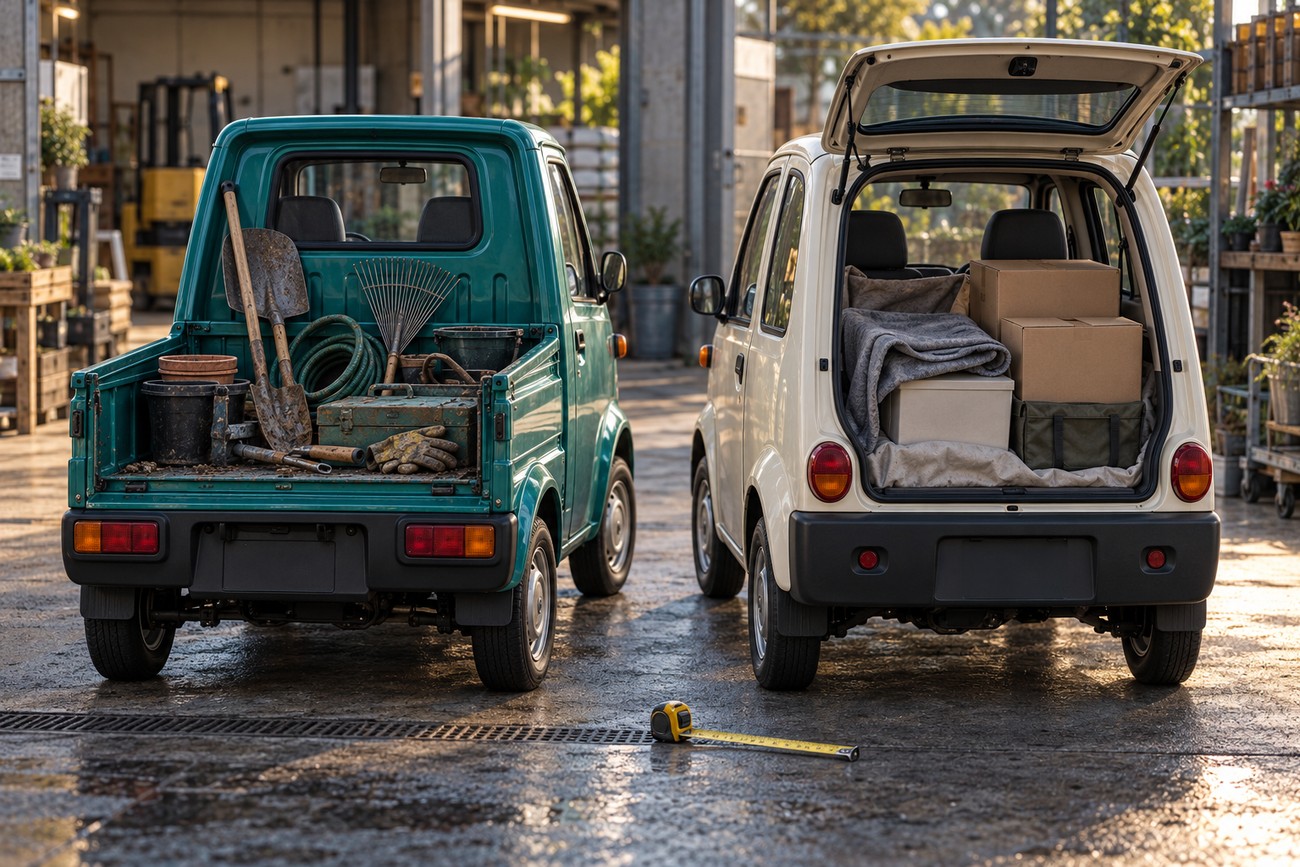
Body style changes what work the Midget II can do. The pickup gives direct access to an open load area, making it the more natural choice for items that are awkward to pass through a rear opening. Its cargo is exposed to weather unless you arrange suitable protection.
The 3-door hatchback/microvan provides an enclosed space for loads that need shelter. That protection comes with a different loading opening and limited interior volume, so measure the items you intend to carry rather than judging capacity from exterior size. Enclosed cargo space does not turn the vehicle into a normal passenger car.
Seat layout matters as much as the body. One-seat versions cannot carry another person, while two-seat layouts still leave little room for gear; the presence of a second seat can reduce usable cargo space. Inspect the exact vehicle’s seating and cargo arrangement before choosing a version for a recurring task.
Do not borrow a payload figure from an unrelated listing. Useful carrying capacity depends on the particular body and modification, and the exact version’s real payload needs verification. An overloaded, aging Midget II will ask more of its modest suspension and powertrain than either was bought to provide.
How to Inspect a Midget II Before Buying
Start by confirming that the listing is for a Daihatsu Midget II rather than an earlier or differently cataloged Midget. Match the body style, seating, engine details, and transmission to the vehicle and its paperwork. Power and other catalog specifications can vary by version and market, so resolve discrepancies before making a purchase decision.
Next, inspect corrosion with access to the underside, paying close attention to structural areas and suspension attachment points. Look for evidence of fatigue or repairs that need further assessment. A clean exterior is insufficient evidence on an old utility vehicle.
Check whether parts for the exact body and trim can be obtained before paying. A mechanically straightforward Midget II can still be sidelined by a scarce panel, interior piece, or small fuel-system component.
On the test drive, assess steering response, tire condition, suspension behavior, and braking in a safe setting. Pulling, uneven tire wear, excessive movement, or poor braking warrants investigation rather than an assumption that tiny vehicles naturally drive that way. Ask how the vehicle was used and confirm its payload before planning to carry loads that could accelerate suspension wear.
Run the engine from cold if possible, then check starting, idle, response, heat in the cabin, and transmission behavior as it warms. Have a qualified mechanic investigate suspected fuel-system, brake, or suspension faults rather than pricing the vehicle on a vague promise of an easy fix. Research the availability of engine, fuel-system, brake, suspension, body, and interior parts for that exact example before committing.
Who Should—and Should Not—Own One?
The strongest case for a Midget II is a defined, short urban task where its narrow-street usability matters. A buyer who accepts simple, close-quarters motoring may appreciate the unusual design and the modest official fuel-economy claim. The right example still has to be sound enough to do that job.
Drivers who need regular highway travel, comfortable space for two, family transport, or modern passive safety should look elsewhere. Limited power, a restricted cabin, and inherent noise and vibration are characteristics of the vehicle, not merely defects to repair. Age-related work and parts sourcing can also interrupt use.
Judge each candidate against a real route and load, then against the condition of its structure, running gear, and available parts. A tidy pickup that cannot protect your cargo, or an enclosed version that cannot accept it, is the wrong purchase regardless of charm. Buy the condition and the mission, not the novelty.
Frequently asked questions
What is the average price of a Daihatsu Midget II?
No reliable single average price is established here. Compare asking prices within your market for the same body style, then account for structural condition, mechanical work, originality, and the availability of missing or damaged parts. An apparently cheaper vehicle can cost more to put into service if its rare body or interior pieces are absent.
How fast does a Daihatsu Midget II go?
There is no verified universal factory top-speed figure in the supplied information. Its real-world speed usability depends on the version, load, hills, gearing, and mechanical condition; 31–33 hp is workable for short city use but noticeably constrained at highway speeds. A test drive on a representative route is more useful than an isolated maximum-speed claim.
Which Midget II version is easier to live with, the pickup or the hatchback?
The easier version is the one that matches what you carry and has the better-supported restoration needs. Choose the pickup if open access matters more than weather protection; consider the hatchback/microvan if enclosed cargo is essential and your items fit its opening. For either, check the actual seat layout and the availability of body-specific parts before treating it as the practical choice.







