
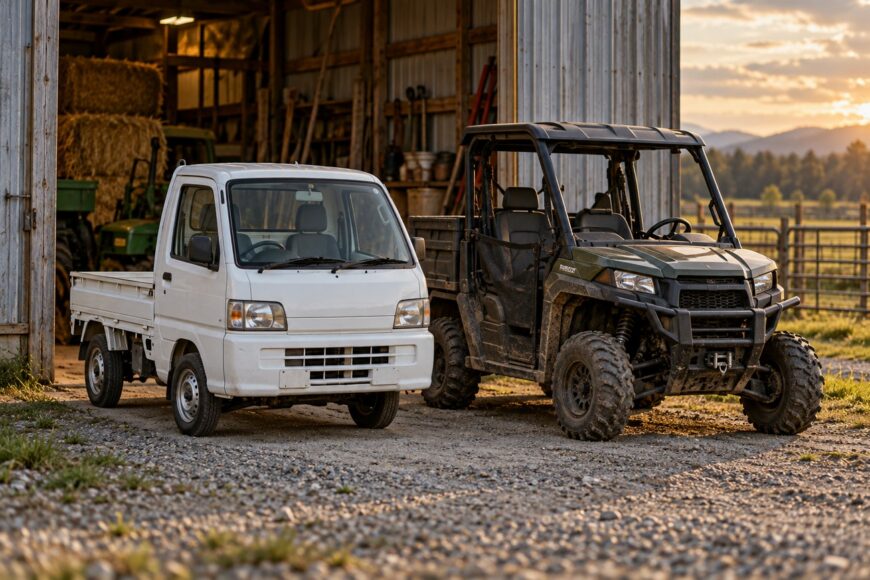
A Daihatsu Hijet offers a proper cargo bed, road-oriented utility, and a compact footprint. A farm UTV usually handles rough, wet, and narrow terrain better, with greater off-road clearance and better occupant protection. Those strengths overlap, but they do not make the two vehicles interchangeable.
The right choice depends on your routes, loads, legal use, and the exact Hijet generation. Horsepower alone tells you little. A two-wheel-drive truck used on hard-packed lanes may be more productive than a UTV, while a four-wheel-drive UTV can save time and recovery work in mud, snow, or deep ruts.
- What the Daihatsu Hijet Is—and What It Is Not
- Daihatsu Hijet vs. Farm UTV: Which Fits the Job?
- Where a Hijet Makes More Sense on a Farm
- Where a Farm UTV Still Has the Advantage
- The Numbers That Can Mislead a Hijet Buyer
- Buying and Using an Imported Hijet on the Farm
- Frequently asked questions
- What should I verify before registering an imported Daihatsu Hijet for road use?
- How should I inspect a used Hijet that has very low mileage?
- What are some good mini trucks for farm use besides the Hijet?
What the Daihatsu Hijet Is—and What It Is Not
The Hijet Truck is a Japanese kei-class mini truck: a small road vehicle designed to carry goods in a short bed. It is not a UTV with a roof and a cargo box. Its chassis, controls, suspension, and road-biased layout reflect a different job, even when an imported version is fitted with four-wheel drive.
Japanese kei vehicles are limited to a maximum length of 3.4 m, width of 1.48 m, height of 2.0 m, and maximum engine size of 660 cc. Modern Hijet Truck dimensions are approximately 3395 × 1475 mm, so the truck fits into tight farm buildings, lanes, and loading areas. That compact size is a practical advantage rather than a cosmetic specification.
Hijet power is approximately 43–53 hp, depending on the engine and generation. That is adequate for carrying moderate loads on firm surfaces, but the small engine has limited reserve on steep grades or when the bed is loaded. Generation, transmission, axle ratio, tire size, and condition can change the working result substantially.
Some generations and trims offer 4WD and low-range gearing, while others are two-wheel drive and have no equivalent traction aid. Imported examples may also have different bodies, equipment, and maintenance histories. Treating every Hijet as mechanically identical is one of the quickest ways to buy the wrong machine.
Daihatsu Hijet vs. Farm UTV: Which Fits the Job?
The useful comparison is task by task. A Hijet tends to suit contained loads and road-connected routes, while a farm UTV tends to suit repeated travel across rough ground and trails.
| Farm task | Daihatsu Hijet | Farm UTV |
|---|---|---|
| Boxes, bags, containers, and tools | Strong fit: the bed sides keep separate loads organized and can reduce trailer use. | Useful, especially with a fitted cargo box, though bed shape and tie-down provision vary. |
| Muddy ground, deep ruts, and soft soil | Usually a poor fit, especially in 2WD; wheel size, clearance, and weight distribution can become limiting. | Generally the stronger choice because its off-road geometry is designed for this work. |
| Barns, orchards, and greenhouse aisles | Strong fit where the surface is firm; the turning radius after the 2007 update was approximately 3.7–3.8 m. | Often highly maneuverable, particularly on narrow trails, though exact dimensions vary. |
| People and dirty tools | The open cab and exposed bed offer limited weather and dirt protection. | Usually easier for frequent stops and may offer better occupant protection, depending on the cab. |
| Public-road travel between fields | Generally better suited to road-connected work, subject to local registration and road rules. | Road legality and equipment vary; many are primarily intended for off-road use. |
| Payload figures | Typical Japanese kei-truck payload is approximately 350 kg. Imported-market claims require separate verification. | Payload depends heavily on the model and local specification. |
Where a Hijet Makes More Sense on a Farm
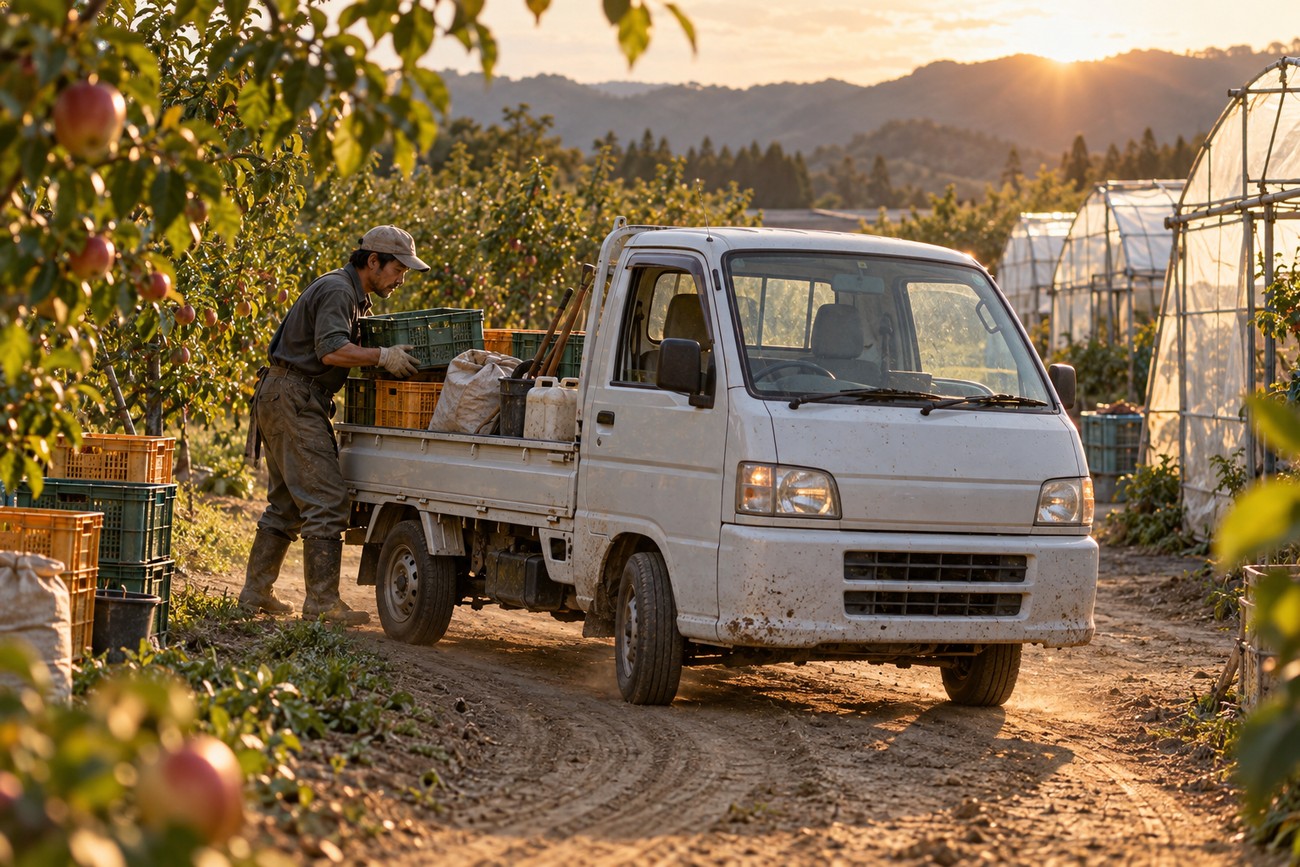
A Hijet earns its place where the farm has firm lanes, buildings, orchards, greenhouse access, or short road journeys between work areas. The bed is shaped for boxes, bags, jerry cans, containers, and tools. Loads that would need a trailer behind a UTV can often be carried directly, with less coupling and uncoupling during a busy day.
The approximately 3.7–3.8 m turning radius after the 2007 update is valuable in barns, orchards, and greenhouse aisles. A small truck can turn between structures or approach a loading point without a large three-point maneuver. The cab also gives the operator a more familiar road-vehicle layout when regular travel includes public roads.
New Japanese Hijet Truck versions are listed at approximately 16.5 km/L on WLTC, although real use depends on load, terrain, traffic, and drivetrain. Fuel economy matters most when the vehicle makes many short transport runs. It does not compensate for repeated stuck-vehicle recovery or extra trips caused by an unsuitable route.
The same compact design has drawbacks. A short wheelbase and small wheels can produce a harsh ride over uneven ground, and a light, empty truck may bounce across ridges or potholes. The bed is excellent for contained cargo, yet less convenient for muddy tools, loose vegetation, or equipment that must be grabbed and put away repeatedly.
Where a Farm UTV Still Has the Advantage
A specialized farm UTV generally has the advantage on soft ground, deep ruts, rough trails, and uneven field access. Its off-road geometry is designed around clearance, tire contact, suspension travel, and low-speed control. A Hijet can reach many farm areas, but it does not automatically have the clearance or traction needed to reach them safely in every season.
The 660 cc engine class also leaves limited power reserve when the truck is loaded or climbing. The vehicle may complete a slope on a dry day and struggle after rain, especially with 2WD. A 2WD Hijet can be a poor choice for wet soil, snow, and field work; 4WD matters, and low-range gearing can materially improve control where it is fitted.
Weather exposure is another practical difference. An open Hijet cab and bed provide less protection from rain, dirt, and dust than a closed UTV. That becomes tiresome during winter feeding, wet harvest work, or long periods of travel between buildings. A covered truck can improve the cab, but it may reduce the quick in-and-out access that makes a UTV useful for frequent stops.
UTVs also tend to work better on narrow trails where the route itself is rough rather than merely tight. A truck’s small overall dimensions do not eliminate its wheel tracks, axle clearance, or approach limitations. If the normal route includes fallen branches, standing water, snow, or deep wheel marks, evaluate the route after bad weather rather than during a dry inspection.
The Numbers That Can Mislead a Hijet Buyer
Payload is the first number to verify. The typical Japanese kei-truck payload is approximately 350 kg. Some mini-truck dealers advertise approximately 600–1,300 lb of payload and 500–750 lb of towing, but those figures may apply to other markets, versions, homologation standards, or modifications. They must not be compared directly without checking the specific vehicle and local documentation.
Power figures are equally easy to overvalue. Hijet output is approximately 43–53 hp, depending on generation and engine, yet a lower-powered truck with suitable gearing and traction can be more useful than a higher-powered one on a firm route. Load, tire grip, slope, surface, and distance describe the job better than a horsepower headline.
Check the actual load against the vehicle plate and local specification, then drive the intended route with that load before trusting a dealer’s payload or towing number. A figure that fits one market or modification may be unsuitable for an imported vehicle.
Newer Japanese versions are cited at approximately 16.5 km/L WLTC for the Truck and 15.6 km/L WLTC for the Cargo. Older JC08 figures can be higher, but the two test cycles are not directly comparable. Fuel figures also say little about performance: a loaded 660 cc truck loses speed and reserve on grades, particularly with frequent stops or four-wheel-drive components.
Age deserves equal attention to mileage. An imported Hijet can show low mileage while still needing rubber components, brake work, seals, or suspension repairs. Deterioration from time, moisture, corrosion, and long storage may matter more than the number on the odometer, especially when replacement parts are less readily available for rare versions.
Buying and Using an Imported Hijet on the Farm
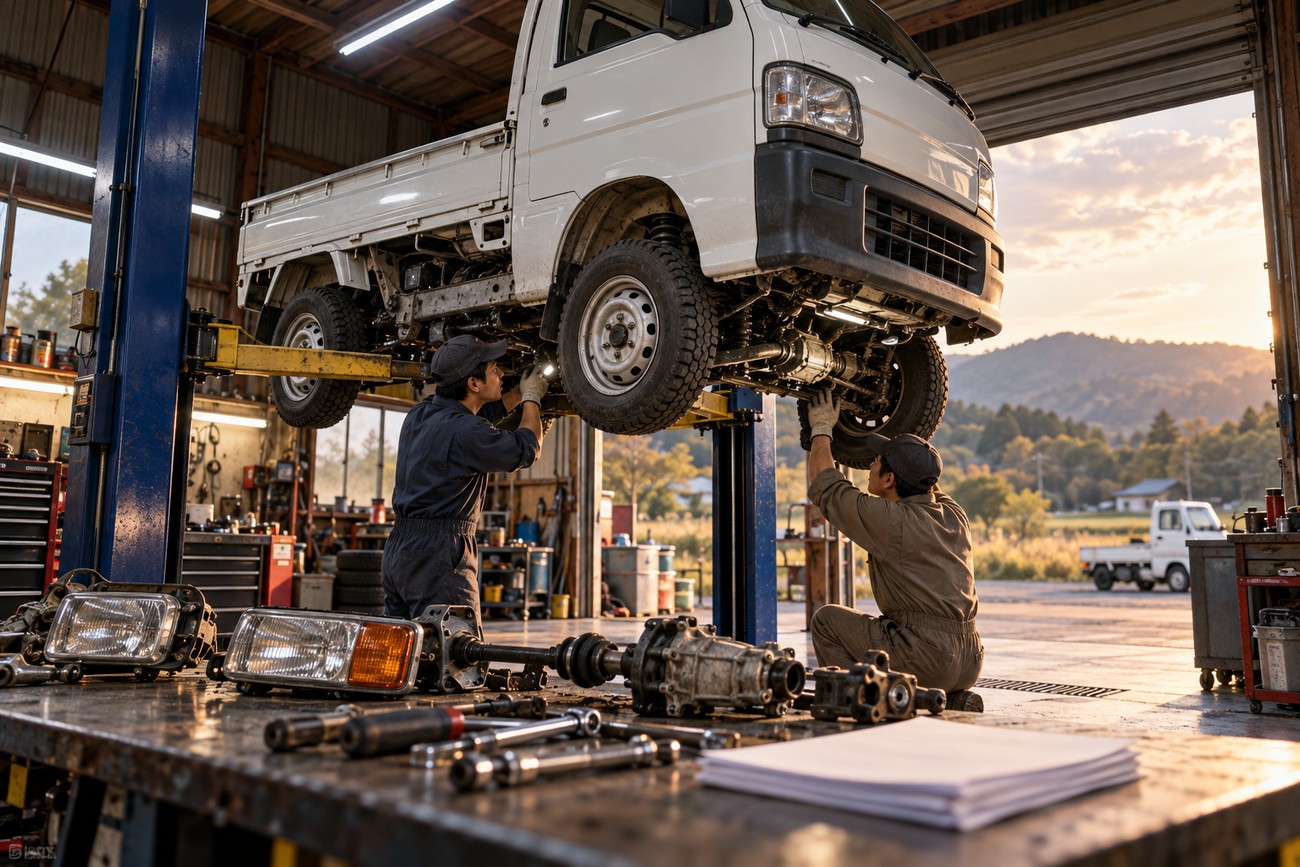
Start with legality before inspecting accessories. Confirm the vehicle’s local classification, title or ownership documents, registration route, road-access rules, lighting requirements, insurance terms, and inspection obligations. A truck that is mechanically sound may still be unsuitable for public-road use if its imported specification does not meet local requirements.
Then identify the exact generation and drivetrain. Confirm whether the vehicle is 2WD or 4WD, whether low range is fitted, and whether the transmission and axles match the advertised specification. Rare or non-standard imported versions may suffer parts shortages despite a mechanically simple design, so check the supply of filters, brake components, suspension parts, belts, and body items before purchase.
Inspection should include the frame and bed for corrosion, followed by brake operation, steering play, suspension mounts, wheel bearings, driveshafts, seals, and tires. Examine rubber hoses, bushings, and weather seals even when the truck appears clean. A long-stored vehicle can need more immediate work than a higher-mileage example that has been used and maintained regularly.
Finish with a route-and-load test. Measure the real load, identify the worst surface and slope, and calculate the distance between loading points. If most work involves boxes on hard-packed lanes, a 4WD Hijet with suitable gearing may reduce trailer dependence. If the route regularly becomes mud, snow, or deep ruts, a farm UTV is usually the safer and more productive choice.
Frequently asked questions
What should I verify before registering an imported Daihatsu Hijet for road use?
Verify the ownership documents and vehicle identification first, then confirm how your local authority classifies the truck. Ask whether its dimensions, lighting, mirrors, indicators, emissions equipment, and safety equipment meet the requirements for that classification. Obtain an insurance quote before buying, because some imported mini trucks are treated differently from ordinary passenger vehicles or commercial trucks.
Check inspection requirements and permitted road use in writing rather than relying on a seller’s general assurance. Registration may depend on the exact year, specification, modifications, and intended area of operation. The result determines whether the Hijet can legally connect separate fields or must remain on private property.
How should I inspect a used Hijet that has very low mileage?
Inspect age-sensitive parts in a fixed order: look for corrosion and water entry, test the brakes and brake lines, examine suspension bushes and mounts, and check rubber hoses, belts, seals, and tires. Inspect the underside for storage damage and leaks, then test the steering, transmission, 4WD engagement, and low range if fitted. Low mileage does not prove that these components remain healthy.
A cold start and a drive over the intended type of surface can reveal issues that a stationary inspection misses. Listen for driveline noise, check whether the truck tracks straight under braking, and look for bouncing or harsh suspension response. If parts support is uncertain, price the inspection and likely repairs before treating the low odometer reading as an advantage.
What are some good mini trucks for farm use besides the Hijet?
Compare alternatives by support and specification rather than by model name alone. Check the availability of parts in your region, the documented payload for that exact market, the presence of 4WD and low-range gearing, and the vehicle’s registration path. A familiar model with local parts support can be a better farm tool than a cheaper import with uncertain documentation.
Match the alternative to the route and load in the same way as a Hijet. Confirm bed dimensions, turning space, tire condition, and the ability to carry your normal containers without exceeding the local rating. A mini truck remains a road-oriented cargo vehicle, so a farm UTV may still be the better choice if rough terrain dominates the work.







