
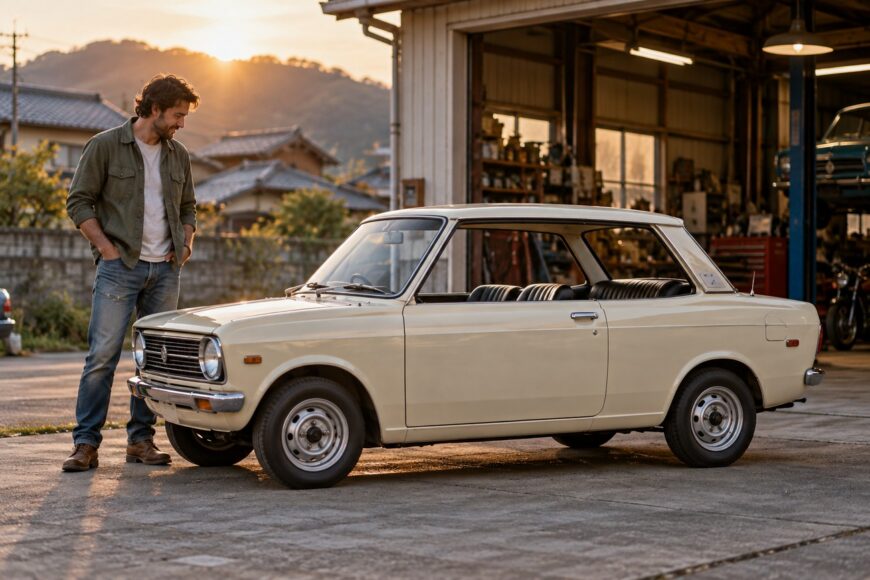
The Daihatsu Fellow Max L38 is a tiny front-wheel-drive kei hardtop built around a water-cooled 356cc two-cylinder two-stroke. Its short body, low mass, four-speed manual transmission, and period sporting versions give it character, while its rarity makes even basic ownership an exercise in finding parts and identifying components.
That character comes with practical complications. Difficult restarting after storage, fragile or unavailable components, hidden corrosion, and inconsistent period specifications can turn an apparently complete car into a long investigation. A running engine or attractive paintwork is useful evidence, but neither proves that the car is a sound restoration candidate.
- What the Daihatsu Fellow Max L38 Actually Was
- Daihatsu Fellow Max L38: Versions, Dimensions and Performance
- Why the 356cc Two-Stroke Is More Complicated Than the Numbers Suggest
- Buying and Restarting an L38: The Checks That Matter
- Restoration Reality: Rare Parts, Hardtop Panels and Hidden Rust
- Fellow Max Myths: What the Specifications Do Not Prove
- Frequently asked questions
- How can a seller’s 120 km/h claim for an L38 be evaluated?
- What information should a parts request for a Fellow Max include?
- What should be checked before buying or restarting an L38?
What the Daihatsu Fellow Max L38 Actually Was
The Daihatsu Fellow Max L38 belonged to the kei-car market of approximately 1970–1977. It was designed around the period’s compact-car limits, with a body under 3 meters long and an engine displacement of 360cc or less. Within those constraints, Daihatsu offered a more purposeful and stylized car than the name alone might suggest.
The two-door hardtop appeared in 1971 and was discontinued in 1976. Its fixed-roof profile, frameless-looking side windows, and dedicated door and interior parts give it a different restoration profile from more practical Fellow Max body styles. A hardtop shell can look complete while still missing trim that is difficult to reproduce.
The L38 used front-wheel drive. This matters because earlier Daihatsu Fellow models are often grouped with the Fellow Max in listings, conversations, and parts catalogs, even though their construction should not be assumed identical. Check drivetrain, suspension, body fittings, and engine-related references against the actual L38.
For a buyer, the model name is only the starting point. Record the chassis code, production year, body style, engine designation, and trim before comparing specifications or ordering parts. Confusing an earlier Fellow with an L38 can produce a technically plausible answer that is useless for the car in front of you.
Daihatsu Fellow Max L38: Versions, Dimensions and Performance
The following figures describe the L38 in period context. Output varies by year, trim, and measurement method, while the reported top-speed figure should be treated as a conditional specification rather than a guaranteed road result.
| Item | Daihatsu Fellow Max L38 |
|---|---|
| Engine | Water-cooled 356cc two-cylinder two-stroke, designated ZM/ZM4 |
| Transmission | Four-speed manual |
| Base output | Approximately 31–33 hp, depending on year and measurement method |
| SS output | Approximately 37–40 hp, depending on year and measurement method |
| Length | 2,995 mm |
| Wheelbase | Approximately 2,090 mm |
| Width | Approximately 1,285–1,295 mm; sources differ |
| Drivetrain | Front-wheel drive |
| Front suspension | Front struts |
| Rear suspension | Semi-independent layout with trailing arms |
| Brakes | Front disc brakes on higher-grade versions |
| Kei-class context | Period limits centered on displacement up to 360cc, length under 3 m, width around 1.2 m, and mass around 500 kg |
| Reported mass | Approximately 495 kg appears in some listings, but independent confirmation across bodies and trims is unavailable |
| Top-speed claim | Some specifications state 120 km/h; test conditions are unconfirmed, so it is not a guaranteed cruising speed |
Base cars produced approximately 31–33 hp, while SS versions are commonly associated with approximately 37–40 hp. Environmental changes reduced affected versions from approximately 33 to 31 hp and from approximately 40 to 37 hp. Those figures should not be combined into one output claim for every L38.
The dimensions explain much of the car’s appeal. A length of 2,995 mm and a wheelbase of approximately 2,090 mm leave little space for wasted structure, while the narrow body suits the kei-class brief. They also leave little tolerance for poor repairs: distorted door openings, incorrect glass, or badly repaired suspension mounting areas can affect both fit and safety.
Why the 356cc Two-Stroke Is More Complicated Than the Numbers Suggest
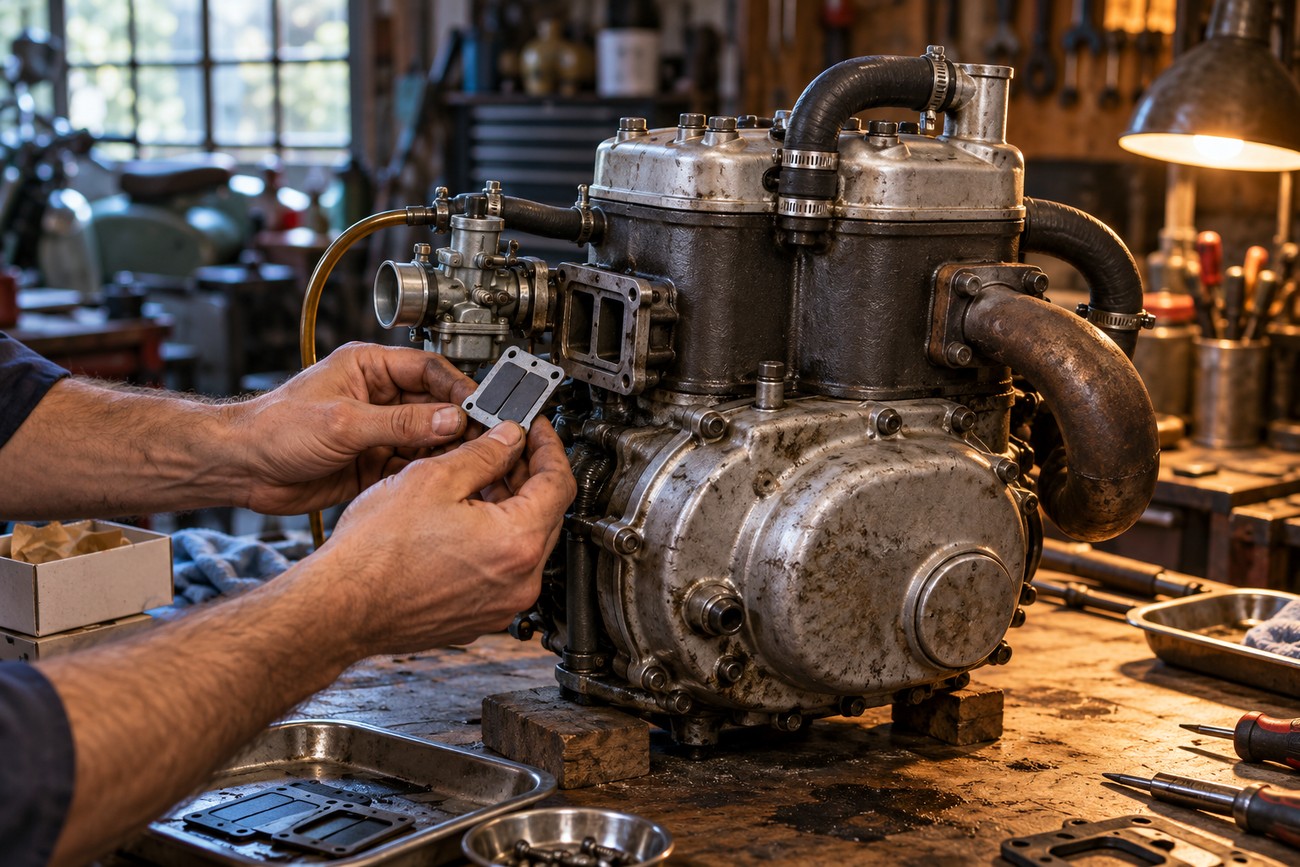
The ZM/ZM4 is a water-cooled 356cc two-cylinder two-stroke, and its small displacement does not make diagnosis simple. Intake condition, ignition, carburetor metering, exhaust flow, and lubrication must work together. A fault in one area can resemble a fault in another, especially after long storage.
Reed valves deserve particular attention. Original steel reeds can be found broken in rebuilt engines, and a replacement is not defined only by its outline. Material and stiffness influence starting, throttle response, cylinder filling, and the engine’s overall character. A modern reed set may work, but it requires appropriate setup rather than automatic installation.
Peak power occurs at approximately 6,000 rpm, making a tachometer valuable during diagnosis and road testing. Without one, an engine that feels busy may simply be operating outside its useful range, while incorrect ignition, carburetor, or exhaust settings can be dismissed as normal two-stroke behavior. The narrow usable range also makes gearing and engine condition more important than the displacement figure suggests.
Later environmental requirements reduced output on affected versions. Base figures declined from approximately 33 to 31 hp, and sporting figures from approximately 40 to 37 hp. SAE figures and Japanese factory figures should not be mixed as though they were directly comparable; the measurement standard and model year belong beside every power claim.
Two-stroke operation also carries oil into the exhaust, producing more pollution than later four-stroke kei engines. That is part of the mechanical design, not evidence by itself that a particular engine is badly tuned. Excessive smoke, poor response, or plug fouling still require diagnosis, because oiling, mixture, ignition, and exhaust restriction can all contribute.
Buying and Restarting an L38: The Checks That Matter
An engine that starts is only an initial sign of life. Before purchase or recommissioning, check compression, crankcase air leaks, ignition timing and spark quality, reed condition, carburetor metering, exhaust restriction, and the lubrication arrangement separately. A brief burst of running can conceal problems that become expensive once the car is driven.
Starting after storage often requires checking ignition, carburetion, and reed valves together. A carburetor cleaning does not guarantee correct two-stroke operation, particularly if the intake has an air leak, the jets are wrong, the reeds do not seal, or the exhaust is restricted. Record what has been changed rather than replacing several systems at once.
Substituting a modern carburetor or reed assembly requires establishing the appropriate jetting, ignition settings, and reed stiffness for the engine. A component that physically fits can still produce poor starting, weak cylinder filling, or a dangerous mixture. Verify the original lubrication arrangement for that specific engine before changing to a fuel-oil premix.
During a viewing, ask for cold-start evidence, compression information, and details of the last successful running period. Inspect fuel lines, throttle operation, cooling-system condition, and the exhaust before prolonged running. A seller’s statement that the car “just needs a carburetor clean” should be treated as a hypothesis, not a diagnosis.
Restoration Reality: Rare Parts, Hardtop Panels and Hidden Rust
Engine parts are only one part of the problem. Daihatsu Fellow Max L38 components for the engine, body, and interior are scarce, and some repairs depend on donor cars or fabrication. Body and glass parts can be harder to replace than mechanical items because their shapes are specific and their supply is smaller.
The two-door hardtop has its own risk areas. Doors, window frames, glass, roof lining, and interior trim cannot be assumed interchangeable with another Fellow Max body style. A complete-looking car may have incorrect glass, missing seals, or improvised trim that becomes obvious only when the doors are adjusted or the cabin is disassembled.
Inspect the sills, floor, suspension cavities, and structural mounting points from below and from inside the cabin. Corrosion in these areas can remain hidden behind underseal or fresh paint. An outwardly tidy body does not confirm structural integrity, particularly on a car more than half a century old.
Parts searches work better when they include L38, ZM or ZM4, production year, body style, and trim code. Listings often mix years, body styles, and specifications under the Fellow Max name. Before ordering a supposedly complete restoration kit, compare the part number, measured dimensions, mounting details, and the component removed from the car.
Some listings quote a mass of approximately 495 kg, but independent confirmation across bodies and trims is unavailable. Treat that figure as a listing detail rather than a universal specification. Whatever its listed mass, corrosion at load-bearing points should not be overlooked.
Fellow Max Myths: What the Specifications Do Not Prove
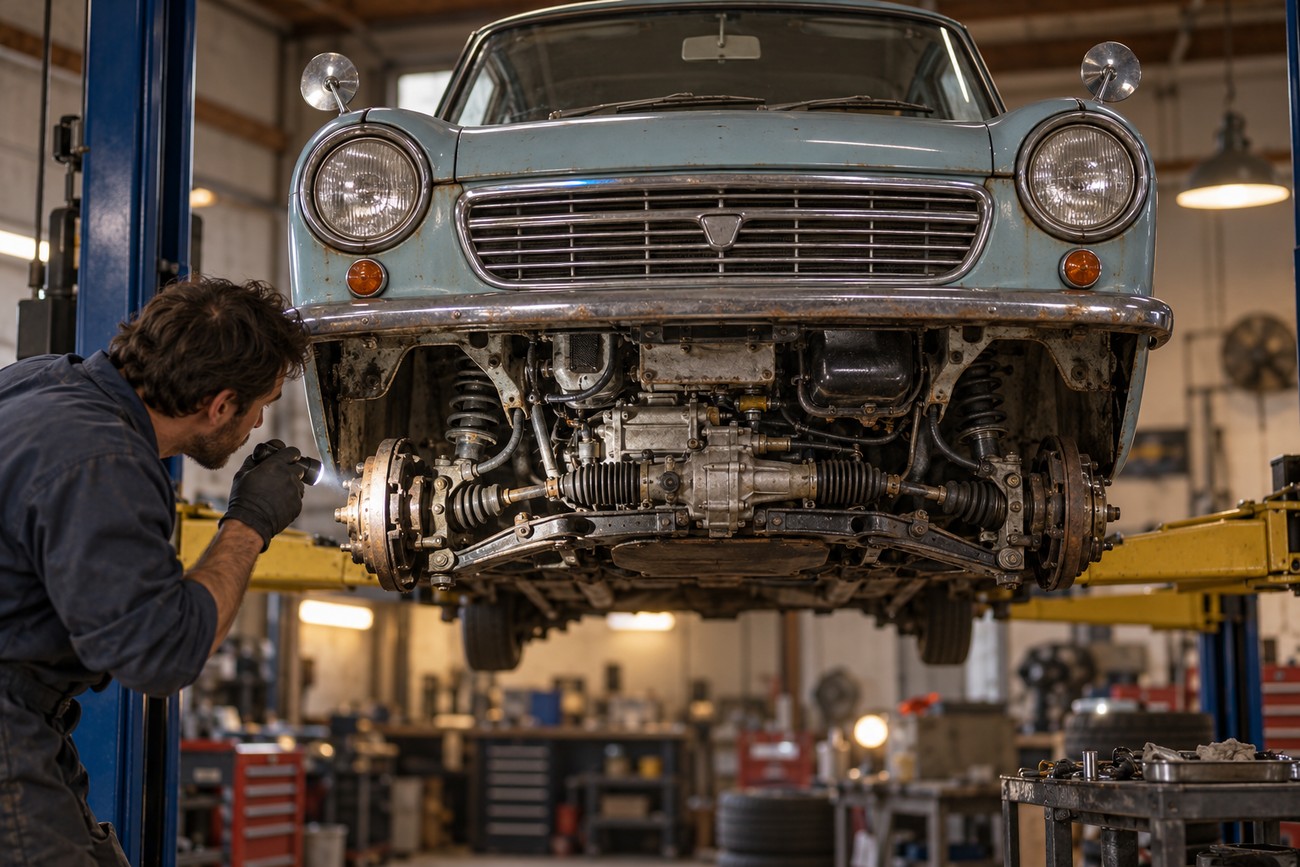
The claim that every Fellow Max was rear-wheel drive is incorrect for the L38. The Fellow Max L38 is identified as front-wheel drive, while earlier Daihatsu Fellow models should not be used as automatic evidence for its layout. This distinction affects suspension parts, drivetrain components, and the way a prospective restoration should be inspected.
Nor did every version produce 40 hp. Approximately 40 hp applies to certain sporting versions and measurement conditions; base cars were approximately 31–33 hp, and affected later versions could be lower. A proper comparison names the trim, model year, and measurement method instead of repeating the highest figure associated with the range.
Identical 356cc displacement also does not guarantee identical performance. Carburetion, emissions changes, gearing, ignition condition, reed valves, and engine wear alter how the car accelerates and holds speed. Two cars with the same badge can therefore feel substantially different without either specification being fraudulent.
Some specifications state a maximum speed of 120 km/h, but the test conditions are unconfirmed. That number should not be treated as a guaranteed cruising speed for a surviving car. Mechanical condition, gearing, tuning, load, road conditions, and the period’s measurement standard all matter more than a single headline figure.
Frequently asked questions
The L38’s period specifications are useful only when tied to the correct body, year, and trim. The following checks help separate a documented car from a description assembled from mixed catalog data.
How can a seller’s 120 km/h claim for an L38 be evaluated?
Ask for the exact trim, production year, transmission or gearing details, measurement method, test conditions, and mechanical state of the car. A brochure or listing may report 120 km/h without establishing whether the figure came from a controlled test, an indicated speed, or a particular sporting version.
Then compare the claim with compression, ignition timing, carburetor setup, reed condition, exhaust condition, tire size, and engine speed at the stated velocity. The figure can be recorded as a period specification, but it should not be accepted as evidence that every L38 can safely cruise at that speed.
What information should a parts request for a Fellow Max include?
Include the L38 chassis code, production year, ZM or ZM4 engine designation, trim, and body style. Add left- or right-hand fitment where relevant, especially for interior, door, glass, and control components, and provide measured dimensions for seals, brackets, and restoration items.
Photographs of the old part, its mounting points, and any identification marks can prevent a catalog mismatch. Avoid using “Fellow Max” alone: listings may combine earlier Fellow models, different L38 years, hardtop and non-hardtop bodies, and incompatible engine or trim specifications.
What should be checked before buying or restarting an L38?
Check compression, crankcase air leaks, ignition timing, spark quality, reed valves, carburetor metering, exhaust restriction, cooling-system condition, fuel lines, and the lubrication arrangement. Inspect the sills, floor, suspension cavities, and structural mounting points for concealed corrosion.
Request cold-start evidence and details of the last successful running period. A brief start or clean paintwork does not prove that the engine, body, suspension, and hardtop fittings are ready for regular use.







