

Asking an entire country to reverse a deeply learned driving habit on the same morning meant changing more than which side of the road cars used. Every turn, crossing, and bus stop could prompt a familiar action that had suddenly become wrong. On 3 September 1967, Sweden switched from left-hand to right-hand traffic. The day became known as Dagen H.
The operation was orderly, and its early crash figures were lower than many might expect. Those figures deserve care, though. Roads were subject to temporary restrictions, and drivers knew they were doing something unfamiliar. Sweden’s switch shows what coordinated preparation can achieve; it does not provide a clean test of whether driving on the right is safer than driving on the left.
- Why Sweden drove on the left—and chose to change
- The work behind the overnight switch
- 3 September 1967: ten minutes between two rules
- The hard part was unlearning the old road
- The first crash figures: orderly, not accident-free
- What lasted after the caution wore off?
- Frequently asked questions
- Which other countries have switched driving sides?
- What happened to trams during the changeover?
- When did Sweden switch to driving on the right?
- Which countries have changed the side of the road they drive on?
- Why did Sweden drive on the left?
Why Sweden drove on the left—and chose to change
Before Dagen H, driving on the left was Sweden’s established rule. Across its neighboring land borders, traffic kept right. A driver moving between the two systems had to change road position at the border, while road planners had to accommodate that change on routes connecting them.
Vehicle design added another reason to reconsider the rule. Most cars in Sweden already had left-hand steering, placing the driver nearer the roadside when traveling on the left. From that position, judging the gap to oncoming traffic before overtaking was less convenient: a driver could need to edge farther out to see past the vehicle ahead.
Right-hand traffic aligned the usual steering position with the center of the road, improving that particular view. It also made Sweden’s road rule compatible with its neighbors’. Neither argument requires a story about why Sweden first adopted left-hand traffic; the relevant issue in 1967 was how the existing rule worked with the cars and connections people used.
The work behind the overnight switch
Dagen H takes its name from Högertrafikomläggningen, the change to right-hand traffic. Making the rule effective required a coordinated operation, rather than an instruction to drivers alone. Temporary road closures created room to change signs and markings and to manage the points where traffic would meet.
Junctions needed particular attention because their approach lanes and turning paths would work differently. Bus stops also mattered: a change in which side vehicles approached from could alter where passengers should wait and board. A roadside instruction would have been little help if the route through an intersection or to a stop still followed the old arrangement.
The public campaign gave the change a common cue: the H symbol. Information reached beyond people who would be driving at the moment of the switch, since pedestrians, passengers, and occasional motorists also needed to recognize the new pattern. Physical alterations and public warnings served the same purpose—helping everyone make the same change at the same time.
3 September 1967: ten minutes between two rules

Traffic stopped nationwide at 04:50 on 3 September 1967. Drivers were to move to the right, then resume at 05:00 under the new rule. That pause gave a clear boundary between the old and new systems, so vehicles already on the road would not have to infer when the instruction changed.
The ten-minute sequence is memorable, although it can make the operation sound simpler than it was. Temporary closures controlled where vehicles could move, and the first journeys were unusually slow. A driver who had pulled over could follow the new rule at 05:00 without assuming every nearby junction was immediately back to ordinary use.
Moving to the right also meant taking a safe available position, rather than forcing a maneuver through an obstruction or closure. The changeover worked because the timing was shared and movement was constrained. Its precision was a traffic-control measure, not evidence that normal driving resumed everywhere the moment the clock struck five.
The hard part was unlearning the old road
A familiar turn could now end in the wrong position. After turning into a road, a driver accustomed to keeping left had to settle on the right instead. At the next junction, the direction from which traffic approached and the lane needed for a turn demanded fresh attention. These were predictable points of confusion, even for someone who knew the new rule.
People outside cars had habits to revise as well. A pedestrian crossing a road had to look for traffic coming from its new direction; a bus passenger might find that the relevant stop or boarding arrangement had changed. An intersection with old visual cues could be troublesome precisely because it looked familiar.
Signs and road markings supplied reminders where memory could no longer be trusted. Drivers also had to pay attention to how their vehicles’ headlights worked under the new traffic pattern, without assuming every car required the same adjustment. The lasting challenge was ordinary repetition: turns, crossings, and lane choices would still occur after the first day’s warnings and restrictions had passed.
The first crash figures: orderly, not accident-free
Sweden recorded 157 reported crashes on Dagen H, including 32 with injuries; there were no fatalities. The distinction matters. An absence of deaths does not mean an absence of collisions, and a count of all reported crashes should not be read as a count of people hurt.
The following Monday brought 125 reported crashes and no fatalities. That crash count was below the range of 130–198 recorded on preceding Mondays. It is a useful sign that the first return to weekday traffic did not produce an obvious surge in reported collisions.
It is a limited comparison, however. Temporary speed restrictions and exceptional driver caution accompanied the new road rule. Slower, more attentive traffic can change the number and severity of crashes regardless of which side of the road it uses. The early figures describe what happened during the managed transition; they cannot isolate the safety effect of switching sides.
What lasted after the caution wore off?
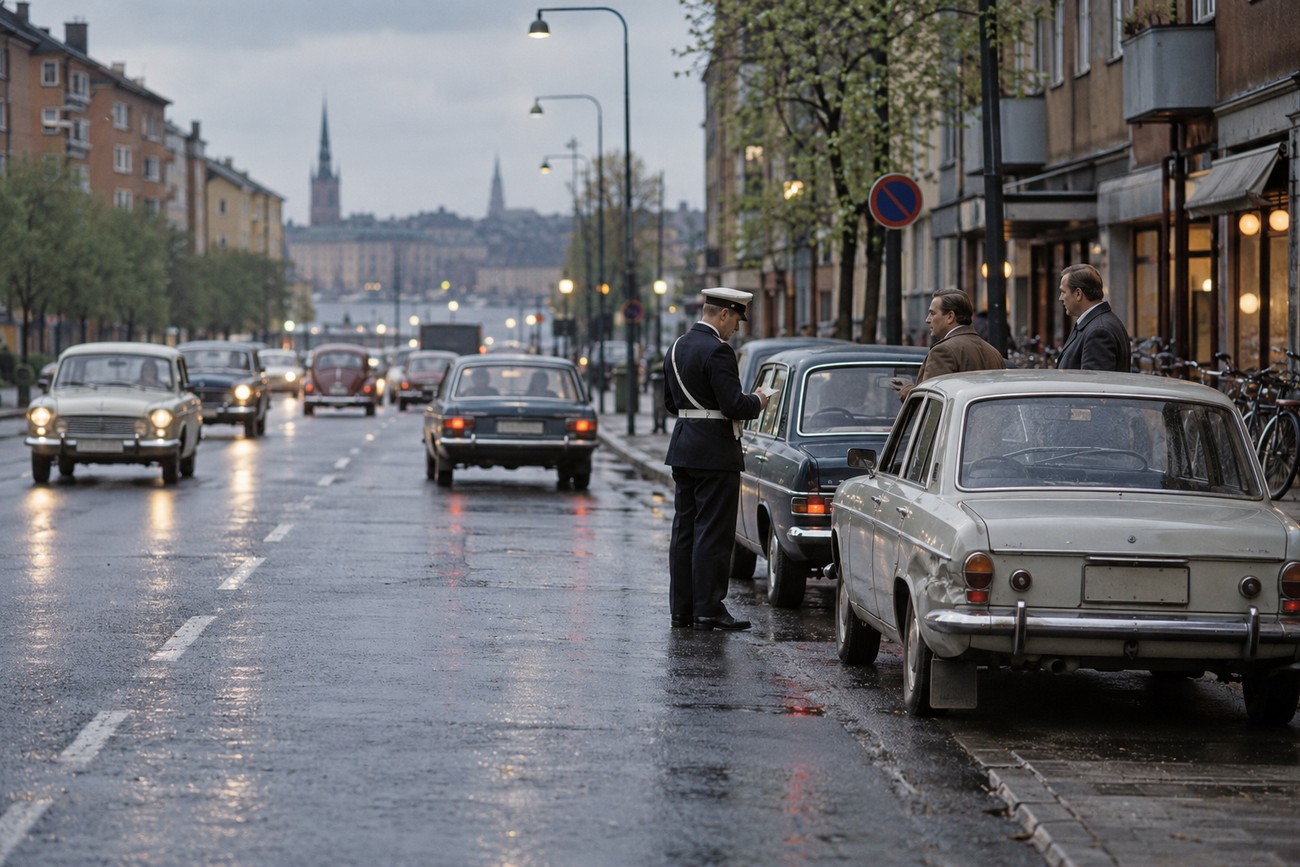
Sweden recorded 1,077 road deaths in 1967, compared with 1,313 in 1965. The lower annual total is significant, although the two-year comparison does not isolate Dagen H. Traffic levels and driving conditions can change across years, while speed restrictions, safety messaging, and unusually cautious behavior coincided with the switch.
Shorter-term measures tell a different part of the story. Insurance claims returned to their usual level in about six weeks, and crash levels approached their former level by 1969. Claims, reported crashes, and deaths measure different outcomes; a return in one series should not be treated as an identical change in another.
That distinction helps explain how the operation could have an orderly start without delivering a permanent fall in road danger. The change addressed a specific mismatch between left-hand-drive cars and left-side roads, particularly the driver’s view when overtaking. It did not remove errors of attention, speed, or judgment.
The durable lesson is about preparation and compatibility. Sweden brought signs, junctions, stops, public information, and a timed traffic halt into the same plan, while adopting the road side used by its neighbors. The achievement was a controlled national change in driving practice, rather than proof that one side of the road is inherently safer.
Frequently asked questions
Some related questions call for distinctions beyond Sweden’s main-road change. Other countries have switched for different reasons, while fixed tram tracks presented a separate set of practical constraints.
Which other countries have switched driving sides?
Iceland switched from left-hand to right-hand traffic in 1968. Samoa went in the opposite direction, changing from right-hand to left-hand traffic in 2009. The examples show that a switch need not follow one universal direction or timetable.
What happened to trams during the changeover?
Trams could not simply pull across the street like cars: tracks, boarding platforms, and vehicle doors shaped where passengers could get on. Stockholm’s inner-city street trams were withdrawn around the changeover, while Gothenburg retained trams and adapted its system for right-hand traffic. Local network design therefore determined the response.
When did Sweden switch to driving on the right?
Sweden adopted right-hand road traffic on 3 September 1967, known as Dagen H. The rule covered road traffic nationwide; the changes to individual routes and stops required advance preparation and temporary controls.
Which countries have changed the side of the road they drive on?
Sweden and Iceland are examples of countries that changed from left to right; Samoa changed from right to left. Each change had its own transport context, so Sweden’s timetable and early safety figures should not be assumed to apply elsewhere.
Why did Sweden drive on the left?
Left-hand driving was Sweden’s established road rule before Dagen H. Its precise historical origin is separate from the reasons for changing it: by the 1960s, neighboring countries drove on the right, and most Swedish cars had left-hand steering.







