
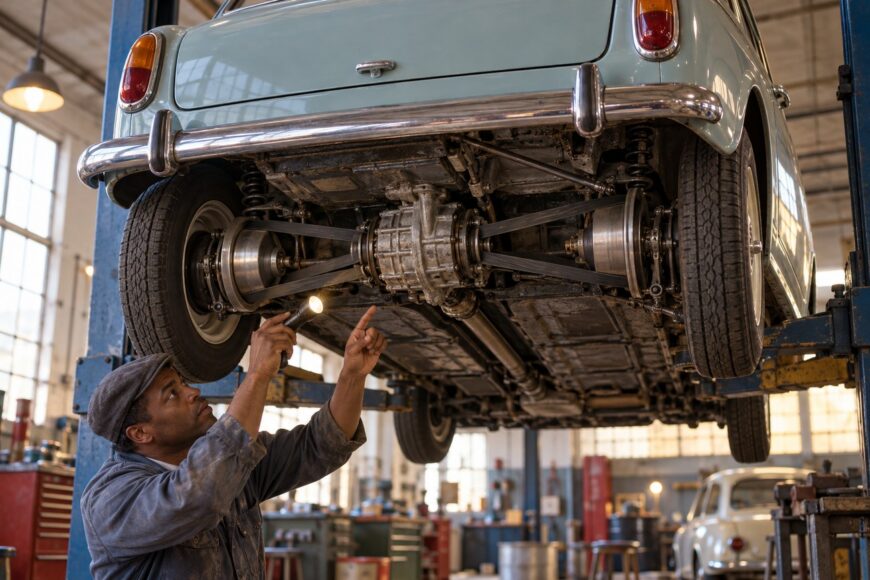
The engine rises in pitch while the DAF 600 gathers speed without a familiar gear change. To a driver accustomed to fixed ratios, that sound can suggest clutch slip or a transmission that has lost its way. The sensation explains the famous “rubber-band” nickname, yet the label raises a more useful issue: does it describe a flaw, or a design that demands different expectations?
Built from 1959 to 1963, the DAF 600 was a modest small car with an unusually consequential transmission. Its approximately 0.6-litre, air-cooled flat-twin produced about 22 hp under the SAE rating, while early cars were commonly quoted at roughly 95–100 km/h. Those figures made it ordinary in performance terms; the Variomatic made it historically distinctive.
The car’s significance lies in making a belt-driven continuously variable transmission part of series passenger-car production. Its behavior can feel smooth and clever when correctly adjusted, or vague and noisy when worn. Understanding that difference is essential to appreciating the DAF 600 as an engineering experiment that reached ordinary roads.
- The small car that made its transmission the headline
- What the Variomatic’s two belts actually do
- Why the engine seems to race ahead of the car
- The ownership trap: blaming every problem on the belts
- A crucial correction: the DAF 600 was not rear-engine
- Why the experiment still matters
- Frequently asked questions
- Why does the DAF 600 Variomatic have two drive belts?
- What happened to DAF passenger cars?
- What is CVT rubber banding?
- Why stay away from CVT transmission?
The small car that made its transmission the headline
The DAF 600 entered production in 1959 and remained in production through 1963. Its air-cooled, approximately 0.6-litre flat-twin petrol engine was rated at about 22 SAE hp, although reported output figures vary with the measurement method. The engine’s modest power placed the car firmly in the economical small-car class of its period.
Early cars were commonly quoted at roughly 95–100 km/h, with the exact figure depending on the source, body, and condition of the individual vehicle. Acceleration was never the central attraction. Ease of operation mattered more: the driver could select forward or reverse and allow the transmission to manage the ratio without manually choosing fixed gears.
That simplicity changed the character of low-speed driving. In traffic, the absence of shift pauses made progress feel continuous, while the small engine could keep working without the driver coordinating a conventional clutch and gear lever. The result suited drivers who valued uncomplicated control more than brisk acceleration.
The DAF 600 is best described as an early series-production passenger car with a belt-driven CVT. Claims that it was the world’s first CVT car need qualification, because experimental systems and production cars belong to different historical categories. Its achievement was bringing this particular form of continuously variable drive into a practical passenger car, where drivers could experience it every day.
What the Variomatic’s two belts actually do
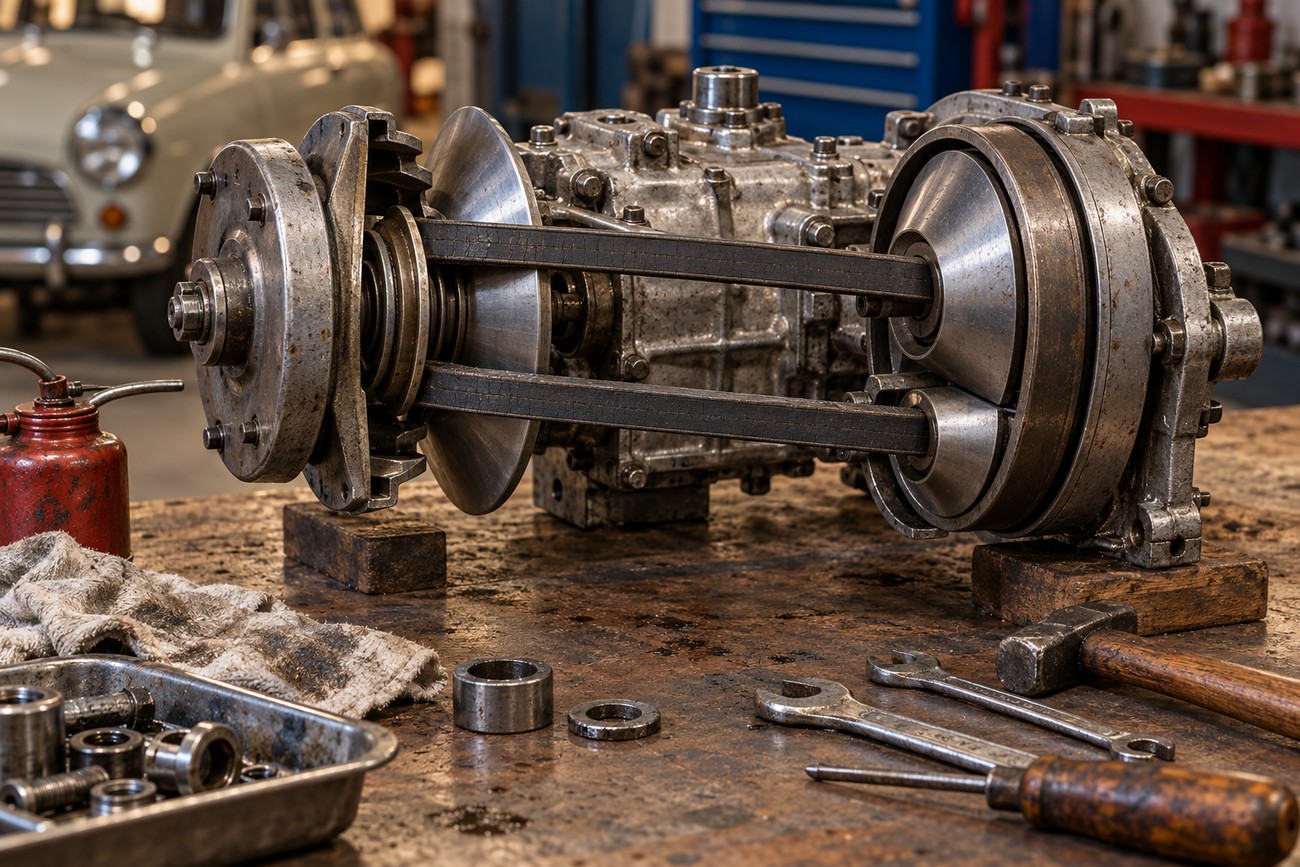
The Variomatic is a belt-driven continuously variable transmission with a centrifugal clutch. Instead of selecting a small number of fixed gear ratios, it alters the relationship between engine speed and road speed continuously. That arrangement allows the engine to remain in a useful operating range as the car accelerates.
Its central parts are two purpose-made V-belts and pulley pairs whose effective diameters change. Each belt runs between a pair of pulley faces. As the faces move closer together or farther apart, the belt rides at a different diameter, altering the ratio in the same basic way that changing sprocket sizes changes the relationship between input and output speed.
At takeoff, the system provides a low effective ratio suited to moving the car away from rest. As speed rises, the pulley geometry changes progressively, allowing the transmission to move toward a higher ratio. There are no fixed gear steps for the driver to feel, so acceleration does not arrive as a sequence of distinct shifts.
The centrifugal clutch connects the engine as rotational speed rises, allowing the car to pull away without a manually operated clutch pedal. This gives the DAF a different operating feel from a manual transmission and also separates it from a modern torque-converter automatic, which uses hydraulic fluid coupling and usually includes a set of planetary gear ratios.
“Rubber-band transmission” is a figurative nickname. The belts are engineered V-belts designed for the pulley profiles and loads of the Variomatic; they are not simple elastic bands. The phrase refers either to the visible belt idea or to the perceived delay between rising engine revs and increasing road speed.
Why the engine seems to race ahead of the car
With fixed gears, an acceleration run usually includes changes in engine pitch as the driver or transmission selects another ratio. The Variomatic removes those familiar pauses. Engine speed can remain relatively steady or high while the car continues to gain road speed, which makes the sound seem disconnected from the motion.
A driver may therefore hear the flat-twin working hard before feeling a corresponding increase in speed. That is a normal consequence of allowing the transmission to hold a useful ratio. The experience can seem especially pronounced in a small, lightly insulated car, where engine and transmission noise reach the cabin clearly.
Extra hesitation, persistent sluggishness, or an impression of actual slipping deserves closer inspection. Worn belts, damaged pulley faces, incorrect adjustment, or poor centrifugal-clutch engagement can exaggerate the rubber-band effect. Sound alone cannot establish a fault, since a correctly functioning Variomatic may also hold high engine speed during acceleration.
The same caution applies to claims about smoothness and economy. A continuously variable ratio can help the engine operate in a consistent range, and DAF promoted that characteristic, but economy does not follow automatically in every condition. Belt condition, adjustment, load, driving speed, and the driver’s use of the throttle all influence the result.
The ownership trap: blaming every problem on the belts
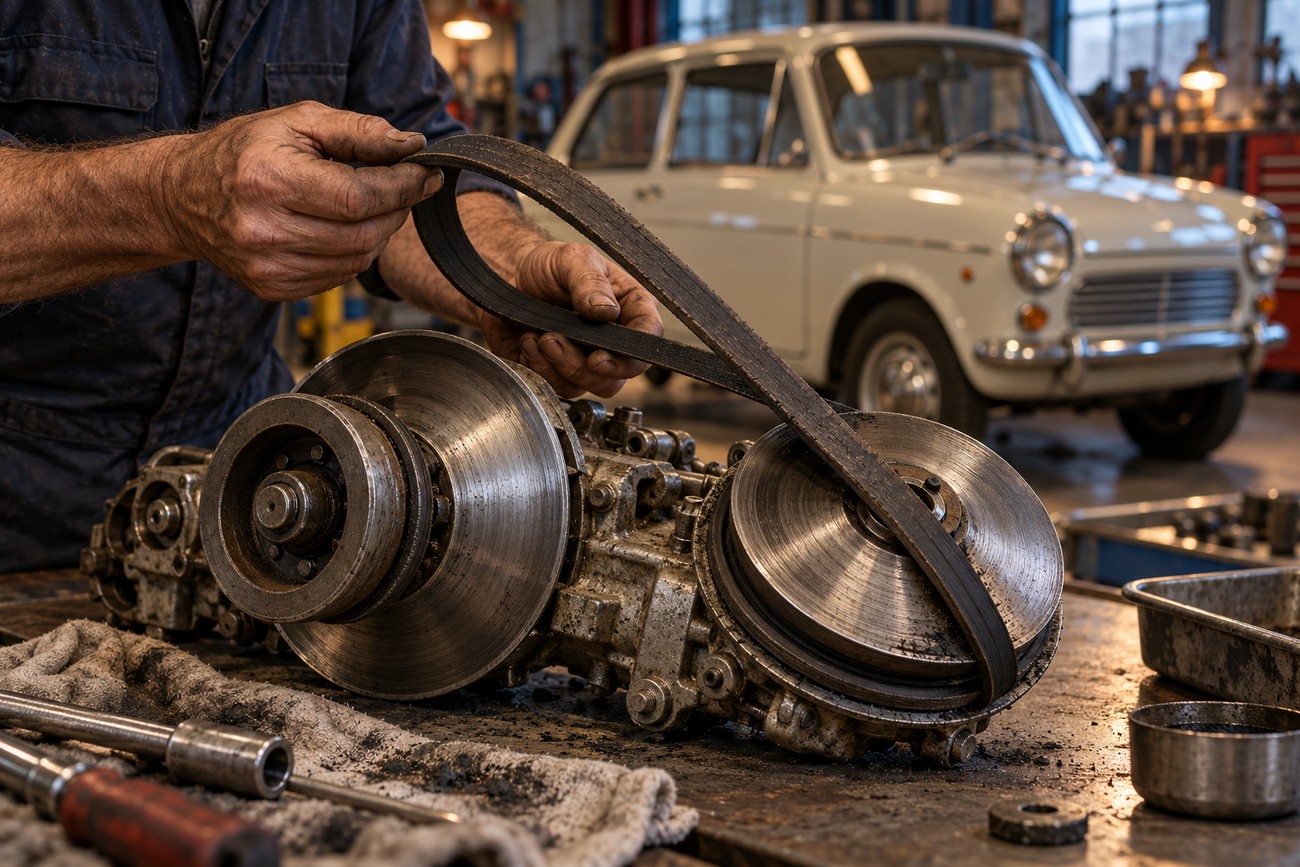
A prospective owner should begin with the belts, but should not stop there. Their profile, length, cross-section, and condition must suit the Variomatic’s pulley geometry. A belt that appears close enough by eye can still alter the working diameter, engagement behavior, and available ratio range.
The pulley faces deserve equal attention. Wear, scoring, contamination, or incorrect adjustment can prevent the belt from seating correctly. A transmission that feels slow to pull away may therefore have a pulley or setup problem even when the belts themselves look serviceable.
Sluggish takeoff is best assessed as a system: belt fit, pulley faces, adjustment, and centrifugal-clutch engagement must agree before the belts alone are blamed.
The centrifugal clutch is another important checkpoint. Its engagement should be considered alongside belt movement, because poor clutch operation can imitate a transmission that is slipping or reluctant to transmit power. Ignoring this part often leads to repeated belt replacement without resolving the original complaint.
Service history is especially valuable on a surviving DAF 600. Records or knowledgeable inspection should establish what belts and related parts were fitted, how the pulleys were adjusted, and whether the clutch has been maintained. Original or suitable specialist parts may require help from marque clubs, experienced suppliers, or specialist workshops.
Restoration costs can also exceed the purchase price suggested by the car’s small size. Correct belts, pulley work, clutch repairs, and careful setup require parts and labor that are unusual for a compact economy car. A cheap example can become expensive if its transmission has been neglected, although individual cars vary substantially in condition.
A crucial correction: the DAF 600 was not rear-engine
The DAF 600 has a front-mounted engine and rear-wheel drive. It should therefore not be described as a rear-engine car, and handling claims based on a supposedly light rear end from that layout are unreliable. Getting the basic architecture right matters before drawing conclusions about traction, weight distribution, or winter behavior.
The Variomatic drive components are associated with the rear-drive layout, which can cause confusion when descriptions compress the engine and transmission into one vague “rear-mounted” system. The engine remains at the front, while the transmission and rear-drive components form part of the system that delivers power to the rear wheels.
This distinction also affects maintenance expectations. Access to a rear-associated transmission assembly can shape the repair procedure, while the front-mounted engine creates a separate set of access points and service tasks. A mechanic diagnosing a belt or pulley problem must identify the actual component location rather than rely on a simplified description of the car.
Handling impressions still depend on tires, suspension, road surface, loading, and vehicle condition. They should not be attributed to a nonexistent rear-engine layout. The DAF 600’s unusual driving character comes primarily from its Variomatic and modest powertrain, combined with the steering and chassis standards of the late 1950s.
Why the experiment still matters
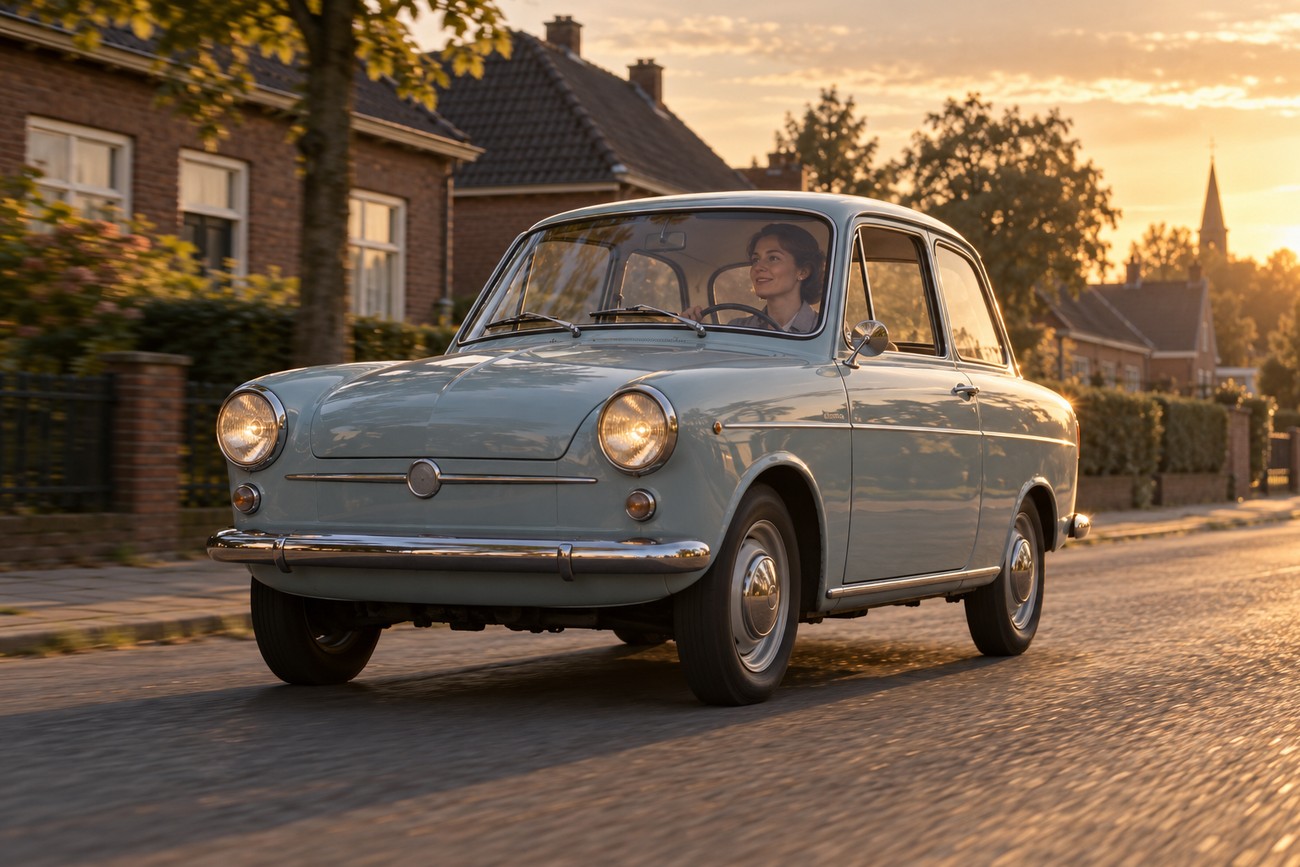
The DAF 600 remains interesting because it made a sophisticated transmission idea approachable in a small production car. From 1959 to 1963, its Variomatic changed ratio continuously rather than selecting fixed gears. That arrangement gave ordinary drivers a direct encounter with CVT behavior long before the technology became familiar in later cars.
Its limitations are equally clear. About 22 SAE hp from an air-cooled, approximately 0.6-litre flat-twin leaves little reserve for rapid acceleration, while period sound insulation and high engine speeds can make highway travel tiring. The car’s compact size does not remove the need for careful transmission maintenance.
A well-adjusted example can feel smoother than the nickname suggests. That is an owner impression rather than a measured performance claim, and it depends heavily on belt fit, pulley condition, clutch operation, and adjustment. When those parts work together, the absence of fixed shifts becomes a coherent driving characteristic rather than a series of disturbances.
The lasting lesson is precise. The DAF 600 offered an ingenious production solution, not a guarantee that every CVT would be effortless or trouble-free. Its historical value comes from showing how a small car could make transmission design the main event, while also revealing how much that design depends on correct parts and careful setup.
Frequently asked questions
The DAF 600’s transmission raises questions about its belt arrangement, ownership risks, and place in DAF’s history. The answers below separate normal Variomatic behavior from signs of wear and explain what happened to the passenger-car business.
Why does the DAF 600 Variomatic have two drive belts?
The two belts provide separate drive paths for the rear-wheel-drive system. Each belt works with its own pulley path, allowing the transmission to transmit engine power to the rear-drive arrangement while maintaining the continuously variable ratio.
Using two purpose-made V-belts also spreads the drive load across the system and keeps the pulley arrangement compact. Their operation must remain closely matched, so belt specification, condition, and adjustment are important to smooth and reliable behavior.
What happened to DAF passenger cars?
DAF’s passenger-car operation later passed to Volvo. The transfer continued the story of the passenger-car designs under a different manufacturer, while DAF itself continued as a truck marque.
This distinction explains why the DAF name remains familiar in commercial vehicles even though new DAF-badged passenger cars are no longer part of the company’s current identity.
What is CVT rubber banding?
CVT rubber banding describes the perceived mismatch between rising engine revs and the car’s slower-feeling increase in road speed. The engine may hold a high or relatively steady speed while the transmission continuously changes ratio, so acceleration lacks the usual sound and feel of gear changes.
In the DAF 600, the phrase is especially vivid because the Variomatic uses purpose-made V-belts. It does not mean that the transmission contains literal elastic bands, and an unusually weak response may indicate wear or incorrect adjustment rather than normal CVT behavior.
Why stay away from CVT transmission?
A buyer might avoid an early CVT when specialist parts, service history, or correct adjustment are unavailable. The DAF 600’s Variomatic is sensitive to belt specification, pulley condition, and centrifugal-clutch operation, so neglected examples can require more specialized work than their size suggests.
That concern is different from saying that every CVT is unreliable. A correctly maintained system can operate smoothly, while a poorly maintained one can become costly. Inspection by someone familiar with the Variomatic is more useful than judging the transmission from its unusual sound alone.







