
The Daewoo Tico is often reduced to “a Suzuki Alto with a Daewoo badge.” That description points to a genuine connection, since the Korean city car was based on the 1988-generation Suzuki Alto. It also hides the details that matter to a buyer: different engines, fuel systems, equipment levels, and market specifications appeared during its production life.
Production began in South Korea in 1991 and ended in 2001. Its low weight and simple mechanical layout can make it inexpensive to run in town, while corrosion, limited performance, uncertain specification data, and age-related failures can quickly outweigh a low purchase price. The Tico deserves a condition-focused inspection rather than a nostalgic reading of its badge.
- What the Daewoo Tico really was
- Daewoo Tico specifications and variants
- How the Tico drives—and what the fuel numbers hide
- The Tico faults buyers overlook
- Maintenance, parts and the Alto compatibility trap
- Tico myths that can make a cheap car expensive
- Frequently asked questions
- Why did Daewoo fail?
- How should I identify the right replacement part for a Tico?
- What does the Tico’s low weight mean in a crash?
What the Daewoo Tico really was
Daewoo developed the Tico as a small, economical Korean city car based on the 1988-generation Suzuki Alto. Production began in South Korea in 1991 and ended in 2001, giving the model a long enough run for equipment and mechanical details to change between years and markets.
The Alto connection is useful when researching the car, especially for some engine-related parts. It does not make every Tico component interchangeable. The engine specification, fuel system, wiring, equipment, and transmission could vary, so an Alto reference is a starting point for identification rather than proof of compatibility.
Early cars commonly used a carburetor, while later versions received fuel injection and Euro 2 compliance. Those changes affected more than the intake system: sensors, wiring, fuel delivery, and engine management also changed. A seller’s description such as “Alto-based” or “injected Tico” should therefore be checked against the actual vehicle and its production details.
This distinction matters most with old cars because replacement parts, registration data, and online listings are often mixed together. A specification quoted for one export market may not describe a Korean-market car or an earlier carbureted example. Confirm the engine code, build year, transmission, and fuel system before using a catalog figure or ordering parts.
Daewoo Tico specifications and variants
The following table separates a commonly reported early specification from later or market-specific figures. Values marked as variable should be verified against the individual car.
| Specification | Early or common version | Later or market-specific version |
|---|---|---|
| Engine | 796 cc transverse inline three-cylinder petrol engine | 796 cc transverse inline three-cylinder petrol engine |
| Fuel system | Carburetor | Fuel injection; later versions received Euro 2 compliance |
| Power | About 41 hp | About 48 hp in some later or market-specific versions |
| Drivetrain | Front-wheel drive | Front-wheel drive |
| Mass | Approximately 680 kg | Approximately 680 kg, depending on specification |
| Transmission | Five-speed manual | Five-speed manual; three-speed automatic offered for the Korean market |
| Dimensions | One common specification: 3340 × 1400 × 1394 mm | |
| Wheelbase | 2334 mm | |
| Common tires | 155/70 R12 | |
The approximately 41 hp and 48 hp figures describe different specifications and should not be treated as interchangeable. About 41 hp is typical of an early specification, while about 48 hp appears in some later or market-specific versions. The model year, market, and fuel system are more useful clues than the number in an advertisement.
Every Tico used a transverse 796 cc inline three-cylinder petrol engine and front-wheel drive, but the transition from carburetion to injection changed the ownership experience. Fuel injection generally improves starting and emissions control when the system is healthy. It does not give the old 0.8-liter car the performance of a modern small hatchback.
The main transmission was a five-speed manual. A three-speed automatic was offered for the Korean market, so listings that casually describe an automatic as a four-speed should be treated with caution. Confirm the transmission fitted to the car and the availability of parts for that exact unit.
The approximately 680 kg mass helps explain the Tico’s low-load city-car character, while the 155/70 R12 tires and compact dimensions reflect its original purpose. These figures also underline why tire condition, braking performance, and structural integrity deserve priority over cosmetic upgrades.
How the Tico drives—and what the fuel numbers hide
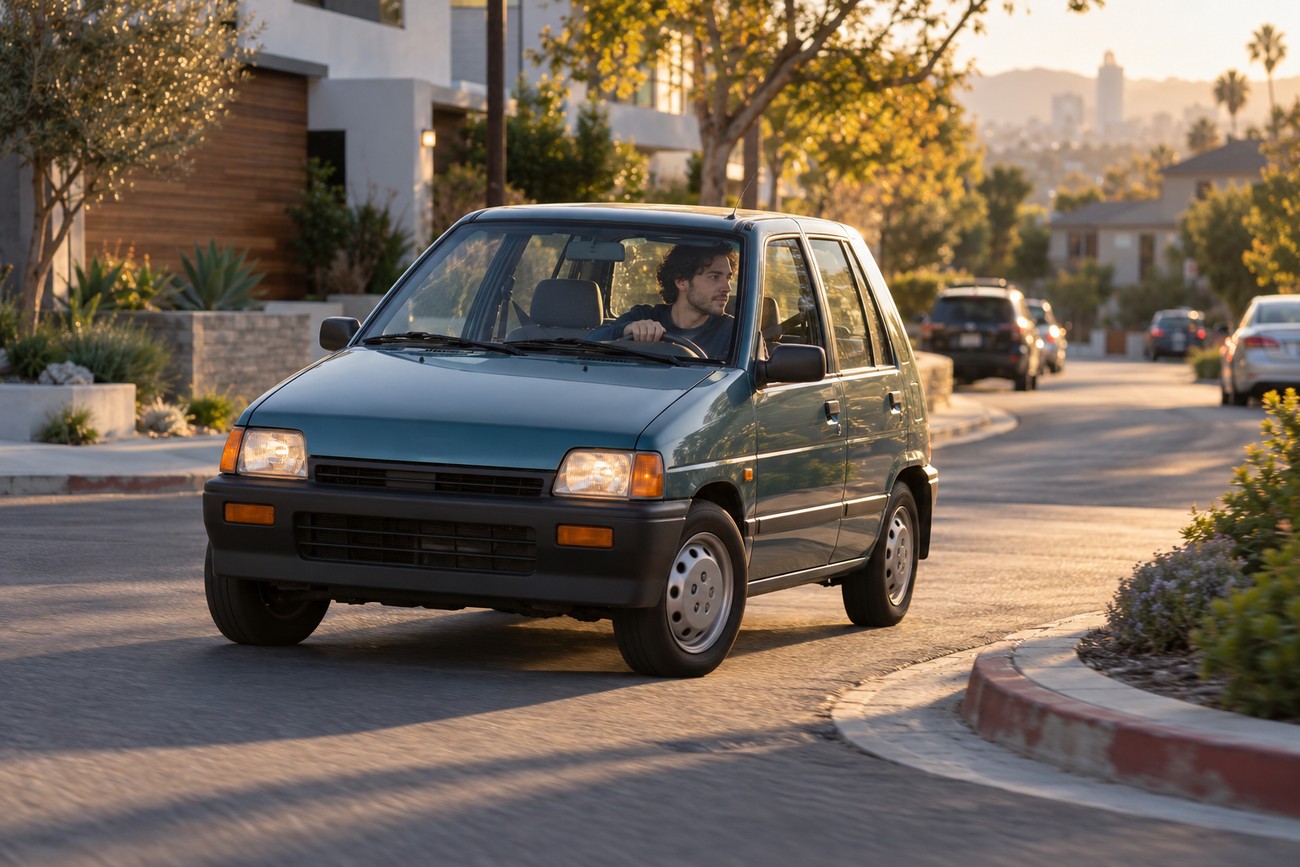
In town, the Tico’s small footprint, front-wheel drive, and low mass make it easy to place on narrow streets and simple to maneuver. The five-speed manual can keep the small engine usable at urban speeds, provided the engine is correctly tuned and the cooling system is sound.
Performance becomes limited as speed, gradient, and load increase. The early 41 hp version is listed at approximately 0–100 km/h in 17.5 seconds. Overtaking, climbing, and carrying several occupants require planning, with usable acceleration depending heavily on road conditions and the engine’s actual health.
A catalog mixed-cycle figure is about 6.2 L/100 km. That figure should be read as a specification reference rather than a promise for every surviving car. Carburetor adjustment, fuel-system condition, tire pressure, traffic, weather, and driving style all affect the result.
Universal claims of 4–5 L/100 km are not confirmed by the cited specifications. A healthy injection car used gently in light traffic may differ from a worn carbureted example driven at sustained highway speed, but the buyer should calculate ownership costs from measured consumption after purchase rather than from the most attractive listing claim.
The Tico faults buyers overlook
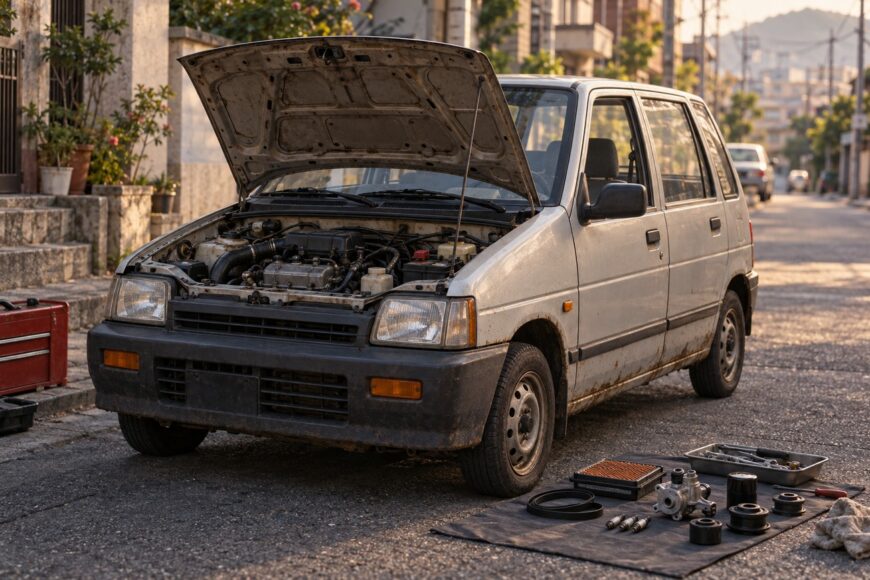
Begin with the structure. Inspect the wheel arches, sills, floors, reinforcements, and suspension-tower areas from above and below. Rust in these locations can affect how safely the body carries suspension and braking loads, while a low odometer reading says little about corrosion accumulated over decades.
Fresh underseal, plastic trim, and recently painted panels deserve closer inspection rather than automatic approval. Probe suspicious areas, inspect repair edges, and look for uneven seams, trapped moisture, or mismatched metal. A clean-looking underside can conceal previous structural repairs or active corrosion.
A compression test, oil-pressure check, and inspection of the floor, reinforcements, and suspension-tower areas reveal more than a quiet cold-start video or a freshly undersealed chassis.
Engine condition is the next priority. Oil consumption in an older engine may be associated with valve-stem seals or piston rings, and a smooth idle alone cannot distinguish between a healthy engine and one that has been warmed up before viewing. Check compression, oil pressure, exhaust behavior, overheating, and coolant condition.
Carbureted cars can develop unstable idle, poor cold starting, and hesitation after storage. Replacing or adjusting the carburetor without checking for intake leaks, ignition faults, compression, and fuel-level problems can leave the original fault untouched.
Electrical problems are often age-related. Inspect wiring, connectors, alternator output, battery connections, and grounding points. Daily-use safety items also need direct checks: brake pipes, tires, belts, cooling components, charging, and evidence of neglected repairs should be assessed before judging the car by its purchase price.
Maintenance, parts and the Alto compatibility trap
Some engine parts may still be available through relationships with the Suzuki F8B/F8C family. That connection can make mechanical servicing easier than the car’s age suggests, especially for routine engine work. Compatibility must be verified by engine code and exact version, because similar-looking parts can differ in fittings, dimensions, or control systems.
Body and interior parts are significantly harder to source. A door trim, dashboard component, lamp, seal, or suspension-related fitting may be listed under Tico, Alto, or another related application without matching the mounting points. Compare the old part, its dimensions, connectors, and attachment points before ordering.
The carburetor-to-injection change is a systems change. Fuel-injected cars use different wiring, sensors, an engine-control unit, and fuel-delivery hardware, so converting between versions is not a simple exchange of the intake assembly. The exact production version should be recorded before diagnosing a fault or buying a replacement harness or control unit.
For an engine assessment, compression, oil pressure, and overheating checks provide more useful evidence than a steady idle on a warm engine. A cold start, road test, cooling-system inspection, and charging test complete the picture. These checks cost less than rebuilding an engine or chasing incompatible parts after purchase.
Tico myths that can make a cheap car expensive

Myth: every Tico has 48 hp. Reality: approximately 41 hp specifications also exist, especially among earlier cars. About 48 hp appears in some later or market-specific versions, so the engine, year, and fuel system should be verified before comparing performance or insurance and registration information.
Myth: every Tico automatic is a four-speed. Reality: the Korean-market automatic is described as a three-speed unit. Confirm the transmission fitted to the car, since a generic listing can confuse market versions and make replacement parts more difficult to locate.
Myth: every Tico achieves 4–5 L/100 km. Reality: a catalog mixed-cycle figure is about 6.2 L/100 km, while actual consumption depends on the fuel system, mechanical condition, and driving conditions. A carbureted car with an intake leak or worn engine may consume substantially more than an advertised figure.
Myth: the Tico is simply an Alto with a different badge. Reality: it was based on the 1988-generation Suzuki Alto, but engine details, fuel systems, equipment, and market specifications varied. The sound purchase decision rests on structural condition, documentation, engine health, and functioning safety systems rather than the lowest price or the most attractive specification claim.
Frequently asked questions
The Tico’s age makes identification and condition more important than a single catalog specification. These answers address the ownership decisions that are easiest to get wrong.
Why did Daewoo fail?
Daewoo’s collapse involved substantial group debt, the Asian financial crisis, and the subsequent breakup of the conglomerate. The failure was a corporate and financial event rather than a direct consequence of one small model’s mechanical design.
For Tico buyers, the practical result is a fragmented parts and documentation landscape. The Daewoo name does not guarantee ongoing factory support, so exact identification and independent verification are important when maintaining an older car.
How should I identify the right replacement part for a Tico?
Start with the engine code, production version, fuel system, transmission, and the exact component being replaced. Record connector shapes, mounting points, dimensions, and any markings on the original part before searching by a Suzuki Alto or Tico label.
Use an Alto or F8B/F8C reference as a compatibility lead, then confirm the fit against the individual car. This approach is particularly important for electrical components, injection hardware, body panels, and parts affected by the change from carburetor to fuel injection.
What does the Tico’s low weight mean in a crash?
The approximately 680 kg mass indicates a limited passive-safety margin by modern standards. In a collision with a substantially heavier or newer vehicle, the Tico’s small size and low mass can be a serious disadvantage.
The cited specifications do not confirm modern passive-safety systems. Euro 2 compliance concerns emissions, not crash protection, and should not be interpreted as evidence of modern occupant protection. Structural condition, tires, brakes, and restraint equipment therefore deserve careful inspection before regular use.







