
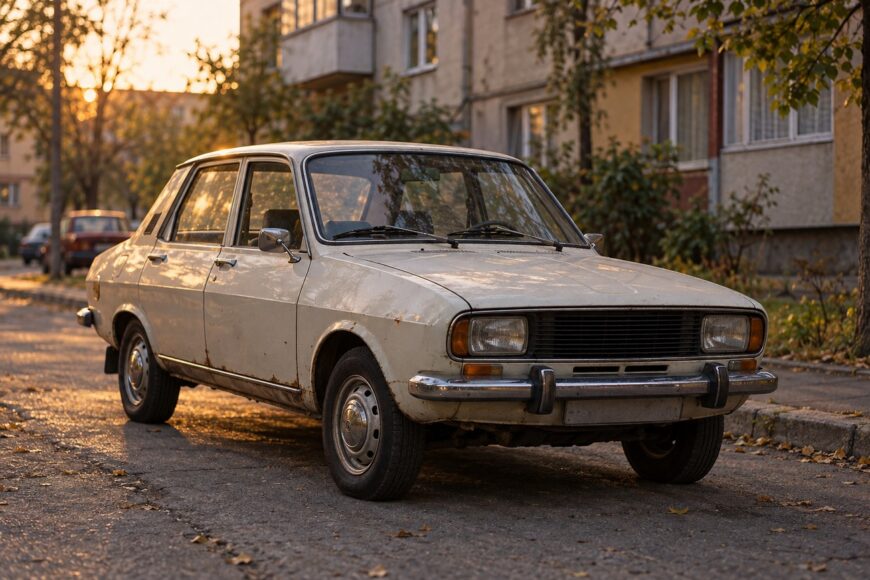
The Dacia 1300 is Romania’s licensed version of the Renault 12, built for a market where a practical family car also carried industrial and national significance. Its front-wheel-drive layout, simple petrol engine, and useful body styles made it easy to understand and, in its day, relatively straightforward to maintain.
That familiar design can mislead a buyer today. A shiny shell may conceal serious corrosion, while a Renault 12 parts listing may describe a component that does not fit a particular Romanian car. The badge establishes the model’s origins; it does not establish the condition, specification, or interchangeability of the surviving example.
- How the Renault 12 became the Dacia 1300
- The original 1300 on the road and under the hood
- Why Renault 12 parts are not always a direct fit
- What matters most when inspecting a surviving car
- Frequently asked questions
- What should I check before restarting a Dacia 1300 that has been parked for years?
- How can I tell an early 1300 from a later car with changed trim?
How the Renault 12 became the Dacia 1300
Dacia 1300 production began on 23 August 1969 under Renault 12 license. The Romanian car used the Renault 12’s basic engineering and became an important family vehicle in Romania, where local production made a modern front-wheel-drive sedan available on a substantial scale.
The original Dacia 1300 was produced until 1984. The later 1300/1310 line continued until 2004, so references to a “Dacia 1300” can describe cars from different periods, with changes to trim, lighting, engines, transmissions, and locally sourced components.
This distinction matters when buying or restoring one. Romanian versions changed over time, and a later Dacia is not simply a Renault 12 with a different badge. Shared origins help with technical literature and some parts searches, but they do not guarantee identical components.
The original 1300 on the road and under the hood
The Renault 12-based layout places the engine at the front and drives the front wheels. Buyers could choose a four-door sedan or a five-door wagon, both using a wheelbase of about 2,441 mm. The wagon offers more practical loading space, although its rear door and larger body area add places where corrosion can develop.
The early car uses a carbureted 1,289 cm³ petrol inline-four producing approximately 54 hp. “1300” is the model designation, rather than the exact displacement. Early examples are predominantly fitted with a four-speed manual gearbox; five-speed gearboxes occur on later variants and should not be assumed on every car.
These figures describe modest, usable transport rather than modern traffic performance. Third-party catalog data sometimes quotes about 145 km/h and 18 seconds to 100 km/h, but those numbers should not be treated as universal factory specifications for every year or version.
Carburetor complaints deserve diagnosis rather than excuses about “old-car character.” Difficult starting, a high idle, or hesitation may come from the choke, blocked jets, a weak fuel pump, incorrect adjustment, or an air leak. Ignition condition and engine vacuum should be checked before replacing the carburetor.
Why Renault 12 parts are not always a direct fit
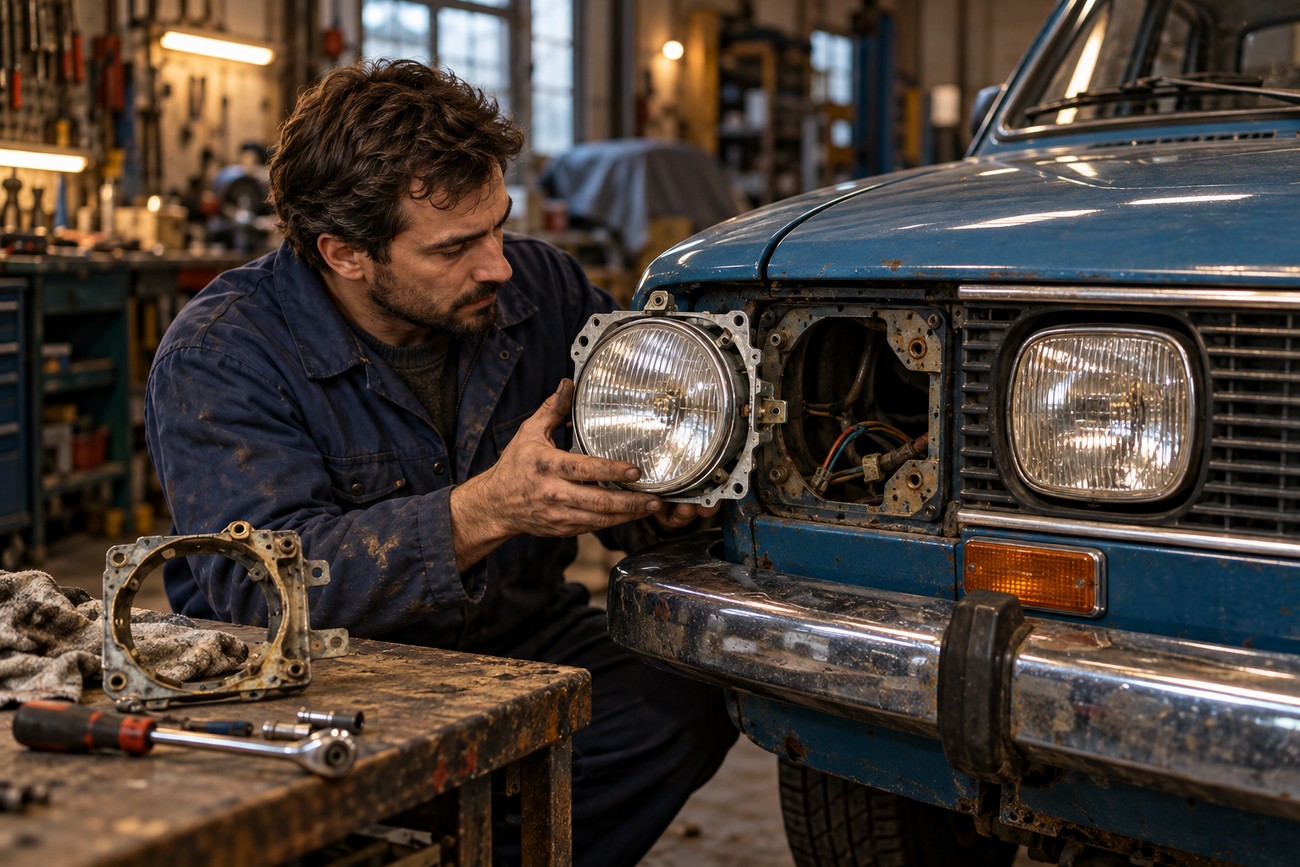
Renault 12 documentation remains useful because the underlying design provides a valuable reference point. Manuals, repair guides, and parts catalogs can clarify the layout and help identify service procedures that are otherwise difficult to reconstruct.
Compatibility becomes less certain as the search moves from routine service items to lights, trim, body panels, suspension parts, and version-specific mechanical components. Local production and model-year changes mean that two visually similar cars may use different fittings or assemblies.
Before ordering, match the vehicle’s year, body style, engine, and part number against a relevant catalog. Renault-related supply channels may help with some service parts, while owners still report difficulty finding body panels and certain Dacia-specific components. A listing that says “Renault 12” is a starting point, not proof of a direct fit.
What matters most when inspecting a surviving car
Inspect the structure before judging the paint. Look closely at the floor, sills, chassis members, suspension mounting areas, welded seams, and previous repairs. Fresh paint, thick underseal, filler, and bright trim can hide corrosion that is far more expensive to correct than worn mechanical parts.
Electrical faults are common on an aging car: corroded contacts, weak grounds, and unreliable charging can produce several symptoms at once. Check the wiring methodically rather than assuming a new battery has solved the problem. Brake cylinders, hoses, steering components, joints, and gearbox synchronizers also deserve inspection on cars that have been neglected.
A repaired sill or seam should be examined from both sides, with attention to weld quality, metal thickness, drain paths, and whether underseal stops at an obvious repair boundary. A tidy surface is not evidence that the surrounding structure is sound.
The mechanical layout is comparatively simple, which can keep many repairs understandable and accessible. It does not remove the effects of age on rubber, wiring, seals, brakes, and metal. Passive safety also reflects a late-1960s design, so the car should be driven with its period limitations in mind rather than judged by modern expectations.
Frequently asked questions
Two common questions concern cars that have been parked for years and cars whose trim may not match their original specification. A restart calls for more than a fresh battery. Identifying a car also takes more than reading its badge.
What should I check before restarting a Dacia 1300 that has been parked for years?
Do not begin with the battery alone. Inspect the brake hoses and cylinders, replace or assess old fluids, examine the tires, and check the fuel lines and tank for deterioration before attempting a road test. Turn the engine by hand if appropriate, confirm lubrication, and inspect for leaks before sustained running.
How can I tell an early 1300 from a later car with changed trim?
Badges, grilles, and lights are useful clues but are insufficient on their own. Cross-check the registration details and period parts documentation against the engine, gearbox, body style, and fitted components. This avoids assigning early 1300 specifications to a later 1300/1310 simply because the car carries an older-looking badge.







