
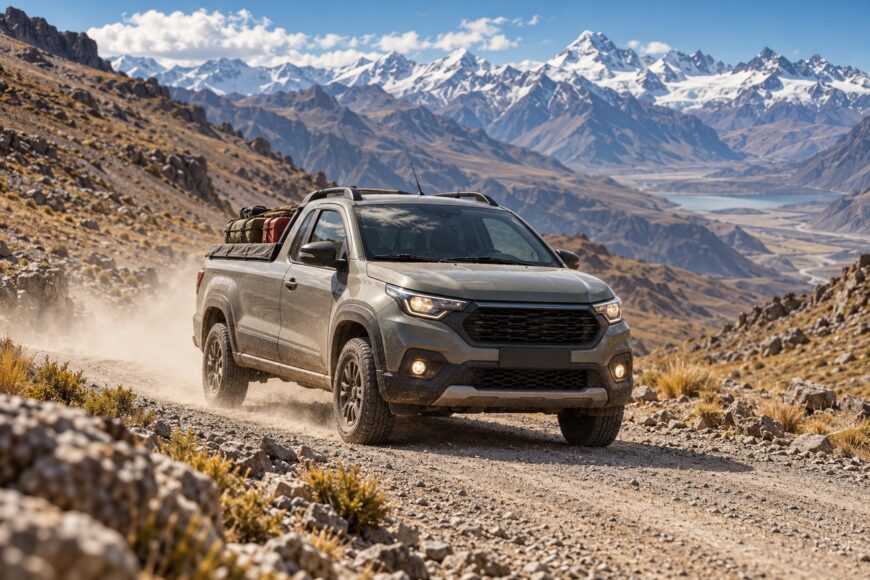
Taking a Fiat Strada across a high Andean pass has a clear appeal: the pickup is compact enough for narrow roads, light enough for rough surfaces, and useful when equipment must travel outside the cabin. A maintained route across the mountains can therefore look entirely reasonable on a map.
The difficult part begins where the road climbs, the air thins, and the surface changes. A passable road does not guarantee adequate power, grip, or braking margin in a loaded Strada. The outcome depends on the specific generation and engine, the pass condition and weather, the vehicle’s preparation, and the driver’s ability to recognize when the margin has disappeared.
- Can a Fiat Strada cross the Andes?
- What altitude does to a loaded Strada
- Choose the pass, not just the destination
- Prepare the pickup before the climb
- Drive the ascent and descent with a margin
- When the Strada is the wrong vehicle
- Frequently asked questions
- What documents do I need to take a Fiat Strada across an Andean border?
- Where should I arrange fuel and help before a remote pass?
- What is the most famous road trip in Chile?
- How far is Santiago, Chile, from the Andes Mountains?
Can a Fiat Strada cross the Andes?
Yes, a sound Fiat Strada can use suitable open Andean roads, including paved routes and dry gravel approaches. It is a compact light pickup, and specifications vary by generation and trim. That makes the individual vehicle more important than the model name: engine, tires, payload, suspension condition, and available traction equipment all affect the result.
Some Adventure and later versions are reported with ground clearance of up to approximately 200–210 mm. That is useful over rocks, drainage channels, and uneven gravel, yet it does not establish extreme off-road ability. The Strada has no low-range transfer case, so it cannot multiply torque at very low speed in the way a dedicated 4×4 can.
An electronic traction aid, where fitted, may help when one wheel loses grip on a relatively mild obstacle. It is not equivalent to a mechanical differential lock, and it cannot compensate for deep mud, loose snow, steep cross-axle terrain, or tires with poor grip. A pickup bed also encourages extra equipment, which can turn a manageable climb into a slow, heavily loaded one.
Reports of Stradas completing crossings such as Paso Jama or Paso de Agua Negra are useful as evidence that the trip can be possible. They remain individual travel reports, not a systematic reliability record. A dry crossing in good weather says little about the same route after fresh snow, rain, rockfall, or a change in road maintenance.
What altitude does to a loaded Strada
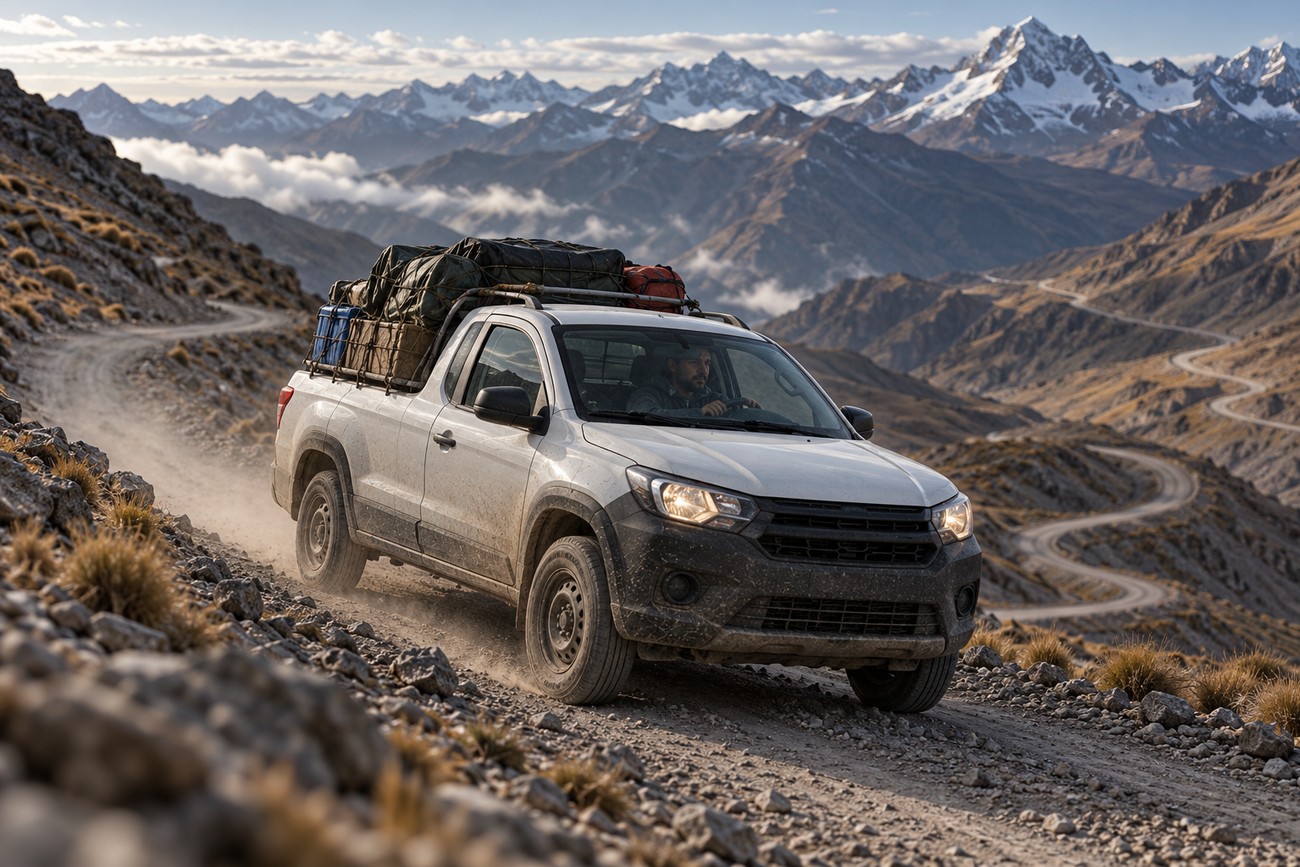
Many Andean road passes used by civilian vehicles lie roughly 3,000–4,800 m above sea level. At substantial Andean altitude, atmospheric pressure can be roughly 60–70% of sea-level pressure. Naturally aspirated engines can lose around 25–30% of their sea-level power, depending on elevation, conditions, and the engine.
The effect is most noticeable on long climbs above roughly 3,000 m, especially with a naturally aspirated Strada carrying passengers, fuel, tools, and camping equipment. The engine may still run smoothly, yet acceleration becomes slow and a lower gear may be needed for longer periods. A turbocharged engine generally retains power better at altitude, although its actual response still depends on the vehicle and its condition.
Reduced power changes the timing of the whole crossing. A climb that looks short on a map can consume more daylight, and repeated low-speed work increases heat and fatigue. Planning to arrive at an exposed section late in the day leaves less room for a weather delay, a blocked lane, or a decision to turn around.
The driver faces a separate altitude problem. Above 4,000 m, headache, weakness, poor sleep, and reduced concentration can affect judgment even when the vehicle is operating normally. Acclimatisation, hydration, a willingness to stop, and a second driver who is also fit may matter as much as the engine’s power reserve.
Choose the pass, not just the destination
Andean crossings vary sharply in road standard. One route may offer maintained pavement for most of its length, while another combines asphalt, concrete, gravel, and dirt approaches. Dry gravel can suit a light pickup; the same surface after rain may become mud that quickly removes the Strada’s traction advantage.
Check the specific pass rather than relying on a general statement that a border route is open. Confirm official status, forecast, operating dates, daily hours, and any vehicle restrictions before leaving, then check again locally. Snow, rockfall, flooding, or road work can cause a closure with little warning, and seasonal arrangements differ between crossings.
Weather timing deserves practical attention. Local drivers may prefer a daytime window when visibility is better and overnight ice is less likely, but no fixed period guarantees safe conditions across the Andes. Leave enough time to cross the exposed section without rushing, and treat an approaching storm or deteriorating road as a reason to wait rather than a challenge to overcome.
Local information can be more valuable than a generic route description. Identify the last dependable fuel point, the latest place with a reliable weather update, and the location of a recovery service or roadside contact. Phone coverage can disappear well before the most demanding section, so download maps and keep the route details available offline.
Prepare the pickup before the climb
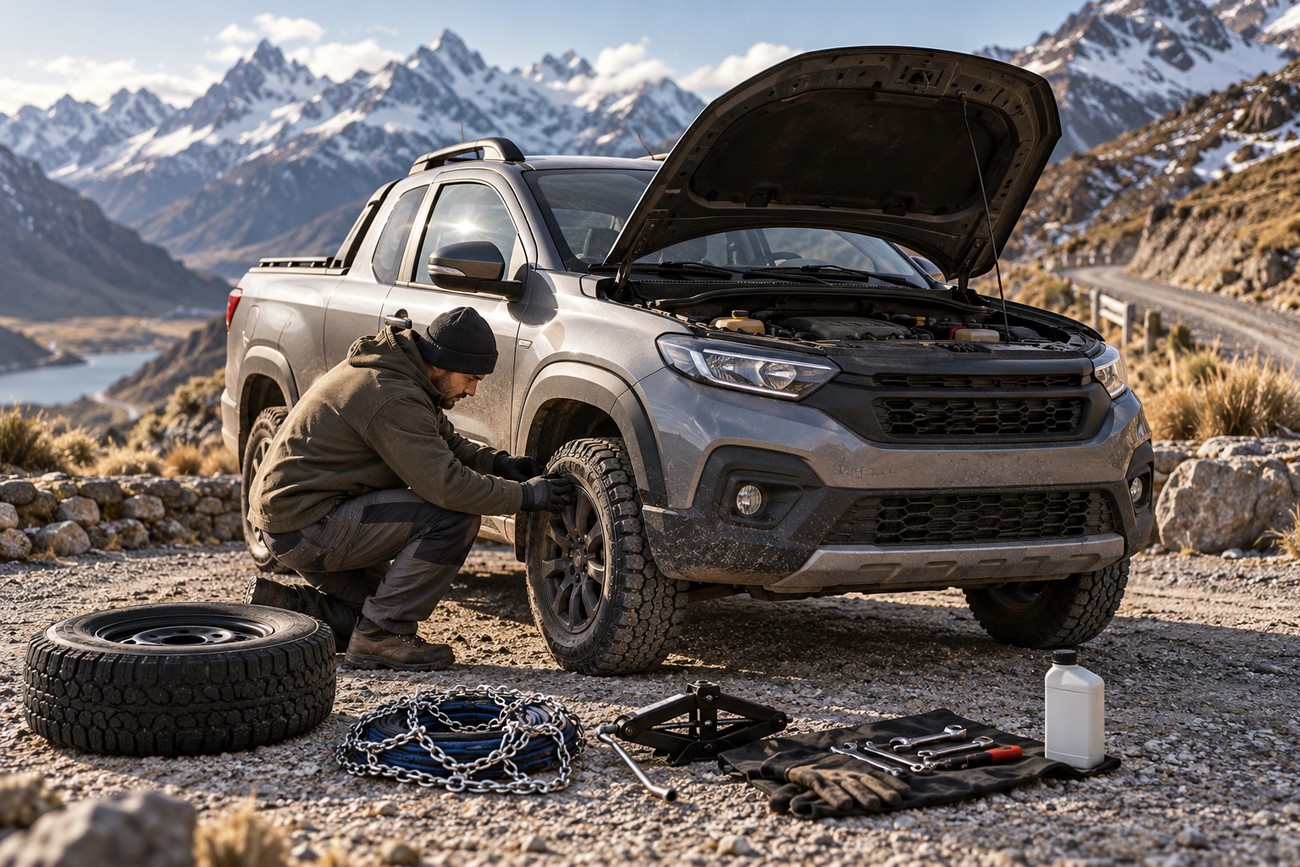
Start with tires suited to the forecast and actual surface, plus a usable spare. Road-oriented tires can lose traction on wet dirt, mud, or snow; all-terrain or M+S options may be more appropriate when conditions justify them. Chains may be required by local rules or road authorities, and they must fit the exact tire and suspension clearance before the trip.
Inspect the braking system, brake fluid, cooling system, belts, hoses, battery, and underbody protection. Long descents make brake condition and load especially important. An older Strada also warrants a close check for corrosion, worn suspension components, cracked mounts, and damage from earlier gravel-road use.
Reported payload ratings reach approximately 650–700 kg, depending on generation and version. Use the individual vehicle’s rated payload as a legal and mechanical limit, not as a target for a remote, steep crossing. Heavy tools, water, spare parts, and recovery equipment should be secured low and close to the vehicle’s center, with loose objects prevented from shifting on corrugations.
Lowering tire pressure can improve comfort and flotation on suitable loose ground, but it increases the need to avoid sharp rocks and to reinflate before faster pavement. Carry a dependable compressor and a pressure gauge if you use this approach. A small auxiliary light may help on poor roads, while weak factory lighting makes a pre-dawn or foggy mountain run a poor plan; lights must also comply with local regulations.
Drive the ascent and descent with a margin
Allow extra time for a high-altitude climb and accept that a naturally aspirated Strada may spend long sections in a lower gear. Keep the engine in a useful part of its rev range without forcing it through overheating, clutch abuse, or repeated abrupt acceleration. The aim is steady progress with enough reserve to stop safely if the surface or visibility changes.
Choose a suitable lower gear before a steep descent, according to the transmission and road conditions. Engine braking reduces the need to hold the brake pedal continuously, while a controlled speed leaves more room for loose gravel, oncoming traffic, and unexpected bends. If the brakes begin to smell, feel soft, or require a longer pedal, stop in a safe place and allow them to cool.
Choose the descent gear before the steep section begins. Discovering that the brakes are fading after repeated pedal braking leaves fewer safe options and often forces a rushed stop on an exposed slope.
Washboard gravel creates a different risk. The vibration can fatigue occupants, loosen poorly secured cargo, and stress an already tired suspension. Reduce speed to a level the vehicle can absorb, keep visibility ahead, and avoid treating a rough surface as a test of endurance.
Turn back when grip, weather, visibility, or driver alertness deteriorates. Above 4,000 m, altitude symptoms can impair concentration, and a tired driver may misjudge both a climb and a descent. Reaching the destination is less important than keeping a workable margin for the return route.
When the Strada is the wrong vehicle
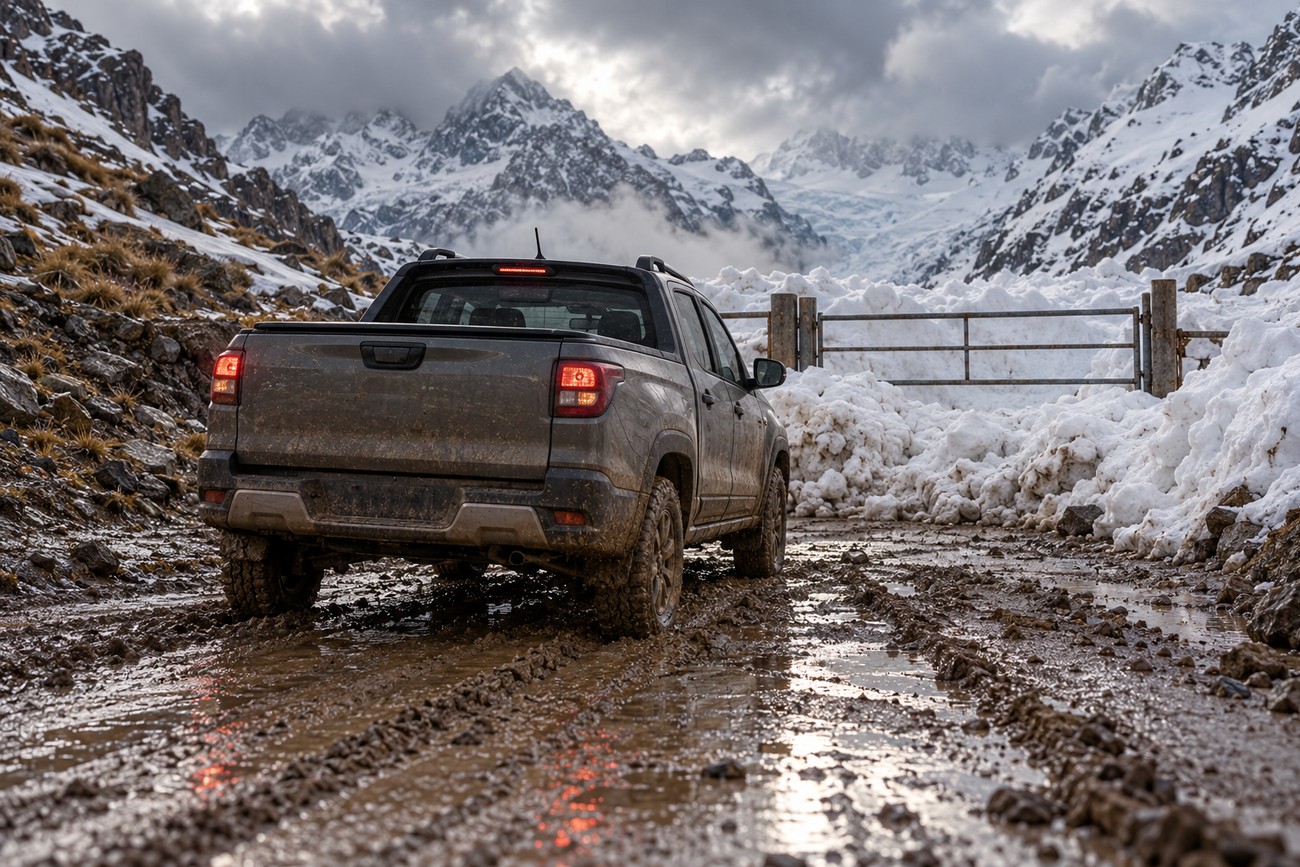
A maintained road open in suitable weather is a different proposition from a closed pass, fresh snow, deep mud, or a track that requires recovery equipment. The Strada can be a sensible travel vehicle for the first situation when prepared correctly. The second may require waiting, a local transport solution, or a vehicle with low-range gearing and stronger recovery capability.
Ground clearance of up to approximately 200–210 mm applies only to certain versions. It helps the body clear isolated obstacles, yet it does not provide traction on a polished muddy slope or control on a loose descent. Likewise, an electronic traction aid can assist in limited low-grip situations where fitted, but it does not replace a mechanical differential lock or low-range transfer case.
Load is another decisive boundary. A pickup that performs well with two people and moderate equipment may climb slowly, brake heavily, and punish its suspension when filled to its rated payload. A remote crossing also magnifies small faults: a damaged tire, failed hose, or corroded mounting point may become a major delay far from parts and assistance.
Make the decision from four current facts: the vehicle’s condition, the real load, official and local pass information, and the driver’s physical state. Successful crossing reports are encouraging but anecdotal. If any of those four elements is uncertain, waiting for a better weather window or changing vehicles is the more capable choice.
Frequently asked questions
Border paperwork, fuel planning, and route selection all affect whether a crossing is practical. Requirements can differ between countries and change independently of road conditions. The following questions address common planning points before departure.
What documents do I need to take a Fiat Strada across an Andean border?
Carry the vehicle registration, valid driving documents, required insurance, and any authorization needed when the driver is not the registered owner. Border rules, temporary vehicle-import procedures, insurance requirements, and permission documents depend on the countries and the vehicle arrangement.
Confirm the current requirements with both border authorities before departure. A rental, borrowed, financed, or company-owned Strada may require additional permission, and rules can change independently on each side of the crossing.
Where should I arrange fuel and help before a remote pass?
Plan fuel at the last dependable station before the remote section, allowing for detours, slow climbing, and a possible wait caused by weather. Do not treat a station shown on an old map as guaranteed to be operating.
Before entering the pass, identify likely phone-coverage gaps and save a local recovery or towing contact offline. Ask locally about current road conditions and where chains, tire repairs, or emergency assistance can be obtained; those contacts may be more useful than distant online advice.
What is the most famous road trip in Chile?
The Carretera Austral is widely regarded as Chile’s best-known long-distance scenic road trip. It runs through southern Chile and is a route within the country, not one specific Chile–Argentina border crossing.
How far is Santiago, Chile, from the Andes Mountains?
Santiago lies immediately west of the Andes, with the mountain front reachable by a short drive east of the city. The distance to a particular pass, ski area, or international crossing varies considerably, so route planning should use the named destination rather than “the Andes” as a single point.







