
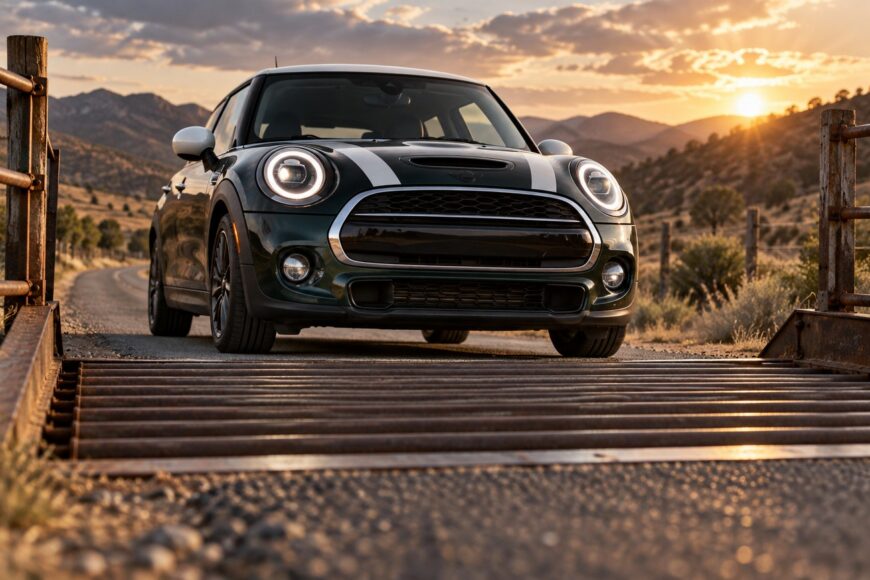
A Mini Cooper may fit across a cattle guard while its low bumper, underbody, or exhaust still strikes the structure. The car’s small size does not remove the risks created by a raised edge, poor transition, or slippery metal.
A safe decision depends on ground clearance, approach angle, the condition of the guard, and available traction. Mini Cooper ground clearance commonly falls around 115–146 mm, depending on generation, suspension, version, and load. That range is only a starting point, so inspect the crossing before committing to it.
- Can a Mini Cooper Cross a Cattle Guard Safely?
- Read the Guard and the Approach Before You Drive On
- The Correct Line: Straight, Slow, and Controlled
- Wet Metal, Ice, and Other Conditions That Change the Risk
- What Can a Cattle Guard Damage on a Mini Cooper?
- When Should You Turn Around Instead?
- Frequently asked questions
- How effective is a cattle guard if there is open ground beside it?
- What should I do if my Mini Cooper scrapes before the front wheels reach the guard?
- What smells do cows hate?
- How many cows do you need to make $100,000 a year?
- How effective is a cattle guard?
Can a Mini Cooper Cross a Cattle Guard Safely?
A Mini Cooper can sometimes cross a cattle guard safely, provided the guard and its approach are in good condition and the car has enough clearance. There is no universal answer for every Mini or every installation. A car that clears one guard may scrape another because the frame height, edge shape, ramp angle, and surrounding ground differ.
The wheels are usually not the main concern. The more relevant contact points are the front lip, lower bumper, sills, underbody protection, exhaust, and frame edge. A short wheelbase can help the car settle over a compact crossing, yet it does not prevent a low front bumper or spoiler from reaching the near edge first.
Many cattle guards are installed for road and agricultural use, often with larger vehicles and farm equipment in mind. Their width and load capacity may be generous while their transitions remain abrupt for a low passenger car. Look underneath from outside the vehicle if possible, and pay particular attention to the highest edge rather than judging the guard by its overall size.
Higher-suspension or crossover-style Mini versions generally have more clearance margin. Lowered and sport-oriented versions generally have less, especially when carrying passengers or luggage. Neither configuration is automatically protected, because load and approach geometry can reduce the available margin.
Read the Guard and the Approach Before You Drive On
Assess the entire transition, including the ground before the front tires reach the metal. A dirt ramp, embankment, rut, or sharp change from gravel to steel can make the front lip scrape before the guard itself becomes the problem. Inspecting on foot is safest when conditions allow.
Common road and agricultural installations are often approximately 2.4–4.0 m wide and 1.5–3.0 m deep per section, although local standards and manufacturers vary. Those dimensions describe the structure, not its compatibility with a Mini. A wide guard can still have a raised frame edge or a steep approach that catches low bodywork.
Check for bent bars, raised corners, damaged welds, loose sections, large gaps, debris, and signs that the supporting frame has shifted. A deformed guard can load one wheel or one side of the car unexpectedly. The cattle guard works as a visual and geometric barrier that discourages cattle from stepping across; it is not a trap designed to catch vehicle wheels.
Look at the surface between and around the bars. Mud, gravel, packed snow, or ice can change the effective shape of the crossing and hide the depth of a gap. If the car scrapes on the approach, reassess the transition before continuing.
The Correct Line: Straight, Slow, and Controlled
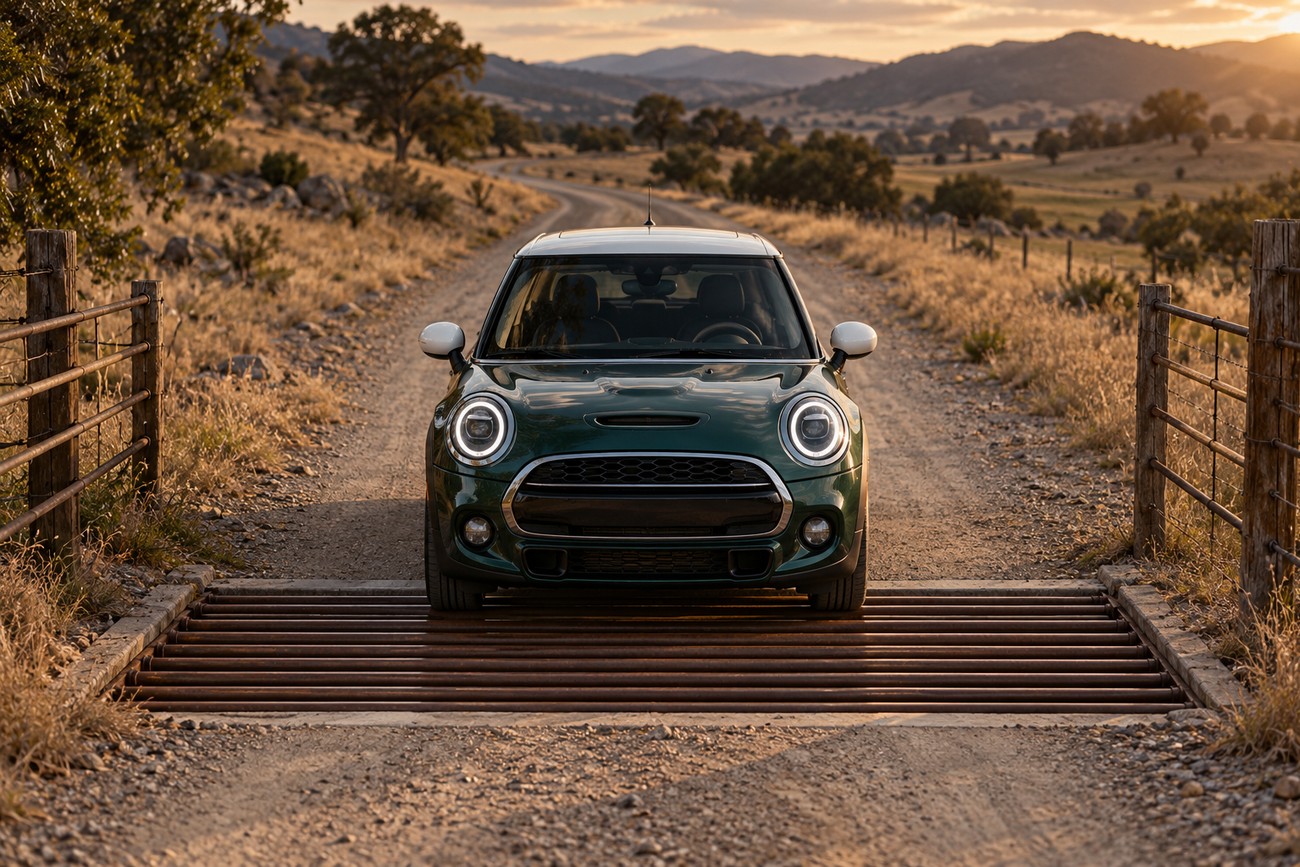
Stop before the guard and align the Mini as close to perpendicular as the site allows. Keep the steering straight, settle the car, and use the lowest speed that remains stable and controllable. The aim is smooth wheel loading, with no sudden acceleration, braking, steering, or gear change on the bars.
Diagonal entry lets one wheel meet an edge first. That can twist the car, increase uneven underside contact, and place more side load on the tires if the metal is slippery. A short wheelbase does not eliminate front-overhang risk; the low bumper or spoiler can still reach the near edge before the front wheels are fully supported.
Once the front wheels are across, maintain the same calm line until the rear wheels have cleared the structure. Avoid correcting the steering while the tires are on the bars. If the car begins to slide, avoid abrupt inputs and reassess rather than adding throttle to force the crossing.
Wet Metal, Ice, and Other Conditions That Change the Risk
Wet metal and ice substantially reduce tire grip. On a slippery guard, the main problem may be stopping and steering rather than getting the wheels across. A slow approach does not compensate for a surface where the car cannot remain straight or stop before the next edge.
Use extra caution after rain, freezing temperatures, or livestock activity that leaves mud on the structure. Ice or packed material between the bars can alter the apparent geometry and create an unpredictable impact. It may also make one side of the guard behave differently from the other.
The hazard can begin on the approach. A steep embankment may compress the suspension as the front wheels climb, reducing clearance at the bumper. A sudden drop after the guard can produce a second impact, even if the vehicle clears the bars themselves.
Turn around or choose another route if you can see ice, severe deformation, an unknown drop, or a transition that already scrapes. A spotter can help identify the highest edge and watch the underside, yet a spotter cannot restore traction or make a damaged guard structurally sound.
What Can a Cattle Guard Damage on a Mini Cooper?
The front lip, lower bumper plastic, wheel-liner material, and splash protection are often more exposed than the suspension itself. A raised frame edge can crack or pull away lower plastic, while a poor transition can contact underbody protection or exhaust components. The damage may be minor, though it can leave a panel hanging into the tire path.
Excessive speed turns a manageable transition into a sharp vertical impact. The suspension compresses quickly, the body receives a stronger jolt, and loose material underneath can strike the structure. Even at a slow pace, a raised edge can catch a low lip if the approach angle is poor, so speed alone cannot solve a clearance problem.
After crossing, stop somewhere safe and look for hanging plastic, a displaced wheel liner, fresh scrapes, or an exhaust component that appears to have moved. Listen for new rattles and check for fluid leaks. A new vibration or change in steering feel also deserves attention.
These signs do not identify the exact fault by themselves. If the car has suffered a hard impact, continues to make unusual noise, leaks fluid, or feels different through the steering, avoid treating it as harmless road vibration. A proper inspection is safer than continuing over additional rough crossings.
When Should You Turn Around Instead?
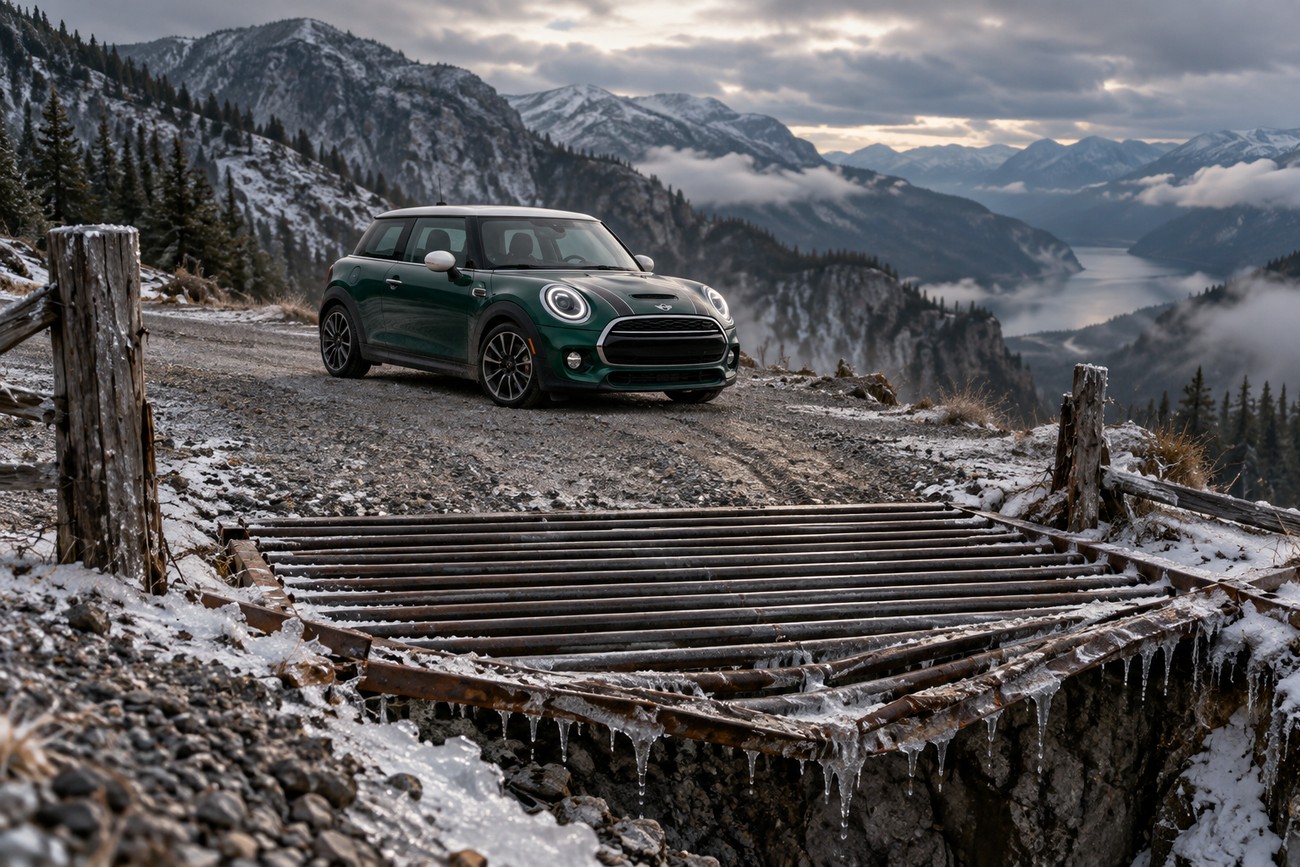
Turn around when the guard is visibly damaged, icy, steep, or difficult to assess, especially if you cannot inspect the far side. A route around the obstacle, a better-positioned crossing, or help from someone familiar with the site may be the sensible choice. Losing a few minutes is preferable to committing a low car to an unseen drop or raised frame.
Higher-suspension or crossover-style Mini versions generally have more clearance margin than lowered or sport-oriented versions. A short front overhang can help, but it does not compensate for insufficient clearance or a poor approach angle. Extra passengers, luggage, and a soft or compressed suspension further reduce the margin available at the front.
Ask someone familiar with the site to help inspect the guard when the edge is difficult to see, the surface is slippery, or the crossing is narrow enough to leave little room for correction. Keep the vehicle straight and do not rely on a guess based on how other vehicles look from a distance. Their clearance, wheelbase, tires, and suspension may be different.
A cattle guard is also less effective for livestock when animals can bypass it along an unfenced edge, berm, or nearby track. Side fencing may be necessary for the barrier to control animal movement. That issue does not make the vehicle crossing safer; it simply means the guard’s purpose and its physical condition should be assessed separately.
Frequently asked questions
These answers address decisions that may arise before or after a Mini Cooper reaches a cattle guard. Site conditions remain decisive, particularly where the structure is damaged, icy, or difficult to inspect.
How effective is a cattle guard if there is open ground beside it?
Its livestock-control effectiveness can be poor if cattle can walk around the ends. The bars discourage animals from stepping across the visual and geometric barrier, yet an open shoulder, berm, or nearby track may provide an easier route.
Side fencing and properly closed edges are often needed for the guard to work as intended. This is separate from whether a Mini can drive over it: a guard may be easy for a vehicle to cross and still fail to contain livestock.
What should I do if my Mini Cooper scrapes before the front wheels reach the guard?
Stop immediately, keep the car settled, and avoid rocking or accelerating through the contact. Continuing can pull loose plastic into a tire or turn a light scrape into damage at the bumper, underbody, or exhaust.
Inspect the approach transition and identify what touched first. If the edge cannot be corrected or another line cannot provide clear space, find another route rather than adding speed.
What smells do cows hate?
There is no dependable smell-based substitute for a properly designed cattle guard and side fencing. Livestock may react inconsistently to odors, and weather, wind, habituation, and available routes can change that response.
Physical layout remains the reliable control: a correctly maintained guard, closed edges, and fencing that prevents an easy bypass.
How many cows do you need to make $100,000 a year?
There is no fixed herd size that guarantees that income. The result depends on cattle type, land, feed, breeding performance, sale prices, labor, veterinary costs, financing, and whether the figure means gross revenue or net income.
A cattle count alone is therefore insufficient for a sound estimate. A farm budget based on local costs and expected sales is needed before treating an income target as realistic.
How effective is a cattle guard?
A cattle guard can be effective when its geometry discourages animals from stepping across and its ends connect to suitable fencing. Its performance falls when cattle can bypass it through open ground, berms, or nearby tracks.
Regular checks matter because bent bars, damaged welds, shifted frames, and debris can affect both livestock control and vehicle safety. Effectiveness is a property of the complete installation, not the bars alone.







