
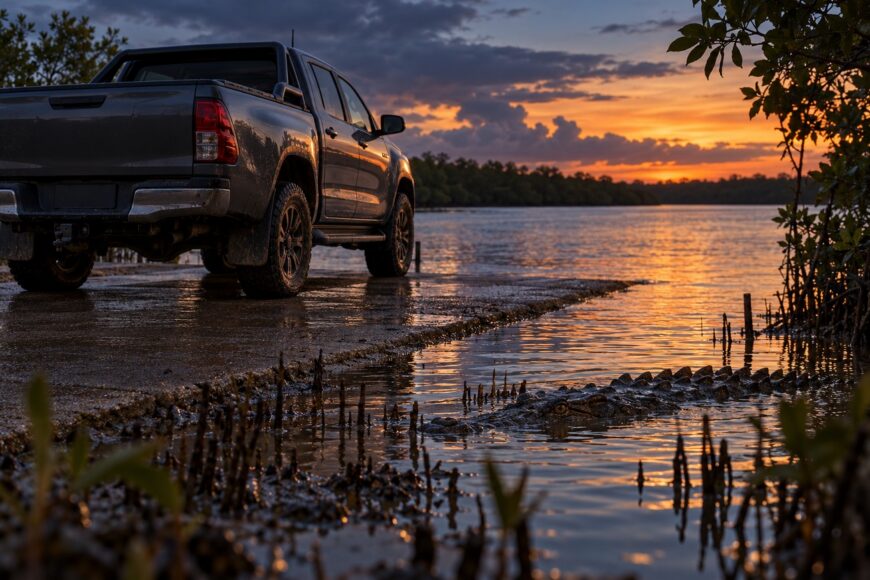
Finding a crocodile beside or under your Toyota HiLux at a boat ramp is an unsettling possibility in parts of northern Australia. The vehicle may give you a higher view, but its size and ground clearance do not make the space around it safe. The danger arises when someone steps out close to the water without a clear view of the bank or the ground beside the vehicle.
That does not mean every northern ramp carries the same risk. Location, current conditions, visibility, and what people do at the water’s edge all matter. A sensible response starts before anyone gets out: check the site, keep your distance from the water where possible, and treat a possible sighting as a reason to leave rather than investigate.
- Could a Crocodile Really Be Under Your HiLux?
- Why Boat Ramps Become Crocodile Meeting Points
- The Ramp Habits That Put People Closest to the Water
- A Safer HiLux-and-Boat-Ramp Routine
- What the Numbers, Signs, and Crocodile Myths Actually Mean
- Frequently asked questions
- What should I do if I see a crocodile near a boat ramp?
- How long can crocodiles stay underwater?
- What is the most crocodile-infested river in the world?
Could a Crocodile Really Be Under Your HiLux?
Yes, a crocodile could be near a parked vehicle or a boat ramp, and you should not assume the ground around a HiLux is clear without looking. Crocodylus porosus, commonly called the saltwater or estuarine crocodile, is the largest living reptile and the most dangerous crocodile species to people in northern Australia. The immediate concern at a ramp is where people stand, walk, and unload, rather than whether a crocodile would fit beneath a particular vehicle.
A crocodile can be difficult to detect in muddy water, at dusk, or close to the bank. Part of an animal at the surface may resemble a log or debris, while vegetation and the slope of a ramp can obscure the edge. A quick glance from the driver’s seat cannot establish that the launch area is clear.
The HiLux’s height may help you see over some obstacles, but it does not control what happens when a passenger opens a door or walks toward the trailer. Distance from water and awareness of the area around the vehicle matter more than the badge, size, or ground clearance. Keep people inside while assessing an uncertain site, and avoid stepping out beside an obscured bank.
If something near the ramp might be a crocodile, give it space. Do not move closer for a photograph or try to determine whether it is merely debris. You can make that decision from a safer position: stop the launch and leave the area.
Why Boat Ramps Become Crocodile Meeting Points
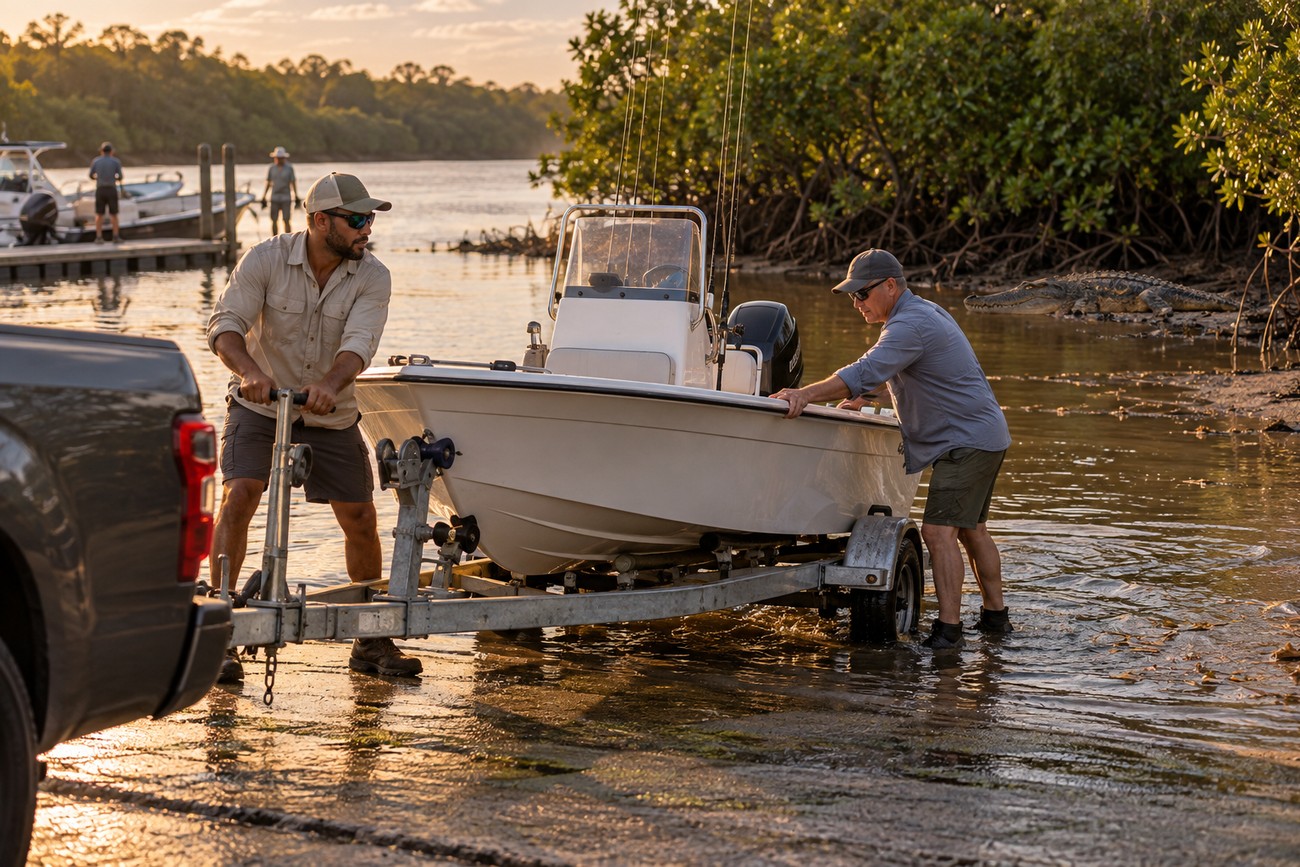
Boat ramps, river mouths, and fishing spots bring people to the same edges used by crocodiles. In Australia, the main risk area is the northern, north-eastern, and north-western coastline. Within that broad region, the conditions at a particular access point matter more than how familiar or busy it looks.
Saltwater crocodiles use rivers, estuaries, lagoons, swamps, coastal waters, and nearby marine areas. Adults can spend several months at sea without apparent harm, so a ramp near the coast should not be dismissed as safe because it is outside a freshwater river. Water that looks open and well traveled can still be crocodile habitat.
Rain, tides, and changing water levels can alter the risk at a familiar stopping point. Water may reach closer to a parking area, obscure the bank, or change where people must stand to handle a boat. A spot that offered a clear view on an earlier visit may require a different decision today.
Regular use of a ramp is no proof that an animal is absent. The practical test is whether you can follow local advice and carry out the launch without people lingering at an exposed edge. If conditions make that difficult, use another access point or postpone the trip.
The Ramp Habits That Put People Closest to the Water
Small tasks often create the longest exposure. Someone stands at the waterline for a photo, sorts tackle beside the trailer, or starts unloading before checking the bank. Moving those jobs to a suitable area away from the edge reduces the time people spend where visibility may be poor.
Cleaning fishing gear beside the water is another avoidable habit. Popular fishing locations can also be crocodile habitat, so a productive spot should not be treated as a safe place to spread out equipment. Anglers may have more gear to handle than other visitors; organizing it before approaching the ramp helps prevent repeated trips to the edge.
An unseen crocodile is not an absent crocodile. Muddy water and low light make that distinction important, particularly when someone is focused on a winch, boat line, or phone rather than the surroundings. Pause if you cannot see the area needed for the task.
Warning signs deserve attention even at a ramp you have used for years. A sign communicates a hazard and may point to local rules; it does not certify that a crocodile is present or prove that none is nearby. Where signs are missing, their absence should not replace an assessment of the site and current local advice.
A Safer HiLux-and-Boat-Ramp Routine
Before leaving, check current warnings and access rules from the relevant local authority for the ramp and waterway you plan to use. Conditions may have changed after rain or a tide cycle. If the site is closed or local instructions restrict access, choose another plan rather than relying on past visits.
On arrival, stop where you can assess the ramp without immediately sending passengers toward the water. Look at the bank, the space beside the vehicle and trailer, visibility across the launch area, and any posted instructions. Keep children, passengers, and loose activity away from the edge while you decide whether to proceed.
Settle who will handle the boat, trailer, and passengers before approaching the launch lane. Last-minute gear sorting beside the water can leave someone waiting at the edge while the driver is occupied.
Prepare equipment away from the water where the site allows, then keep the launch task brief and coordinated. The HiLux is transport, not a wildlife barrier: its height or ground clearance cannot protect someone who has stepped into an exposed area. If the layout forces people to linger where they cannot see the bank, reconsider the launch.
If you suspect a crocodile is nearby, stop, withdraw, and keep others from approaching to check. Follow any directions from local authorities and report the sighting through the relevant local channel. Industry safety codes can support safe practice, but they do not replace legislation, regulatory requirements, or instructions that apply at that site.
What the Numbers, Signs, and Crocodile Myths Actually Mean
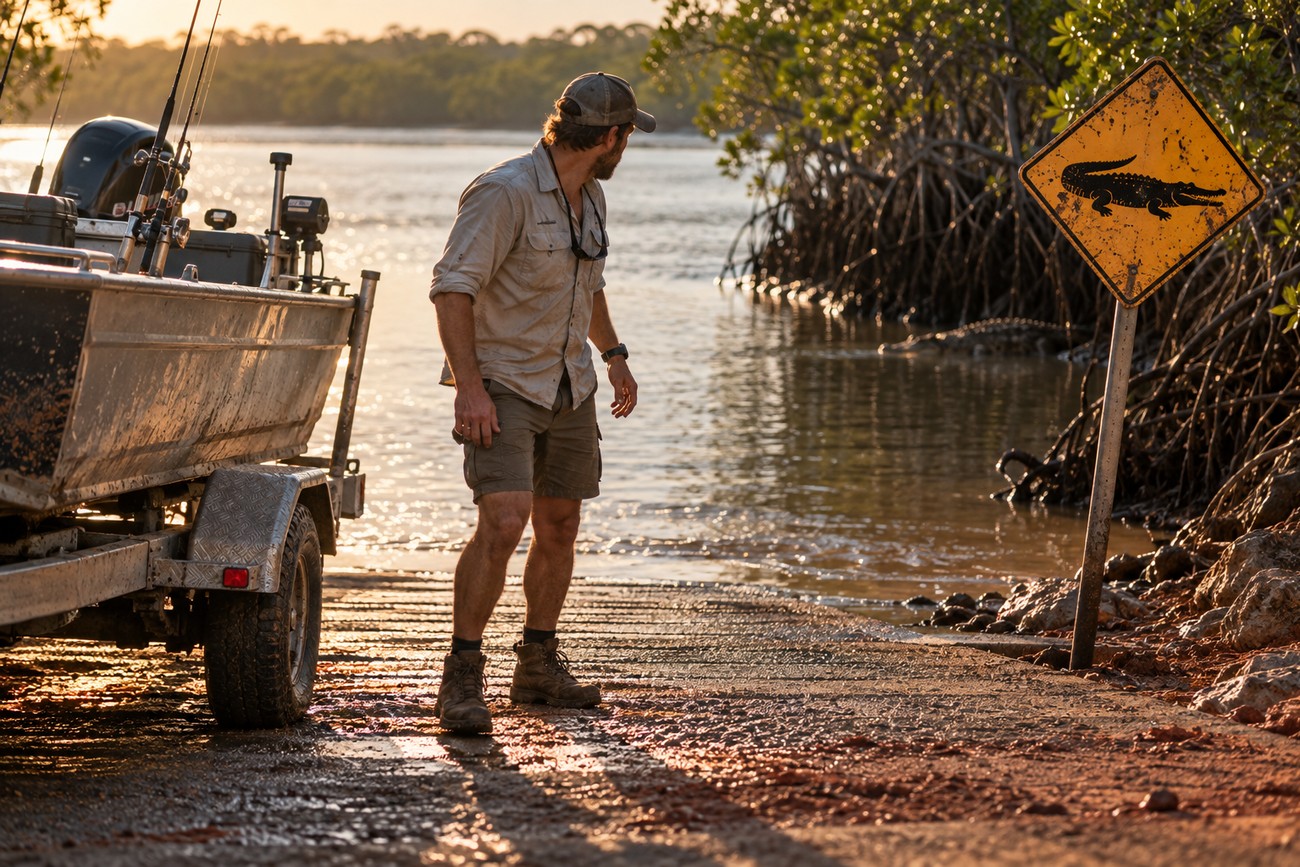
At least 10 crocodile attacks on people are recorded in Australia each year, and about 25% of recorded Australian crocodile attacks are fatal. Those figures establish that the hazard deserves serious attention. They do not predict the chance of an attack at a particular ramp on a particular day.
Australia’s crocodile population is estimated at about 200,000 individuals. That broad estimate cannot tell you whether an animal is beside your trailer, just as a quiet visit cannot prove a site will remain clear. Local warnings and the conditions in front of you are more useful for an immediate decision.
Crocodiles are protected under local legislation; shooting them is prohibited. Do not attempt to confront, move, or harm an animal at a ramp. Withdraw and use the relevant local reporting channel so the sighting can be handled under the rules that apply there.
Popular accounts sometimes cite male crocodiles reaching 7 metres and about 1 tonne. Those are extreme, disputed claims that are poorly tied to measurable field data and should not be treated as typical dimensions. Judging safety by whether you could spot an enormous animal misses the more useful point: a crocodile can be hard to see at the water’s edge.
Neither a warning sign nor an industry code removes the animal from the area. Signs help you recognize and respond to a known hazard, while codes support safer work and boating practices alongside legal requirements. The idea that crocodiles are only a river problem is also misleading; estuaries and coastal waters are part of their habitat.
Frequently asked questions
These answers address decisions that may arise during a sighting or while assessing crocodile risk. For a specific ramp, current local instructions should guide what you do.
What should I do if I see a crocodile near a boat ramp?
Stop the launch or retrieval if you can do so safely, withdraw from the area, and keep other people from approaching. Do not provoke the crocodile, try to move it, or go closer to confirm its size or exact position. Report the sighting through the relevant local authority’s channel and follow any instructions or closure notices.
How long can crocodiles stay underwater?
There is no single reliable underwater-duration figure for every crocodile or situation. Submergence varies with the animal’s activity and conditions, including water temperature, so waiting for one to surface is not a sound way to decide that a ramp is clear.
Time underwater is separate from time spent at sea. Adult saltwater crocodiles can spend several months at sea without apparent harm, but that does not mean they remain submerged throughout that period.
What is the most crocodile-infested river in the world?
There is no single river ranking that can establish whether a specific Australian boat ramp is safe. Such claims depend on what was counted, where it was counted, and when; they offer little guidance about an animal that may be present at your launch point.
Use current local warnings and the conditions at the ramp instead of a global superlative. A less famous waterway still warrants caution if it lies in crocodile habitat, particularly when the bank is obscured or water levels have changed.







