
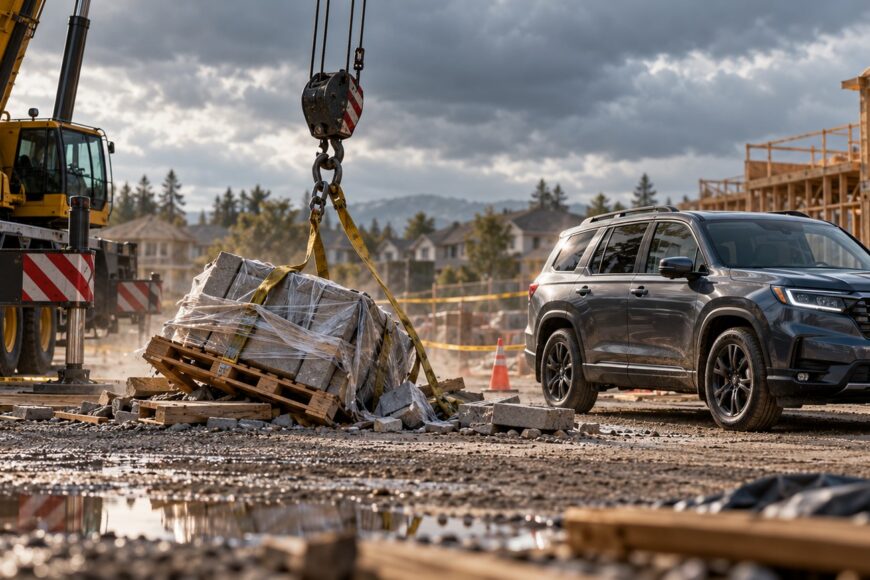
A crane dropping a load near a Honda Pilot is a near miss and a failure of risk control, even if the vehicle was not struck and no one was injured. The event alone does not prove that the sling, crane, or vehicle caused the incident. The reliable starting point is the load path: how the load was rigged, how its balance changed, what the wind was doing, and whether people were kept outside the potential fall and swing zone.
Equipment can look serviceable while the lifting arrangement is unsafe. A synthetic sling may have no obvious damage yet be overloaded, cut by an edge, poorly protected, skewed under load, or used at an unsuitable angle. A sound investigation therefore separates confirmed observations from assumptions and treats the uncontrolled movement itself as evidence that the planned controls were inadequate.
- What a Dropped Load Near a Honda Pilot Actually Reveals
- The Pre-Lift Controls That Should Come Before the Crane Moves
- Why a Synthetic Sling Can Fail Even When It Looks Fine
- Basket Hitch, Test Lift, and the Moment Before Full Load
- The Honda Pilot Context: Vehicle Facts Are Not a Cause Analysis
- What to Do After a Near Miss or Vehicle Strike
- Frequently Asked Questions
- How can you tell when a synthetic sling should be removed from service?
- What should a bystander do if a suspended load starts swinging?
- What evidence should be preserved after a crane near miss?
What a Dropped Load Near a Honda Pilot Actually Reveals
The Honda Pilot’s presence mainly establishes where the hazard became visible. The critical question is whether the load path was controlled from pickup to placement. A load can move unexpectedly because of rigging configuration, an offset center of gravity, wind, contact with another object, or a poorly defined exclusion zone.
A near miss remains serious because the same uncontrolled movement could have reached a person, another vehicle, or the crane. The absence of injury does not validate the lift plan. It may simply mean that the load stopped, shifted direction, or missed the vehicle by chance.
Visual condition is also limited evidence. A synthetic sling that appears intact may still be unsuitable for the load, angle, edge condition, or connection method. Inspection of the fabric must be matched with a review of the complete arrangement, including hardware, protection, attachment points, and load balance.
People must stay outside the potential fall and swing path throughout the lift. A worker who stands clear of the load but inside its possible arc remains exposed, as does a bystander who assumes the operator can stop movement immediately. The exclusion zone must reflect where the load could travel, rather than where it is expected to travel.
The Pre-Lift Controls That Should Come Before the Crane Moves
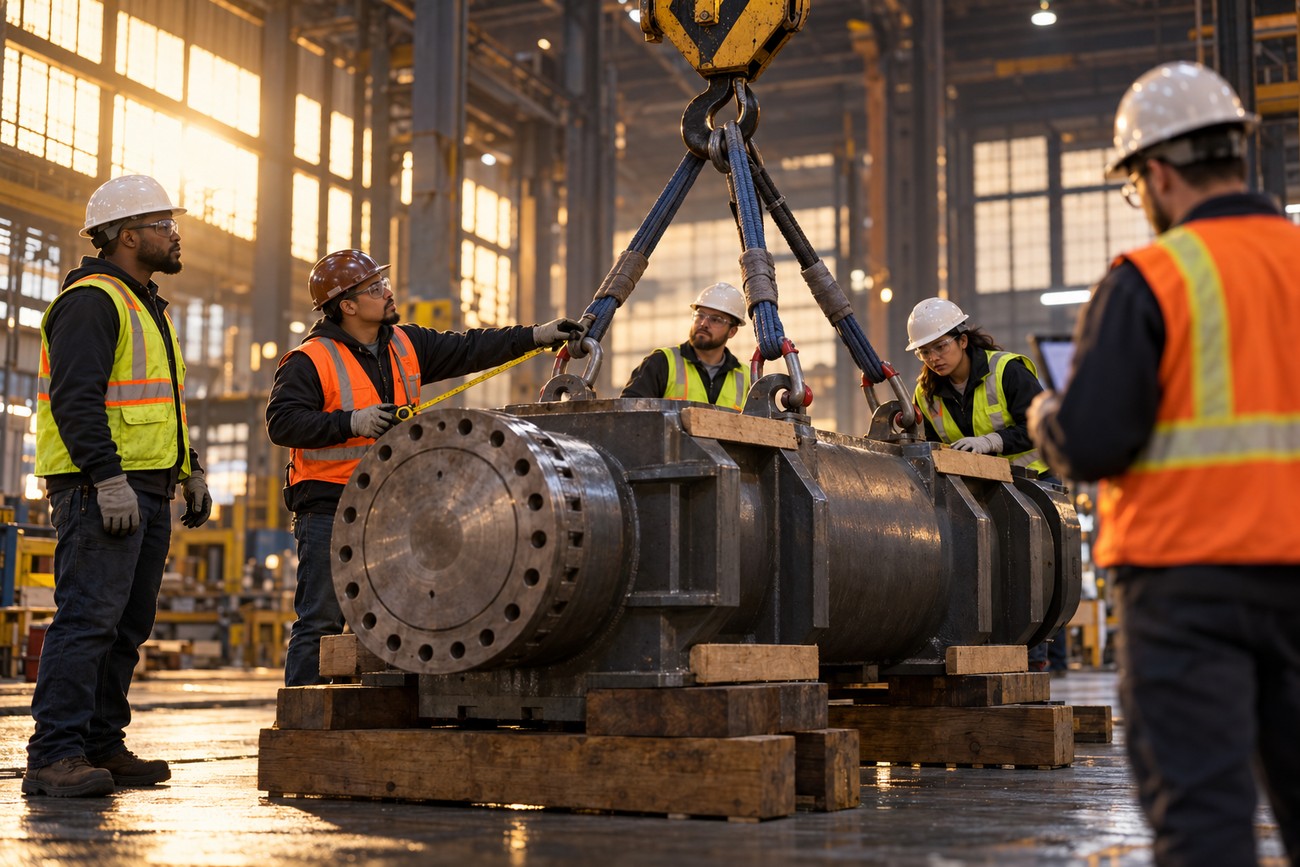
Official safety alerts require detailed lifting procedures to be prepared and followed before heavy loads are moved. Planning starts with the load itself: its weight, dimensions, center of gravity, lifting points, and surfaces that may damage or displace the rigging. If any of those details are uncertain, the lift should pause until they are verified.
The rigging decision must match the specific load and lifting angle. Sling capacity changes with the configuration, and an arrangement that works for one load may become unstable on another because of a different shape, balance point, or contact surface. The crew should also confirm that shackles, hooks, lifting points, and protective materials are compatible with the intended setup.
Contact points deserve particular attention. Sharp or narrow edges can damage synthetic material, while a smooth or sloping surface can allow a sling or protector to migrate. Protection must cover the actual contact area and remain in position as tension develops; placing a protector near an edge without controlling its movement creates a false sense of security.
The exclusion zone should be established before tension is applied, with responsibility for access control clearly assigned. It should account for both a falling load and a swinging load, including movement caused by rotation, snagging, or a sudden release. The operator and signal person should have an agreed communication method and a clear stop signal.
Weather is a decision point, not a note for the paperwork. Wind above the manufacturer’s stated limit is grounds to stop the operation or reduce the load. Even below that limit, a large or suspended load may catch wind and become difficult to control, so changing conditions should trigger a fresh assessment rather than automatic continuation.
Why a Synthetic Sling Can Fail Even When It Looks Fine
A synthetic lifting sling can fail because of inadequate capacity, edge damage, poor protection, skewed loading, defects, or missing proof testing to a recognized standard. These conditions may exist without a dramatic visual warning. Capacity must be considered for the actual hitch, angle, load distribution, and contact conditions, rather than read from a label in isolation.
Edge damage is a common hidden threat. A sling under tension can be cut or abraded by a sharp corner, especially when the load shifts or the sling bears unevenly. Protection that is too short, too narrow, or unable to stay aligned may leave the critical section exposed as soon as the load begins to lift.
Certification does not compensate for misuse. A sling may have been manufactured and tested correctly yet become unsafe when used beyond its capacity, placed around an unsuitable edge, loaded at an improper angle, or allowed to slide. Inspection of the sling is therefore only one part of validating the lifting arrangement.
Protection must stay where the edge needs it, not where it was placed during setup. A thick protector that slides under tension can expose the sling to cutting while making the arrangement appear more carefully prepared.
The crew should verify identification, capacity, condition, fittings, and inspection status before use. Any missing proof testing to a recognized standard, unclear rating, or unexplained damage should be treated as a reason to stop and obtain qualified direction. The fact that a sling survived a previous lift does not establish that it is suitable for the next one.
Basket Hitch, Test Lift, and the Moment Before Full Load
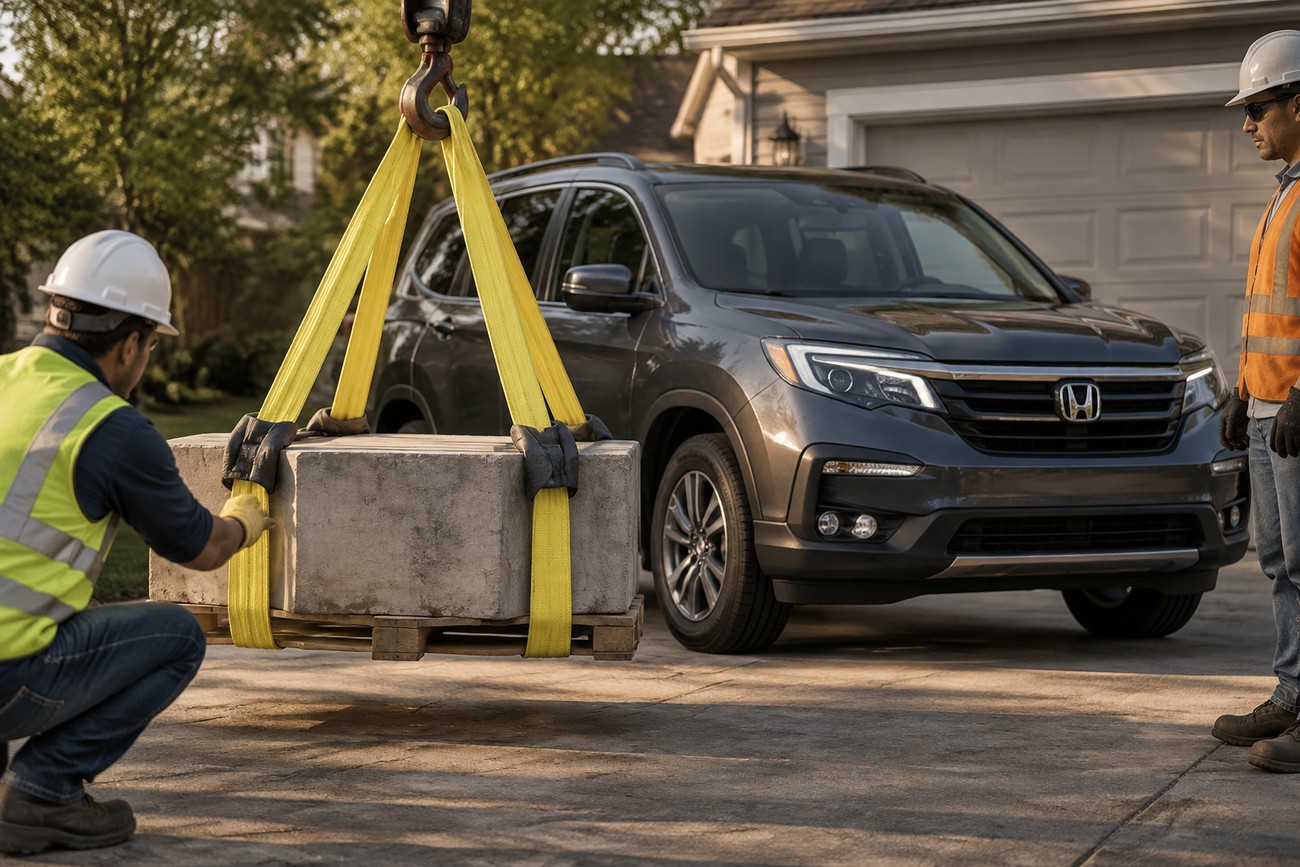
Official recommendations do not favor a basket hitch unless the slings and protection are secured against shifting on the load. The arrangement becomes more sensitive when the load is unbalanced, rounded, smooth, or difficult to restrain. A strong sling can still migrate if the load surface and the hitch do not provide reliable control.
Protection used with a basket hitch should be secured so it cannot move, and protection with a lip can help prevent slippage. The crew should also check that both legs remain correctly positioned and that the load will not roll, rotate, or slide out of the basket as tension rises.
The first inches of a test lift often show sling migration before the load has enough height to create a larger consequence. Watch the protector and sling together; movement in either one can indicate that the full lift should not proceed.
A standard test lift raises the load 3–4 feet and holds it for about 5 seconds to check stability. During that pause, the crew should look for tilt, center-of-gravity movement, sling migration, protector displacement, unusual stretching, contact with nearby objects, and any sign that the load is beginning to rotate or swing.
The test lift is an active stability check, not a formality. If the load settles differently from the plan, the operator should lower it, clear the area, and correct the arrangement before attempting the full lift. Continuing because the load has already left the ground removes the opportunity to correct a developing failure at its safest stage.
The Honda Pilot Context: Vehicle Facts Are Not a Cause Analysis
The Honda Pilot was first shown in 2002. The cited source describes the Pilot as Honda’s largest SUV, which explains why its size and location may be relevant when assessing clearance, possible contact points, and visible damage after a crane event.
The current Pilot uses a 3.5-liter V6 with direct injection and start-stop. Those vehicle specifications may help identify the vehicle and guide later inspection, but they do not establish why a nearby load moved, fell, or swung.
Owner discussions mention alignment or rear-axle concerns and power-steering hose leaks, while reviews of used Pilots report unstable shifting associated with software issues in selected 9-speed automatic-transmission applications. These are reported complaints, not established causes of a crane incident.
Vehicle maintenance complaints do not by themselves explain a dropped-load event. A proper assessment should first document the crane operation and then examine the Pilot for impact marks, deformation, suspension movement, steering effects, and possible powertrain or underbody damage. Model specifications and unrelated service history should not replace physical evidence.
What to Do After a Near Miss or Vehicle Strike

Stop the lift and keep people out of the danger area. Do not resume while the cause of instability or failure remains unresolved, even if the load appears stable after being lowered. Secure the scene without creating another exposure, and isolate damaged rigging or equipment from further use.
Preserve the rigging configuration before it is altered where doing so is safe. Record the sling orientation, hitch type, protector placement, hardware position, load location, and any visible damage. Photographs should show both close details and the wider work area, including the vehicle, crane, load path, and exclusion-zone layout.
Document weather conditions, including wind observations and any applicable manufacturer limit, along with the lift plan, equipment records, inspection information, and witness accounts. The investigation should consider the load, sling condition, protection, angle, balance, wind, and exclusion-zone control together. A single damaged component may be a consequence rather than the original cause.
Vehicle damage assessment should proceed in stages. Visible dents, broken glass, paint transfer, or panel movement can be documented immediately, while the condition of the Honda Pilot’s chassis, suspension, steering, and powertrain requires a qualified technical inspection. A vehicle that starts and drives away may still have alignment, underbody, or structural damage.
Frequently Asked Questions
How can you tell when a synthetic sling should be removed from service?
Remove a synthetic sling from service when it has cuts, melted or glazed fibers, chemical damage, abnormal stretching, damaged fittings, or an unreadable identification tag. These conditions can affect strength or prevent reliable confirmation of the sling’s capacity and inspection status.
Do not return the sling to use based on appearance alone or after a quick cleaning. Isolate it for evaluation under the applicable procedure, and replace it if its condition, rating, or history cannot be verified. The decision also applies when the sling was exposed to a severe event, such as shock loading, contact with a sharp edge, or an uncontrolled load shift.
What should a bystander do if a suspended load starts swinging?
A bystander should move away from the fall and swing zone without approaching the load or trying to steady it. Leave the area by a route that does not pass beneath the load or through its possible travel path, and warn others nearby if doing so does not increase personal exposure.
Do not rely on the operator to stop the movement instantly, and do not re-enter the area until the lifting crew has lowered or secured the load and confirmed that access is safe. If you are part of the crew, use the established stop signal; if you are not, prioritize distance and report the event from a safe location.
What evidence should be preserved after a crane near miss?
Preserve photographs of the sling orientation, protection placement, load position, crane position, vehicle condition, and surrounding work area before the setup is altered. Record weather conditions, including observed wind, and retain the lift-plan documents, equipment identification, inspection records, and relevant communications.
Collect witness accounts separately and promptly, using descriptions of what each person saw rather than conclusions about fault. Keep damaged slings, hardware, or protective materials out of service and identify them for examination. This record helps distinguish the original configuration from changes made during recovery and supports a technical assessment without treating an unverified cause as established fact.







