
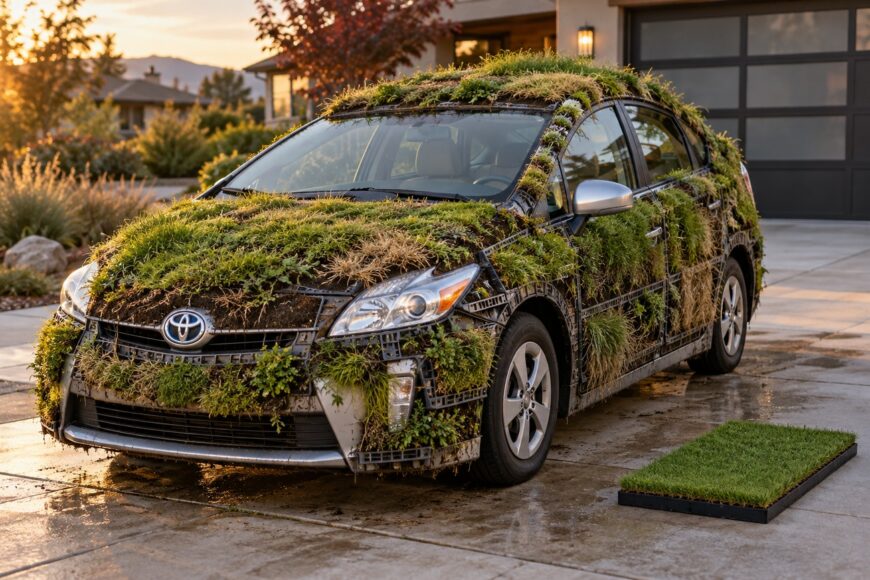
A Toyota Prius covered in real grass can look like a moving patch of landscape: the smooth hatchback disappears under a green, textured skin, and the effect is striking in photographs. At a parked event, that visual contrast can work especially well because the car becomes a scenic object rather than ordinary transportation.
The practical conflict is substantial. Living turf needs roots, growing medium, water, drainage, ventilation, and regular care, while a moving car needs low weight, secure attachment, clear visibility, and clean surfaces. A grass-covered Prius therefore makes sense primarily as a temporary, show-only installation, with the vehicle stationary while the display is assembled, watered, inspected, and viewed.
A thin piece of sod attached directly to painted body panels cannot provide a durable growing system. A more practical design separates the living or scenic material from the car, controls water and dirt, and treats removal as part of the build rather than an afterthought.
- What Covering a Prius in Real Grass Actually Requires
- Why Real Grass Quickly Fails on a Moving Prius
- Hidden Damage, Water, and Safety Problems
- A Safer Show-Only Way to Create the Effect
- Real Grass, Synthetic Turf, or a Moss-Like Finish?
- Before Driving: Legal, Mechanical, and Cleanup Checks
- Frequently asked questions
- How can I protect a lawn from cars during a display or event?
- What is the most realistic synthetic grass for a Prius display?
- What happens if you lay artificial grass directly on soil?
- What happens to artificial turf when it rains?
What Covering a Prius in Real Grass Actually Requires
Real grass needs a root zone, substrate, drainage, water retention, secure support, ventilation, and ongoing maintenance. Those requirements are easy to overlook because a roll of turf appears self-contained. Once placed on a vehicle, however, the grass has no dependable way to receive water, release excess moisture, or keep its roots cool unless the supporting structure is designed for those jobs.
A thin layer of sod placed directly on the body does not provide a durable living system. It may hold together for a short display, yet the roots remain shallow, the growing medium dries unevenly, and water can run toward seams, glass channels, and trim. Adhesive or simple straps can keep the material visually close to the car while doing nothing to solve drainage, ventilation, or plant health.
A workable installation needs a controlled root zone and a way to collect or direct runoff away from the Prius. It also needs access for watering, trimming, inspection, and cleaning. The support must remain stable while parked, protect the paint from abrasive soil, and allow the whole assembly to be lifted without dragging wet organic material across the finish.
Separate wet planting modules from the painted body, and test drainage, lifting points, and removal access before adding greenery. If those parts are difficult to reach while the car is bare, the finished installation will be harder to control and far messier.
Maintenance continues for the entire display period. Grass requires watering and trimming, while the structure needs ventilation, inspection, cleanup, and a planned removal sequence. A stationary show vehicle gives the plants a better chance of surviving because there is no continuous airflow, vibration, or road contamination. Regular driving changes the design problem from horticulture to load security and traffic safety.
Why Real Grass Quickly Fails on a Moving Prius
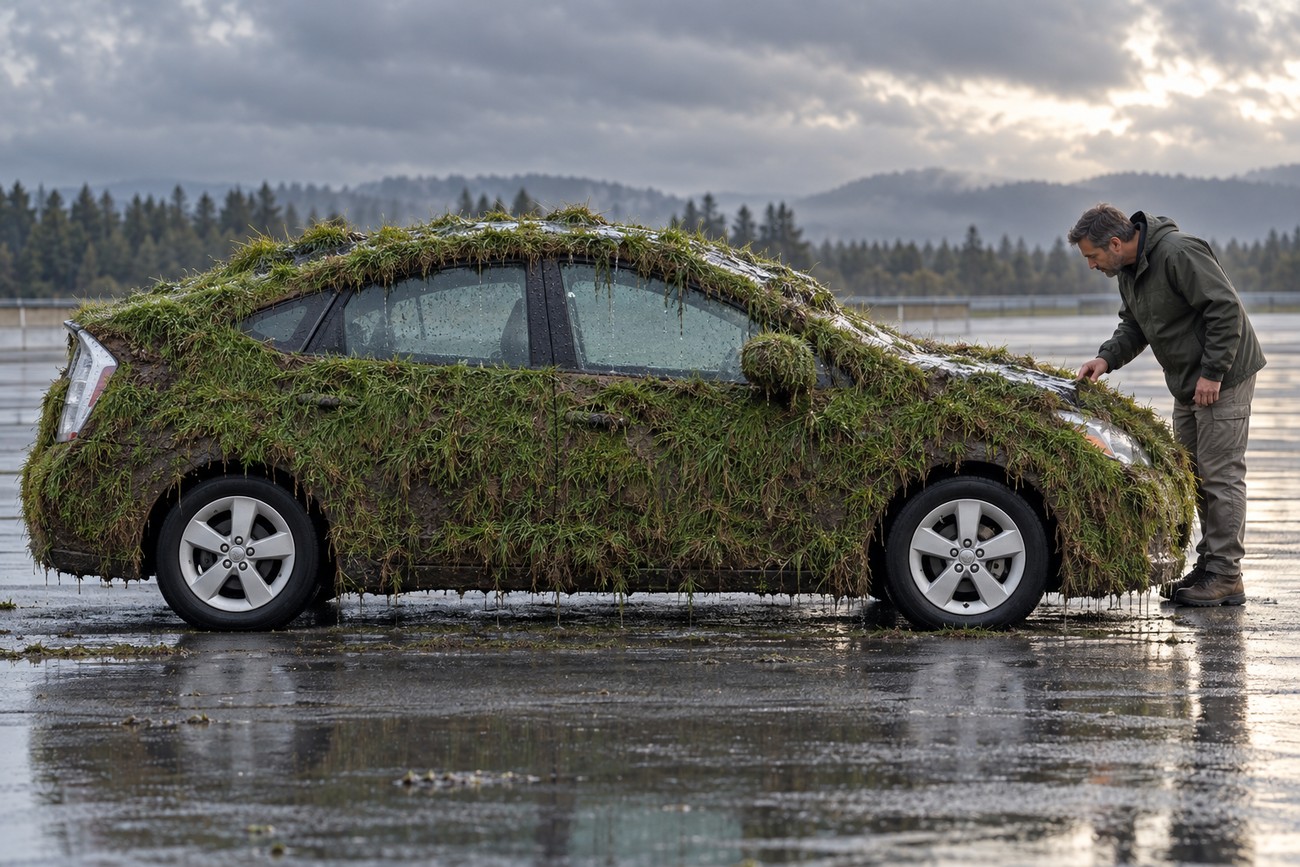
Exterior grass and support structures increase aerodynamic drag. A flat-looking green covering still creates exposed fibers, edges, gaps, and raised modules that disturb airflow. The effect becomes more serious when the material extends over the roof, hood, mirrors, or rear edges where air separates from the body.
Grass, wet substrate, and retained water increase weight and can reduce fuel economy and acceleration. The car can feel more sluggish during acceleration, while the installation becomes harder to support and remove. Water also changes the load during the day, so a system that feels manageable when dry may become substantially heavier after watering or rain.
High-mounted mass creates a separate handling problem. Weight on the roof raises the center of gravity and can affect the car’s response during steering, braking, and direction changes. Even a carefully distributed display should avoid treating the roof as a convenient place for a heavy, wet garden.
Heat and direct sun accelerate the biological failure. Without a controlled water and microclimate system, fresh grass can yellow, darken, and develop an unpleasant odor within days rather than weeks. Owners may encounter dry, straw-like patches first, followed by damp areas underneath, a smell of stagnant organic material, and water running from the installation onto the body.
Airflow creates the most serious failure mode once the car moves. Weakly secured turf, soil, seeds, and other debris can detach and contaminate glass, sensors, nearby vehicles, or the road. A parked display can look stable while still having edges that lift under moving air; static appearance does not prove road-speed security.
Hidden Damage, Water, and Safety Problems
Organic material holds moisture against paint, metal edges, seals, trim, glass channels, sensors, and fasteners. Dirt trapped in that moisture can abrade the finish as the car vibrates or the covering shifts. Over time, the owner may find staining, softened trim, blocked gaps, or corrosion that was hidden until the grass and its support were removed.
Soil and roots can enter drains and narrow spaces around windows, moldings, fasteners, and body joints. Water then takes longer to escape, especially where the installation lies against a curved panel. The covering can conceal existing paint damage or corrosion, making a problem more difficult to assess and repair after the event.
Watering needs its own containment plan. Poorly designed irrigation can leave carpets, trim, door edges, and body seams wet, while dirty runoff spreads across the pavement. A hose placed on top of the car is also difficult to control: water may reach the cabin through door gaps, run over cameras, or carry soil onto areas that should remain clean.
Safety equipment and access points must remain clear. The installation must not obstruct the driver’s view, doors, locks, mirrors, cameras, radar, ventilation openings, lighting, or emergency access. Loose material can affect other road users, and a green surface that looks harmless at a show can become a visibility or debris hazard in traffic.
A Safer Show-Only Way to Create the Effect
The most practical approach uses a removable, freestanding, or mechanically supported display system rather than planting a continuous carpet directly on the Prius. Modular cassettes or containers with drainage and containment let the builder control the wet material, inspect each section, and remove individual modules. A protective interface should isolate the bodywork from wet organic material and abrasive soil without trapping water against the paint.
Low-growing groundcover reduces height, wind exposure, and visual bulk compared with ordinary lawn grass. Artificial moss-like material, synthetic turf, or removable scenic panels can create a similar green effect with less water and organic mess. These options still need secure edges and stable backing; lightweight does not automatically mean safe for driving.
A parked display should have a defined footprint, a method for collecting drainage, and enough clearance to ventilate the underside of each module. Watering should be controlled rather than generous, with runoff contained before it reaches the car or the ground. Trimming, inspection, and cleanup belong in the event schedule, as does a plan for lifting the modules without scraping soil across the body.
Attachment points should be engineered for static display loads and should never be assumed safe at road speed. The system must remain stable during handling by staff, wind at the venue, and routine access around the car. Public-road use introduces airflow, vibration, braking forces, and consequences for anything that comes loose, so the safer decision is to transport the Prius separately and install the greenery at the display site.
Plan removal before installation. A removable frame or cassette that can be lifted in sections is easier to inspect than a bonded surface, and it reduces the time wet material remains against the vehicle. Afterward, the Prius needs a careful wash and inspection of seams, drains, seals, sensors, fasteners, and paint rather than a quick rinse.
Real Grass, Synthetic Turf, or a Moss-Like Finish?
Each material solves a different part of the display problem. The table compares visual effect, moisture burden, handling, maintenance, and suitability for a parked show vehicle.
| Material | Appearance | Water and drainage | Weight and mess | Maintenance and reversibility | Parked display suitability |
|---|---|---|---|---|---|
| Real grass | Most literal living effect, with natural variation | Needs a root zone, substrate, water retention, and controlled drainage | Wet soil and water add weight; dirt and runoff are likely | Needs watering, trimming, ventilation, inspection, and planned removal | Works only as a carefully controlled show installation |
| Removable synthetic turf | Consistent green surface with a lawn-like texture | Does not need irrigation, but rain still needs a route away and time to dry | Lighter and cleaner than living turf, though backing can retain dirt | Low routine care; secure edges and backing make removal practical | Suitable for a parked display when separately supported and contained |
| Artificial moss-like material | Low, textured, scenic green finish | Little water demand; drainage still matters if used outdoors | Usually less height and wind exposure than lawn grass | Easy to inspect and replace in sections | Often a controllable visual option for a stationary show car |
| Removable scenic panel or green wrap | Graphic or staged effect rather than living vegetation | No watering; rain and surface dirt still require protection and cleanup | Can be lightweight, with little organic mess | Highly reversible when installed with suitable protection | Practical for display use; road use still depends on securement and local rules |
Before Driving: Legal, Mechanical, and Cleanup Checks
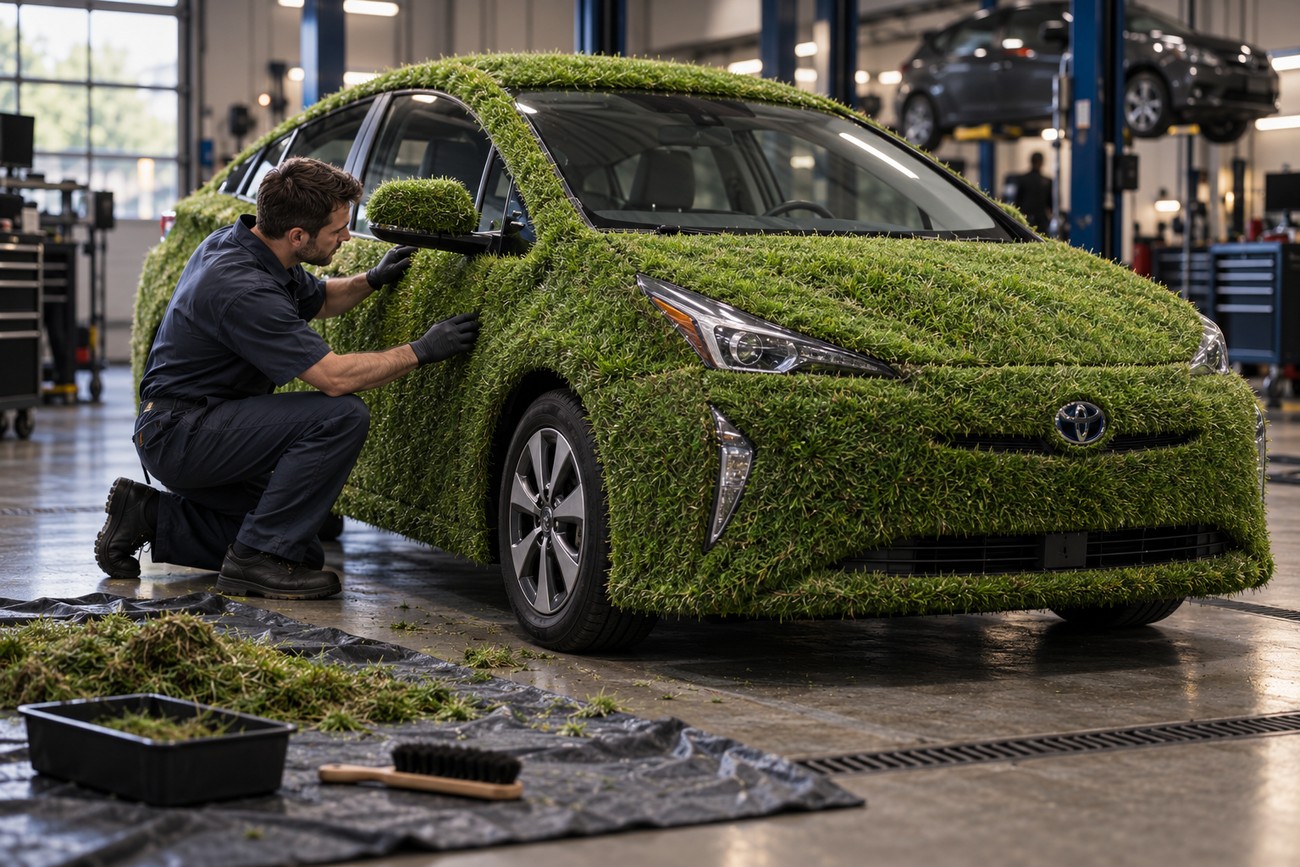
Exterior vegetation may be treated as a vehicle modification or load rather than simple decoration. Local rules and event operators may address visibility, securement, road contamination, exterior changes, and access to safety equipment. Check with the relevant authority and review event requirements before transporting or displaying a covered Prius, especially if any part remains attached outside private property.
A final inspection should confirm that nothing can shed, leak, obscure, or loosen. Check attachment points, protective layers, drains, cameras, radar areas, windows, mirrors, lights, ventilation openings, doors, locks, and tires. If the installation is wet, unstable, obstructive, or capable of dropping soil and plant material, it should remain off public roads.
After the display, remove wet modules promptly and clear soil from body gaps and drainage paths. Inspect paint, seals, trim, fasteners, and hidden edges for staining or trapped moisture. Roots, soil, odor, and damp residue may require extended cleaning, and a quick exterior wash can leave contamination behind.
Fuel economy, acceleration, handling, and road cleanliness are practical limits, regardless of how convincing the finished Prius looks. Aesthetic appeal does not establish that a grass-covered vehicle is safe to drive. The cleanest project separates the show effect from everyday operation and treats the car as a stationary exhibit until every removable element is gone.
Frequently asked questions
A parked Prius display affects both the vehicle and the surface beneath it. Ground protection helps define where the car can move and stop, while removable coverings make the display easier to inspect and clean. The questions below address those surfaces and what happens when synthetic materials get wet.
How can I protect a lawn from cars during a display or event?
Use barriers, a marked access lane, ground protection, and a defined parking footprint. The Prius should approach the display through a planned route and stop on a prepared surface rather than relying on the lawn to tolerate repeated turning, braking, or parking.
Keep the vehicle’s footprint separate from visitor circulation and service access. Barriers also reduce the chance that people will step into wet planting modules, drag soil onto the grass, or move the car across an unprotected area during cleanup.
What is the most realistic synthetic grass for a Prius display?
Choose a short, dense pile with flexible backing, restrained color variation, low shedding, and a finish that does not resemble a tall residential lawn. A lower profile creates a more controlled scenic surface and is less likely to catch air or look oversize on the Prius body.
The material still needs stable support, secure edges, and protection from abrasive contact with paint. Select sections that can be lifted for drying and inspection rather than one large piece that traps dirt against the car.
What happens if you lay artificial grass directly on soil?
The backing can trap moisture, shift under weight, collect mud, develop odors, and allow weeds to grow through it. Soil also works its way into the fibers and underside, so the material becomes harder to lift and clean after rain or repeated foot traffic.
Use a prepared interface with drainage and a defined edge if the turf must sit outdoors. For a Prius display, keep the synthetic material on a removable scenic support instead of placing it directly against soil or painted bodywork.
What happens to artificial turf when it rains?
Rain may rinse the surface while leaving the backing and trapped dirt wet. Runoff can carry mud underneath the material, and drying takes longer where the turf lies flat against a body panel or ground surface.
Control the runoff, then lift or ventilate the turf after a wet event so air can reach the underside. Do not store or reinstall it while damp, since retained moisture can create odor, stain nearby surfaces, and cause dirt to stick to the backing.







