
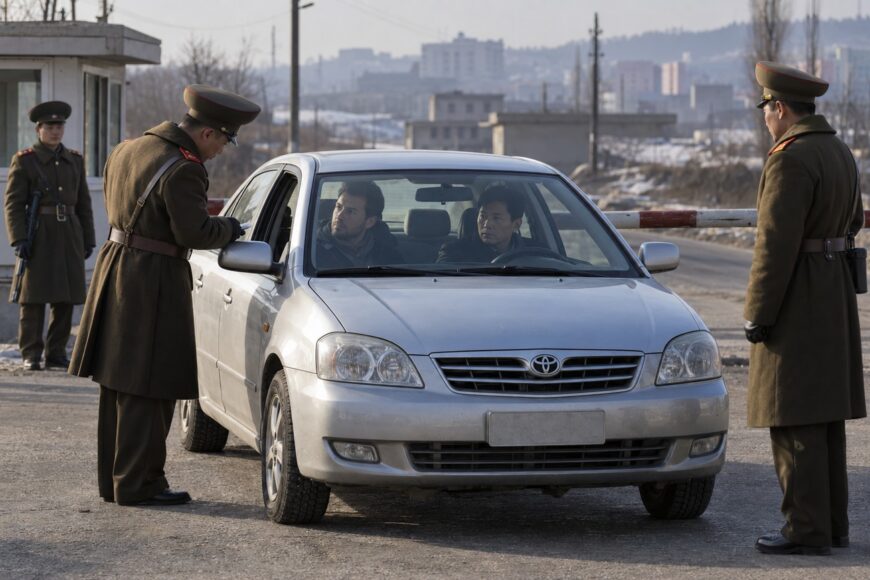
An ordinary foreign tourist cannot legally drive a Toyota Corolla independently in North Korea, even if a Corolla is already present in the country. Seeing the same model on a street, or riding in a car as part of an organized visit, does not create a right to operate one.
The practical distinction is between access to a vehicle and permission to drive it. Tourists generally travel in transport arranged by an operator, with accompanying guides, while independent routes, vehicle use, and movement between destinations remain controlled. An international driving permit is not recognized in North Korea.
For anyone considering a privately imported or locally obtained Corolla, the obstacles extend beyond licensing. Route permissions, police and military checkpoints, unfamiliar signs, limited fuel, uncertain repairs, and sanctions can all affect whether a trip is lawful and workable.
- The Short Answer: Tourists Cannot Drive a Corolla Independently
- What Driving Actually Looks Like: Roads, Signs, and Checkpoints
- Why a Corolla in North Korea Does Not Prove You Can Bring Yours
- The Resident Exception: Local License, Registration, and Permission
- The Practical Risks of Using Your Own Corolla
- Common Myths About Driving a Corolla in North Korea
- Frequently asked questions
- What should a foreign resident confirm before trying to use a privately owned car?
- What happens if a privately used Corolla breaks down outside Pyongyang?
- Which country do Koreans love the most?
- Which side of the car do Koreans drive on?
The Short Answer: Tourists Cannot Drive a Corolla Independently
Foreign tourists cannot independently drive in North Korea. A tour operator normally arranges the vehicle, and accompanying guides remain part of the travel arrangement. Sitting in a Corolla, hiring a car with a driver, or passing a driving school does not make a tourist an authorized driver.
An international driving permit does not solve the problem. North Korea does not recognize an international driving permit as a substitute for its own driving authorization. A foreign visitor who arrives with a national license and an international document should therefore not assume that either document permits personal driving.
This restriction applies even when the proposed journey appears simple, such as driving across Pyongyang or following a pre-agreed road to another destination. An escort is not a legal exception that lets a tourist take the wheel. The operator’s transport arrangement is designed to control the group’s movement, rather than supervise a tourist’s private driving.
The key question is therefore not whether a Toyota Corolla exists in North Korea or whether the roads appear usable. It is whether the person has the correct status, local license, vehicle registration, import basis, and permission for the route. A normal tourist does not have that combination of rights.
What Driving Actually Looks Like: Roads, Signs, and Checkpoints
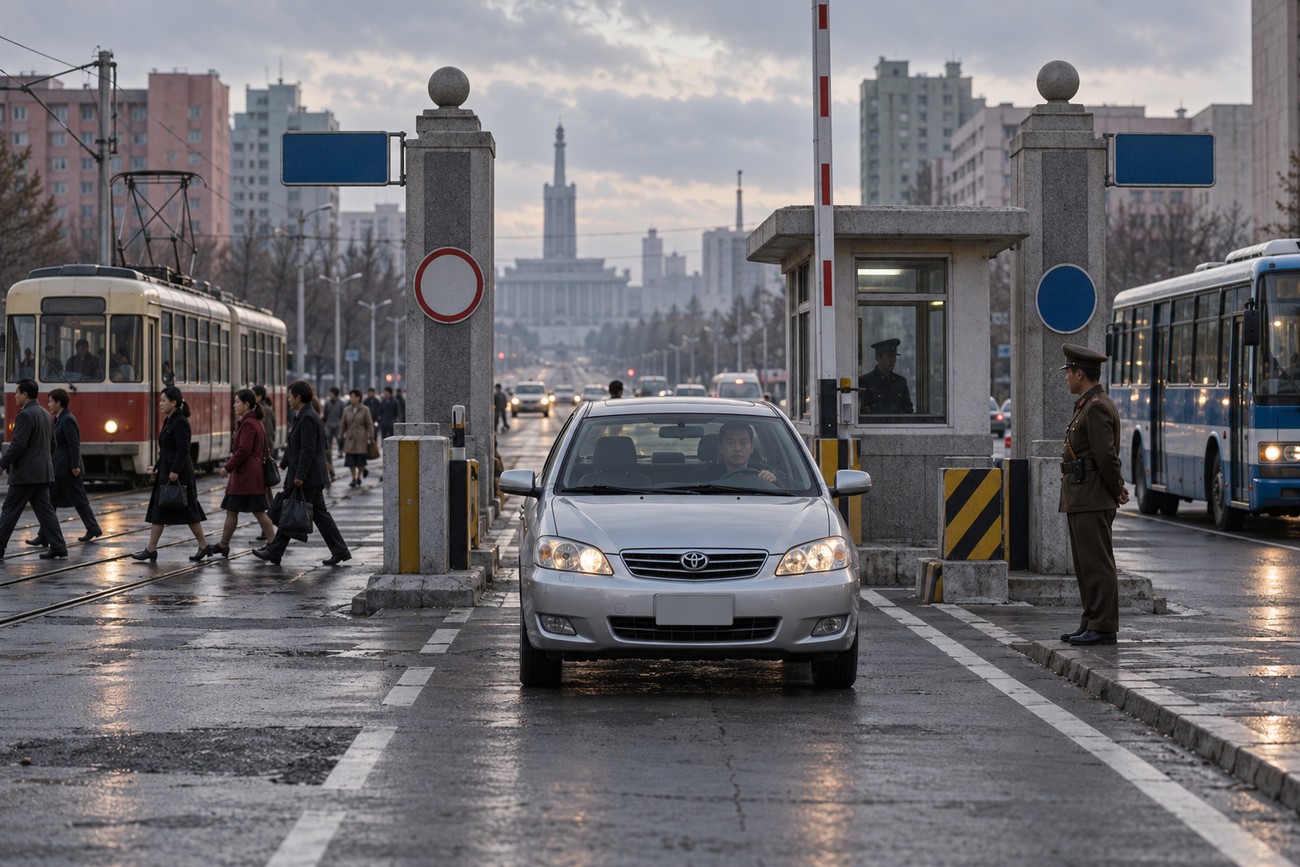
North Korea uses right-hand traffic, so a visitor from a right-driving country may find the basic road position familiar. That limited similarity can be misleading. Priority is given to pedestrians, trams, and buses, and those priorities may require decisions that differ from a driver’s usual expectations.
Road signs may not correspond to international standards and can be difficult for foreign drivers to interpret. A driver who recognizes the general shape of a sign may still misunderstand its local meaning, the permitted route, or the restrictions applying to a particular road. Familiar road markings are not a reliable substitute for local knowledge.
Apparently empty roads do not remove the need for caution. Low traffic can conceal a different risk: a driver may have little experience with local road behavior, may encounter pedestrians or public transport with priority, and may not know which stopping or turning points are acceptable.
Police and military checkpoints may inspect documents and route permissions, including at city entrances. Officers may be concerned with whether the vehicle, driver, and journey are authorized, rather than simply whether the car is mechanically roadworthy. A delay at a checkpoint can affect an itinerary even when the road itself is clear.
Movement outside Pyongyang or between destinations can depend on authorization, not merely on distance or road conditions. A route that looks logical on a map may require permission held by the organized tour or its local counterparts. The ability to see a road is not evidence that a foreign driver may use it.
Why a Corolla in North Korea Does Not Prove You Can Bring Yours
Toyota Corollas and other foreign cars may be visible in North Korea, but their presence does not prove that a tourist can lawfully import the same model. Vehicles may enter through informal channels, including routes near the Chinese border. Their existence says little about the paperwork attached to a particular car.
UN sanctions have prohibited vehicle exports to North Korea since December 2017. That restriction makes an ordinary commercial shipment of a Corolla, replacement parts, or related equipment legally sensitive. A private plan can raise separate questions about the exporter, the route, the transaction, and whether the goods fall within applicable sanctions restrictions.
The official service picture is also limited and uncertain. The presence of a Toyota vehicle does not establish that an official global Toyota service network operates in North Korea, or that compatible parts and diagnostic equipment will be available. The age, engine, transmission, and market specification of a particular Corolla may matter when repairs are needed.
Reuters has reported that a licensed driver may purchase one vehicle per family through certified sellers. That report concerns reported private ownership and does not establish a universal right for foreign tourists to import or drive a car. Ownership rules, licensing rules, and permission for a foreign visitor are separate matters.
This distinction is easy to miss because a local private market can look like proof of general access. A car may be privately held, legally registered to one person, and still unavailable to an unlicensed foreign visitor. It may also have entered the country under circumstances that do not provide a lawful model for a new import.
The Resident Exception: Local License, Registration, and Permission

The position of a foreign resident is narrower and more complicated than that of a tourist. Foreign residents must obtain local North Korean driving rights through a local license and examination. An international driving permit does not replace that requirement.
A local license is only one part of the legal chain. The driver must also consider whether the car is registered, how it entered the country, whether its ownership is recognized, and whether the intended route is authorized. A license does not automatically legalize an imported vehicle, and registration does not automatically authorize every journey.
A practical guide claims that foreign residents may import and drive vehicles, but that claim requires confirmation with local authorities for the person’s exact status. The answer may depend on residence documents, employment or institutional affiliation, the vehicle’s provenance, and the permissions attached to the proposed use.
Even a legally licensed foreign resident does not automatically receive unrestricted permission to travel between cities. Route controls and checkpoints can remain relevant after the licensing issue has been resolved. Before using a personal car, a resident would need written or otherwise verifiable confirmation covering both the vehicle and the specific journey.
The Practical Risks of Using Your Own Corolla
Fuel availability and vehicle density are limited, so a journey cannot be planned on the assumption that fuel or roadside assistance will be available at the next stop. A breakdown can become a logistical problem rather than a routine service call, particularly outside Pyongyang.
Repair capacity, compatible parts, and official Toyota service are also limited or uncertain. A Corolla built for another market may require parts or diagnostic equipment that are difficult to source locally. The car’s age and specification can therefore matter as much as its general reputation for reliability.
Vehicles may be expected to be clean before entering cities. That requirement is easy for a visitor to overlook because it is not a conventional mechanical or traffic rule. It illustrates why local operating expectations matter: a car can be roadworthy and still attract attention for failing to meet a practical condition of entry.
A workable pre-trip check must cover route authorization, fuel, recovery, spare parts, and vehicle cleanliness together. Resolving the license question alone does not make an independent journey workable.
The consequences of an incident can also be more serious than an ordinary traffic fine. A vehicle may be confiscated after a collision, fleeing an incident, blocking traffic or pedestrians, or damaging infrastructure. Authorities may also demand compensation for the resulting damage.
That risk changes the calculation for a private car. A minor mistake can involve the vehicle, the driver’s status, the permitted route, and the cost of restoring damaged property. Leaving the scene or trying to move around a checkpoint without authorization could compound the original problem.
Common Myths About Driving a Corolla in North Korea
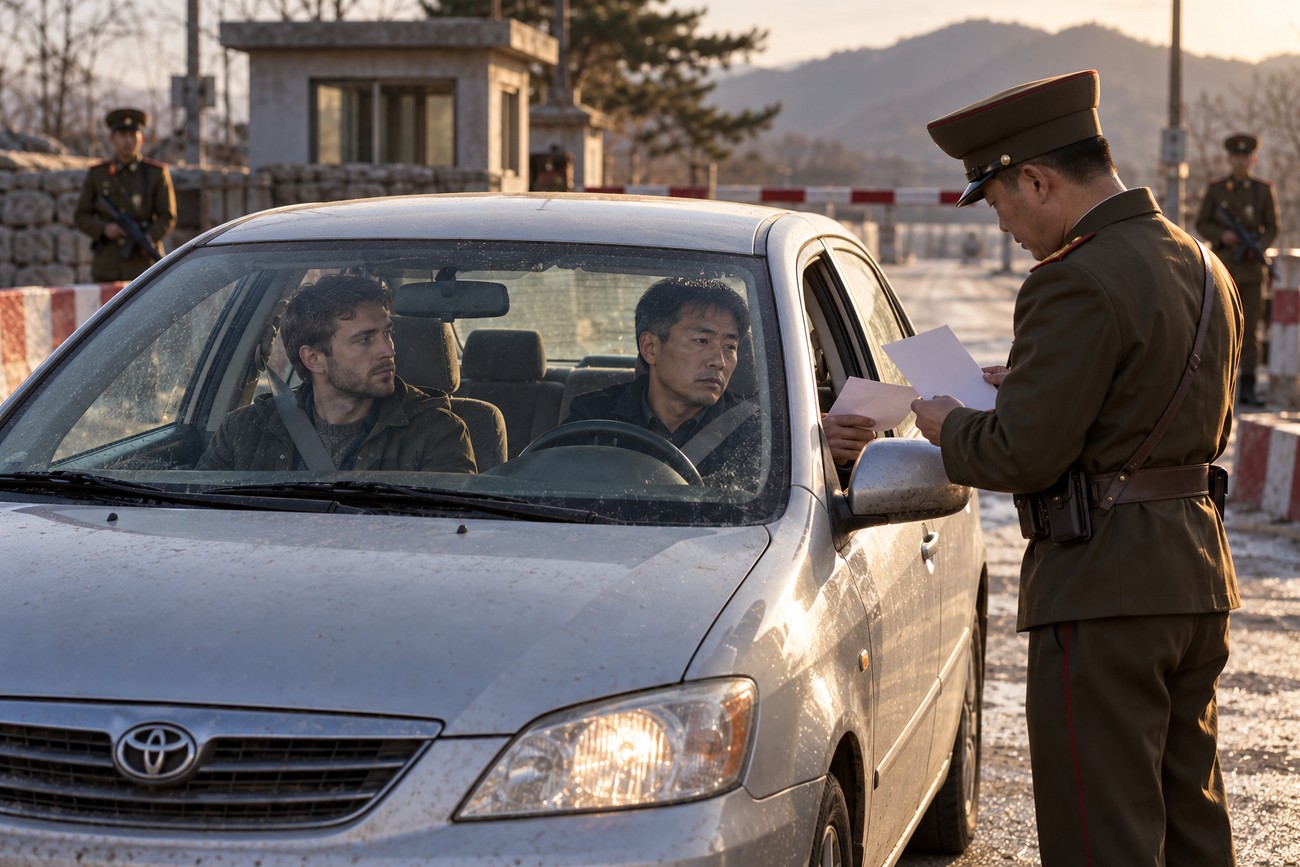
The first myth is that an existing Corolla proves a foreign tourist can bring one or drive one. It proves only that a vehicle of that type is present. Informal import channels, local ownership arrangements, and foreign tourist permissions are different issues.
The second myth is that international driving documents are enough. They are not: an international driving permit is not recognized in North Korea, and foreign residents must obtain local driving rights through examination. Tourists generally remain passengers in operator-arranged transport with accompanying guides.
Discussion of a road link between Russia and North Korea can create a further misunderstanding. Even when cross-border road travel is discussed or reopened, foreign visitors may still be directed into organized bus tours. A road connection does not itself create permission for a tourist to cross in a personal Corolla.
Finally, sparse traffic does not make the rules optional. Pedestrians, trams, and buses have priority, signs may be difficult for foreign drivers to interpret, and checkpoints may examine documents and route permissions. Unauthorized driving, a collision, blocked movement, or damage to infrastructure can lead to confiscation and a demand for compensation.
Frequently asked questions
The answers below separate tourist travel from resident driving, vehicle ownership, and permission to use a particular route. Where the available rules are unclear, the relevant authorization must be confirmed for the person’s status and vehicle.
What should a foreign resident confirm before trying to use a privately owned car?
The resident should verify the sequence, rather than treating a license as the only requirement. Confirm resident status, obtain the local North Korean license through the required examination, and check the vehicle’s registration and import provenance. The owner should also establish what insurance or liability arrangements apply and whether the intended route has separate permission.
These confirmations should come from the relevant local authorities for the resident’s exact status. A reported possibility that foreign residents may import and drive cars is not a universal authorization, and private ownership does not by itself settle route control or checkpoint requirements.
What happens if a privately used Corolla breaks down outside Pyongyang?
The driver should already know who is authorized to recover the car, where compatible parts can be obtained, and who can approve roadside movement. Fuel, repair capacity, and official Toyota support are limited or uncertain, so a breakdown may require coordination rather than an ordinary tow-and-repair visit.
The driver must also be able to explain the vehicle and its route at a checkpoint. Moving the car without the required authorization could create a separate problem, particularly if the breakdown blocks traffic or pedestrians. A recovery plan should therefore include route permission and checkpoint contact arrangements, not only tools and spare parts.
Which country do Koreans love the most?
There is no reliable single answer for “Koreans,” because North Koreans and South Koreans live under different political systems, media environments, and travel conditions, and individual views vary. Official statements or diplomatic relationships should not be treated as a measure of every person’s private preference.
For this driving question, national sentiment does not determine whether a foreigner may drive. Licensing, vehicle status, and route authorization remain the relevant tests.
Which side of the car do Koreans drive on?
North Korea uses right-hand traffic, meaning vehicles generally travel on the right side of the road. South Korea also uses right-hand traffic.
That similarity does not remove the need to learn local priorities and signs. In North Korea, pedestrians, trams, and buses have priority, and road signs may be difficult for foreign drivers to interpret.







