
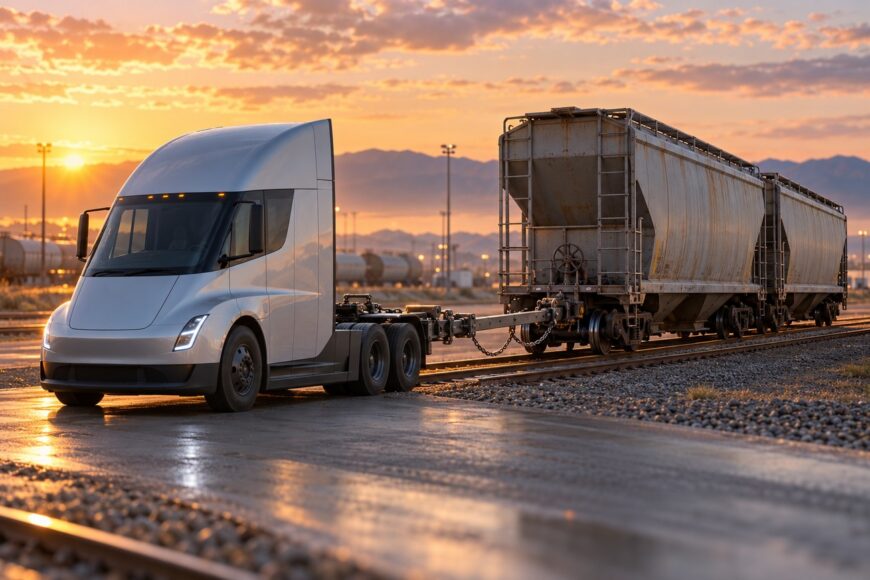
A powerful electric truck pulling a line of railcars is an appealing image. Yet “pulling a freight train” could mean towing a few cars from pavement, driving a modified truck on rails, or replacing a locomotive in regular service. Those are different engineering tasks.
A Tesla Semi might move railcars in a carefully arranged, low-speed demonstration. That would show that force was transmitted to the cars under those conditions; it would not establish how much train the truck could start, control, and haul repeatedly. The distinction matters most when the route includes grades, curves, changing rail conditions, and a need to stop the entire consist safely.
- The short answer: a railcard move is not a freight-train haul
- Why horsepower and the 82,000-pound figure do not settle it
- What determines whether the train starts—and keeps moving
- The missing interface: wheels, couplers, and train control
- Roadside tow, rail conversion, and locomotive: What changes
- What a viral towing demonstration would—and would not—prove
- Frequently asked questions
- How far can a Tesla Semi go fully loaded?
- How much weight can a Tesla Semi truck pull?
The short answer: a railcard move is not a freight-train haul
A standard Tesla Semi is a road tractor, not a rail vehicle. Its tires, chassis, and controls are designed for road travel. Moving railcars would therefore require a suitable arrangement between the truck and the cars before motor output became useful.
On level ground, a short, slow pull could be possible if the truck has enough tire traction and the connection can transmit the force safely. Once railcars are rolling, keeping them moving at low speed may require less force than starting them. That limited result is worth observing, but its conditions must be stated.
A freight-train haul asks more of the vehicle. It must start the consist where required, maintain speed over the route, manage changes in resistance, and control the cars during slowing and stopping. A limited railcard movement does not establish locomotive-equivalent performance.
No substantiated maximum freight-train towing weight for a standard Tesla Semi is established in the supplied research. Assigning one from a short pull, a power figure, or a road weight rating would hide the conditions that determine whether the move works.
Why horsepower and the 82,000-pound figure do not settle it
Semi power is reported at approximately 800 kW; that figure alone does not establish usable train-pulling force. Power describes the rate at which work can be done, while a standing train first needs enough force at the point of contact to overcome starting resistance. If the driving wheels lose grip, additional motor output cannot become additional pull.
The stated GCWR is up to 82,000 lb for the combined road vehicle, not an allowable rail tow. It includes the tractor and trailer within a road operating rating. It is neither a trailer-only payload figure nor a limit that can be transferred to railcars.
Even a comparison with locomotive power leaves out how long that output can be sustained. A railway duty cycle can demand prolonged pulling, with electrical supply and component temperatures becoming relevant. A peak or reported power figure does not answer those operating questions.
Advertised battery range and charging capability describe aspects of the road truck, too. Neither measures force at a railcard coupling or demonstrates that a consist can be hauled and stopped over a route. Readers should treat road specifications as road specifications unless a controlled rail test supplies the missing evidence.
What determines whether the train starts—and keeps moving
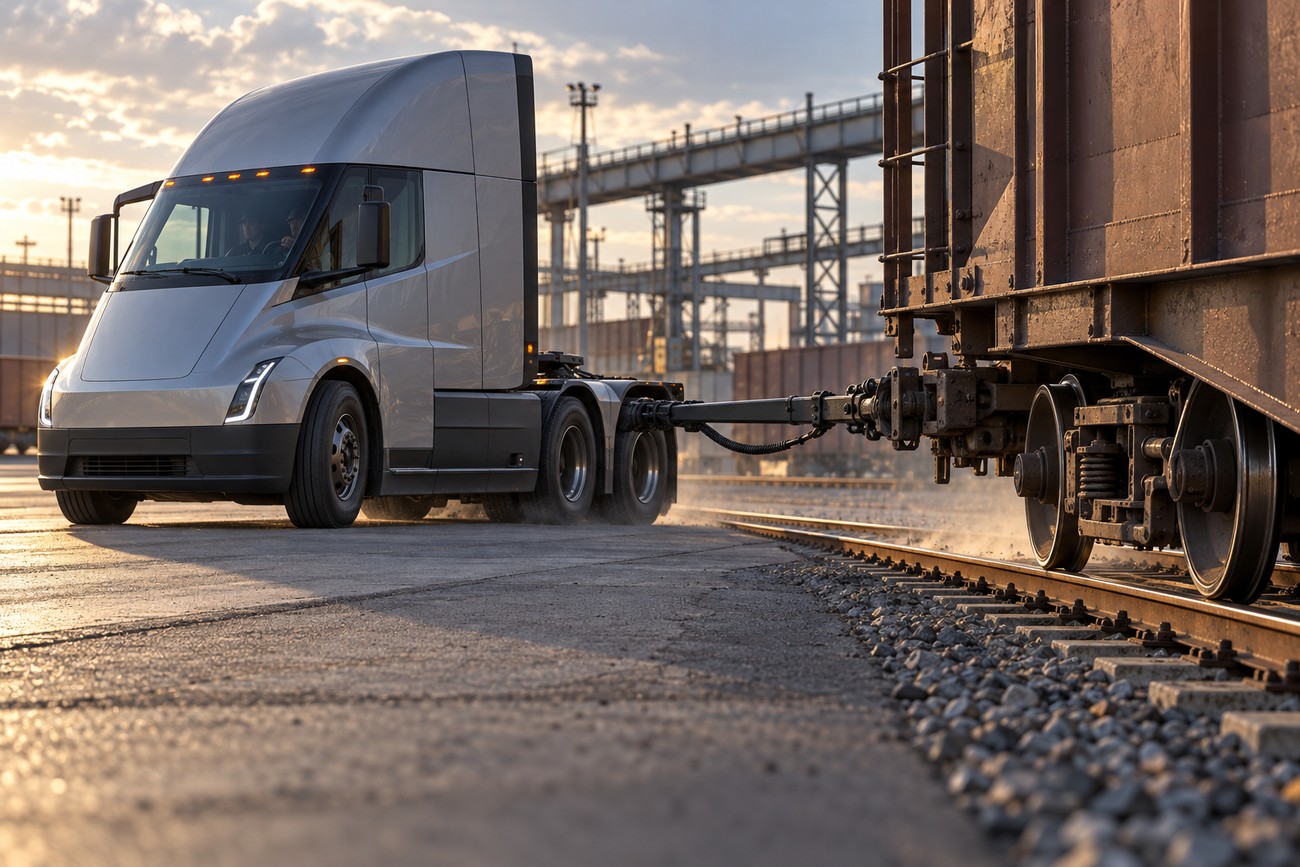
At the first movement, the available pull must exceed the resistance of the cars while the driving wheels retain grip. An illustrative starting-resistance range is roughly 4–6 kgf per tonne, not a universal design value. Car condition and the circumstances of the move matter, so applying that range to an unspecified train cannot produce a credible towing capacity.
Grip depends on where the truck’s driving wheels run. A truck towing from pavement relies on rubber-tire traction; a hypothetical rail-converted truck would face steel-wheel adhesion on the rail. Rail-wheel adhesion and road-tire traction are different constraints, and neither can be inferred from motor power alone.
On a grade or a contaminated railhead, a pull that worked on clean, level track can run out of usable grip before motor power becomes the limiting factor.
After the train starts, the resistance changes with speed. The simplified Davis resistance model is R = A + BV + CV²; its coefficients depend on the train and operating conditions. The squared-speed term helps explain why a result at walking speed says little about the power needed for a sustained, faster haul.
Grades add a force that must be overcome throughout the climb, while curves can increase resistance and complicate how a tow is conducted. Starting pull and sustained power therefore need separate assessment. A vehicle might initiate movement under favorable conditions yet be unable to maintain the required speed, or lack enough grip to start a consist it could otherwise keep rolling.
The missing interface: wheels, couplers, and train control
Road tires cannot simply run on railway rails as though the Semi were a locomotive. If the truck stays on pavement beside the track, the route must allow a controlled tow without creating unsafe sideways forces or conflicts with the railway. If it is converted to run on rails, wheel guidance, load distribution, and traction become a different design problem.
Force also needs a suitable path into the railcars. A secure coupling must cope with the forces and alignment of the move; attaching a line to a convenient point does not establish that the truck or railcard can safely take the load. An adapter alone would not resolve wheel contact, steering, or train control.
Stopping is as important as starting. The truck’s own brakes and regenerative braking act through its wheels, while the railcars need compatible control of their brakes. Regenerative braking does not replace a compatible system for controlling and stopping railcars.
These interfaces determine whether a movement can be conducted safely and repeated, rather than merely captured on video. A standard Tesla Semi remains a road tractor, and a limited railcard movement does not establish locomotive-equivalent performance.
Roadside tow, rail conversion, and locomotive: What changes
The configuration determines where grip comes from, how pulling force reaches the cars, and which operating limits must be addressed.
| Configuration | Wheel contact and grip | Force transfer to railcars | Principal operational limit |
|---|---|---|---|
| Roadside tow by a standard Semi | Road tires grip pavement; railcars remain on steel rails. | A controlled towing connection must carry the pull without unsafe alignment or side loads. | Suitable access, tire traction, coupling, and control of the railcars restrict the move. |
| Hypothetical rail-converted Semi | Rail-running wheels would introduce rail-wheel adhesion and load-distribution requirements. | A suitable rail coupling and structure would have to transmit the force. | Guidance, adhesion, sustained operation, and compatible train braking would need engineering validation. |
| Locomotive | Rail wheels and weight distribution are designed around railway traction. | Rail couplers transmit force to the consist. | Its usable haul still depends on the route, train, adhesion, and operating limits. |
What a viral towing demonstration would—and would not—prove
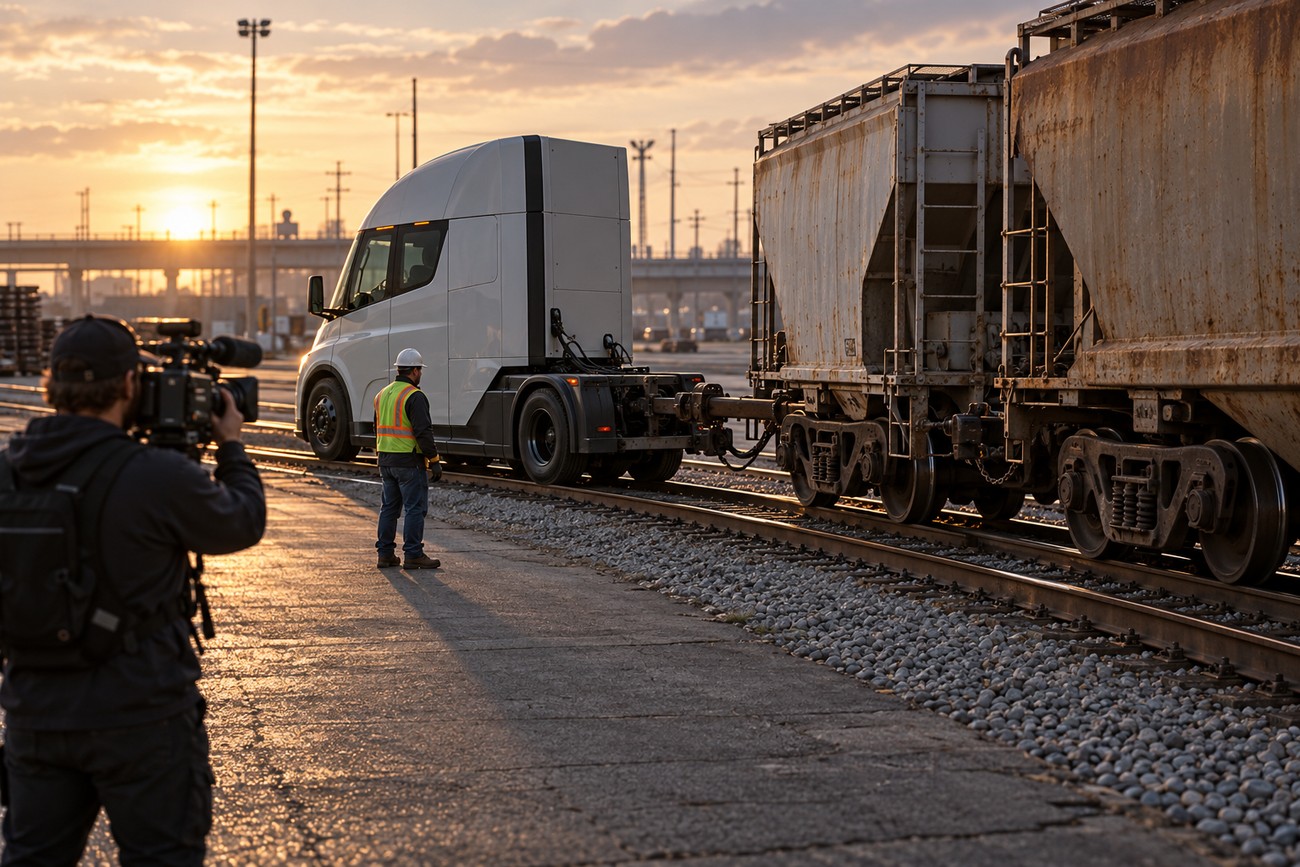
A video of railcars moving behind a Semi could document a real achievement under specific conditions. To judge its meaning, readers need the consists mass, track condition and grade, and whether the truck started stationary cars or joined cars already rolling. Speed and duration matter as well: a brief move does not test a sustained haul.
The connection deserves equal scrutiny. Clear evidence should show how force reached the cars, how their brakes were controlled, and how the movement was stopped. Without those details, footage can show motion while leaving the most consequential safety questions unanswered.
Repeatability requires more than completing one pass. A credible operating assessment would examine starts and stops across relevant grades and curves, changing grip, and whether the truck can sustain the duty without thermal limits interrupting the work. Those conditions separate a controlled demonstration from railway service.
A limited railcard movement does not establish locomotive-equivalent performance. No substantiated maximum freight-train towing weight for a standard Tesla Semi is established in the supplied research, so an impressive clip should remain evidence of the particular move it records.
Frequently asked questions
Road ratings can help describe the Semi as a truck, but they cannot be converted into a rail-towing range or capacity. The two common figures answer different questions.
How far can a Tesla Semi go fully loaded?
The stated Semi variants have advertised ranges of 500 miles and 325 miles; these are not guaranteed fully loaded outcomes. Actual road distance depends on conditions such as load, speed, terrain, and weather.
Neither advertised range predicts rail-towing endurance. Moving railcars would impose a different duty cycle, and the energy required would depend on the consist, route, speed, and method of towing.
How much weight can a Tesla Semi truck pull?
The stated GCWR is up to 82,000 lb for the combined road vehicle, not an allowable rail tow. Because that combined figure includes the tractor and trailer, it should not be read as the weight of cargo in the trailer or as a trailer-only towing figure.
It also cannot establish a freight-train rating. Railcar resistance, the truck’s available grip, the towing connection, and control of the cars would all need assessment for a specified movement; no substantiated maximum freight-train towing weight for a standard Tesla Semi is established in the supplied research.







