
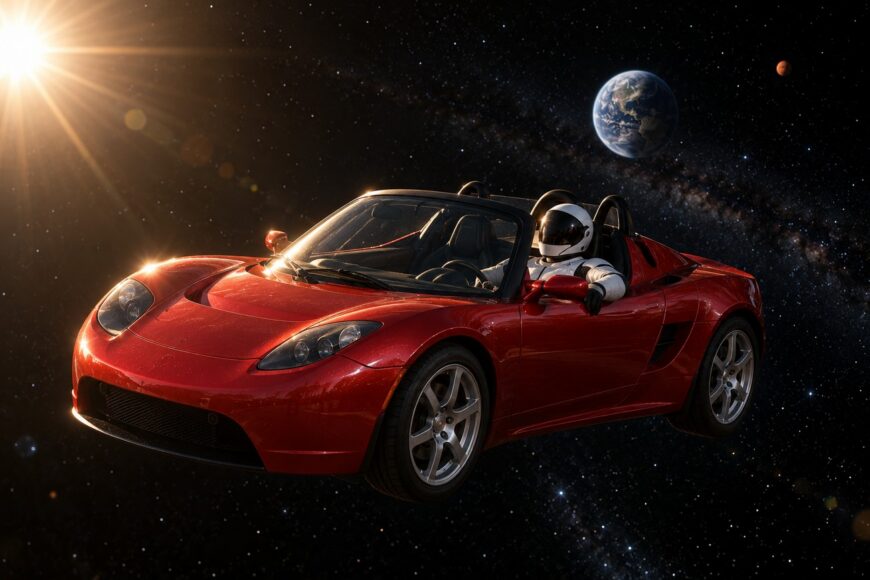
A Tesla Roadster circling the Sun has the appeal of a technological time capsule: a familiar car moving through interplanetary space long after its launch vehicle has disappeared from public attention. The image suggests permanence. Vacuum removes air, rain, and ordinary rust, so it is easy to picture the car continuing unchanged for ages.
That conclusion confuses two different kinds of survival. The Roadster may remain an orbiting mass for millions of years, while its paint, seals, interior, electronics, and composite parts gradually lose their shape and strength. Its orbit is also only statistically stable: over immense timescales, gravitational encounters can send the object into a planet or the Sun. “Forever” is therefore a cultural shorthand for a very long period, not mathematical or physical permanence.
- The Roadster Is Orbiting the Sun, Not Traveling to Mars
- Why Vacuum Does Not Preserve a Car Forever
- The Interior Will Disappear Before the Metal Does
- How Long Can Its Orbit Survive?
- The Hidden Problem: No Steering, No Repairs, and Little Data
- Frequently asked questions
- Why are predictions about the Roadster’s final fate expressed as probabilities?
- Which part of the Tesla Roadster is likely to last the longest?
- What will happen to the Tesla Roadster in space?
- How much will the 2027 Tesla Roadster cost?
The Roadster Is Orbiting the Sun, Not Traveling to Mars
Falcon Heavy launched the Tesla Roadster on February 6, 2018. The car was placed on a heliocentric elliptical orbit around the Sun, so it travels as a small artificial body in the same broad planetary system as Earth and Mars. It has no destination at Mars and does not circle Earth.
The orbit has a period of approximately 1.53 years, or 557–558 days, and a semimajor axis of approximately 1.32 AU. Its perihelion is approximately 0.99 AU, while its aphelion is approximately 1.66 AU. Those distances carry the car from close to Earth’s orbital distance to beyond the orbit of Mars during some parts of its path.
Its orbital inclination is approximately 1° to the ecliptic, the plane used as a reference for most planetary orbits. The Roadster’s path therefore crosses the orbital regions of Earth and Mars, although crossing an orbital region does not mean meeting a planet. The planets must occupy the same location at the same time, and their relative positions change continuously.
Calling it a Mars-bound spacecraft creates a misleading picture of its motion. The Roadster has no propulsion system for entering Mars orbit, landing, or making later corrections. It follows the trajectory established at launch and responds to the gravity of the Sun and planets.
Why Vacuum Does Not Preserve a Car Forever
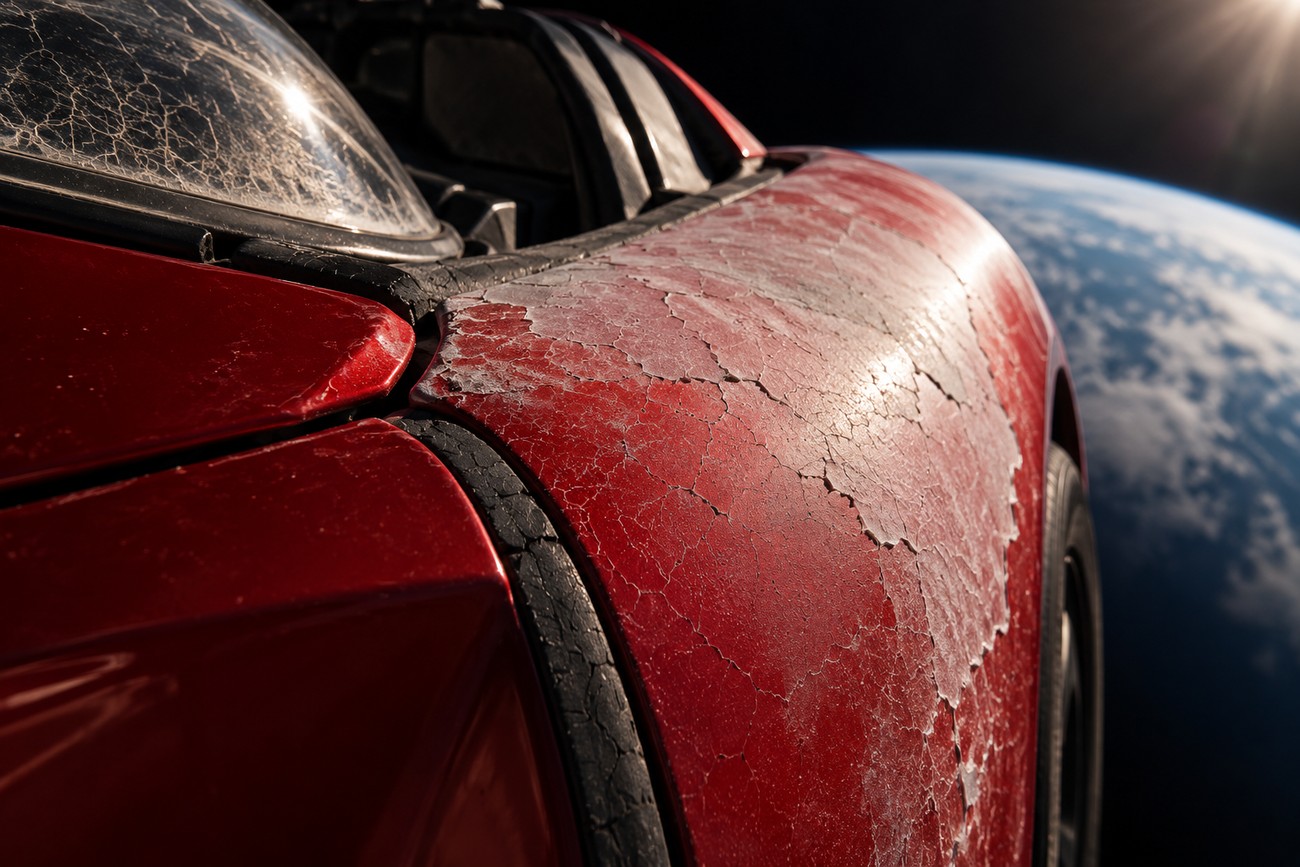
Vacuum reduces atmospheric corrosion and ordinary oxidation, which is the limited sense in which space can preserve a vehicle. Steel will not rust in the familiar terrestrial way, and there is no rain, saltwater, or humidity attacking the body. That advantage says little about how the exposed surfaces will age.
Ultraviolet light, cosmic radiation, and charged particles can break chemical bonds in paints, plastics, rubber, fabrics, and adhesives. The damage may begin as discoloration or embrittlement, then become cracking, flaking, and loss of mechanical strength. A surface can look intact for a long time while its ability to flex or carry a load has already declined.
The Roadster also experiences repeated heating and cooling as its solar distance and illumination change. Sun-facing areas heat strongly, while shaded areas cool, and different materials expand and contract at different rates. Those cycles place stress on joints, seals, coatings, and bonded interfaces, even without an atmosphere to carry heat by convection.
Micrometeoroids and cosmic dust add a slower form of physical erosion. Particles traveling at kilometers per second can pit, puncture, and abrade surfaces. Over millions of years, repeated impacts could damage glass, thin panels, exposed wiring, and other vulnerable elements, leaving a vehicle-shaped object progressively less vehicle-like.
The Interior Will Disappear Before the Metal Does
A car is a collection of materials with different failure modes, rather than one uniform object. Paint, rubber, plastics, leather-like materials, textiles, and epoxy-based composites can degrade under ultraviolet and radiation exposure over thousands to millions of years. Their exact lifetimes depend on shielding, orientation, composition, and thermal history, so no single expiration date is credible.
The interior is especially vulnerable. Upholstery, plastic trim, foam, seals, and electronic components depend on organic materials, delicate interfaces, and stable chemistry. Even if some pieces remain physically attached, they may lose their recognizable appearance and function long before the main structural metal has been seriously eroded.
Vehicle materials fail as a system: coatings, seals, adhesives, polymers, and composites usually lose integrity long before the strongest metal parts vanish.
Aluminum and steel may persist substantially longer than polymers and composites, although they are still exposed to radiation, thermal fatigue, micrometeoroid impacts, and surface erosion. Glass can survive for a long period in the right conditions, yet it remains vulnerable to impacts and thermal stress. A surviving metal frame would represent persistence of material, not preservation of a functioning automobile.
Thermal cycling can also separate materials that were reliable on Earth. Adhesives may lose toughness, bonded panels may develop cracks, and repeated expansion and contraction can fatigue connections. These are estimates based on material behavior and the space environment, rather than laboratory-certified forecasts for this particular car.
How Long Can Its Orbit Survive?
Long-term predictions for the Roadster use chaotic-dynamics models similar to those applied to asteroids. The orbit is statistically stable for millions of years, yet planetary gravity keeps changing its future in small ways. Earth and Venus are especially important because repeated encounters can gradually alter the trajectory.
Long-term models estimate approximately a 22% collision probability with Earth, 12% with Venus, and 12% with the Sun. These figures describe modeled outcomes over long timescales; they are not a schedule of events and do not identify a particular future year. Other trajectories can remain in solar orbit for much longer.
The probability of avoiding a major collision falls by roughly half every 15 million years. This trend gives a useful sense of why “forever” becomes misleading. A body can have a substantial chance of continuing through one interval while its chance of surviving indefinitely approaches zero in practical terms.
The recognizable-car timescale is estimated at several million to tens of millions of years, with substantial uncertainty. Material degradation will occur earlier, so an intact-looking Roadster is unlikely to last as long as the orbit itself. The object may continue as fragments, metal, composite residue, and dust even after the original vehicle has ceased to be identifiable.
Small differences in the starting orbit, solar-system modeling, and future planetary flybys can produce different outcomes. That sensitivity is typical of chaotic orbital dynamics. It makes the broad conclusion reliable—long survival is possible, eternal survival is not—while making an exact final fate impossible to announce in advance.
The Hidden Problem: No Steering, No Repairs, and Little Data
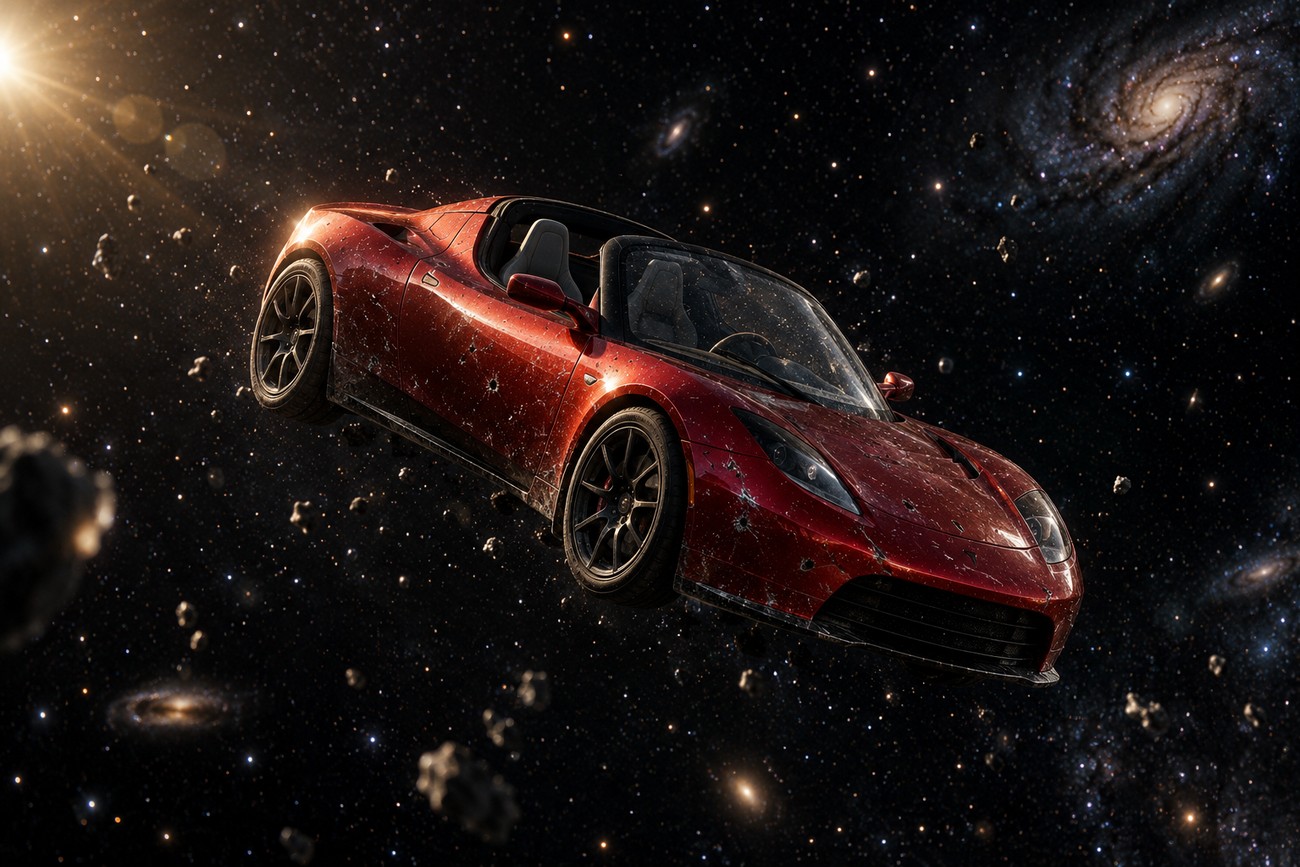
The Roadster has no onboard propulsion or attitude-control system. It cannot correct its trajectory, stabilize its orientation, turn a vulnerable surface away from the Sun, or protect itself from impacts. Its orientation and orbit are passive results of its initial motion and subsequent gravitational and environmental forces.
There is also no detailed official long-term condition-monitoring program providing regular information about the car’s physical state. External observers can track its orbit and use models to estimate its position, but that does not reveal whether the paint, glass, interior, or panels remain intact. Current condition assessments therefore rely on third-party tracking, inference, and modeling.
The vehicle carries no dedicated scientific instrument package and produces little direct scientific data. Its value is mainly cultural and symbolic: it made a familiar consumer object part of the solar system’s visual story. Critics reasonably describe it as an additional piece of space debris rather than a scientific mission, while its supporters see the launch as a memorable demonstration of heavy-lift capability.
That distinction matters for expectations. The Roadster is useful for discussing orbital mechanics, long-duration material exposure, and the boundaries between engineering and publicity. It cannot report its own radiation dose, photograph its exterior, or send measurements about its gradual deterioration.
Frequently asked questions
The Roadster’s future is easier to understand when orbital persistence, material survival, and mission purpose are treated as separate questions.
Why are predictions about the Roadster’s final fate expressed as probabilities?
Because its orbit is part of a chaotic gravitational system. Tiny differences in position and velocity can change the timing and geometry of future planetary encounters, and each encounter can amplify those differences. Models can calculate distributions of possible paths, but they cannot provide a dependable timetable millions of years ahead.
The collision estimates therefore describe statistical outcomes across modeled trajectories. They are useful for showing that Earth, Venus, and the Sun remain possible destinations, while the exact fate of this individual object remains uncertain.
Which part of the Tesla Roadster is likely to last the longest?
The main structural metals, especially aluminum and steel, are likely to persist longer than coatings, rubber, plastics, textiles, leather-like materials, electronics, and epoxy-based composites. Their survival still involves gradual erosion and impact damage, so “last” means remaining as material rather than retaining the original car’s function.
Glass may outlast many interior and polymer components in some locations, but it can be fractured by micrometeoroids and stressed by temperature changes. The longest-lived remnant may therefore be a damaged metal structure or fragments of it, rather than a complete vehicle.
What will happen to the Tesla Roadster in space?
It will continue along its heliocentric elliptical orbit while radiation, thermal cycling, micrometeoroids, and dust gradually damage its materials. The interior and exposed polymers are expected to lose their appearance and function before much of the structural metal disappears.
Over longer timescales, gravitational perturbations may leave it in solar orbit, send it into a collision with Earth or Venus, or bring it into the Sun. The outcome is probabilistic, and “forever” describes a popular image of long duration rather than permanent preservation.
How much will the 2027 Tesla Roadster cost?
No reliable price for a 2027 Tesla Roadster can be established from the facts about the space-launched vehicle. The car in orbit is the original Roadster launched in 2018, and its trajectory does not provide pricing information about a future production model.
Any claimed 2027 price would require a confirmed manufacturer announcement and production details. It should not be inferred from the launch, the vehicle’s symbolic value, or the cost of placing an object in a heliocentric orbit.







