
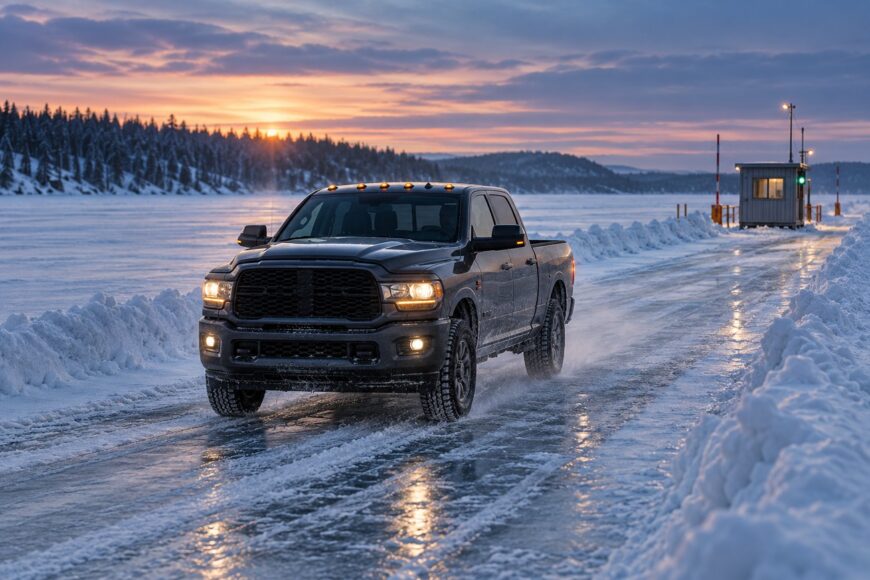
A Ram 2500 may be allowed on some Canadian ice roads, but four-wheel drive does not make weak ice safe. The decision depends on actual travel weight, axle loading, ice type and condition, traffic controls, speed, and the road operator’s current clearance.
A managed northern ice road differs from a frozen-lake crossing or an ordinary winter road. The truck badge offers no exemption. A Ram 2500 can have the traction and ground clearance to reach remote areas while still imposing too much load on a particular section of ice.
- Can a Ram 2500 Run Canada’s Ice Roads?
- Weight Is the First Constraint, Not Off-Road Traction
- Ice Thickness and Vehicle Mass: Why the Numbers Are Conditional
- How Canadian Ice Roads Control Speed, Spacing, and Traffic
- The Ram 2500’s Hidden Disadvantages on Ice
- A Practical Go/No-Go Check Before Driving Onto the Ice
- Frequently asked questions
- What is the best truck for driving in Canada during the winter?
- What year of Ram 2500 should you stay away from?
- What year to stay away from Ram 2500?
Can a Ram 2500 Run Canada’s Ice Roads?
Yes, some Ram 2500s may be admitted to specific Canadian or Arctic routes. Admission depends on the operator’s current limits for actual mass, axle load, speed, spacing, season, and vehicle class. Those limits can change as ice conditions develop.
An ordinary winter road may simply be a plowed route over frozen ground. A temporary ice crossing is more controlled and may have a local weight limit. A managed northern ice road is an operating system with inspections, dispatch instructions, staged loading, speed rules, and restrictions that can be tighter than promotional material suggests.
Depending on configuration, a Ram 2500 has a curb weight of approximately 3.0–3.6 tonnes. Its gross vehicle weight rating can reach approximately 4.5 tonnes or more. Four-wheel drive improves traction and mobility; it does not reduce the load imposed on the ice.
The useful distinction is capability versus ice loading. The truck may climb, tow, and steer well in snow, yet those strengths do not answer whether the ice can carry it safely. A current clearance from the road operator takes priority over general tables, forum advice, and a driver’s confidence.
Weight Is the First Constraint, Not Off-Road Traction
The diesel engine, reinforced frame, and heavy-duty drivetrain can place a Ram 2500 near the upper end of its curb-weight range. Passengers, fuel, tools, a winch, an aftermarket bumper, recovery gear, and cargo then increase the actual travel weight before a trailer is attached.
Curb weight is an unladen vehicle reference. Actual travel weight includes occupants, equipment, cargo, and trailer load, while gross vehicle weight rating is the manufacturer’s rated maximum. Ice-road decisions require the first of those practical figures and the axle loads, rather than a brochure’s model description.
A truck that appears comfortably below its rating can still exceed a local axle limit after cargo is placed behind the rear axle. Weight should be distributed so each axle remains within the road operator’s limit. A trailer requires a fresh calculation because its tongue load changes the truck’s axle loading.
Heavy equipment also changes the margin in a way that is easy to miss at home. A diesel Ram with a steel bumper and recovery kit may be substantially heavier than the remembered stock specification. If the road operator cannot confirm the permitted mass for that configuration, the correct response is to stop and obtain a verified answer.
Ice Thickness and Vehicle Mass: Why the Numbers Are Conditional
Indicative freshwater references help screen a trip, but they do not grant permission to drive.
| Approximate vehicle mass | Indicative freshwater-ice thickness | Limits of the reference |
|---|---|---|
| 5 tonnes | Approximately 30 cm | Assumes suitable freshwater ice and still requires local safety factors. |
| 7 tonnes | Approximately 35 cm | Traffic frequency, axle loading, cracks, and season can require more. |
| 20 tonnes | Approximately 60 cm | A screening figure, not a universal operating rule. |
A common general reference is at least 30 cm of freshwater ice for ordinary vehicles. That is a screening reference, not automatic permission for a Ram 2500. River current, underwater springs, channels, leads, cracks, and uneven freezing can make a single thickness measurement misleading.
One cited engineering method uses P = 4h², where P is mass in tonnes and h is ice thickness in decimeters. Real road rules apply safety factors and corrections for traffic frequency, wheel or track loading, season, ice type, and local conditions. The formula alone cannot certify a crossing.
Sea ice is approximately 25–30% weaker than freshwater ice at the same nominal thickness, so the required thickness is greater. Spring ice can have roughly half the strength of solid winter ice. A thick-looking surface near freezing may therefore offer less margin than a thinner, uniform sheet formed during stable severe cold.
How Canadian Ice Roads Control Speed, Spacing, and Traffic
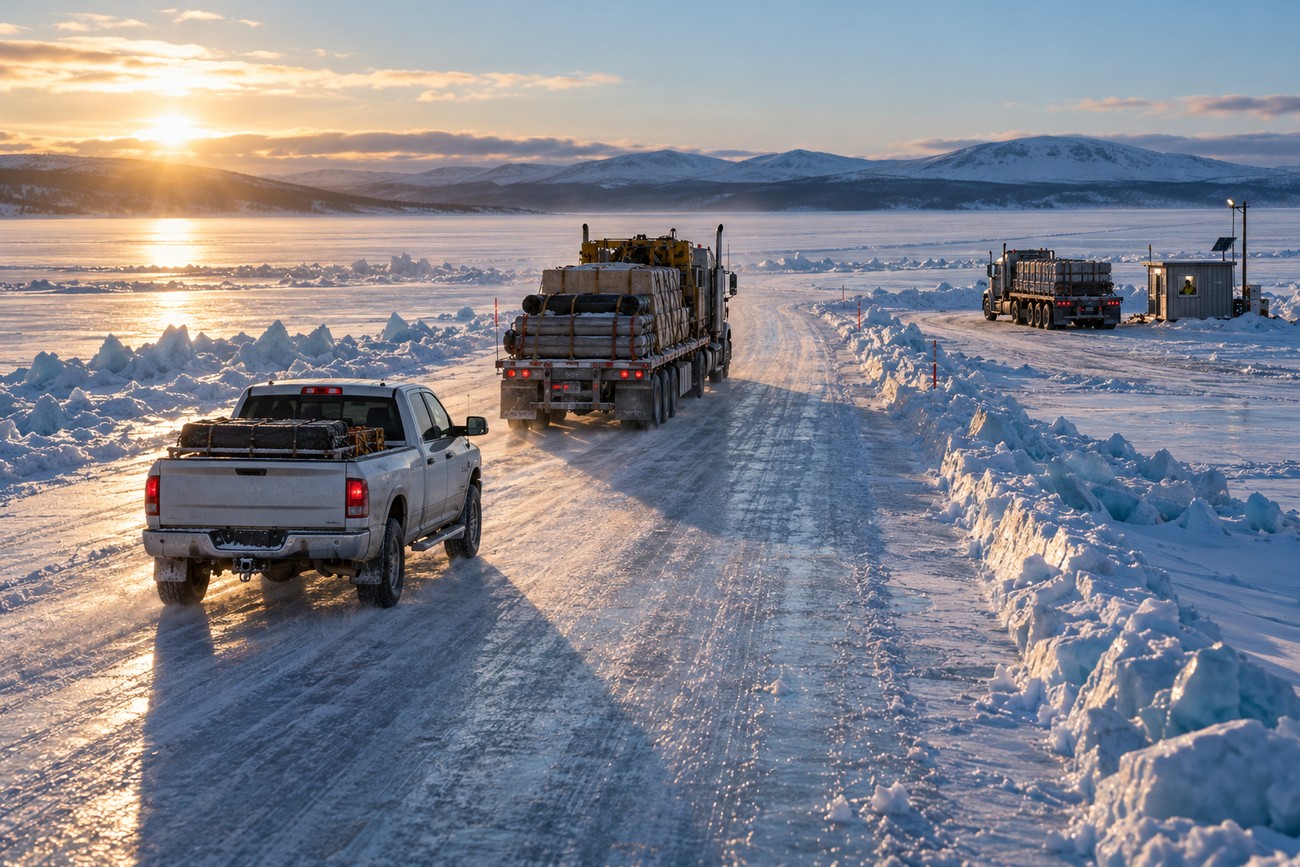
Managed Canadian and Arctic routes may limit speed to approximately 70–75 km/h, with substantially lower limits on difficult sections. Those figures are route controls, not targets for a private driver. The operator’s posted limit, dispatch instruction, and local conditions always take precedence.
Early-season access may be restricted to partially loaded vehicles. Fully loaded heavy vehicles are generally allowed only after the ice has carried lighter traffic and conditions have been tested through sustained cold. A road that opened for light vehicles may therefore remain closed to a loaded Ram 2500.
Large gaps reduce the chance that several heavy vehicles will load the same ice sheet in the same phase. Operators may stagger traffic because moving trucks can create a wave effect through the ice, even when the surface looks intact.
Spacing matters because a heavy vehicle creates a moving load, rather than a static mark on the ice. Traffic frequency, vehicle type, season, and wheel or track loading can all require correction factors. Following another truck closely, accelerating sharply, or bunching at a control point can defeat the margin built into the route plan.
Cracks, booming sounds, and vibration should be reported rather than interpreted as harmless background noise. The experienced response is to follow the operator’s procedure, preserve spacing, and avoid sudden braking, steering, or throttle changes.
The Ram 2500’s Hidden Disadvantages on Ice
Ram 2500 factory materials do not establish a general approval or operating limit for ice roads. The truck has no standard factory ice-road monitoring system or integrated underwater recovery provision. Any claim that a modification makes it ice-road certified should be treated with caution.
Size creates a practical problem as well as a weight problem. Some configurations can be approximately 6.3 m long, while an ice-road lane or detour may be around 3 m wide. A long, wide pickup has less room for passing, turning, and avoiding a damaged edge or temporary obstruction.
High torque is useful in snow and can also create trouble on weak ice. Abrupt acceleration or wheel spin concentrates forces at the tire contact patches and may disturb the surface without moving the truck forward. Four-wheel drive can make that mistake easier to initiate because traction feels available.
A lift or wide off-road tire changes the center of gravity and slippery-surface handling without reducing vehicle mass. Extra sidewall flex, altered steering response, and a taller body can matter during a correction on polished ice. Such equipment may improve access to snowbound ground while making controlled ice-road driving less predictable.
A Practical Go/No-Go Check Before Driving Onto the Ice
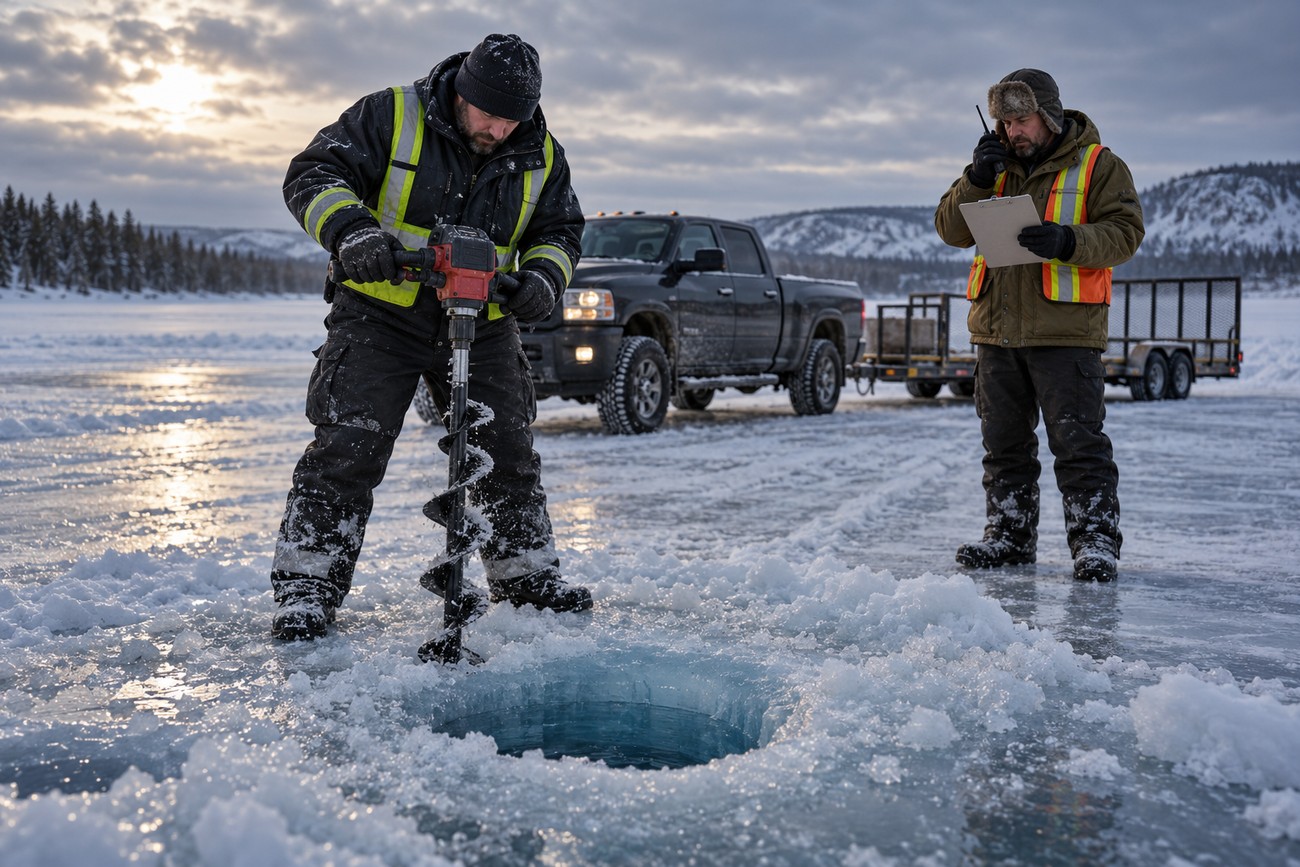
Begin with current operator clearance for the exact route, vehicle class, configuration, actual mass, axle loads, speed, and spacing. Confirm that private traffic is permitted if the road primarily serves commercial transport. An officially open route can still exclude a particular pickup or trailer combination.
Verify the ice type and the method used to assess it. Ask how recent the measurements are, whether the route crosses river or sea ice, and whether current, springs, channels, or leads affect the corridor. Stable severe cold generally produces stronger, more uniform ice than temperatures fluctuating around freezing.
Weigh the truck in its travel condition, including occupants, fuel, tools, cargo, accessories, and trailer load. Check axle loading and distribute equipment securely. Do not substitute a folklore chart such as “15 cm for 2 tonnes” for the operator’s local method, especially during spring or on saltwater ice.
Plan to drive at the assigned speed with the required spacing and gentle inputs. A crack, booming sound, unusual wave, or fresh water on the surface is a reason to follow the route’s emergency procedure and contact dispatch. Excessive speed, hard braking, quick lane changes, and a last-minute trailer addition are poor decisions on a controlled ice route.
Finally, confirm insurance in writing. Coverage for a vehicle lost through ice may be limited or disputed even when the route is officially open. If the operator cannot provide current clearance, the ice assessment is stale, or the loaded mass is unknown, the practical go/no-go decision is no-go.
Frequently asked questions
The right winter vehicle depends on the route, its operating limits, and the truck’s condition. Model year and equipment matter, but neither guarantees permission to use an ice road. The following questions address vehicle choice and Ram 2500 suitability.
What is the best truck for driving in Canada during the winter?
There is no single best winter truck for every Canadian route. The better choice is the vehicle that suits the road’s access rules, has dependable cold-weather starting and service support, carries suitable tires, and stays within the operator’s limits. A lighter pickup may have more ice margin, while a heavy-duty truck may be necessary for payload or towing.
For remote travel, parts availability and maintenance history can matter more than maximum power. A vehicle that fits the route, can be recovered, and can be serviced locally is usually a safer selection than the heaviest available model.
What year of Ram 2500 should you stay away from?
No model year should be rejected without checking its condition, configuration, maintenance records, recalls, and evidence of hard use. A neglected truck with a favorable year can be a poorer winter choice than an older example with documented servicing and sound electrical, cooling, braking, steering, and drivetrain systems.
Inspect the frame and suspension, verify recall completion, check cold-start behavior, and review modifications such as lifts, oversize tires, winches, and heavy bumpers. These checks address reliability and control; they do not create permission to use an ice road.
What year to stay away from Ram 2500?
There is no responsible blanket “stay away” year for every Ram 2500 buyer. Screen each candidate for corrosion, neglected diesel maintenance, transmission or drivetrain symptoms, electrical faults, accident damage, incomplete records, and equipment that has increased weight or altered handling.
For an ice-road trip, the road operator’s vehicle policy should be checked before purchase. A sound truck can still be unsuitable if its configuration, axle loading, trailer combination, or private-vehicle status falls outside the route’s current rules.







