
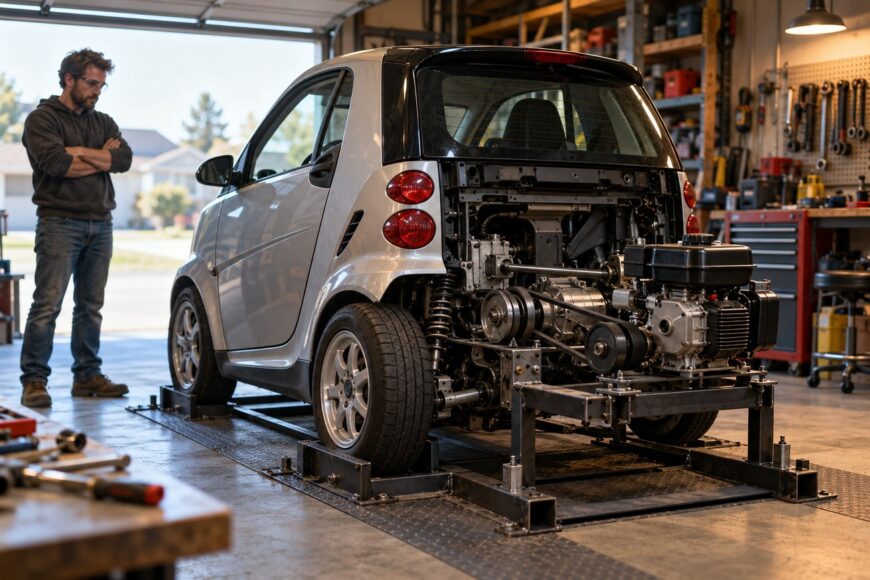
A Smart Fortwo is unusually light for a road car, yet that does not make every small engine suitable for it. The 450, 451, and 453 generations typically weigh approximately 730–950 kg ready to drive. A lawn mower engine may produce enough torque to make the car creep forward, but moving the wheels is only the first test.
A carefully geared 5–6 hp setup might move a Smart very slowly on level ground. That is a controlled demonstration, not normal or safe road performance. The real decision depends on torque at the wheels, reduction, cooling, drivetrain integration, braking, handling, and legal usability.
- The Short Answer: Yes, It Might Move—but That Is Not the Same as Driving It
- Why Horsepower Alone Does Not Settle the Question
- The Conversion Problems That Usually Stop the Project
- What a Moving Prototype Still Cannot Prove
- Frequently asked questions
- What engines can you fit in a Smart car?
- How much does a Smart Fortwo weigh?
- What else can you use a lawn mower engine for?
The Short Answer: Yes, It Might Move—but That Is Not the Same as Driving It
Typical walk-behind mower engines produce approximately 4–8 hp. Riding-mower and garden-tractor engines commonly produce approximately 10–20 hp. For perspective, 5 hp is approximately 3.7 kW, while 10 hp is approximately 7.5 kW. Those figures are far below the output of most factory Smart engines.
The Smart’s low mass helps at very low speed. With suitable gearing, a small engine can overcome rolling resistance and start the car on flat ground. A 5–6 hp engine may therefore produce the impressive result that the car moves under its own power.
Road use creates a longer list of demands. The car must start repeatedly, climb grades, accelerate into traffic, maintain speed, and keep operating without overheating. A setup that manages 20–30 km/h in a quiet yard may have no useful reserve for a hill, headwind, rough surface, or emergency maneuver.
Power also has to pass safely through the entire vehicle. The mounts, clutch or belt drive, differential, brakes, steering, suspension, and cooling system all become part of the conversion. A low-speed experiment can be worthwhile as an engineering project, provided it stays in a controlled area and is treated as unapproved until properly tested.
Why Horsepower Alone Does Not Settle the Question
Peak horsepower says little about how easily the car will pull away. Mower-engine torque is generally concentrated at high rpm within a relatively narrow useful range. The engine may need to remain close to its rated speed, while the wheels need strong torque at near-zero road speed.
Useful wheel torque depends on engine torque, reduction ratio, first-gear ratio, clutch engagement, traction, and drivetrain losses. Without enough reduction, the engine can scream near maximum rpm while the Smart barely moves. With excessive reduction, it may pull away slowly but run out of speed before reaching practical road pace.
A common mistake is to compare the mower engine’s advertised horsepower directly with the Smart’s factory engine output. That ignores the difference between a short peak rating and the power needed continuously through a car drivetrain. Rolling resistance matters at low speed, while aerodynamic drag rises quickly as speed increases.
Traction and clutch control add another complication. A small engine can stall during engagement, or the clutch can slip while trying to multiply limited torque. A well-chosen first reduction can make the car move; it cannot create the thermal capacity, acceleration reserve, or braking performance expected from a road vehicle.
The Conversion Problems That Usually Stop the Project
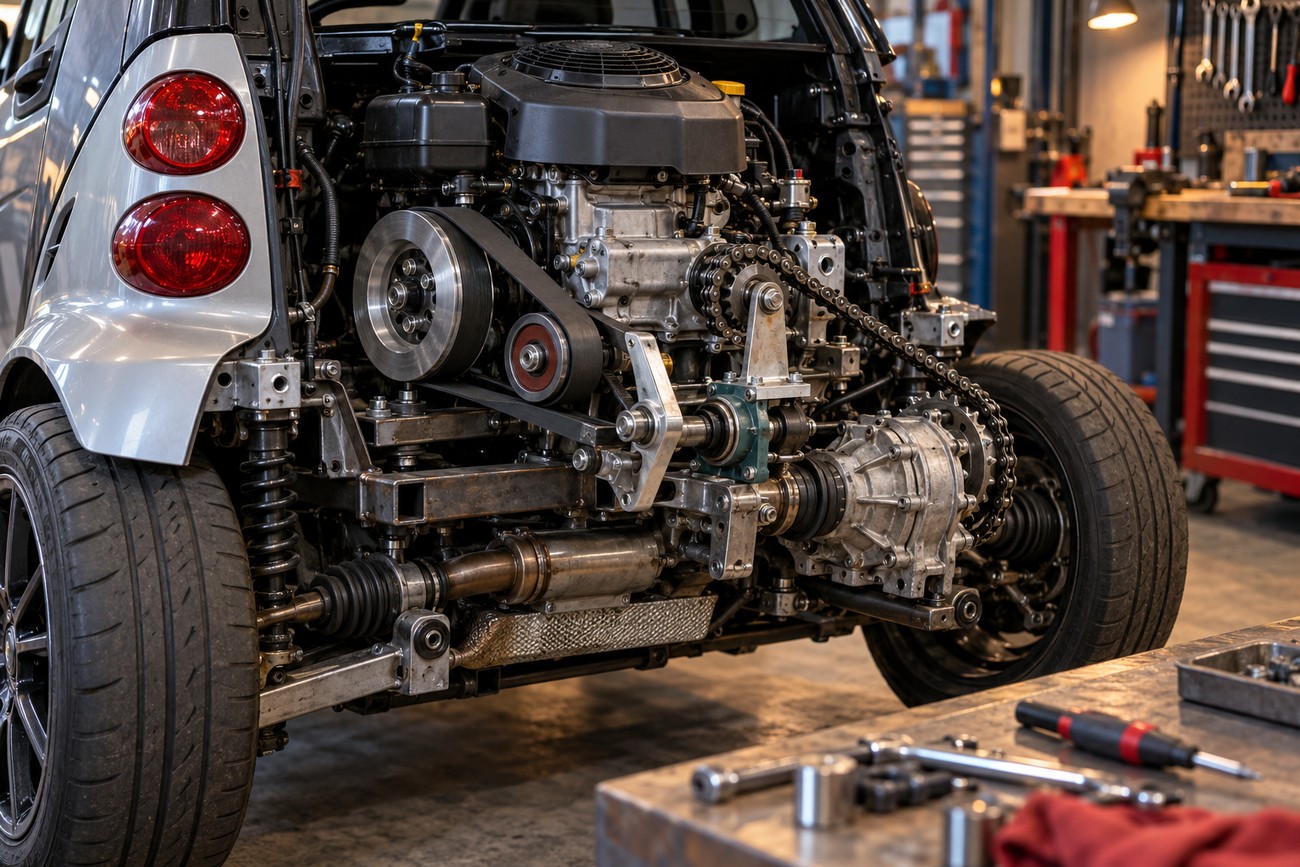
Many standard mower engines use a vertical shaft. Automotive drivetrains usually need a different power-transfer layout, so the engine cannot simply be bolted to the Smart’s transmission. A belt, chain, reduction unit, or custom gearbox may be needed before the drive can reach the differential and wheels.
That intermediate system has to carry torque while staying aligned under vibration and suspension movement. Pulleys, chains, and belts need suitable tension, guarding, and support. A shaft that appears aligned on a workbench can move enough under load to damage bearings, throw a belt, or loosen its mounts.
Making the wheels turn is often the easy milestone. Shaft orientation and reduction come first, then continuous cooling, vibration control, and engine mounting determine whether the installation can survive repeated loads.
Many mower engines are designed for specific or shorter-duty cycles rather than prolonged automotive loading. Continuous road operation can expose overheating, poor lubrication on inclines, excessive vibration, and failures in belts, pulleys, or engine mounts. The cooling airflow available inside a modified Smart may also differ sharply from the airflow around the original engine.
Lubrication deserves particular attention. A mower motor designed to work on a relatively level machine may experience different oil movement when installed in a car that brakes, climbs, corners, and runs for long periods. A conversion that survives a short test can still suffer damage once heat and load accumulate.
What a Moving Prototype Still Cannot Prove
A prototype reaching about 20–30 km/h does not prove that its brakes, handling, mounts, or cooling are suitable. The original weight distribution can change when the engine, reduction system, fuel tank, and batteries or accessories are relocated. That can alter steering feel, suspension loading, and stability.
Low engine output does not remove the need for dependable brakes and secure mounting. The car still carries substantial mass, and the driver still needs predictable control if the engine stalls, a belt breaks, or the throttle sticks. Noise and vibration can also become tiring and may loosen fasteners or damage surrounding components.
Fuel use may be disappointing as well. A small engine working near maximum rpm through several mechanical losses is not automatically economical. Repeated belt failures, overheating, and improvised mounts can make the project less practical than its compact engine initially suggests.
DIY projects on very light chassis show that low-power vehicles can move; they do not establish compatibility with a Smart Fortwo. For a road conversion, the complete installation needs engineering, testing, and compliance with local inspection, registration, and modification requirements.
The practical verdict is narrow. A mower engine can move a Smart slowly on level ground with ideal gearing, especially in a controlled project. It is generally unsuitable for normal road driving unless the entire powertrain, cooling system, controls, brakes, mounting, and legal status have been properly resolved.
Frequently asked questions
Engine choice is only one part of a Smart conversion. The mechanical layout and the vehicle’s intended use determine whether the result is a useful experiment or a road-capable vehicle.
What engines can you fit in a Smart car?
Physical fit is only the starting point. The engine must also match the shaft layout, reduction system, cooling arrangement, mounts, differential, driven wheels, controls, and available space for safe service.
A mower engine may require an intermediate belt, chain, reduction unit, or custom gearbox because many use a vertical shaft. The finished vehicle may also need inspection and approval under local rules, even if the engine physically fits in the bay.
How much does a Smart Fortwo weigh?
Smart Fortwo generations 450, 451, and 453 typically weigh approximately 730–950 kg ready to drive. That is light by car standards, which reduces the force needed to begin moving on level ground.
The mass still creates automotive demands. Braking, cornering, climbing, acceleration, and safe operation in traffic require dependable systems, regardless of whether the replacement engine produces only a few horsepower.
What else can you use a lawn mower engine for?
A lawn mower engine is naturally suited to purpose-built low-speed equipment such as mowing machines, small utility vehicles, pumps, and controlled mechanical projects, provided its shaft orientation and duty cycle match the application.
Those uses usually have simpler loads, predictable gearing, and less demanding cooling and braking requirements than a road car. A low-speed test platform is therefore a more realistic application than powering a modified Smart in traffic.







