
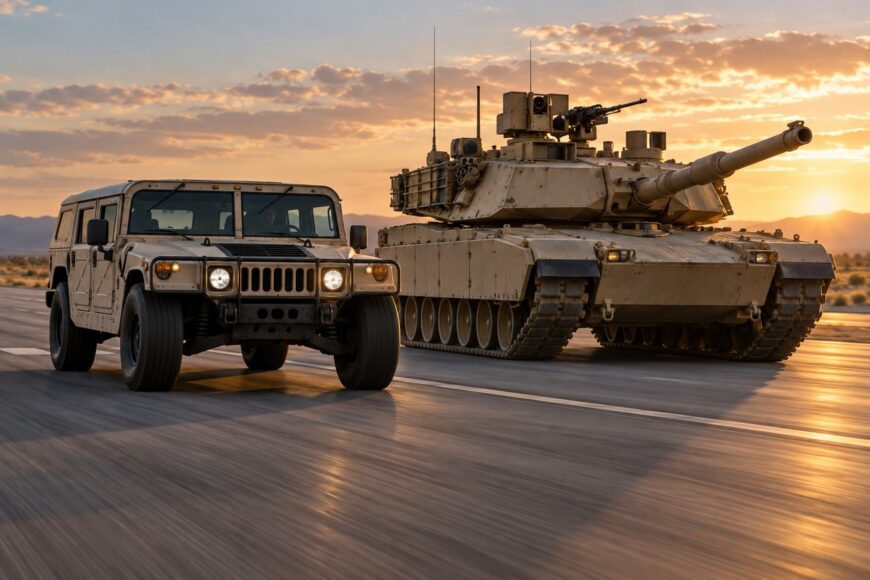
A civilian Hummer H1 reached 83 mph in a road test, while an Abrams with approximately 1,500 hp has an official maximum road speed of roughly 41.5–45 mph, depending on the specification. That apparent mismatch makes more sense once the vehicles’ jobs are clear. One is a wheeled vehicle tested on a road; the other is a heavily armored, tracked vehicle whose operating limits account for mechanical life as well as speed.
Surface, distance, load, and traction can matter more than the headline horsepower figure. The H1 has a clear maximum-speed advantage on a firm, flat road, but its acceleration is slow. On poor ground or an obstacle-heavy route, the comparison can shift toward the tank. Neither speed figure establishes a winner for every course.
- The short answer: the H1 wins on a straight road
- What the numbers actually measure
- Acceleration is where the H1 looks less impressive
- Why the Abrams is slower but more capable off-road
- H1 Hummer vs. Abrams: the fair comparison
- The 60-mph Abrams claim and why the limiter matters
- The hidden drawbacks behind both speed claims
- So, could a Hummer H1 outrun a military tank?
- Frequently asked questions
- What is the top speed of a H1 Hummer?
- How far can an HMMWV go on a full tank?
- How bulletproof is a military Humvee?
The short answer: the H1 wins on a straight road
By maximum speed on a firm, flat road, the tested civilian H1 wins: Car and Driver recorded 83 mph, versus an official Abrams road-speed range of approximately 41.5–45 mph, depending on modification and specification. If both vehicles have enough clear road to reach their normal maximum speeds, that gap favors the H1.
Maximum speed is only one way to define “outrun.” A short sprint puts more weight on acceleration, while a rough route rewards traction and the ability to keep moving through obstacles. The H1’s higher road-test maximum does not establish that it would lead from the start or finish first across difficult ground.
Vehicle condition and load also matter. The 83 mph figure belongs to one civilian H1 in one road test; it is not a guaranteed result for every H1, much less for every military HMMWV configuration. A useful comparison must identify the distance, surface, payload, vehicle condition, and whether the winner is determined by acceleration, maximum speed, or route time.
What the numbers actually measure
Car and Driver tested a civilian H1 rated at 190 hp and weighing 6,766 lb. It recorded a top speed of 83 mph and a 0–60 mph time of 18.1 seconds. Those results describe a particular vehicle under road-test conditions, rather than a universal specification for the H1.
A civilian H1 is not automatically identical to the original military HMMWV configuration. Engine, mass, equipment, and calibration may differ, so substituting one vehicle’s test result for anther’s can distort the comparison before the tank even enters it.
Abrams figures come from military operating specifications, and the listed road maximum varies by modification: approximately 41.5, 42, or 45 mph. These figures reflect a controlled operating range for a tracked vehicle. They are not results from the same test program, surface, or loading conditions as the civilian H1 road test.
That distinction matters most when cross-country figures appear alongside road figures. An Abrams cross-country speed of approximately 25–30 mph describes movement over different terrain. Comparing it directly with the H1’s 83 mph road-test maximum would exaggerate the difference between the vehicles.
Acceleration is where the H1 looks less impressive

The tested H1 took 18.1 seconds to reach 60 mph. Owner reports commonly describe approximately 18–20 seconds for the same run, which is consistent with a vehicle that needs time and clear space to build speed. Its 83 mph maximum should therefore not be read as evidence of brisk passing response.
The test vehicle’s 190 hp had to move 6,766 lb. Mass is part of the explanation, but horsepower alone cannot predict a launch: gearing, rolling resistance, traction, and any speed controls also shape what happens between a standing start and cruising speed.
The Abrams has approximately 1,500 hp from a gas-turbine engine, yet that output serves a heavily armored tracked vehicle. Its road-speed limit says little by itself about how quickly it covers a short distance. Without comparable acceleration tests under defined conditions, declaring a winner in a sprint would go beyond the available figures.
This is the counterintuitive part of the road verdict: the H1 could win a long enough maximum-speed contest without immediately pulling away. For a shorter course, the starting speed and distance may matter more than either vehicle’s published maximum.
Why the Abrams is slower but more capable off-road
The Abrams uses approximately 1,500 hp to move armor, tracks, and a combat load. That power supports mobility under demanding conditions; it does not make road speed the tank’s overriding design goal. Armor and survivability impose demands that the civilian H1 does not carry.
Tracks provide a different way to put power into poor ground, and the tank is built to negotiate obstacles that would change a wheeled vehicle’s route or pace. On firm pavement, those strengths do little to close the H1’s maximum-speed advantage. Where traction and obstacles govern progress, they can become decisive.
The Abrams’ approximately 25–30 mph cross-country figure is an operating measure for rougher terrain, not a lower road-test score to place beside the H1’s 83 mph. Equally, the H1’s road maximum says nothing reliable about how fast it could complete that same cross-country route.
Terrain changes more than available grip. A heavy tank must also brake, turn, and change direction with substantial inertia, so its top speed cannot stand in for route time. A course with soft ground, obstacles, and repeated changes of direction calls for an actual timed run under matched conditions.
H1 Hummer vs. Abrams: the fair comparison
The figures below keep each vehicle’s purpose and measurement conditions attached to its speed claim.
| Measure | Civilian Hummer H1 | M1 Abrams |
|---|---|---|
| Role and propulsion | Wheeled civilian vehicle derived from the military HMMWV; not identical to every HMMWV configuration. | Tracked, heavily armored military vehicle built for combat mobility and survivability. |
| Power and load context | The Car and Driver test vehicle produced 190 hp and weighed 6,766 lb. | Gas-turbine engine producing approximately 1,500 hp to move a heavily armored vehicle and its load. |
| Published or tested speed | 83 mph in a Car and Driver road test; not a universal H1 maximum. | Official maximum road speed of approximately 41.5–45 mph, depending on modification and specification; cross-country speed of approximately 25–30 mph. |
| Acceleration evidence | 0–60 mph in 18.1 seconds in the road test. | No directly comparable acceleration result established by these speed specifications. |
| Terrain | Road-test advantage on firm, flat pavement; performance on poor ground depends on conditions. | Tracks, traction, and obstacle-handling design can favor it on difficult routes. |
| Operating trade-offs | Slow acceleration, noise, harsh ride, and specialist maintenance. | High fuel and logistics demands; speed can increase wear on tracks and running gear. |
This table compares purposes and the conditions behind the available figures, not results from identical tests. It supports a road maximum-speed verdict while leaving a short sprint or rough-terrain route open to the conditions of the test.
The 60-mph Abrams claim and why the limiter matters
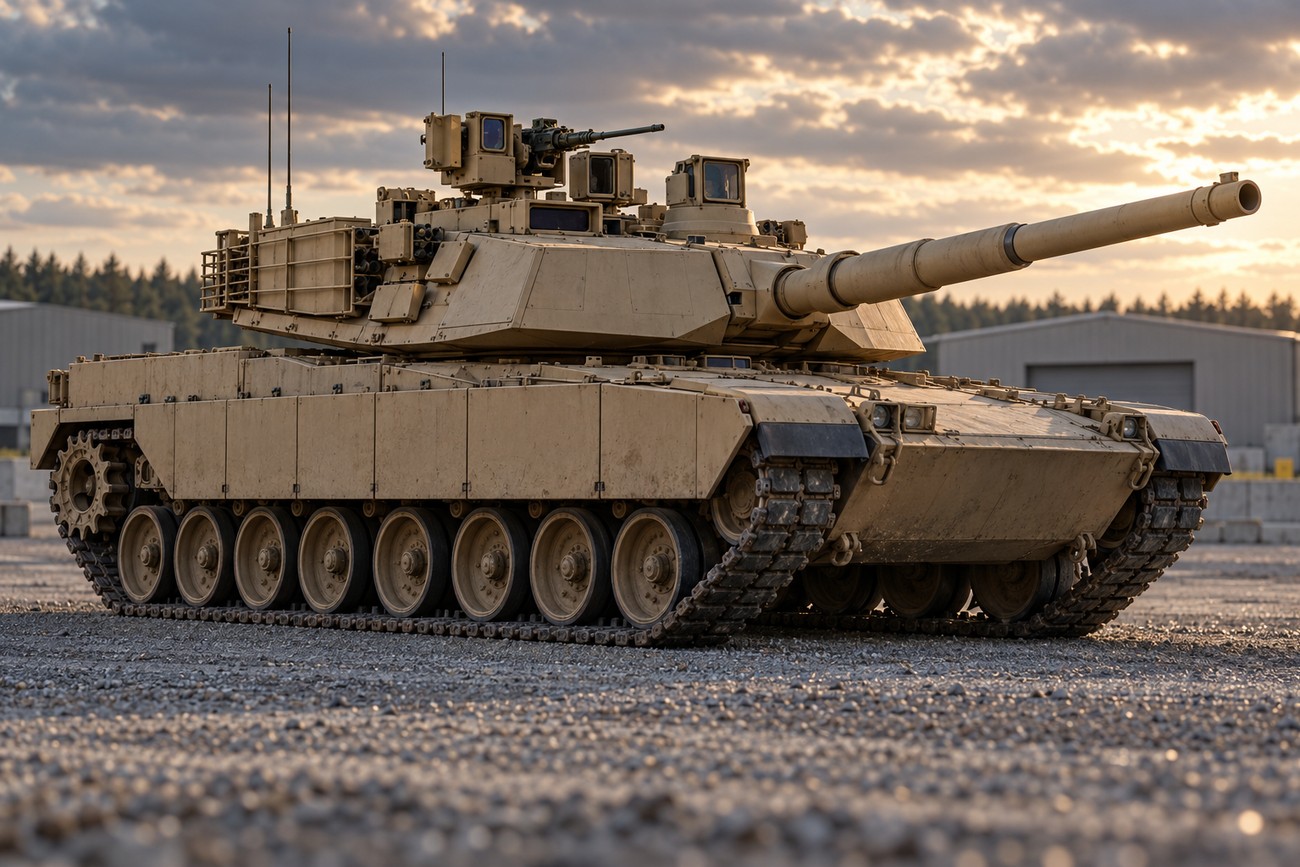
Claims that an Abrams can travel at 60 mph or more recur in promotional and secondary accounts. They should not replace its official maximum road-speed range of approximately 41.5–45 mph. The higher claim is disputed and associated with exceeding or removing the limiter, rather than normal operation.
A speed limit on a tracked vehicle has a mechanical purpose. Pushing beyond the normal range can increase wear on tracks and running gear and raise the risk of transmission damage. Available engine power does not, on its own, define a sensible sustained operating speed.
That is why an exceptional speed claim, even if achieved, would answer a different question from the official specification. The fair road comparison uses the Abrams’ normal operating range and identifies any unrestricted claim separately.
The hidden drawbacks behind both speed claims
The H1’s 83 mph road-test result does not establish that running at that speed is safe, stable, or sensible as a routine practice. Owners commonly report noise, a harsh ride, and poor sound insulation on ordinary roads. Those traits matter to anyone treating the test maximum as a useful cruising target.
Its slow acceleration also affects everyday driving. Passing requires room to build speed, even though the vehicle can ultimately reach a much higher maximum than the tank. A peak-speed figure cannot tell a driver how much distance is needed for a maneuver.
Maintenance adds another qualification to the H1’s performance. Large tires, specialized components, portal gearboxes, and difficult-to-access parts can make repairs expensive. The portal-gearbox layout contributes to ground clearance, but that benefit comes with mechanical complexity an owner has to maintain.
The Abrams carries a different burden. Its gas-turbine engine has major fuel-consumption and logistics demands, while high-speed running can accelerate wear on tracks and running gear. A tank that can cross difficult ground still depends on fuel, maintenance, and serviceable components to keep doing it.
So, could a Hummer H1 outrun a military tank?
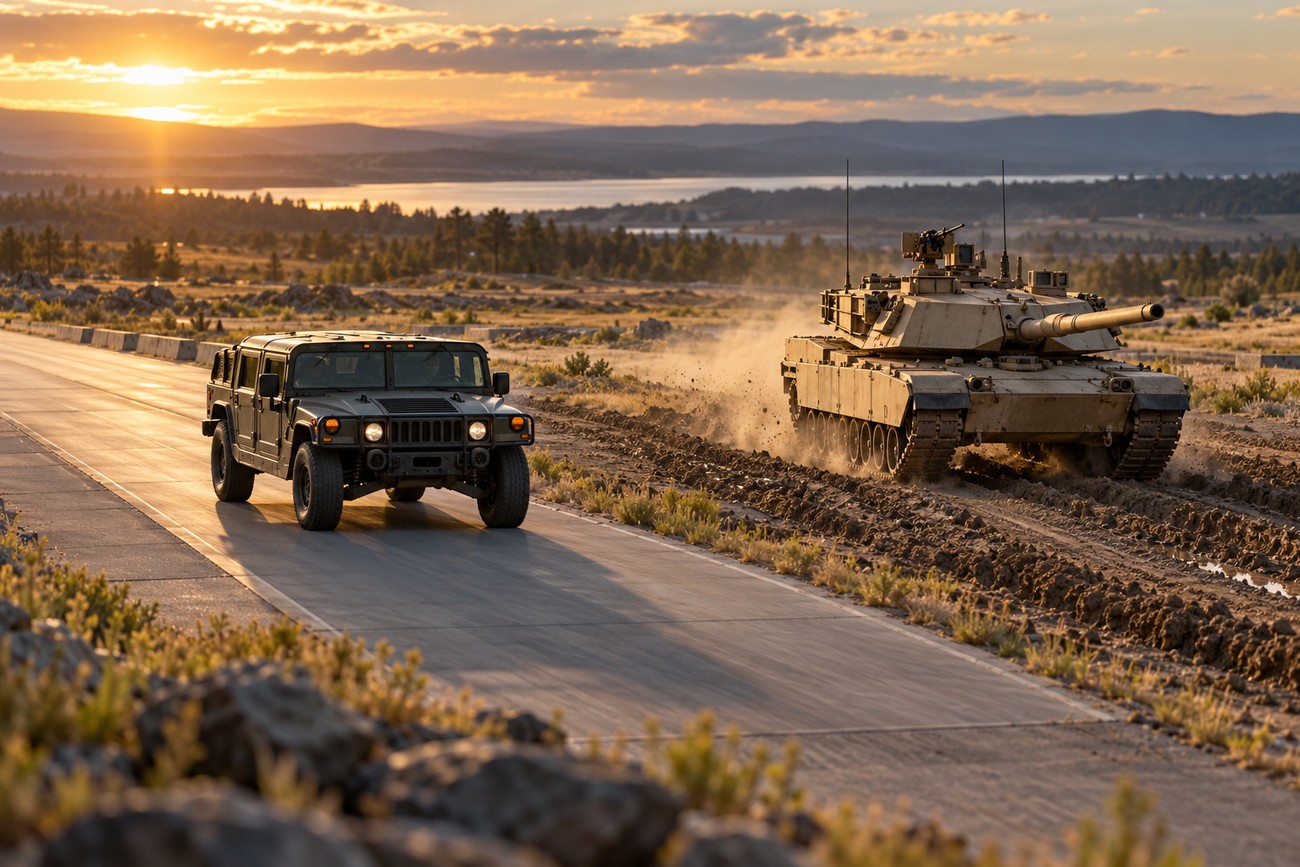
Yes, if the contest is maximum speed on a firm, flat road and the tank is an Abrams operating within its official limit. The tested civilian H1 reached approximately 83 mph, compared with the Abrams’ approximately 41.5–45 mph official maximum road speed. That is a specific road-speed verdict, not a claim about every tank or every H1.
On poor ground or an obstacle-heavy route, the Abrams may gain the advantage through tracks, traction, and purpose-built cross-country mobility. A paved straightaway and a difficult route test different capabilities, so the road result cannot be carried over unchanged.
A short sprint remains less certain as well. The H1’s 18.1-second 0–60 mph road-test time means its higher maximum speed may take a while to matter. Any valid race must specify distance, surface, payload, vehicle condition, and whether winning means acceleration, maximum speed, or total route time.
Frequently asked questions
These distinctions also help separate the civilian H1 from military HMMWV variants. Speed, fuel range, and protection describe different characteristics, and none can be inferred from the shared Humvee lineage alone. The exact vehicle and its configuration matter.
What is the top speed of a H1 Hummer?
Car and Driver recorded 83 mph in a road test of a civilian H1. That is a result for the tested vehicle, not a guaranteed top speed for every H1. Version, condition, tires, and test conditions can affect what another vehicle achieves.
How far can an HMMWV go on a full tank?
There is no single useful range figure without identifying the HMMWV variant, fuel configuration, payload, and operating conditions. Road travel and difficult terrain place different demands on the vehicle, so a range estimate needs those details to be meaningful. The civilian H1 and Abrams speed figures do not establish an HMMWV’s fuel range.
How bulletproof is a military Humvee?
A military HMMWV’s protection depends on its configuration and armor package. The Humvee name alone does not specify what threats a particular vehicle can withstand, and an unarmored configuration should not be judged as though it had an armor package.
The civilian H1’s road-test performance provides no evidence of a military HMMWV’s ballistic protection. For a meaningful assessment, identify the specific vehicle and its installed protection before considering a particular threat.







