
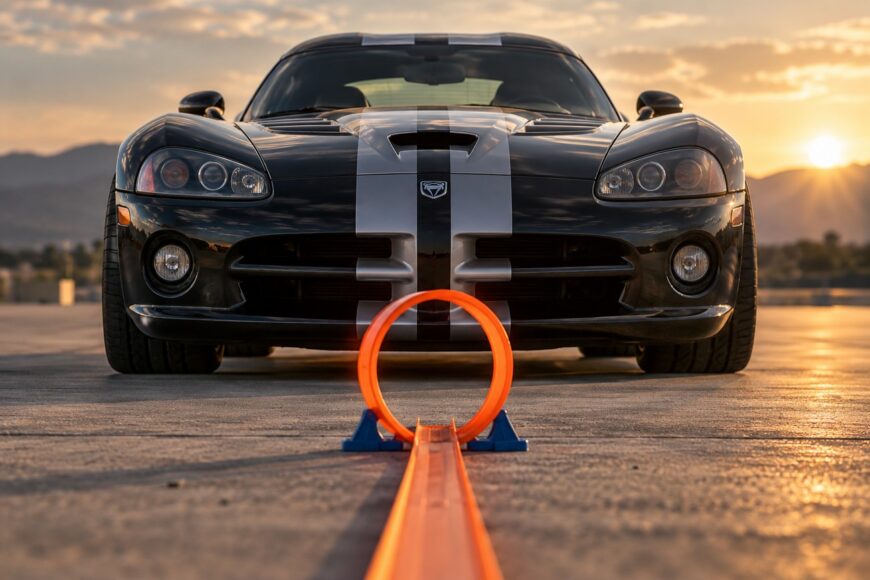
A full-size Dodge Viper charging toward a bright orange Hot Wheels loop is a compelling visual: a low, wide sports car aimed at a toy track designed for palm-sized cars. The image suggests that the Viper’s V10 and high torque might simply overpower the problem.
Physics is less forgiving. A standard Hot Wheels orange track has toy-scale geometry, narrow load paths, and friction- or inertia-track construction intended for small cars. A Viper brings roughly 1.5–1.6 metric tons, much higher tire loads, and structural demands that the toy component cannot support. The answer changes only when “Hot Wheels loop” means a purpose-built automotive stunt structure rather than the standard toy loop.
- A Full-Size Viper Cannot Use a Standard Hot Wheels Loop
- The Physics: Staying on the Loop Is More Than Having Enough Horsepower
- Why a Real Viper Loop Needs a Custom Stunt Structure
- The Failure Points: Tires, Suspension, Alignment, and Human Error
- The “Hot Wheels Loop” Marketing Catch
- So, Could a Dodge Viper Actually Do It?
- Frequently asked questions
- Why are Dodge Vipers so hard to drive?
- Why are Dodge Vipers so rare?
- What does the √(gR) rule actually tell you about a car loop?
- Why can a small track seam ruin a full-size loop attempt?
A Full-Size Viper Cannot Use a Standard Hot Wheels Loop
Hot Wheels orange track is a toy-scale friction- or inertia-track designed for small Hot Wheels cars. Its width, curvature, joints, supports, and material thickness suit a lightweight toy moving under modest loads. A Dodge Viper is a full-size vehicle with a wide wheel track, substantial suspension forces, and a mass measured in metric tons.
The standard toy loop is therefore a physical mismatch before speed enters the discussion. A Viper cannot fit the loop’s geometry, and the track cannot provide an appropriate continuous surface or load path for its tires. Even a slow approach would threaten the track, the car, and anyone nearby.
Scaling the toy loop upward is not a simple matter of multiplying every dimension by the same factor. The structure must carry vehicle weight, dynamic loads, braking and acceleration forces, and the changing direction of those loads through the loop. Joints, supports, foundations, and transitions all become engineering problems.
A real automotive loop is a radically rebuilt custom structure. It may preserve the orange color or branded appearance, yet its design is based on the car’s wheel track, mass, speed profile, and load paths. The toy component supplies the visual idea, not the usable engineering.
The Physics: Staying on the Loop Is More Than Having Enough Horsepower
The key condition appears at the top of the loop. For an idealized vehicle that is just maintaining contact, the theoretical minimum speed is approximately √(gR), where g is gravitational acceleration and R is the loop radius. This expression describes the minimum top-of-loop condition; it does not provide a complete stunt specification.
| Feature | Toy-scale Hot Wheels loop | Custom full-size automotive loop |
|---|---|---|
| Vehicle mass | Designed for a small Hot Wheels car | Designed around a vehicle weighing about 1.5–1.6 metric tons, depending on the Viper generation and specification |
| Track purpose | Friction- or inertia-track for a toy | Engineered ramp or steel structure for a full-size vehicle |
| Speed requirement | Set by toy-scale geometry and low loads | Determined by loop radius, entry conditions, losses, and the required margin at the top |
| Structural design | Lightweight toy track and supports | Structure calculated for vehicle mass, speed, wheel track, and dynamic load paths |
| Tire loads | Small contact forces from toy wheels | High loads affected by tire pressure, temperature, grip, deformation, and allowable load |
| Safety margin | Suitable for controlled toy play | Requires engineered transitions, continuous surfaces, testing, and substantial structural margin |
Real attempts need more speed than √(gR) suggests. Friction, tire deformation, suspension movement, structural flex, and other losses reduce the speed available through the loop. Entering at the theoretical minimum leaves little room for those effects and can make contact at the top marginal.
The Viper’s powerful V10 and high torque can help produce the required entry speed. They do not guarantee that the tires will maintain their intended path, that the car will remain aligned, or that the structure will tolerate the loads. Power is an input to the system, while the loop depends on the complete system.
Mass makes the consequences larger. A Viper typically weighs about 1.5–1.6 metric tons, depending on generation and specification, so the tires, suspension, chassis, and structure must manage forces generated by that mass throughout the changing orientation of the car. A high-output engine cannot compensate for an unsuitable radius, poor grip, or an inadequate transition.
Why a Real Viper Loop Needs a Custom Stunt Structure
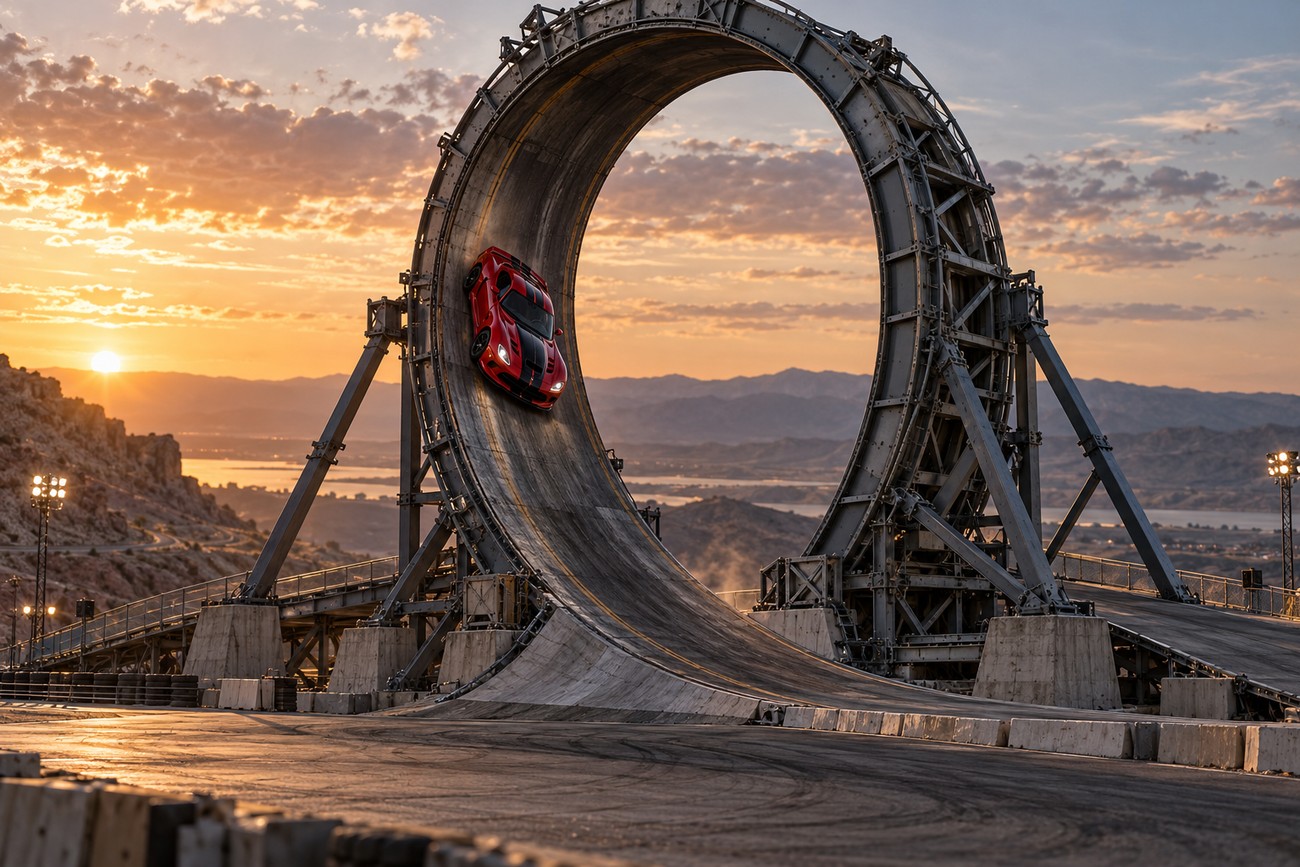
Automotive loops use a large custom-engineered ramp or steel loop rather than a standard Hot Wheels component. The radius must suit the vehicle’s speed and mass, while the width must accommodate the wheel track with enough lateral clearance. The structure also needs a defined load path into its supports and foundation.
The circular section is only one part of the design. Entry and exit transitions control how quickly the car’s direction changes and how the suspension is loaded. A heavy car needs those transitions to be smooth and continuous, because an abrupt change can disturb the tires before the vehicle reaches the loop’s highest load.
Surface continuity matters more than peak engine output once the car is committed. A seam, step, or uneven joint can create a steering or suspension disturbance that changes the trajectory. The track must preserve the intended line while carrying the vehicle through acceleration, inversion, and recovery.
Designers also need a safety margin above the calculated operating condition. That margin covers tolerances in construction, tire behavior, vehicle setup, and speed control. A visual replica of a toy loop can therefore conceal a fundamentally different structure underneath.
The Failure Points: Tires, Suspension, Alignment, and Human Error
Entry alignment is one of the first failure points. A heavy car can be pulled sideways if its approach line is even slightly misaligned, especially as the track begins to curve upward. The driver has limited opportunity to correct the car once the load builds and the vehicle is committed to the loop.
Tire behavior is equally important. Pressure, temperature, available grip, deformation, and allowable load all affect whether the tires remain properly engaged with the track. A tire problem can become a loss of control or a mechanical failure before the Viper reaches the top.
Suspension and chassis loads can exceed what a road car experiences in ordinary driving. Even if the Viper remains on the track, the tires, suspension, body structure, and occupants may face unacceptable forces. A setup that feels stable on a straight approach can behave differently as the car rotates through the loop.
Acceleration must also be repeatable. An imperfect throttle application, changing grip, or inconsistent launch can leave the car short of the required speed or send it into the transition too quickly. Steering cannot reliably rescue a major line error after commitment, because the available tire contact and driver response are constrained by the track geometry.
The financial consequence is substantial. A failed attempt can damage tires, suspension, wheels, bodywork, and other components, while a construction or calculation error can damage the custom structure as well. This is why a real stunt requires measured testing and controlled preparation rather than confidence in the driver or engine.
The “Hot Wheels Loop” Marketing Catch
The phrase “Hot Wheels loop” may describe a branded or stylized concept rather than a standard toy track. Promotional material can use the familiar orange color and loop shape while the actual installation is a large custom ramp or steel structure built around a full-size vehicle.
Preparation may include measurements, pre-testing, vehicle inspection, ballast, tire checks, speed control, and hidden safety systems. The final video may show only the clean run, leaving out failed approaches, repeated takes, recovery planning, and the work needed to verify the installation.
Post-run repairs can also disappear from the finished footage. A tire, suspension component, or body panel may require attention even when the car completes the loop. That omission does not prove that a particular video is unsafe or staged; it shows why promotional footage is incomplete engineering evidence.
Marketing language can make a one-off installation appear repeatable by an ordinary sports car. The label says little about whether the track was standard, how many tests preceded the run, or what vehicle-specific changes were made. Those details determine the real level of risk.
So, Could a Dodge Viper Actually Do It?
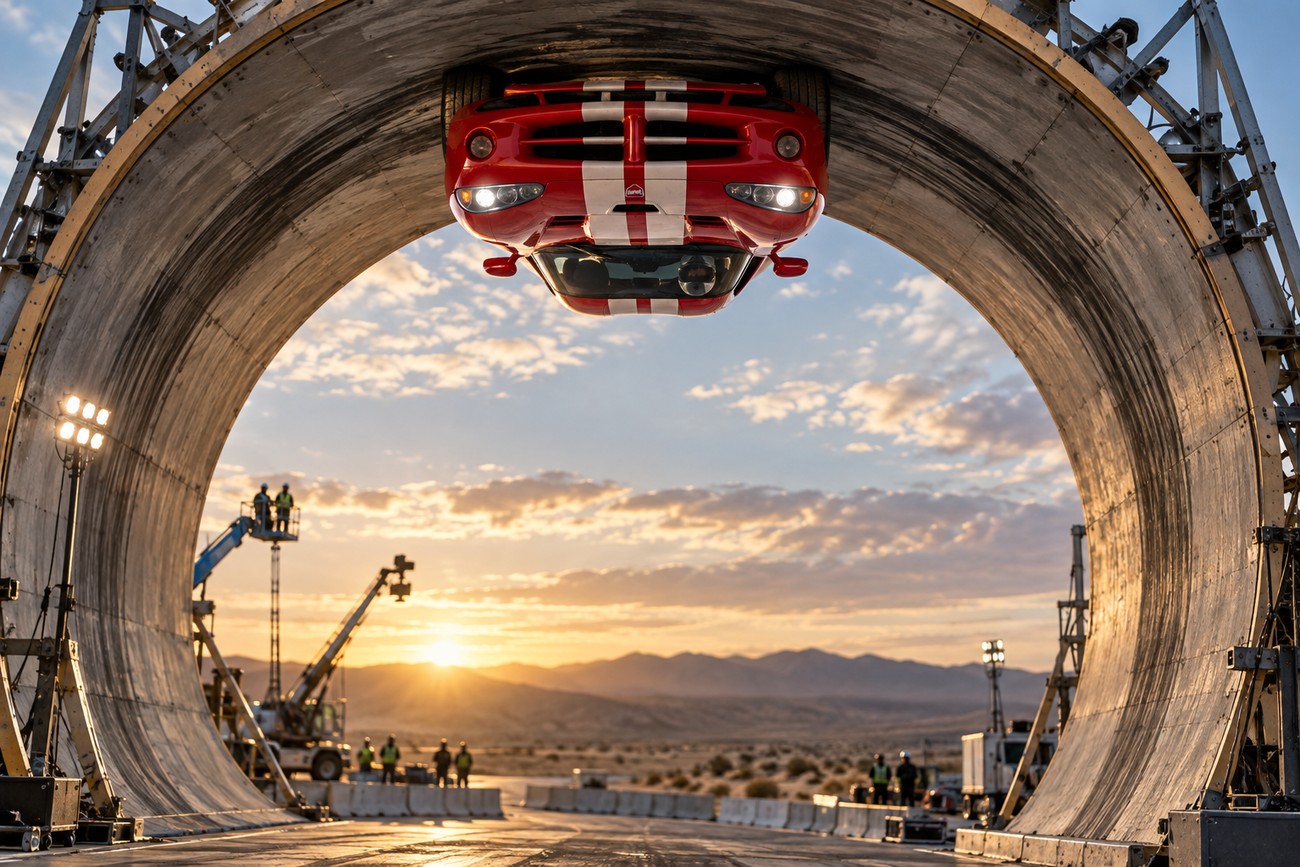
A Dodge Viper cannot use a standard toy-scale Hot Wheels loop. The track is physically unsuitable, structurally inadequate, and built for a different class of vehicle. The Viper’s V10 does not change that conclusion.
A custom automotive loop may be possible when the vehicle and structure are engineered as one system. The exact Viper generation, curb mass, tires, suspension, setup, loop radius, transitions, and speed profile all matter. A car that works in one engineered installation should not be treated as proof that another Viper or another loop will work.
Some automotive discussions cite roughly 60–80 km/h for a large loop, but that range is informal and cannot serve as a universal specification. Without the exact radius, transitions, surface characteristics, losses, and required safety margin, the number says too little to set a safe entry speed.
The real test is therefore not whether the Viper has enough power. It is whether the complete vehicle-and-structure system has been calculated, built, measured, and tested with adequate margin. That is an engineering stunt, rather than a scaled-up toy demonstration.
Frequently asked questions
Why are Dodge Vipers so hard to drive?
A Viper’s high-torque V10 can make throttle control important, especially when traction is changing. A small throttle error can alter the car’s speed or line quickly, while a wide vehicle and limited tolerance for alignment errors leave less room for correction.
For a loop, the challenge is broader than engine output. The driver must deliver a repeatable approach speed and maintain the intended trajectory through transitions where steering corrections have limited authority. The car’s setup, tires, and surface conditions can matter as much as the driver’s skill.
Why are Dodge Vipers so rare?
Rarity is a model- and market-context issue tied to production history, generation, specification, and availability. It does not demonstrate that a particular Viper is suitable for a loop or that its tires, suspension, and chassis are prepared for stunt loads.
A rare or valuable car may be a poor stunt candidate because replacement parts, repairs, and vehicle-specific testing can be difficult or expensive. Suitability must come from engineering evidence, not scarcity or collector interest.
What does the √(gR) rule actually tell you about a car loop?
It estimates the theoretical minimum speed at the top of an ideal loop, using gravitational acceleration and loop radius. The result helps explain why a larger radius changes the required condition, but it does not determine a safe real-world entry speed.
Actual design must include friction, deformation, speed losses, tire behavior, transitions, structural movement, and load margins. The vehicle also needs sufficient speed at the top, rather than merely meeting an idealized threshold under perfect conditions.
Why can a small track seam ruin a full-size loop attempt?
A seam or step can disturb the tire contact patch as the car enters a high-load transition. That disturbance may change the suspension position, create lateral movement, or shift the vehicle away from the intended line before the main loop load is reached.
At full size, the car’s mass turns a small discontinuity into a substantial mechanical event. Engine power cannot correct a loss of alignment caused by the surface, which is why continuous track construction and careful inspection are central to the stunt.







