
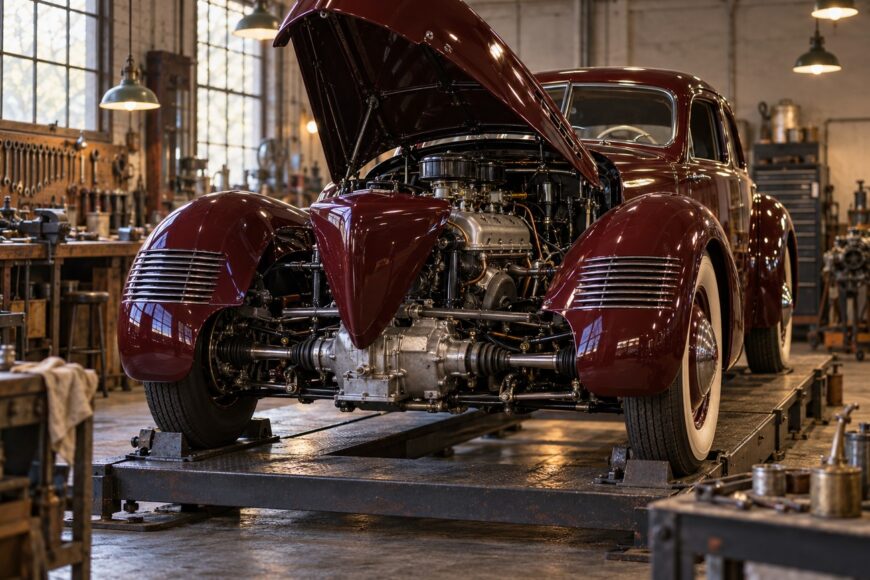
The Cord 810 announces itself with a blunt, grille-less “coffin nose” and headlights that disappear into its front fenders. In 1936, that shape looked less like a conventional American sedan than a streamlined object from a future that had arrived early. The design, attributed to Gordon Buehrig, remains one of the clearest expressions of American Art Deco automotive design.
Its visual drama can obscure the harder truth. The Cord 810 is a front-engine, front-wheel-drive car with independent front suspension, unitary construction, and a four-speed pre-selector transmission controlled through electrical, hydraulic, and vacuum-operated systems. It is an important engineering landmark, but it is a poor choice for anyone seeking a simple vintage V8 with familiar mechanical architecture.
- What Made the Cord 810 Revolutionary
- Coffin-Nose Design and Low-Slung Packaging
- Engine, Front-Wheel Drive, and Pre-Selector Transmission
- Cord 810 vs. 812: Specifications Without the Hype
- Why Cord 810 Ownership Can Become Expensive
- Buying, Authenticity, and Restoration Checks
- Frequently asked questions
- How much is a Cord 810 worth?
- What is the history of Cord Automotive?
- Why are Cord 810 production numbers often disputed?
What Made the Cord 810 Revolutionary
The 810 mattered because its engineering was as unconventional as its appearance. Production ran from 1936 to 1937, and the car combined front-wheel drive with independent front suspension at a time when most American automobiles still used conventional rear-drive layouts and separate frames. That arrangement allowed the engine and transmission to be packaged at the front without a driveshaft tunnel running through the passenger compartment.
The body used unitary, or unibody, construction rather than a traditional body mounted on a separate frame. This helped create a lower floor and a distinctive seating position, while also making the structure more integrated than that of many contemporaries. Such construction was advanced for the period, although it can make restoration and structural repairs less straightforward today.
The historical claim requires careful wording. The Cord L-29 preceded the 810, so the 810 was not simply the first American front-wheel-drive automobile. It is more accurately described as one of the first mass-produced American front-wheel-drive cars with independent front suspension, a distinction that captures its importance without erasing its predecessor.
That combination also explains the car’s lasting appeal to historians. The 810 was not merely a styling exercise placed over a conventional chassis; its low body, front-drive packaging, and integrated construction were connected decisions. They improved cabin packaging and visual proportions while creating mechanical complications that the market of the 1930s was not fully prepared to absorb.
Coffin-Nose Design and Low-Slung Packaging
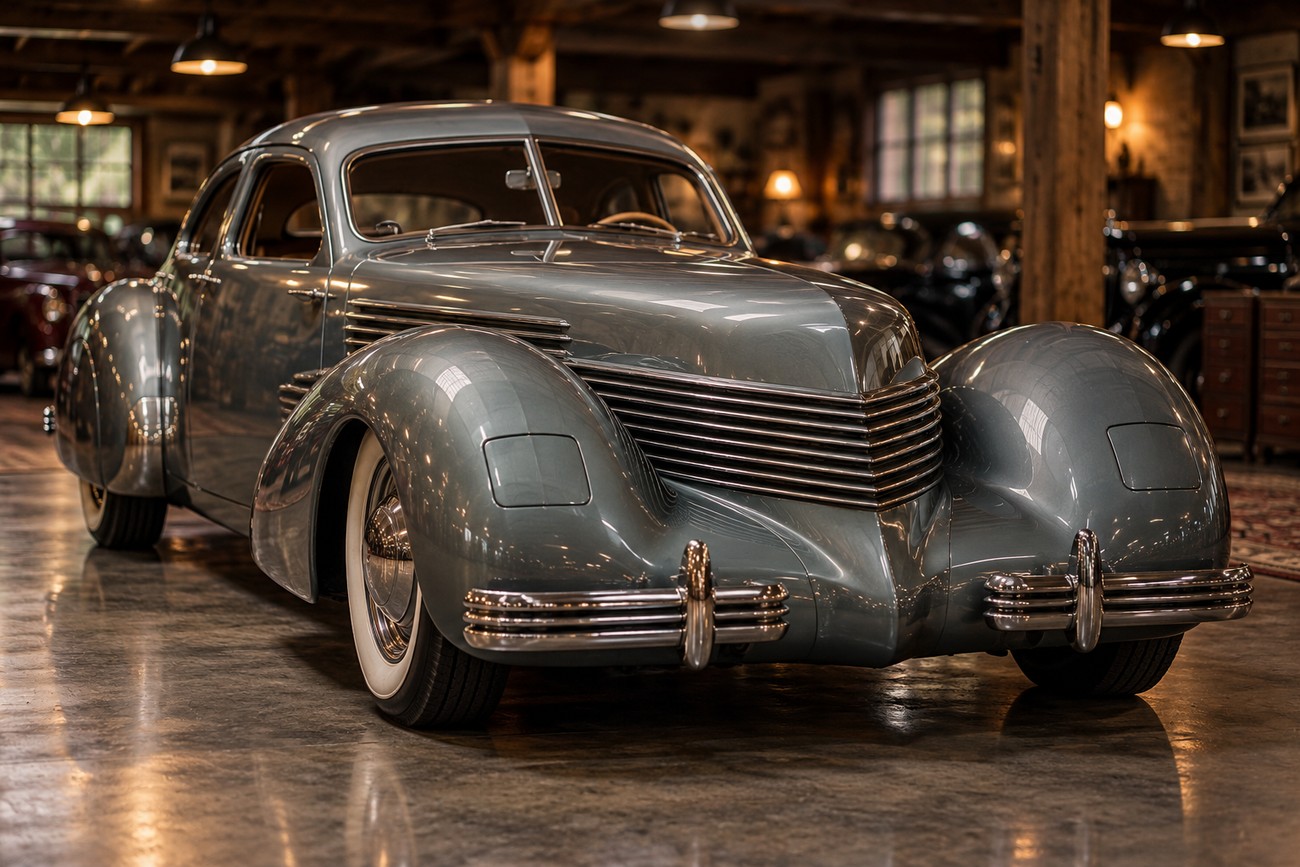
Gordon Buehrig’s design gave the Cord its unmistakable identity. The “coffin nose” refers to the closed, grille-less front-end treatment, whose tapered form replaces the tall radiator opening common on American cars of the period. It is a visual description with engineering implications: the front end was designed as a complete, enclosed form rather than as a traditional grille surrounded by separate fenders.
The headlights retract into the front fenders, leaving the nose clean when they are stowed. This feature was exceptionally unusual in 1936 and remains one of the easiest ways to distinguish an 810 or 812 from other Art Deco automobiles. It also introduces additional mechanical and electrical components that must work correctly if the car is to retain its original character.
The low body and front-drive layout helped eliminate traditional running boards and gave the Cord a remarkably modern stance. The reported road clearance is 270 mm, although conflicting secondary specifications mean that individual published measurements should be treated cautiously. The important point is the relationship between the low floor, the body sides, and the absence of external steps.
That packaging has a cost for modern owners. The low seating position can make entry and exit awkward, particularly for taller drivers, and the broad body does not behave like a small, lightweight sports car. The Cord’s visual lightness comes from its clean surfaces and low roofline; the mechanical and structural package remains substantial.
Engine, Front-Wheel Drive, and Pre-Selector Transmission
The Cord 810 used a 4,729 cc Lycoming V8, with the naturally aspirated base version rated at 125 bhp. That specification is often overshadowed by the more powerful 812, but keeping the two models separate is essential when evaluating a car. The 810’s engine is a large American V8; the unusual character comes primarily from how its power reaches the front wheels.
Its four-speed pre-selector, or semi-automatic, transmission was not a modern automatic transmission. The driver selected a gear in advance, then operated the clutch control as required by the system. Electrical, hydraulic, and vacuum-control elements worked together, creating a sophisticated arrangement whose behavior depended on the condition and adjustment of several linked systems.
In theory, the layout reduced the need for a conventional manual gear change. In service, it could become troublesome. Faults in control components, wiring, vacuum circuits, or hydraulic mechanisms may prevent proper engagement even when the engine itself starts and runs well. A test drive that includes only forward movement is not enough; every gear and the engagement sequence deserve attention.
Front-wheel drive adds another layer of inspection. The driveshafts, joints, transmission, and steering-related packaging are concentrated at the front, where access can be difficult. Repairs may require more labor than the engine bay suggests, and a replacement component that appears similar may still be unsuitable for an original or correctly restored car.
This is the central ownership paradox of the 810. Its Lycoming V8 can make it look like a familiar American classic, but the transmission and front-drive system turn it into a specialist project. A sound car can be rewarding; a neglected example can consume restoration time through several connected systems at once.
Cord 810 vs. 812: Specifications Without the Hype
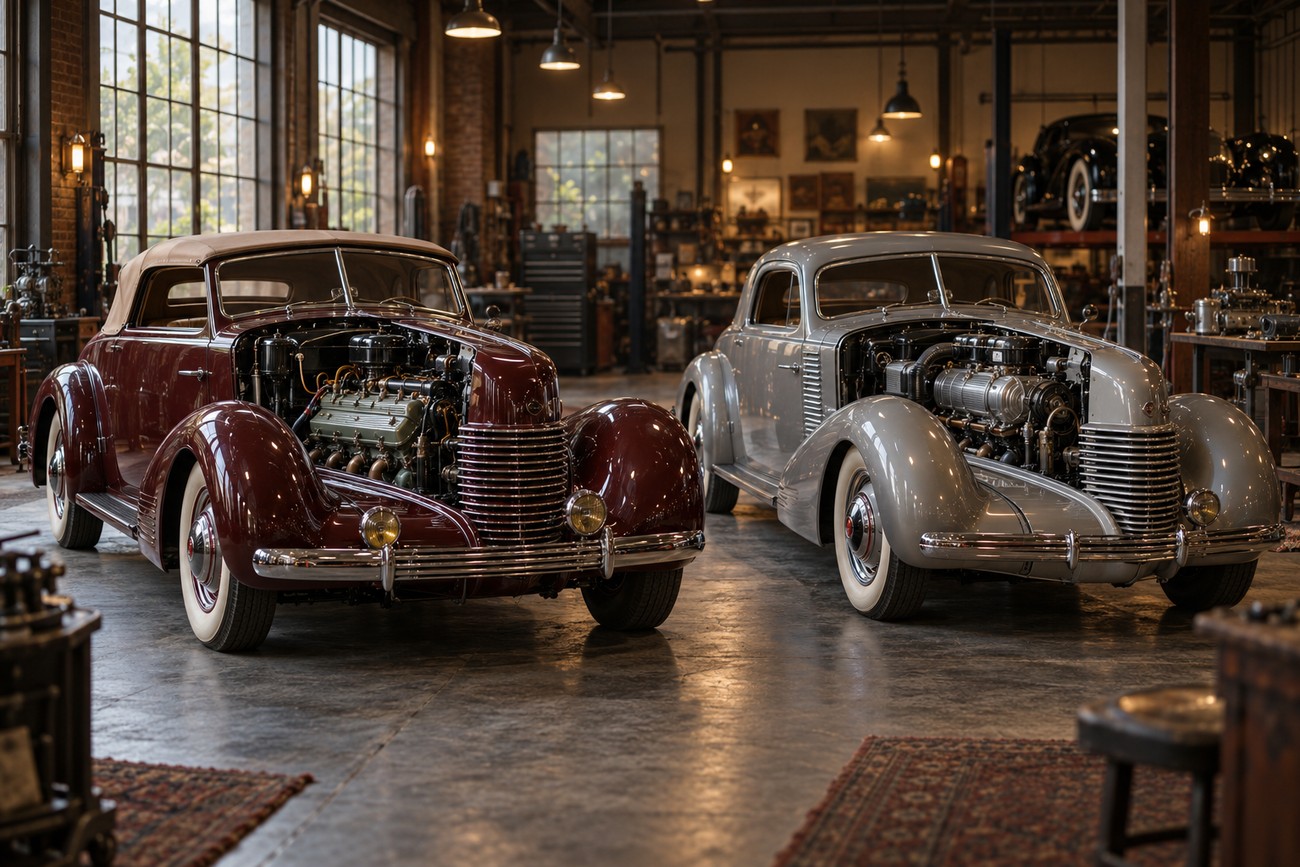
The 810 is associated with a 125 bhp naturally aspirated Lycoming V8. The 812 is the supercharged version commonly listed at 170 bhp. Those figures should be treated as model-level references, then checked against the exact car, its engine, and its restoration history rather than copied from a general advertisement.
Known body styles include Westchester, Beverly, Phaeton, and Sportsman. Body style affects the car’s identity and collector interest, while the 810 or 812 designation affects its mechanical specification. A seller’s description is therefore only a starting point; the engine, induction equipment, controls, and documentation should agree with the claimed model.
Combined production for the Cord 810 and 812 is estimated at approximately 2,320 cars. Exact 810-only accounting is often unclear because surviving production summaries do not consistently separate the two versions. Scarcity is genuine, but rarity alone does not prove originality or mechanical quality.
Performance claims require similar restraint. Advertisements and secondary sources give conflicting speed and acceleration figures, and some descriptions repeat inflated numbers. Verify the exact specification against reliable factory-oriented or museum-oriented references, especially when a claimed top speed or power output is being used to justify a premium.
Why Cord 810 Ownership Can Become Expensive
The pre-selector transmission is the first financial risk because it is both complex and specific to the car’s architecture. A fault may involve the gearbox itself, the clutch, electrical connections, hydraulic elements, or vacuum controls. The apparent symptom—failure to select a gear, delayed engagement, or abnormal operation—does not identify the failed part by itself.
Front-drive components deserve equal attention. Driveshafts, joints, steering, and suspension operate in a tightly packaged area, and access can be labor-intensive. Brakes and suspension also require experienced inspection because the Cord is a large, substantial automobile rather than a light cycle-based classic whose systems can be rebuilt casually in a home garage.
Age affects more than rubber seals and paint. Wiring, vacuum lines, hydraulic components, and control mechanisms may have deteriorated while remaining hidden beneath an attractive restoration. A car that starts easily at a show can still have unsafe braking, unreliable gear engagement, or an inoperative headlight mechanism.
Parts availability increases the risk. Correct components may be scarce, and restoration can depend on donor cars or carefully rebuilt original parts. Non-original substitutions may keep a car moving, but they can complicate future repairs and reduce historical credibility if the owner is pursuing a concours-standard result.
The wrong buying assumption is that a simple-looking V8 makes the Cord simple to own. Its engineering complexity, unusual packaging, and limited production make specialist knowledge more important than a polished engine bay. Budget for it and inspect it as an advanced prewar project, even when the bodywork appears complete.
Buying, Authenticity, and Restoration Checks
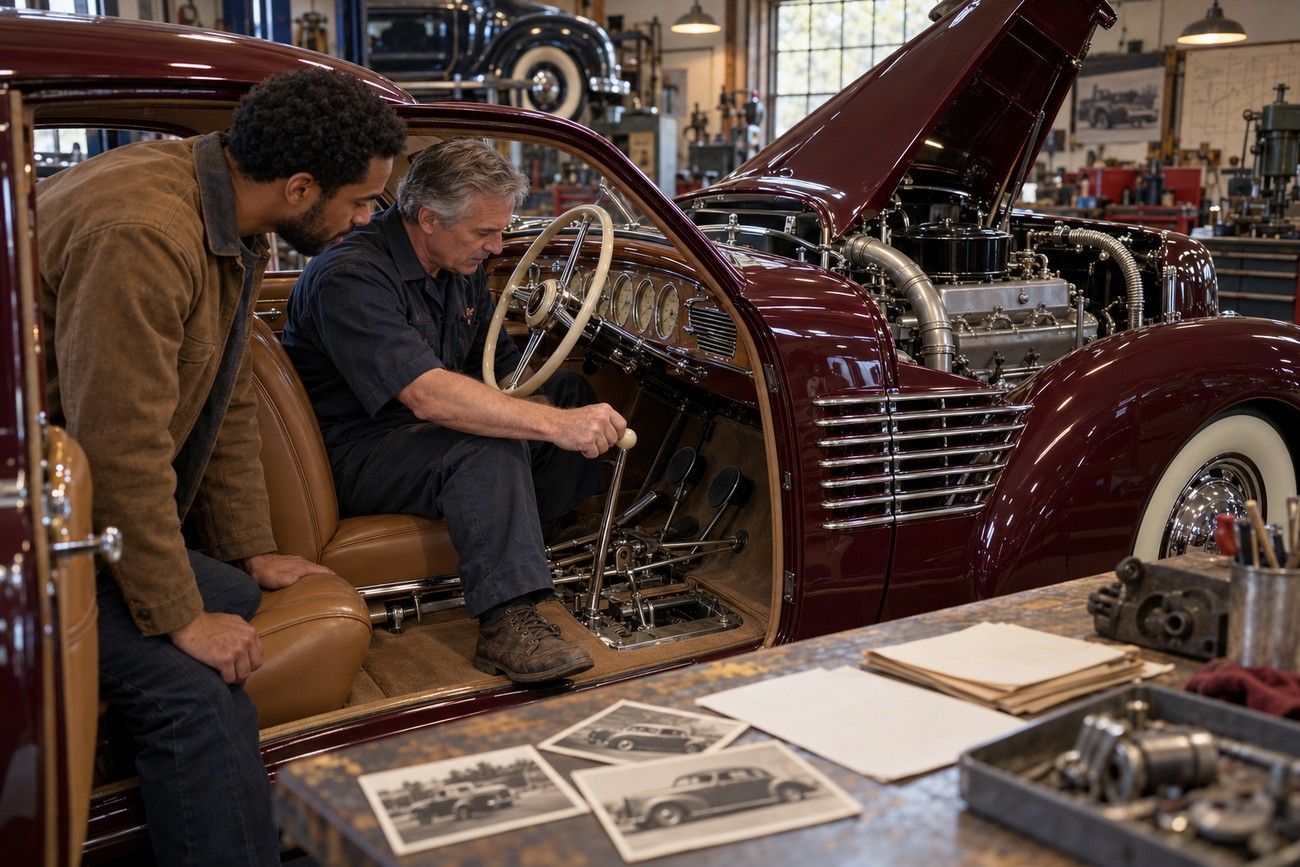
Begin with identity and documentation. Confirm whether the car is an 810 or 812, establish the body style, and compare the engine and induction system with that description. Restoration invoices, older photographs, parts records, and correspondence can be more useful than a recent cosmetic presentation because they reveal what was actually rebuilt and what was merely cleaned.
Test the transmission before judging paint, trim, or engine presentation. The pre-selector should be assessed through its complete operating sequence, with attention to engagement, clutch action, control response, and abnormal noises. The front-drive system, driveshafts, steering, and suspension then deserve a specialist inspection before any decision is based on the car’s show appearance.
Inspect wiring, hydraulic lines, vacuum components, and headlight mechanisms for both condition and originality. Improvised repairs may be functional today while making the next repair harder. The same principle applies to the body: check structural work, panel fit, corrosion repair, and evidence of replaced sections rather than assuming that a smooth finish confirms a correct restoration.
Authenticity is a practical issue, not only a judging concern. Incorrect controls, substituted drivetrain parts, or an engine presented as a supercharged 812 unit can materially change the cost of returning the car to specification. Claims about power, speed, and production identity should be checked against reliable references, and the exact restoration scope should be written into any purchase agreement.
A thorough inspection should finish with a cold start, a complete road test where conditions allow, and an examination of service access. A car that has been displayed mainly with its hood closed may still have unresolved mechanical work. For the Cord 810, evidence of correct function is more valuable than a convincing first impression.
Frequently asked questions
The Cord 810 is easy to summarize and difficult to value. Its short production run, varied body styles, and specialized mechanical systems make the individual car more important than a single headline specification.
How much is a Cord 810 worth?
There is no single universal value for a Cord 810 based on the available facts. A meaningful assessment considers body style, whether the car is genuinely an 810 rather than an 812, originality, restoration quality, documentation, and the condition of the transmission and front-drive system.
A cosmetically impressive car with uncertain mechanical history may carry greater financial risk than a less polished example with documented work. Valuation should therefore separate appearance from operating condition and should account for the availability, correctness, and cost of replacement parts.
What is the history of Cord Automotive?
The Cord marque was produced by Auburn Automobile Company during the short 1936–1937 period. The company’s limited production did not prevent the cars from becoming historically important because the models brought together an unusual front-drive layout, advanced body construction, and a design that departed sharply from conventional American styling.
The 810 and 812 became landmarks through influence and technical ambition as much as through sales volume. Their survival in collector culture reflects the fact that they document a brief period when American manufacturers were willing to attempt radical solutions before the market settled on more conventional engineering.
Why are Cord 810 production numbers often disputed?
Production numbers are disputed because surviving summaries commonly combine Cord 810 and 812 figures. The most useful broad estimate is approximately 2,320 cars for both models together, while an exact 810-only total is often unclear.
This uncertainty does not make the cars unimportant or eliminate the value of production research. It means that a supposedly exact 810 count should be treated cautiously, especially when it appears in a sales description without supporting factory, registry, or museum-oriented documentation.







