
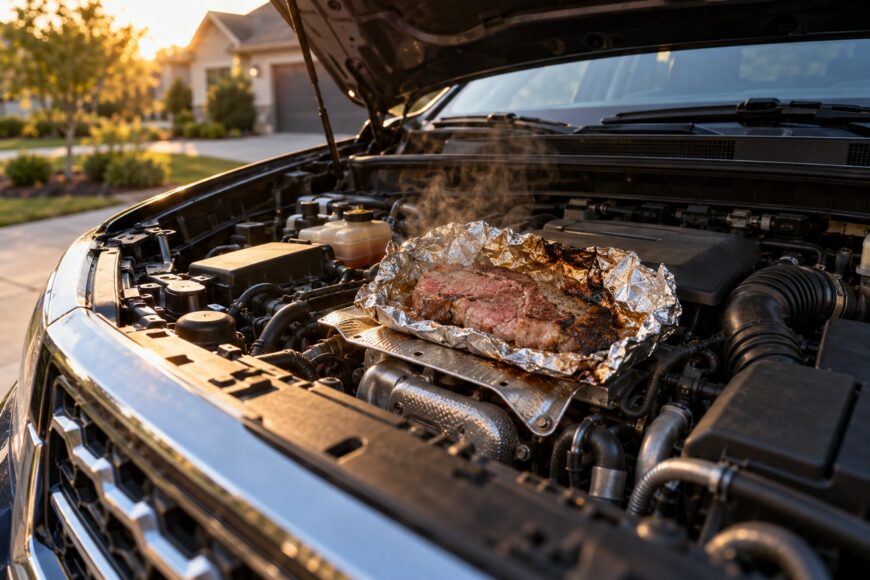
Turning a Ford Explorer into an improvised cooker has an obvious appeal: drive somewhere, open the hood, and find dinner waiting. The idea makes for a striking experiment, especially when a foil-wrapped steak appears to come off a hot engine ready to eat.
Engine heat can warm meat and may slowly cook it under some conditions. It does not offer the clean, stable, high-temperature cooking surface that makes a good steak predictable. The gap between a viral demonstration and a safe meal matters for both the person eating it and the vehicle carrying it.
Can a Ford Explorer Engine Cook a Steak?
Most modern engines run with coolant at approximately 195–220°F (90–105°C) during normal operation. That indicates the engine produces substantial heat, but coolant temperature is not the temperature of every surface under the hood. A steak develops a browned crust on a cooking surface of approximately 230–260°C, well above the temperature of many accessible engine-bay surfaces.
Exhaust manifolds or headers and turbochargers are among the hottest areas; an exhaust manifold can locally exceed 300°C. That figure does not make it a usable griddle. Its temperature changes with engine load, while airflow, shielding, and the shape of the part affect how much heat reaches a package resting nearby.
The result also depends on the Explorer’s engine configuration, outdoor temperature, traffic, and driving load. Even if two drives follow the same route, the meat may receive different amounts of heat. There is no manufacturer-approved cooking position that turns those variables into a dependable recipe.
A Ford Explorer engine may warm a steak or slowly cook parts of it. It cannot reliably deliver a clean, controlled sear or a predictable food-safe result, so a browned exterior in a video should not be taken as proof that the center is cooked.
Why the Viral Method Produces Bad Steak
Foil traps moisture around meat. Instead of drying and browning against a hot pan, the steak can steam in its own juices and emerge gray, soft, and closer to boiled meat than grilled steak. Most engine-bay surfaces cannot sustain the approximately 230–260°C cooking surface associated with a dependable crust.
Heat also reaches a wrapped steak unevenly. An edge pressed against a warm surface may overcook while the center stays cool, and a thicker cut magnifies that difference. Reports from people trying engine cooking describe approximately 30–90 minutes of driving, with results that vary substantially; that range is not a cooking timetable.
Highway driving generally places a steadier load on the engine than stop-and-go traffic, yet weather and vehicle behavior still change the heat reaching the meat. A 20–30 minute drive is not a reliable guarantee that a steak is safely cooked. A warm outer layer is especially poor evidence of what has happened at the center.
Thin steaks up to about 1.5–2 cm and smaller portions heat more readily than thick or large cuts. That explains why experiments can produce different-looking results without proving that either portion is safe. Thickness may reduce the heating problem; it does not provide temperature control or protection from contamination.
The Hidden Risks Under the Hood
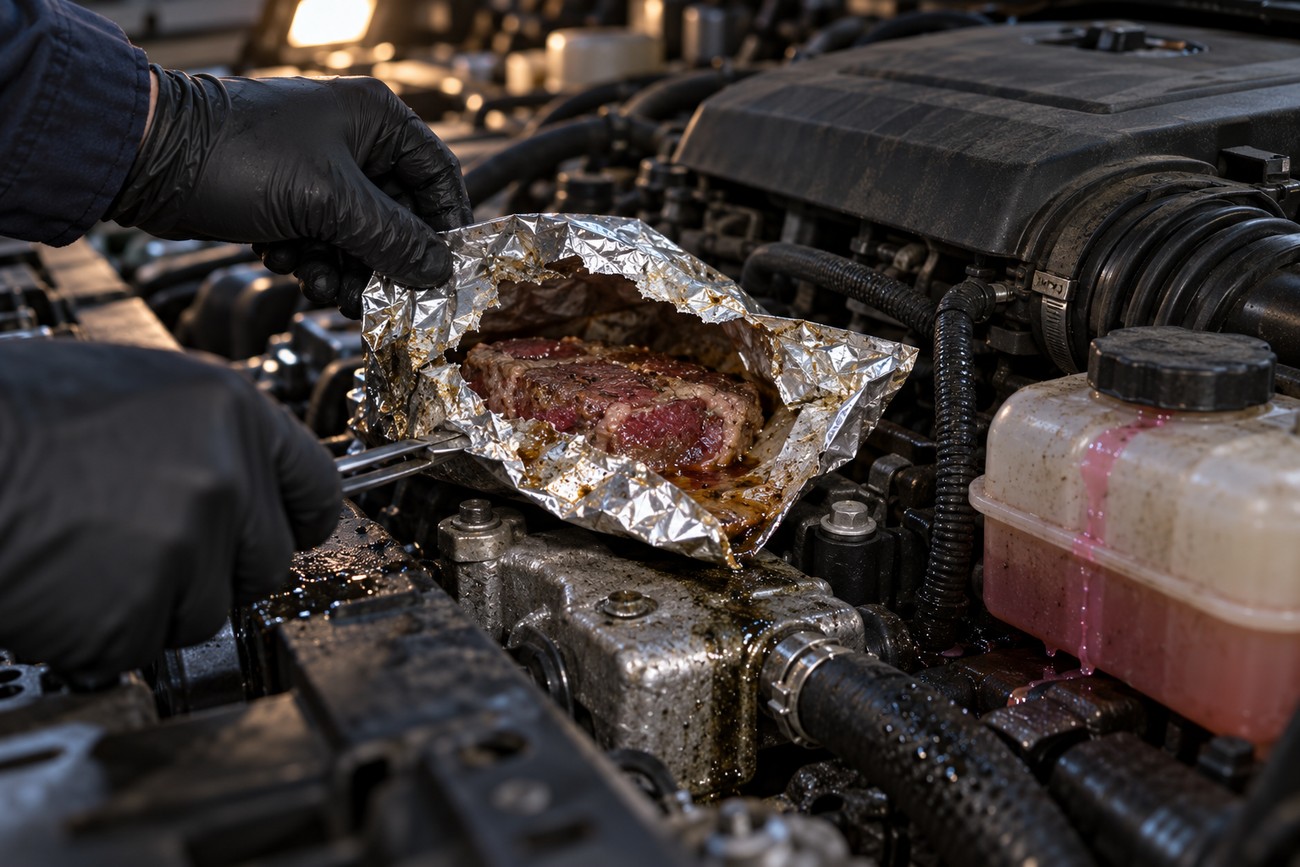
An engine bay is a maintenance space, not a food-preparation area. Oil, fuel, coolant, grease, and dirt may be present, while heated plastics and rubber can give off fumes. Food touching those surfaces, or a wrapper contaminated during handling, creates a risk that does not exist on a clean cooking surface.
Multiple foil layers can reduce direct contact and leakage risk, but they cannot guarantee food safety or eliminate exposure to under-hood contaminants. Foil may tear on a sharp edge or leak where it is folded. A package that looks intact from above may still have touched residue underneath.
A loose package can shift, fall, or contact moving components or hot exhaust hardware. Trying to hold one in place can press it against wiring, hoses, sensors, or plastic parts. A misplaced bundle may also obstruct cooling airflow or make a developing leak harder to spot.
The danger continues after the vehicle stops. Exhaust components and surrounding parts can burn skin, and reaching for food in a crowded engine bay brings hands close to equipment that was never arranged for cooking access. An unpleasant smell from heated residue is a reason to inspect the vehicle, not a sign that dinner is nearly ready.
Vehicle manuals do not provide engine-bay cooking procedures and warn about hot surfaces, burns, fire, and fumes. A sealed package lowers some contact risks; it does not make the environment food-safe or make the practice manufacturer-approved. Damage or fire arising from an added package could also complicate an insurance claim, depending on the circumstances and policy.
A Safer Way to Recreate the Experiment
If the appeal is a steak at the end of a drive, cook it with a skillet, grill, or controlled oven and carry it in a clean, food-safe container. Those tools provide a surface intended for food and heat you can adjust. Keep perishable food at a safe temperature during transport rather than treating the engine bay as storage.
For the browned crust shown in cooking videos, sear the steak on a proper cooking surface and finish it under controlled heat. Pre-searing and controlled finishing are more predictable than asking an engine to complete the job. They also let you separate cooking from the oil, dirt, and hot vehicle parts under the hood.
Use a calibrated meat thermometer to check the thickest part. In this situation, elapsed driving time and the appearance of the outside cannot verify the internal temperature. USDA guidance recommends at least 145°F (63°C) internally for steak, followed by a rest period.
Do not apply the steak minimum to every kind of meat. Ground meat should reach 160°F (71°C) internally, and poultry should reach 165°F (74°C). Those distinctions matter if an engine-cooking video swaps a whole steak for a burger or chicken while keeping the same casual timing advice.
Frequently asked questions
Common steak shortcuts and appliance timings are useful only when their limits are clear. Neither a catchy rule nor a time borrowed from another heat source can verify that meat is cooked through.
What is the 3-3-3 rule for steaks?
The 3-3-3 rule is an informal timing convention, often described as three minutes on one side, three on the other, and three minutes of rest. It is not a doneness or food-safety standard. Pan heat, steak thickness, and starting temperature can all change the result, so check the center with a meat thermometer rather than relying on the slogan.
How long should I cook steak on a George Foreman grill?
There is no universal time for a steak on a George Foreman grill. Models heat differently, and the time also changes with steak thickness, starting temperature, and desired doneness. Preheat the grill as its manual directs and use its guidance as a starting point. Then check the steak’s center with a thermometer without touching the hot plates with the probe. For the USDA steak minimum, look for at least 145°F (63°C) internally and allow a rest period. If you are cooking a burger or poultry instead, use their higher required internal temperatures.







