
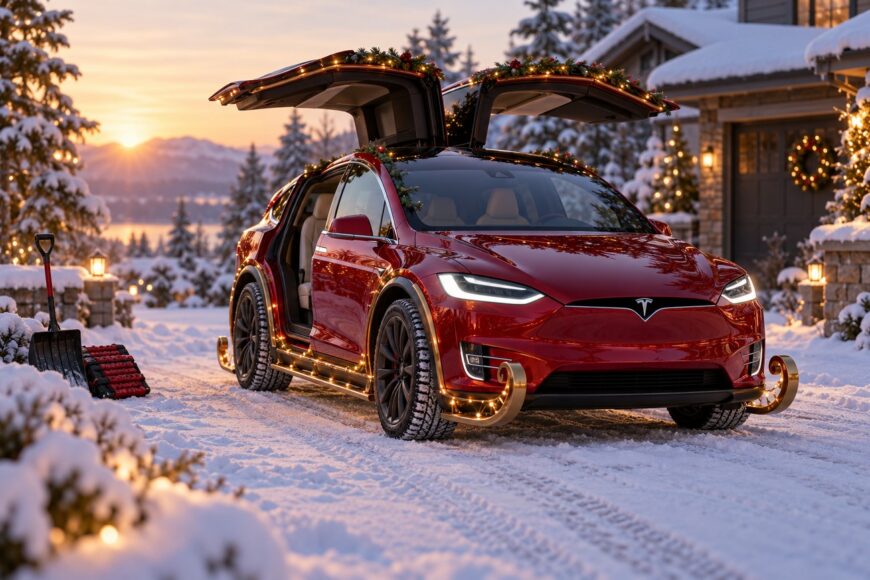
The Tesla Model X already has the proportions of a modern Santa’s sleigh: a tall body, a commanding glasshouse, generous cargo space, and dual-motor all-wheel drive. Add a restrained roof silhouette, warm lighting, and a few removable details, and the result can look festive without becoming a rolling prop display.
Winter exposes the difficult parts of that idea. Cold weather reduces real-world range, cabin and battery heating consume energy, and a cold battery can charge more slowly. Snow and ice also complicate the Falcon Wing doors, while exterior decorations can affect visibility, sensors, paint, door seals, electrical systems, and road compliance.
The safest approach is a removable seasonal conversion. Treat the Model X as a capable winter vehicle first and a Santa’s sleigh second. The quality of the project depends on tire choice, attachment design, power management, and testing more than on the amount of decoration.
- Is the Tesla Model X a Good Base for Santa’s Sleigh?
- Winter Range, Heating, and Charging: The Real Constraint
- Designing the Sleigh Look Without Damaging the Car
- Powering Lights and Audio Without Draining the Tesla
- Visibility, Sensors, Doors, and Public-Road Safety
- A Practical Build-and-Test Plan for a Removable Sleigh
- Frequently asked questions
- What hidden Model X features can help with a Santa sleigh display?
- Which Model X model year should you avoid for a winter sleigh conversion?
- Why is Tesla discontinuing the Model X, and does that matter for this project?
Is the Tesla Model X a Good Base for Santa’s Sleigh?
Production Model X versions use dual-motor AWD, giving the vehicle useful traction when pulling away on snow-covered roads. The tall body also creates a recognizable sleigh profile without requiring a large external structure. Its cargo-friendly shape provides room for lightweight props, cables, covers, and winter equipment.
That capability has limits. The Model X is heavy for a passenger SUV or crossover, so its tires, brakes, and low-grip control systems work harder on snow and ice. AWD can help with launching and stability, yet it cannot create grip where the road surface has little friction. Braking distance and cornering behavior still depend on tires, speed, surface conditions, and vehicle mass.
The large glass area adds visual drama, especially in photographs, but it also creates more surfaces to clear after snowfall or freezing rain. A clean roofline and an elevated camera angle may provide the sleigh impression with less exterior hardware. This matters because every added panel, arch, or prop can increase wind load and the chance of contact with the body.
Falcon Wing doors need a dedicated inspection before any decoration is installed. Snow, ice, dirt, sealing surfaces, overhead clearance, and nearby mounting points can all interfere with normal operation. Keep the area around the doors, hinges, sensors, and seals clear, and never assume that a decoration will remain stationary as the panels move.
Winter Range, Heating, and Charging: The Real Constraint
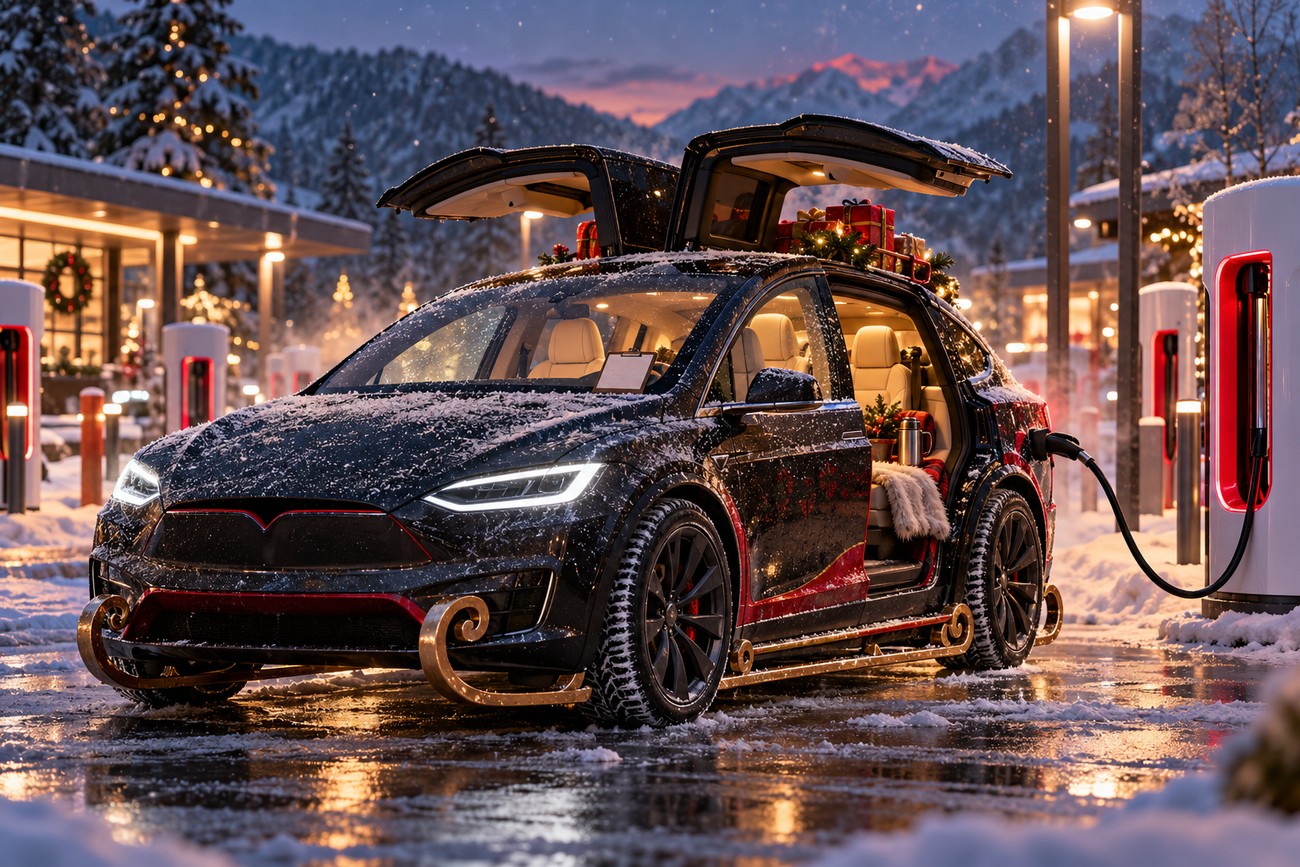
Official Model X range varies by version and wheels. Real-world winter range is typically lower because of temperature, heating, battery conditioning, driving conditions, and winter tires. A festive trip may also include idling at a photo location, repeated door operation, and slow urban driving, all of which complicate a simple distance estimate.
Cabin heating, seat heating, and battery heating draw energy directly from the vehicle’s available energy. The effect is especially noticeable on short winter trips, where the vehicle spends a larger share of the journey warming the cabin and conditioning the battery. Preconditioning while connected to a charger can reduce the energy burden during the drive, provided the route and charging access are planned in advance.
Cold weather affects charging as well as driving. A cold battery can accept charge more slowly, particularly before it has reached a suitable operating temperature. A route that appears comfortable on a mild day may therefore need more time at the charger in winter, especially if the car arrives with a cold battery and limited time before the next appointment.
Winter tires deserve priority over decorative power or extra motor output. Owner discussions commonly emphasize moderate or narrower winter tires and correct pressure for winter traction. Check pressure when the tires are cold, inspect tread and sidewalls, and remember that a heavily decorated vehicle may place additional practical demands on a tire already working on a slippery surface.
Plan the route with a reserve for weather, traffic, heating, and a slower charging session. A short photo shoot can consume more energy than expected if the car remains awake with lights, audio, doors, or accessories operating. Range planning should cover the complete event, including the return journey and a realistic charging alternative.
Designing the Sleigh Look Without Damaging the Car
A convincing sleigh conversion needs a balanced silhouette rather than a heavy sculpture. A lightweight roof outline, discreet rear treatment, and warm, low-current lighting can establish the theme while leaving the Model X recognizable. The tall body already supplies much of the visual height, so the decoration can remain deliberately simple.
Use removable mounts that avoid paint edges, mirrors, wheel arches, door seals, and moving panels. Adhesive, clips, suction mounts, and straps all need a surface-specific assessment; a method that holds in a garage may fail under airflow, vibration, wet snow, or road spray. Heavy pieces create greater aerodynamic loads and can damage paint even when they remain attached.
Wet snow changes the behavior of decorative materials. Washing followed by overnight freezing can make flexible parts rigid, brittle, or difficult to remove. Moisture can also work under tape and clips, while repeated removal may leave residue or pull at vulnerable paint edges. Protect contact points, inspect the finish after each use, and remove the setup before it becomes frozen to the vehicle.
Photography rewards proportion and positioning. A high camera angle, a clear roofline, and even lighting often produce a stronger Santa’s sleigh effect than a crowded exterior. Keep the decoration compact enough for normal parking and low-speed maneuvering, since a wide or projecting assembly can make everyday driving awkward.
Powering Lights and Audio Without Draining the Tesla
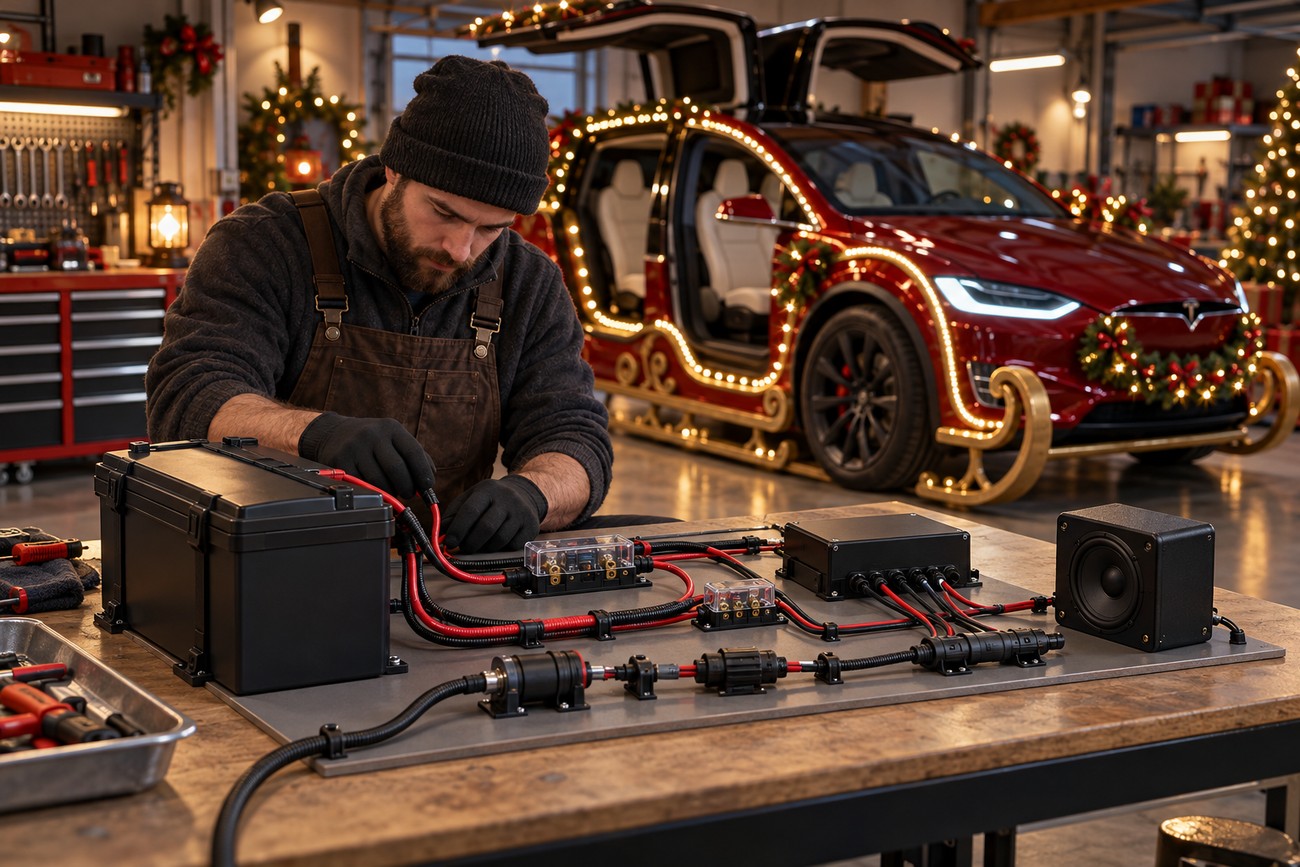
Plan decorative electrical loads separately from the traction battery system. Lights, speakers, controllers, and small accessories can burden the 12V system while also increasing overall energy consumption. The safest design uses a separate, clearly understood auxiliary arrangement rather than improvised connections to vehicle wiring.
Calculate the load for every added circuit and protect it with an appropriate fuse. A fuse should match the wiring and expected load; it is not a substitute for selecting suitable cable, connectors, insulation, and weather protection. Directly attaching a string of lights to an unknown vehicle circuit creates avoidable risk and makes faults harder to diagnose.
Low-current, evenly distributed lighting usually suits the sleigh theme better than maximum brightness. Select equipment with proper heat dissipation, protect connectors from spray, and keep controllers away from water traps and hot surfaces. Warm, consistent illumination can outline the vehicle without obscuring factory lamps or distracting other road users.
Large auxiliary loads can interfere with vehicle sleep behavior and contribute to unexpected cold-soak drain while the car is parked. Test the decoration while stationary, then check the vehicle after it has been left closed and unplugged. If the system remains active when the car should be resting, redesign the control method rather than accepting the drain as part of the display.
Visibility, Sensors, Doors, and Public-Road Safety
A private-property display and a vehicle intended for public roads are different use cases. On private land, a larger photo prop may be manageable under controlled conditions. Public-road use requires unobstructed lighting, cameras, sensors, mirrors, driver sightlines, plate visibility, secure attachments, and compliant dimensions under the rules that apply where the vehicle is driven.
Inspect the finished vehicle from the driver’s seat and from outside at several angles. Decorations must not cover headlights, lamps, cameras, sensors, mirrors, or the plate. They should also avoid creating reflections or shadows that make it harder to judge the vehicle’s edges in darkness, snow, or wet conditions.
Keep all moving zones clear. Falcon Wing doors need space for their movement and clean contact with their sealing surfaces. Snow and ice can accumulate around the roof, door edges, and sensors, while a loose ribbon or rigid prop may become trapped as a door opens. Test both sides repeatedly after fitting the decoration, including in the cold conditions in which the car will actually operate.
External dimensions matter even when the decoration seems light. A projecting antler, sleigh rail, or rear ornament can contact another vehicle, a garage, a snowbank, or a pedestrian area during low-speed maneuvering. Secure every component against wind and vibration, and remove anything that becomes loose, obstructs the view, or affects normal access to the vehicle.
Local requirements vary, so check them before driving on public roads. A festive appearance does not exempt the vehicle from lighting, visibility, attachment, or equipment rules. If the complete setup cannot satisfy those requirements, reserve it for a stationary display or private photo location.
A Practical Build-and-Test Plan for a Removable Sleigh
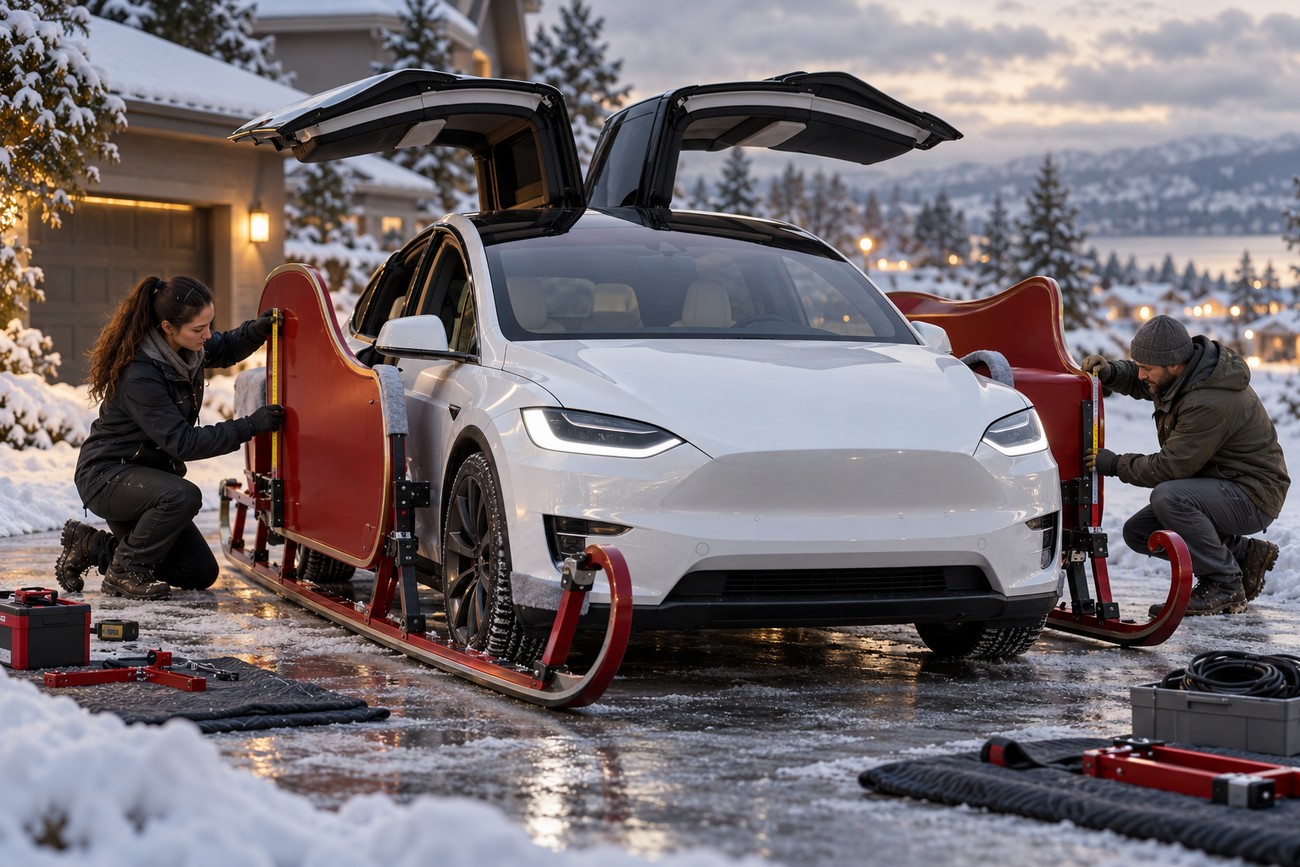
Start by defining the use case: a parked display, a private photo shoot, a short public-road appearance, or regular winter travel with seasonal styling. That decision sets the acceptable size, lighting, mounting method, and inspection standard. Sketch the complete vehicle before buying parts, including door movement, sensor locations, charging access, and storage for the removed components.
Choose lightweight, removable parts and keep the visual mass close to the vehicle’s centerline. Fit mounts without touching paint edges, mirrors, wheel arches, seals, or moving panels. Route electrical cables away from doors and sharp edges, and label any auxiliary equipment so it can be disconnected without disturbing the car’s original systems.
Test the complete setup while stationary. Check attachment security, paint contact, door operation, cameras, sensors, mirrors, driver sightlines, lights, plate visibility, charging access, and electrical load. Confirm that the tires have the correct cold pressure and that the braking area is free of loose material. This is the stage to find a bad clip or an obstructed camera, before snow and road speed add more variables.
Adhesive and clip behavior should be checked after a wet wash-and-freeze cycle before the decoration is trusted at road speed. A mount that feels secure when dry may loosen, stiffen, or shift after moisture gets under its contact surface.
Make the first winter drive short and low speed, preferably on a route with safe stopping areas. Assess steering response, braking, wind noise, vibration, door operation, and any movement in the decoration. Allow extra energy for heating and battery conditioning, and plan for slower charging if the battery is cold.
After the test, remove the decoration and inspect the paint, seals, clips, wiring, and body edges. Do not leave a temporary setup installed through repeated freezing, washing, or road-salt exposure. A removable seasonal system reduces long-term exposure to adhesive residue, failed clips, weathering, and paint damage.
Frequently asked questions
The best Model X sleigh conversion depends on the intended use and the condition of the individual vehicle. These questions address configuration, buying decisions, and long-term support without treating a seasonal display as a reason to compromise the car’s safety systems.
What hidden Model X features can help with a Santa sleigh display?
Existing vehicle features can often provide the presentation effect without adding unnecessary electrical accessories. Use the vehicle’s built-in lighting, audio, climate controls, charging controls, and display functions where available, then keep added decoration simple and low-current. This reduces wiring, heat, connector exposure, and the chance of an accessory remaining active while the vehicle is parked.
Availability varies by model year, software version, and configuration. Check the exact vehicle rather than assuming that every Model X has the same presentation or convenience features. Any feature used for a display should still leave cameras, lights, doors, and driver controls fully usable.
Which Model X model year should you avoid for a winter sleigh conversion?
There is no responsible blanket answer based on model year alone. Screen the individual vehicle for battery condition, charging behavior, Falcon Wing door operation, sealing, tire setup, brake condition, and service history. A well-maintained example with sound winter tires is a stronger starting point than a newer-looking car with unresolved door, charging, or battery issues.
Inspect the car cold, test charging, operate both rear doors, and look for warning messages or inconsistent behavior. Confirm that the intended decoration will not interfere with the specific cameras, sensors, software features, or equipment fitted to that vehicle. The conversion should remain removable regardless of year.
Why is Tesla discontinuing the Model X, and does that matter for this project?
Production and lineup claims can change, so they should be separated from the practical buying decision. For a seasonal conversion, parts availability, service access, software support, battery condition, and the vehicle’s current maintenance record matter more than speculation about future production.
A used Model X can still suit the project if its essential systems work correctly and replacement parts and service are realistically accessible in the owner’s region. Price the condition of the car, including tires, doors, charging equipment, and cosmetic repairs, before budgeting for decorative parts. A festive conversion should never be used to disguise unresolved mechanical, electrical, or safety problems.







