
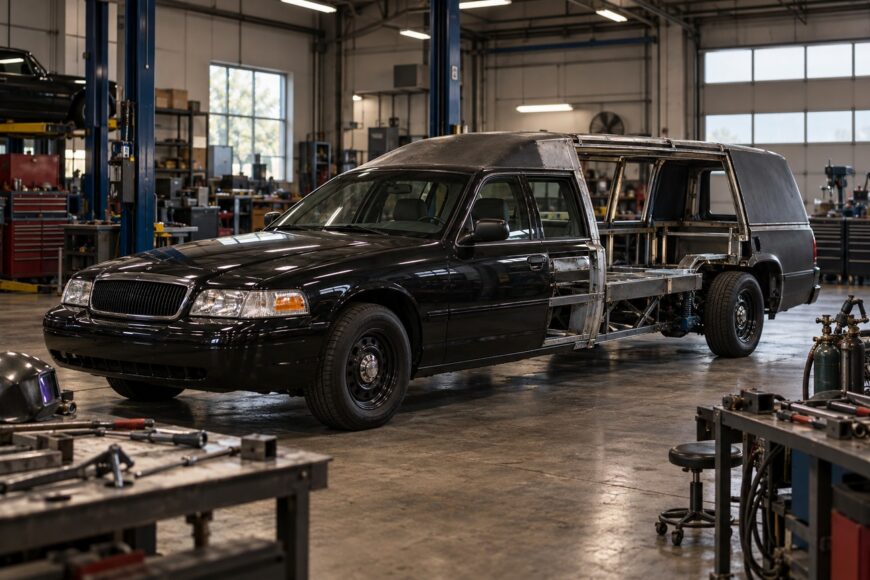
A Ford Crown Victoria looks like an appealing hearse donor: rugged, inexpensive, mechanically familiar, and built on a chassis that tolerates custom bodywork. Its long rear-wheel-drive layout also suits the visual language many builders want. That combination can make the project seem simpler than it is.
A hearse conversion changes structure, load behavior, systems, and potentially the vehicle’s legal status. The finished car must manage a coffin, platform or rollers, interior finish, decoration, and service equipment while remaining stable, controllable, weatherproof, and insurable. A car that looks convincing at a show may still be unsuitable for repeated funeral-service work.
The first decision is therefore practical: are you building a roadworthy service vehicle or a visual show project? Both can be valid goals, but they require different compromises, budgets, testing standards, and documentation.
- Is a Crown Victoria a sensible hearse donor?
- Choose the donor by condition, not by badge
- Define the hearse layout before cutting metal
- What the structural conversion actually involves
- Recalculate suspension, braking, and operating systems
- Plan certification, insurance, and registration before the build
- The hidden costs and failures that change the project
- Common mistakes, myths, and show-build compromises
- A practical build sequence and pre-road checklist
- Frequently asked questions
- What year Crown Vic should you stay away from?
- How much does a funeral hearse cost?
- Why don’t police use Crown Vics anymore?
- How should a converted hearse be tested before carrying a coffin?
Is a Crown Victoria a sensible hearse donor?
Ford Crown Victoria, Mercury Grand Marquis, and Lincoln Town Car models use the body-on-frame Panther platform. That construction can simplify a special-body conversion compared with a unibody car because the frame provides a defined structural base for extended or altered bodywork. It also gives builders access to a large supply of familiar suspension, drivetrain, and service parts.
The platform’s usefulness has limits. Crown Victoria production ended in 2011, and most available donors are now 15+ years old. Age brings frame corrosion, tired wiring, worn bushings, neglected cooling systems, and uncertain drivetrain history. A strong platform cannot compensate for a donor that has already spent years in harsh service or poor storage.
Geometry matters as much as construction. The wheelbase, rear overhang, roofline, opening height, axle position, and available interior volume determine whether the proposed layout will work. A stretched silhouette may look right while leaving an awkward loading angle, excessive rear weight, or insufficient clearance for practical handling.
A factory hearse donor may therefore be the more rational starting point, even if its purchase price or appearance is less attractive. The Crown Victoria is a workable custom platform, not an automatic substitute for a purpose-built vehicle. Decide whether the donor supports the intended duty cycle before committing to its badge or styling potential.
Choose the donor by condition, not by badge
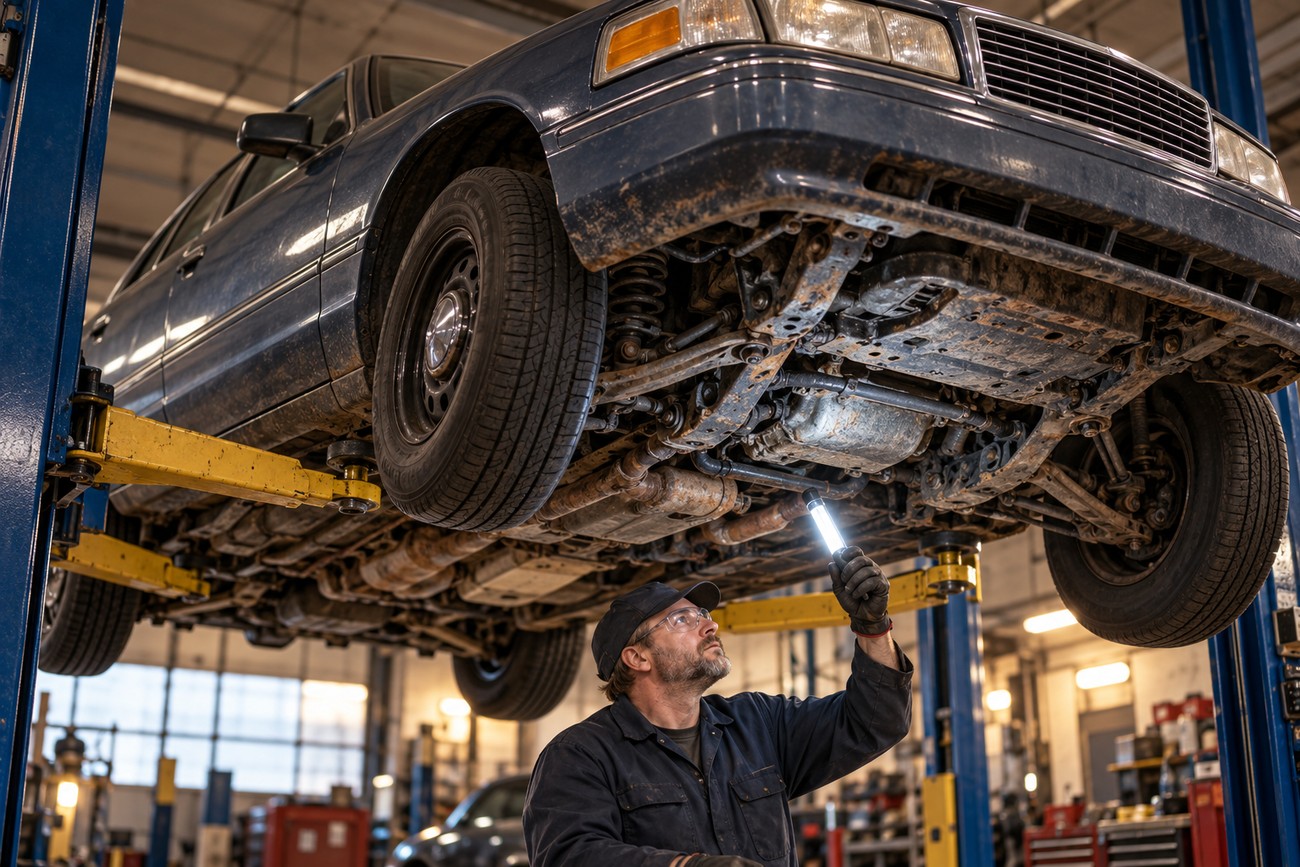
Inspect the frame before discussing paint, upholstery, or body length. Check visible rails, crossmembers, suspension mounting areas, and corrosion around repaired or modified sections. The decisive donor factors are frame condition, corrosion, geometry, and the availability of usable examples.
Confirm that the car tracks correctly and that its suspension mounting points remain sound. Examine the brakes, differential, driveshaft, transmission, cooling system, charging system, and electrical connectors. A typical Crown Victoria Police Interceptor uses a 4.6-liter SOHC V8 and rear-wheel drive, with reinforced cooling and suspension, but that equipment does not automatically establish hearse payload suitability.
Police-service history can be useful and damaging at the same time. Reinforced equipment may provide a better starting point, while long periods of idling, heavy braking, curb impacts, and fleet repairs may have consumed the vehicle’s remaining margin. A complete inspection with service records is more valuable than a trim label.
Former hearses can supply doors, glass, panels, seals, platform hardware, or interior components that are difficult to reproduce. Many builders reduce risk by reusing such parts because their dimensions and interfaces already work together. A cheap Crown Victoria with no compatible components may cost more to finish than a sound donor paired with recovered hearse hardware.
Define the hearse layout before cutting metal
The design should begin with working dimensions rather than exterior styling. Measure the required coffin length and width, platform position, interior clearance, rear opening, partition location, and usable space for attendants. Draw the loading path with the vehicle at realistic ride height.
Rear overhang, opening height, loading angle, rear-axle capacity, and load balance are critical hearse parameters. The loading angle and loading height can matter more in daily use than a low, stretched exterior silhouette. A platform that looks centered in a side view may create an awkward lift, steep ramp, or excessive leverage on the rear structure.
A coffin fitting inside does not prove that the vehicle safely carries the complete operating load. The calculation must include the coffin, platform or rollers, interior finish, decoration, and service equipment. The rear axle, tires, springs, dampers, brakes, and frame all experience the result of that combined arrangement.
Freeze the layout before ordering glass or fabricating panels. Small changes to the partition or platform can affect wiring routes, ventilation, door openings, and axle loading. Building the shell first and solving the working dimensions afterward usually creates expensive rework.
What the structural conversion actually involves
A hearse conversion commonly changes the rear body, partition, floor, glazing, interior wiring, and coffin-platform mounts. That scope makes the project structural work rather than cosmetic customization. The original sedan body was engineered as a system, so every cut or extension affects alignment, stiffness, sealing, and access.
The rear floor needs a controlled load path into the frame or approved structural areas. Platform mounts must resist movement during braking, turning, and uneven-road impacts. Doors, hatch interfaces, window openings, and the partition must remain square enough to close, seal, and operate after the body has been altered.
Factory-hearse doors, glass, seals, and platform hardware preserve alignment that is difficult to recreate from universal parts. They also reduce the improvised load paths that later become squeaks, leaks, and rattles.
Glazing and weather sealing deserve the same attention as the visible body panels. Custom glass, rubber profiles, and trim rarely fit by assumption, and universal solutions often require manual fitting. Poor sealing can expose the floor, wiring, upholstery, and structural joints to moisture long after the paint still looks fresh.
Finish work should wait until geometry and rigidity have been verified. A weak or poorly aligned rear body can produce noise, vibration, and rattles, while inaccessible structural repairs make later troubleshooting slow and costly. Route electrical wiring where it can be inspected and protected from moisture, moving hardware, heat, and future fastener work.
Recalculate suspension, braking, and operating systems
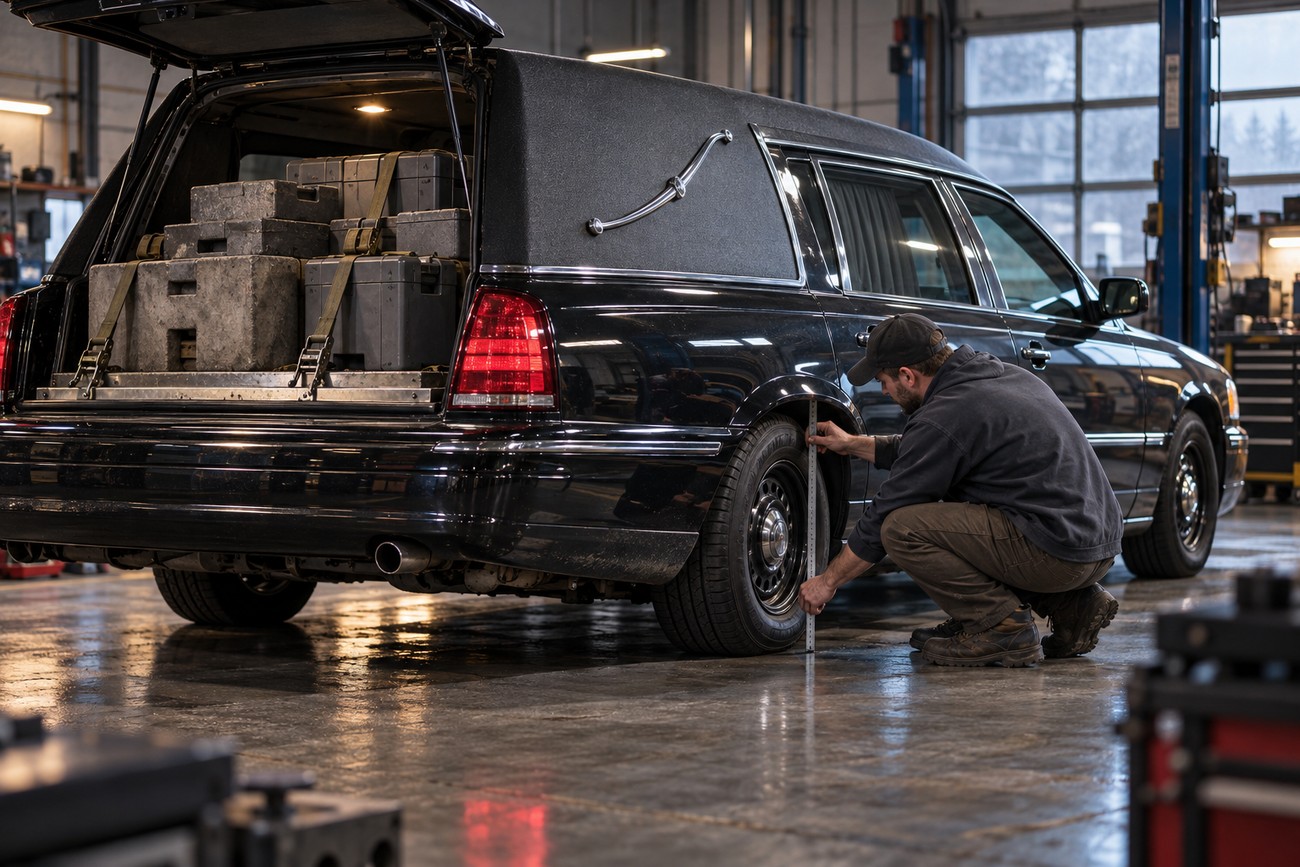
The loaded vehicle must define the chassis setup. A finished hearse is usually heavier and less efficient than the original Crown Victoria, and the added mass changes acceleration, braking, ride height, and fuel consumption. An empty test drive can hide problems that appear as soon as the platform and service equipment are installed.
Watch for rear sag, reduced suspension travel, bottoming, tire interference, and changes in steering response. Springs and dampers must suit the actual build, while the brakes must remain predictable with the intended operating load. For a heavy hearse body, transmission condition, brakes, suspension, and cooling reserve matter more than headline engine power.
The load calculation must include the coffin, platform or rollers, interior finish, decoration, and service equipment; there is no single standardized figure for every build. Check the rear axle and tire ratings against the calculated arrangement, then verify that the load remains restrained during braking and cornering.
Operating systems deserve equal attention. Cooling capacity, charging output, interior lighting, ventilation, moisture protection, and wiring protection influence reliability during slow processions and extended idling. Secure retainers and a protected, washable floor can matter more to service use than decorative trim.
Plan certification, insurance, and registration before the build
A structural hearse conversion may require inspection or certification as a modified, reconstructed, or special-purpose vehicle. Requirements depend on the relevant country, state, or jurisdiction; there is no single universal rule. The classification may affect the title, inspection route, lighting, glazing, restraint requirements, and insurance.
Contact the relevant authority and insurer before cutting the car. Ask what drawings, photographs, receipts, engineering statements, weight information, and inspection records will be required. Confirm whether the vehicle must retain particular lighting, mirrors, glazing markings, door latches, seat-belt equipment, or identification information.
Custom-build marketing often presents the work as a styling exercise. Regulators may treat the same work as a significant change to the vehicle’s construction and intended use. A finished appearance does not prove legal approval, safe load capacity, or insurability.
Keep a build file from the first inspection onward. Record the donor identity, structural changes, component sources, material specifications, wiring changes, axle and tire information, photographs, and test results. Clear documentation cannot replace compliance, but missing records can make an otherwise competent conversion harder to approve or insure.
The hidden costs and failures that change the project
Paint and decoration are visible costs, so they often receive early attention. The larger risks can sit underneath: bodywork, glazing, structural reinforcement, suspension changes, weather sealing, and documentation. Each area can require specialist labor, custom fitting, or a second round of repairs when the first solution proves unsuitable.
Rare glass, custom panels, and unusual trim can reduce resale appeal. Replacement parts may require fabrication or salvage sourcing, and a future buyer may value the car as a curiosity rather than as a dependable working vehicle. That narrow market makes careful component selection important from the beginning.
Electrical rework can expand quietly after the rear body is removed. New lighting, switches, ventilation, platform equipment, and interior fixtures need protected routes and service access. If wiring is buried under finished panels, a minor fault can require dismantling the very interior that took the most time to install.
A discarded factory hearse may be cheaper and more predictable to restore than converting an ordinary Crown Victoria from scratch. Its body geometry, glass, doors, seals, and platform may already solve the most difficult interfaces. Compare the total restoration scope rather than the purchase price of the first donor you find.
Common mistakes, myths, and show-build compromises
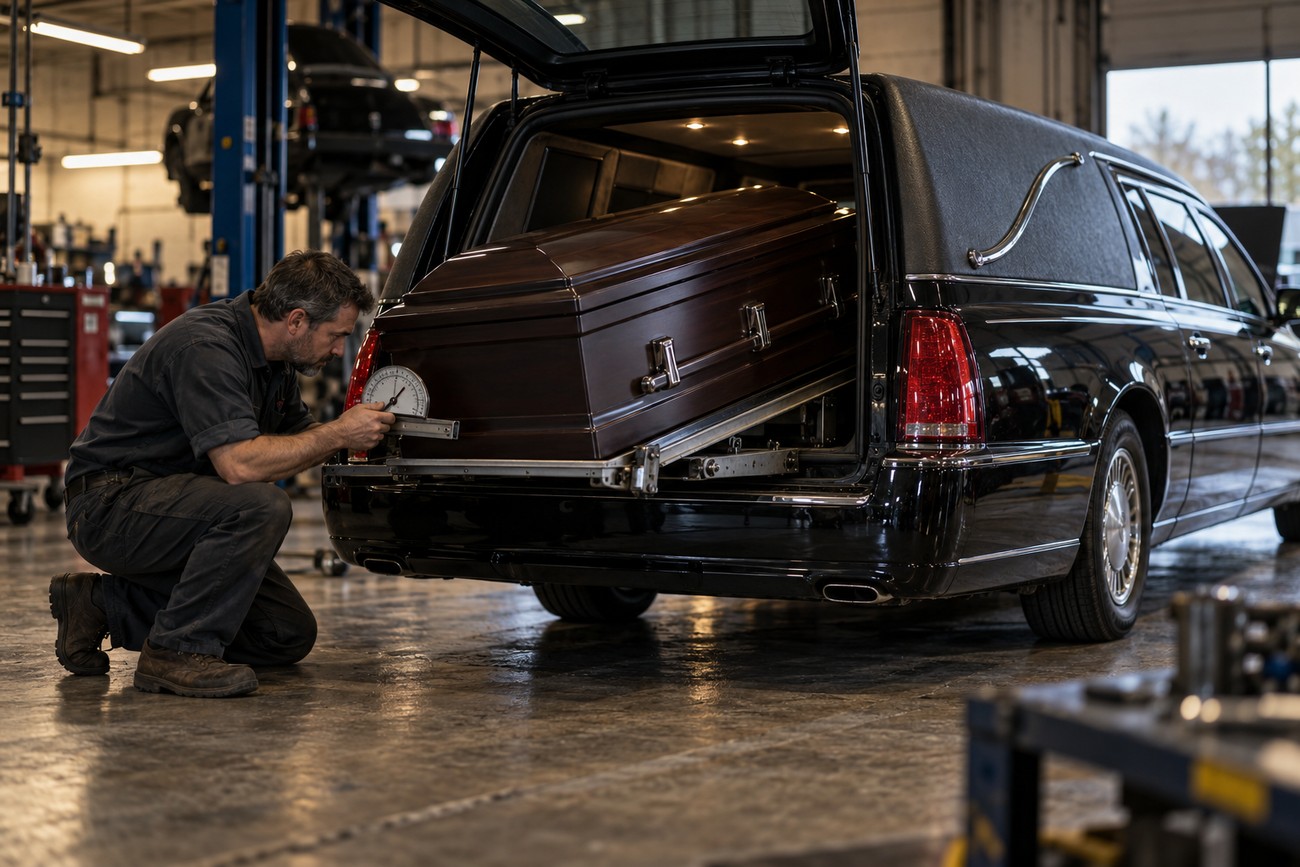
The idea that a long trunk is enough fails at the first loading test. A useful hearse needs the correct opening height, loading angle, platform position, interior clearance, securement, and axle balance. Extending the rear body without recalculating those elements can create a car that accepts the coffin yet handles poorly.
Any long sedan will work is another misleading shortcut. Body-on-frame construction can simplify special-body conversion compared with a unibody car, while geometry, weight, component availability, and legal treatment still govern the result. A less fashionable donor with sound structure and compatible parts may be the better engineering choice.
A hearse-like appearance proves nothing about safety or approval. The vehicle may have inadequate suspension travel, weak platform mounts, poor braking behavior, unsealed glass, or insurance restrictions hidden behind a polished finish. Appearance should be treated as the final layer of the project.
Lowering the suspension can improve the visual silhouette, but excessive lowering can worsen loading and unloading and reduce practical clearance. It may also remove suspension travel needed for a heavy rear body. Set ride height from the working load and loading path, then evaluate the stance within those limits.
Show builds can omit ventilation, interior lighting, floor moisture protection, and practical load retainers because those details are rarely visible in photographs. A ceremonial display vehicle can accept different compromises from a vehicle intended for repeated funeral-service work. State the intended use clearly before choosing which compromises are acceptable.
A practical build sequence and pre-road checklist
Start by confirming jurisdictional, registration, and insurance requirements. Inspect and document the donor before disassembly, including frame condition, corrosion, geometry, drivetrain, brakes, wiring, and cooling. Freeze the operating-load layout before cutting metal, and source compatible hearse components wherever they reduce alignment or sealing risk.
Complete structural work before final paint and trim. Install the floor, partition, glazing, doors, platform mounts, seals, wiring, lighting, ventilation, and interior protection as an integrated system. Check fastener access and service routes while the structure remains open.
Test the unloaded vehicle first. Verify door and hatch operation, glass security, seal integrity, lighting, wiring, steering, suspension clearance, braking, cooling, and abnormal noise. Then repeat controlled checks with the complete operating load, rather than treating an empty road test as final evidence.
- Confirm the coffin platform and retainers prevent movement.
- Check doors, glass, seals, latches, and emergency access.
- Verify ventilation, interior lighting, and moisture protection.
- Inspect wiring for chafing, heat exposure, water entry, and service access.
- Confirm suspension clearance, ride height, tire clearance, and braking behavior under load.
- Complete the required inspection, title, registration, and insurance process before regular road use.
Frequently asked questions
What year Crown Vic should you stay away from?
There is no universal model year that should automatically be rejected. Condition matters more than a simple year rule, especially frame corrosion, body geometry, drivetrain history, brake condition, electrical repairs, and the quality of any previous modifications.
Ask for evidence that the donor can support the intended conversion and that its identity and documentation are clear. A newer but badly corroded or heavily abused car can be a worse starting point than an older, straight, well-maintained example. The conversion records will also matter if the vehicle later requires inspection or certification.
How much does a funeral hearse cost?
The cost depends on whether you are buying a finished hearse, restoring a former hearse, or converting an ordinary Crown Victoria. A meaningful budget separates donor acquisition from structural work, glass, doors and seals, paint, interior finish, platform hardware, suspension and brake changes, electrical work, certification, and restoration of the base vehicle.
A low purchase price can conceal expensive missing parts or inaccessible repairs. Compare the complete scope and legal pathway with a discarded factory hearse before choosing a standard sedan donor. Approval requirements and build costs vary substantially by jurisdiction and specification.
Why don’t police use Crown Vics anymore?
Crown Victoria production ended in 2011, and police fleets gradually replaced aging cars with newer platforms after production stopped. Fleet retirement reflects vehicle age, parts planning, safety requirements, operating costs, and procurement policy; it does not by itself prove that the Panther platform is unusable.
A retired Police Interceptor can still offer a familiar rear-drive layout, reinforced cooling, and reinforced suspension. Those features only describe the starting point. Hearse suitability still depends on frame condition, drivetrain reserve, axle loading, braking, structural work, and approval requirements.
How should a converted hearse be tested before carrying a coffin?
Begin with a detailed inspection of fasteners, welds, platform mounts, retainers, doors, glazing, seals, wiring, lighting, ventilation, and floor protection. Test the vehicle unloaded for steering, suspension clearance, braking, cooling, vibration, and abnormal movement. Resolve leaks, rattles, and alignment problems before adding the operating load.
Next, repeat the checks in a controlled area with the complete operating load, including the coffin, platform or rollers, interior finish, decoration, and service equipment. Confirm that the retainers hold, the rear suspension retains usable travel, the tires remain clear, and braking stays predictable. Document the results and complete any required inspection before carrying a coffin on public roads.







