
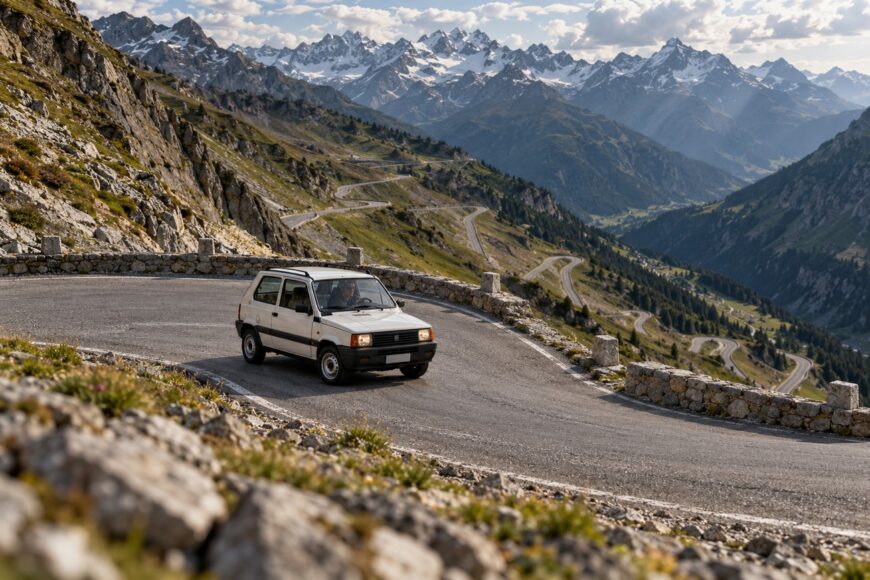
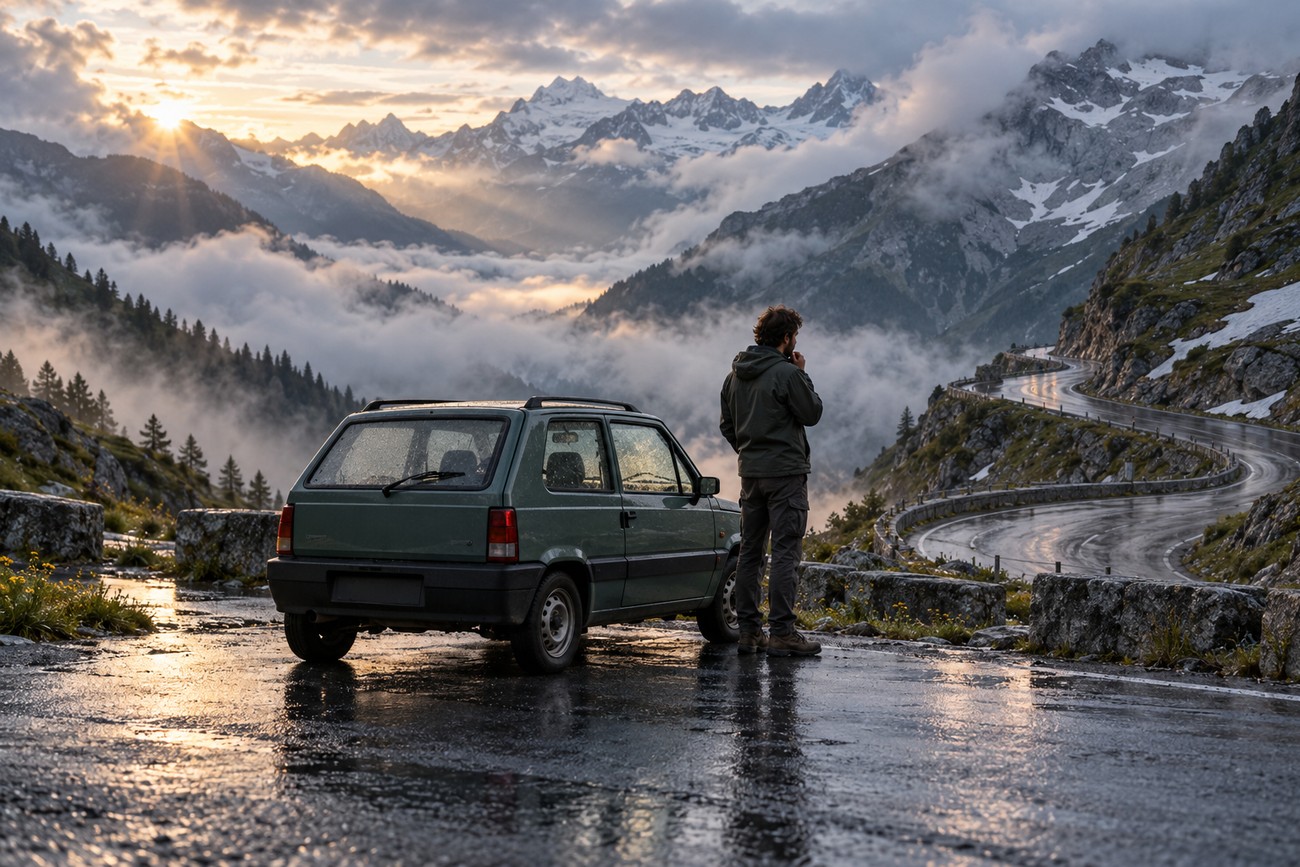
A Fiat Panda reaches Stelvio Pass at a different pace from the cars that make the climb look effortless. Its modest engine may spend much of the northern ascent working hard, with more noise, slower acceleration, and frequent gear changes. That can be entirely normal for a small car on a long Alpine road.
The useful question is therefore not whether a sound Panda can reach the summit. A roadworthy Fiat Panda can make the ascent, but the comfort and safety margin depend on the exact engine, the car’s condition, its load, the weather, and the driver’s decisions. A lightly loaded turbocharged version in good order has a different task from an older, naturally aspirated car carrying four people and luggage.
From the Prato allo Stelvio side, the road becomes a sustained test rather than a short steep hill. The summit is 2,757 m above sea level, and the northern valley approach gains approximately 1,800 m, with 48 numbered hairpins on the northern side. The route rewards patience and preparation more than momentum.
- What the northern climb actually demands
- Can your Fiat Panda make it? Engine, load, and condition
- Checks to make before leaving the valley
- Driving uphill without laboring the engine or cooking the clutch
- Hairpins, cyclists, and buses: finding a pace that works
- Normal small-car struggle versus a reason to stop
- The descent is the bigger test for the brakes
- Timing the attempt and knowing when to turn back
- Frequently asked questions
- How steep is Stelvio Pass?
- How much fuel should I have before starting the climb?
- How long does it take to cycle up Stelvio Pass?
What the northern climb actually demands
The northern ascent is famous for its sequence of tight bends and exposed mountainside sections. The 48 numbered hairpins require repeated braking, turning, acceleration, and repositioning, often at very low speed. Each individual corner is manageable; the demanding part is doing the same work again and again while the road continues to rise.
Approximately 1,800 m of elevation gain from the northern valley approach to the summit means a long period of engine load. The exact gain depends on the starting point, so it is better treated as an indication of the scale of the climb than as a precise measurement for every itinerary. A cited 48–49 km describes a longer northern approach, not a fixed Prato allo Stelvio-to-summit distance, and the endpoints should be checked before using that figure for route planning.
For a Panda, repeated slow corners can be harder than one dramatic ramp. The car must pull away many times, often after a brief stop for a bus, cyclist, or opposing vehicle. Low speeds reduce the cooling airflow, while acceleration out of a hairpin demands torque at the same time that the driver may be tempted to slip the clutch.
Traffic also changes the character of the climb. A map may suggest a simple continuous drive, yet the real road can include queues, uneven gaps between vehicles, and moments when you must wait for a clear view before passing. The result is a route where progress may feel slow even when the Panda is operating correctly.
Altitude adds another layer. As the air becomes thinner, a naturally aspirated engine has less oxygen available for combustion and can lose some of the response it has in the valley. That effect is gradual, so it may feel like the car is becoming reluctant rather than suddenly developing a fault.
Can your Fiat Panda make it? Engine, load, and condition
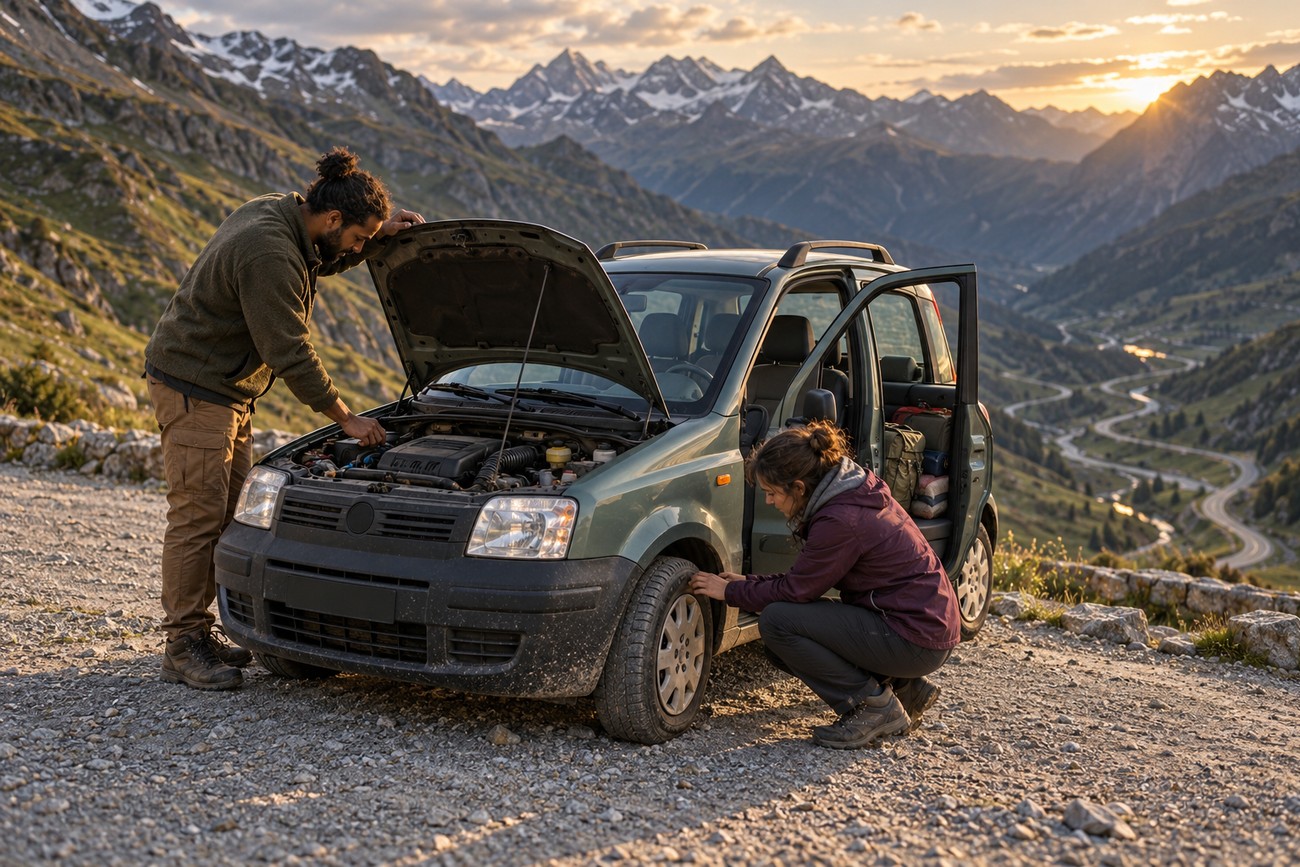
A roadworthy Fiat Panda can make the climb, provided the driver accepts its pace and the conditions are suitable. Panda versions include small petrol engines and, in some generations, turbocharged or 4×4 variants. Those descriptions alone do not establish how one particular car will behave, because age, maintenance, gearing, and load can matter as much as the badge on the tailgate.
A small naturally aspirated petrol engine may need lower gears and more revs for much of the ascent. That can produce a busy engine note and modest acceleration, especially above the tree line. A turbocharged version may feel stronger in the same situation, while a 4×4 model can offer useful traction on loose or slippery surfaces; four-wheel drive does not create extra engine power on dry asphalt.
Passengers and luggage have a direct effect on the climb. More mass makes every hairpin departure harder and increases the work required from the engine, clutch, and brakes. A car that feels relaxed with two occupants can feel noticeably strained with a full cabin and heavy bags, particularly when the road is slow and the driver cannot build speed between bends.
Condition is more important than an optimistic assumption about what a Panda “should” manage. A healthy clutch that engages cleanly, a cooling system in good order, and brakes with a firm, consistent pedal give the driver usable margin. A tired car may still climb for a while, yet the pass is a poor place to discover that a long-standing smell, slipping clutch, or weak cooling fan was an early warning.
Judge the car by how it behaves on a sustained local incline before committing to Stelvio. It should pull without repeated clutch abuse, maintain a stable temperature indication, and respond predictably when you select a lower gear. The aim is to learn the car’s working range, rather than compare its pace with a larger vehicle.
Checks to make before leaving the valley
Begin with routine checks on a cool vehicle and follow the owner’s handbook for fluid levels, inspection points, and permitted operating conditions. Look at the engine oil level, coolant level, visible hoses, drive belts where accessible, and signs of leaks. Check that the cooling system has no obvious damage and that the temperature indication has behaved normally during recent driving.
Inspect the tires for correct inflation, visible damage, and adequate tread, using the vehicle’s specified pressures rather than a generic mountain-road setting. Uneven wear can reveal a problem that makes the car less predictable on repeated bends. The spare wheel or repair equipment should also be present and usable if the Panda is equipped with it.
Brakes deserve attention before the climb because the return journey may place greater demands on them than the ascent. A soft or changing pedal, vibration, pulling, or an established burning smell is a reason to have the car checked before departure. Do not rely on a brief test drive to excuse a brake problem that has already appeared.
Test the clutch in ordinary conditions. Engagement should be predictable, and the engine speed should not rise without a corresponding increase in road speed under load. A clutch that already slips or smells during normal driving is unlikely to become more reliable after repeated starts on steep hairpins.
Load the car with restraint. Keep luggage secured, avoid unnecessary weight, and consider whether every passenger and bag is essential for this particular trip. If the car has a pre-existing fault, an abnormal temperature reading, or a load that leaves it struggling before the first serious bend, reconsider the ascent rather than hoping the pass will be forgiving.
A hot cooling system requires care. Routine inspection belongs before departure or after the vehicle has cooled; opening a pressurized coolant system while it is hot can cause serious injury. If the Panda shows a cooling warning on the road, stop in a safe place, follow the handbook, and seek assistance rather than attempting an improvised repair beside a narrow mountain lane.
Driving uphill without laboring the engine or cooking the clutch
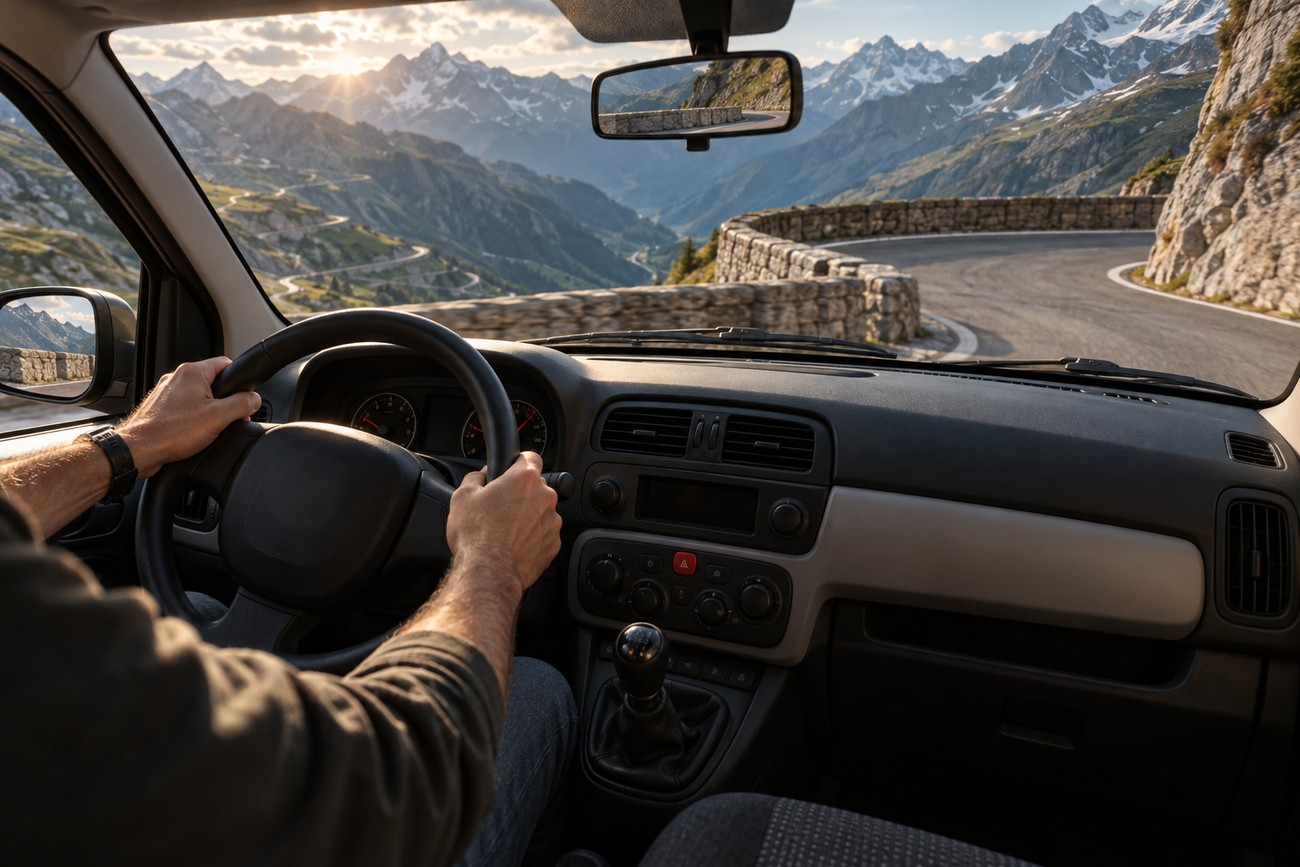
Select an appropriate lower gear before a tight bend, rather than entering the hairpin in a tall gear and asking the engine to recover at low speed. The correct choice depends on the Panda’s engine, transmission, gradient, load, and traffic. You want the engine operating within its normal useful range, with enough response to accelerate smoothly once the car is straight.
Using a high gear at low engine speed can make the engine labor. The noise may initially seem quieter, yet the car can feel reluctant and require more throttle than a lower gear would need. Downshifting early usually gives better control and leaves room to adjust speed without forcing the engine to pull from an uncomfortable low-rpm condition.
Selecting a lower gear before a queued hairpin is often kinder to the clutch than trying to pull away repeatedly in a taller gear. The clutch should connect the engine and drivetrain smoothly; it should not be used as a substitute for the low-speed torque the chosen gear cannot provide.
Clutch heat builds when the driver holds the car on the bite point, especially in a queue that moves a few feet at a time. Leave a sensible gap where traffic allows, let the vehicle roll cleanly, and complete the engagement rather than hovering between full release and full disengagement. On a steep start, use the method described in the handbook or the car’s normal hill-start system, without adding unnecessary throttle and slip.
Throttle control should be smooth. A Panda may need substantial throttle to climb, and that is different from repeatedly flooring the pedal, lifting abruptly, and then slipping the clutch to recover. Let the car build what speed the road and traffic permit, and accept that the engine may sound busy for an extended period.
Watch the temperature indication and pay attention to new smells or a change in response. If the car needs a break, use a designated or genuinely safe stopping place where you are clear of the traffic lane and have adequate visibility. Do not stop in a narrow hairpin simply because the engine is noisy; a poorly placed halt can obstruct vehicles and create a more serious hazard.
Hairpins, cyclists, and buses: finding a pace that works
The northern side’s 48 numbered hairpins are shared by cars, motorcycles, buses, cyclists, and pedestrians near viewpoints or settled areas. A bus may occupy much of the usable road space, while a cyclist can be climbing steadily at a speed that leaves little room for a safe pass. Opposing traffic often appears exactly where the road looks widest on a map.
Use sightlines rather than impatience to decide whether to pass. Wait for a genuinely clear stretch with enough room to complete the maneuver, and leave a safe margin around cyclists. A short delay is preferable to entering a blind bend and discovering an oncoming vehicle or a bus that cannot move aside.
Tight corners require room for other road users to track their line. Keep your Panda positioned predictably and avoid cutting across the center simply to make a hairpin feel less sharp. If an approaching vehicle needs more space, slow down or wait where visibility and road width permit; do not assume that a small car automatically has priority.
Quicker cars may close the gap behind you, particularly on open sections between bends. Let them pass only where it can be done safely and legally, without stopping in a narrow section or creating pressure for the vehicle ahead. A driver who tries to match a faster car can turn normal slow progress into harsh acceleration, late braking, and unnecessary clutch heat.
The mental load deserves the same respect as the mechanical load. Concentrating on repeated corners, traffic, exposed edges, and changing weather can be tiring even when the Panda is functioning perfectly. If fatigue affects your observations or decisions, choose a safe place away from the active lane and take a proper break; do not use a blind bend as a parking area.
Normal small-car struggle versus a reason to stop
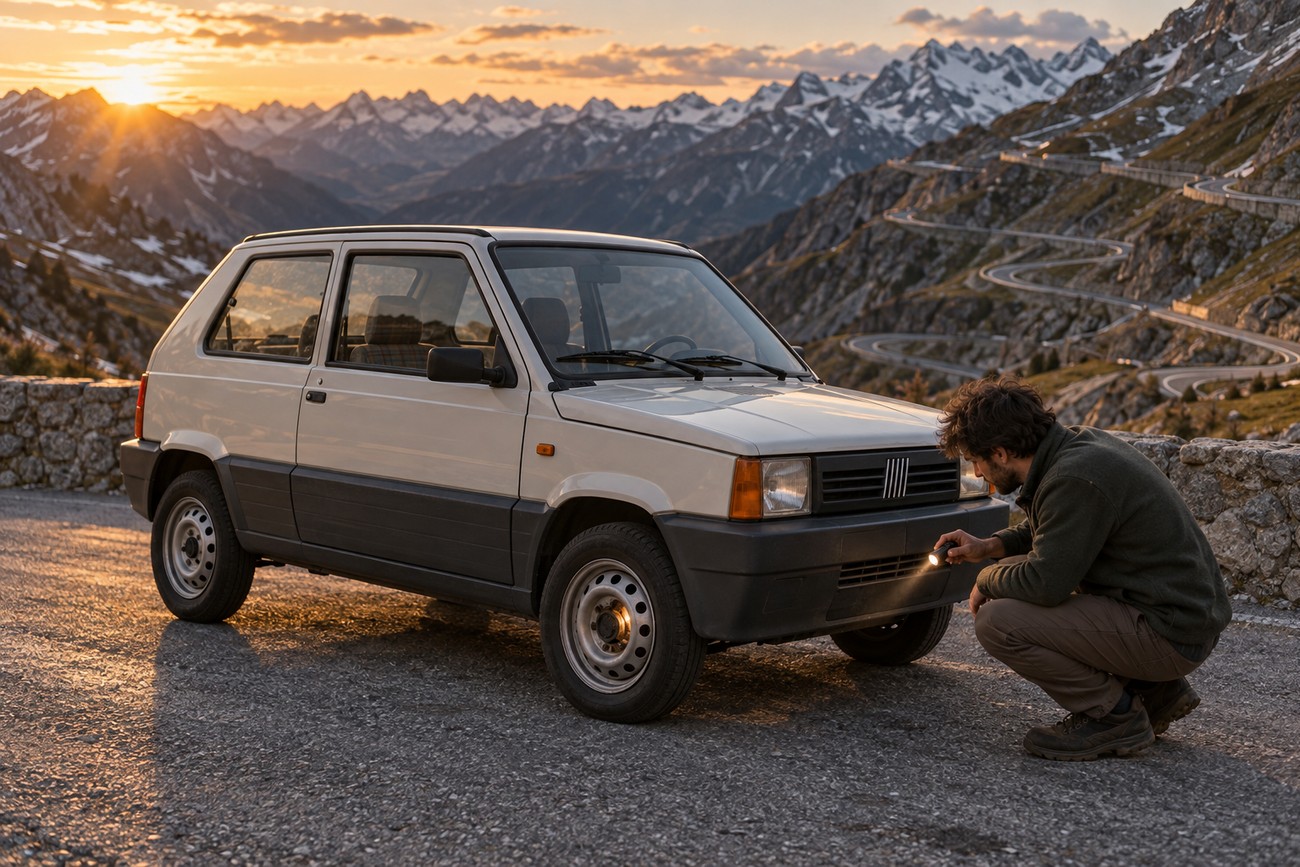
Greater engine noise, modest acceleration, and frequent use of lower gears can be normal for a loaded, small-engine Panda on this climb. A naturally aspirated engine may feel less lively as altitude increases, and the car may take time to gain speed after a hairpin. Those characteristics alone do not prove that a mechanical fault is developing.
Warning signs deserve a different response. An abnormal temperature indication, loss of normal power, persistent clutch smell, smoke, a changing brake pedal, or fading braking response should not be dismissed as “mountain driving.” One symptom cannot identify a fault by itself, so avoid roadside diagnosis based on guesswork and use the handbook’s guidance.
If a warning persists, find a safe stopping place without blocking the road. Let the vehicle settle only where conditions allow, and seek assistance if the warning does not clear or the car’s behavior changes. Continuing simply to reach the summit can convert a manageable delay into a breakdown in a location where recovery and passing traffic are difficult.
Trying to stay with a more powerful car is a common source of unnecessary stress. That vehicle may accelerate between hairpins while the Panda is still building speed, and copying its braking points or corner exits can overload your car. Rejoin the route at a pace the Panda can sustain, even if the group has to wait at a proper stopping area.
Reaching the summit also does not prove that every Panda can maintain the same pace. Different engines, loads, temperatures, and maintenance histories produce different margins. Treat a gradual reduction in performance with caution, especially if it appears alongside a temperature change, smell, or unfamiliar noise.
The descent is the bigger test for the brakes
The climb chiefly tests sustained power and cooling. The descent from a summit at 2,757 m above sea level adds prolonged braking demands, and the brake system can suffer more on the way down than it did on the way up. Gravity keeps asking the car to accelerate, while every bend requires speed to be reduced again.
Select a suitable lower gear before a steep section, using the transmission to help control the car’s speed. Engine braking should limit continuous reliance on the service brake, though it does not eliminate the need to brake for corners, traffic, or changing road conditions. Choose the gear early, because a late downshift in a tight bend can unsettle the car.
Use the brake pedal deliberately, with firm applications followed by release where the road allows, instead of lightly riding the brakes for the entire descent. The exact technique depends on gradient, traffic, weather, and the Panda’s transmission. You still need a speed that gives you a clear margin before each bend, particularly when the road is wet or visibility is poor.
Brake smell, a softening pedal, increased pedal travel, vibration, or a clear reduction in braking response means the descent should be interrupted. Find a safe stopping place away from the traffic lane and allow the system to cool, following the handbook and seeking assistance if performance does not return. Do not pour water over hot brakes or assume that a short pause in a dangerous location is an adequate repair.
Plan the descent before leaving the summit area. Keep enough space from the vehicle ahead to avoid constant braking, and do not let a faster group dictate your speed. A Panda’s small size does not protect its brakes from heat; its lower mass may help in some situations, yet the system still has to absorb the energy of a long downhill road.
The safest descent is usually the one that feels uneventful. Smooth gear selection, early observation, and moderate speed reduce the need for emergency braking. If the weather changes or you become tired, the right decision may be to pause at a suitable location or postpone the next section rather than continue because the summit has already been reached.
Timing the attempt and knowing when to turn back
Stelvio is usually open in summer, yet temporary restrictions or closures can result from snow, weather, rockfall, road works, or other local conditions. Check the current road status and forecast immediately before departure, using official or locally reliable information where available. A route that was open the previous day should not be treated as guaranteed access today.
An early start may bring less traffic and lower temperatures, which can make the hairpins easier for a small car. It cannot guarantee clear roads, stable weather, or an empty route. Mountain conditions can change quickly, and low cloud, rain, cold, or reduced visibility may appear after a pleasant valley departure.
Allow time for slow vehicles, cyclists, traffic delays, safe breaks, and the descent. A fixed arrival time encourages poor decisions when the road is busy or the driver is tired. Fuel planning should also allow for slow uphill running and a route change if a restriction prevents the intended crossing.
Use a simple decision rule: turn back or stop the attempt if weather visibility deteriorates beyond your comfort, the driver is no longer alert, or the Panda shows a warning that does not clear. The summit is optional; a safe stopping or turning point is the priority. Do not wait for a perfect location if the car is developing a serious problem, but do not stop in a narrow bend merely to avoid a delay.
Conditions can be unsuitable even when the road itself remains open. A tired driver, a heavily loaded car, and a forecast of worsening weather may together remove the margin that a healthy Panda needs. Choosing a lower route or postponing the pass is a sound mountain-road decision, not evidence that the car has failed.
Frequently asked questions
How steep is Stelvio Pass?
The gradient varies along the road, so a single percentage would hide the steepest sections and the effect of repeated hairpins. The northern valley approach gains approximately 1,800 m, with the exact figure depending on the chosen starting point; that elevation gain does not by itself state the gradient of every section.
A cited 48–49 km refers to a longer northern approach rather than a fixed Prato allo Stelvio-to-summit distance. Because the distance and endpoints vary, using that figure to calculate one overall gradient would create a misleading result. For driving, the repeated low-speed corners and sustained load matter more than one headline number.
How much fuel should I have before starting the climb?
Start with enough fuel for the planned route, slow uphill running, traffic delays, the return or onward journey, and a possible change of route. Mountain driving can consume more fuel than ordinary valley travel because the engine works under load and the car may spend long periods in lower gears.
Do not plan on reaching a particular point at the last possible fuel level. Check the route and current local information before departure, and treat any opportunity to refuel as part of the wider journey plan rather than assuming that the summit area will meet your needs.
How long does it take to cycle up Stelvio Pass?
There is no reliable single time for every cyclist. Fitness, route starting point, weather, traffic, surface conditions, equipment, and the number of stops all change the duration, and a cyclist starting in the valley may cover a different distance from one joining the northern approach farther up.
For a driver, the important implication is that cyclists may remain on the road for a long period and may climb at a steady, slow pace through several hairpins. Allow space, wait for clear sightlines before passing, and expect the Panda’s progress to be governed by the shared road rather than by the car’s theoretical ability.







