
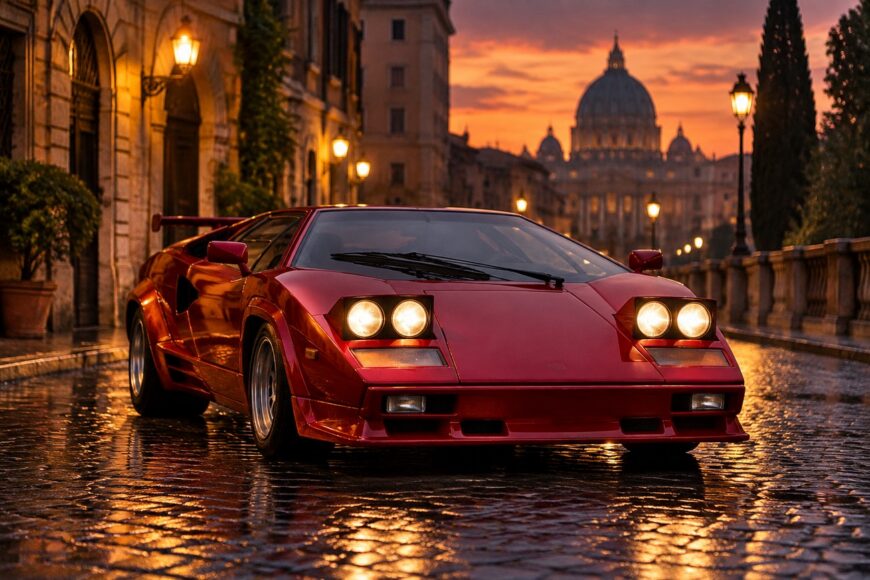
The Cizeta-Moroder V16T built its identity around an apparent contradiction: an extraordinarily wide V16 was installed sideways in a compact-looking supercar. That decision solved a packaging problem while creating new ones in cooling, access, and maintenance. The result is one of the most technically unusual Italian cars of the early 1990s.
Its legend rests on spectacular figures, dramatic styling, and a production run so short that every surviving car carries unusual historical weight. Its ownership reality is harder-edged. Power, acceleration, and even record claims vary between sources, while specialist knowledge and V16-specific parts remain scarce. The Cizeta is therefore as much a provenance and engineering problem as it is a performance car.
- How the Cizeta-Moroder V16T came to be
- Why the V16 sat sideways
- The chassis and the experience behind the wheel
- Horsepower, top speed, and the records that need checking
- What rarity means for the surviving cars
- The ownership costs hidden by the legend
- Frequently asked questions
- How many Cizeta V16Ts were made?
- Where can I find a Cizeta-Moroder V16T for sale?
- Was the Cizeta the first production car with a V16 engine?
How the Cizeta-Moroder V16T came to be
The Cizeta-Moroder V16T emerged from the early-1990s Italian supercar climate, when small manufacturers could still attempt technically extravagant projects outside the established Ferrari and Lamborghini system. Its name combined the Cizeta marque with the involvement of music producer centerpiece no rival could easily imitate.
It was an Italian two-seat coupé with a mid-mounted engine and rear-wheel drive. The low body, wide stance, and twin pop-up headlamp housings gave the car a strong visual identity, yet the most important design decision was hidden behind the cabin. The engine occupied the rear of the car transversely, allowing the V16 concept to fit within proportions that a longitudinal arrangement would have stretched considerably.
Production ran during 1991–1995, and the original run amounted to a single-digit number of cars. That description is safer than repeating one precise total, because published figures can change according to whether a prototype or later build is included. Each interpretation affects the car’s status, documentation, and eventual market value.
The short run also explains why the V16T never developed the support structure associated with a more successful supercar. A large production fleet can generate replacement parts, repair knowledge, and repeatable service procedures. Cizeta produced too few cars for that ecosystem to become self-sustaining, leaving surviving examples unusually dependent on their individual records and on a small circle of specialists.
Why the V16 sat sideways
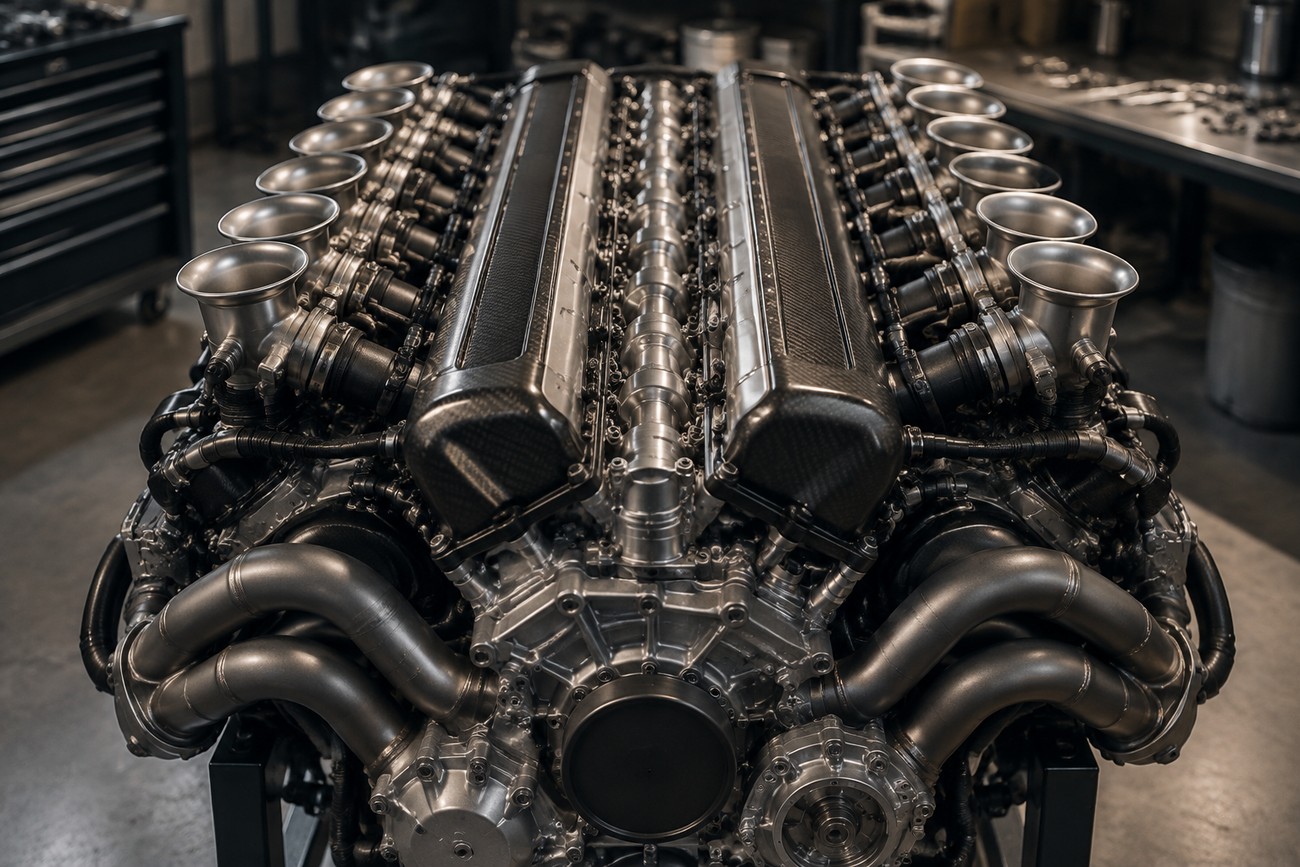
The engine was a 5,995 cc V16 mounted transversely behind the occupants. It is commonly described as two V8 banks sharing a crankshaft, rather than two complete engines simply bolted together. That distinction matters: the shared crankshaft and integrated layout created a single power unit, even though its architecture retained the visual and mechanical logic of two V8 banks.
Each cylinder had four valves, with double overhead camshafts and 64 valves in total. Bosch K-Jetronic injection supplied the engine, adding a period-specific fuel system whose setup can strongly influence how a particular car runs today. The arrangement delivered a distinctive mechanical character, with a sound and vibration pattern closer to a coupled pair of V8 banks than to the smoother impression many people associate with a conventional V12.
Transverse packaging was an engineering response to length. A longitudinal V16 would have demanded a much longer engine bay, affecting the wheelbase, cabin position, and overall proportions. Turning the engine sideways helped preserve the intended shape and accommodate the drivetrain within the wheelbase, although it consumed much of the space available around it.
That density has consequences in the workshop. Access to many engine and transmission components can require extensive dismantling, and heat management deserves close attention because a tightly packed transverse engine leaves limited space for cooling hardware and service clearance. These are design pressures rather than proof that every surviving V16T overheats, yet they explain why a small fault can become a substantial repair operation.
The chassis and the experience behind the wheel
The V16T used a tubular steel spaceframe, independent wishbone-and-spring suspension, four-wheel disc brakes, and a five-speed manual gearbox. The specification reflects an old-school supercar approach: structural tubes, mechanical controls, and a powerful rear-drive layout without the electronic safety net expected in a modern performance car.
Its approximate dimensions are 4,445 mm long, 2,057 mm wide, and 1,115 mm high, with a 2,690–2,694 mm wheelbase. Weight is around 1,700 kg, which gives the car a substantial physical presence despite its low roofline. The width becomes immediately relevant in narrow streets, parking areas, and loading ramps, where the body can occupy more road than its dramatic silhouette suggests.
Rear and side visibility are limited, and the driving position offers little help when judging the outer edges of the car. At low speed, the steering and suspension can feel heavy, while the long wheelbase and mass demand planning during tight maneuvers. A camera or modern parking sensor system cannot be assumed, so ordinary urban driving may require more concentration than the car’s glamorous image implies.
At higher speeds, the same traits require discipline. Rear-wheel drive, substantial mass, and period chassis tuning leave the driver responsible for managing weight transfer and available grip. Owners who approach it like a modern electronically managed supercar, particularly on ordinary or aged tires, may discover that the car gives less forgiveness than its headline performance suggests.
Horsepower, top speed, and the records that need checking
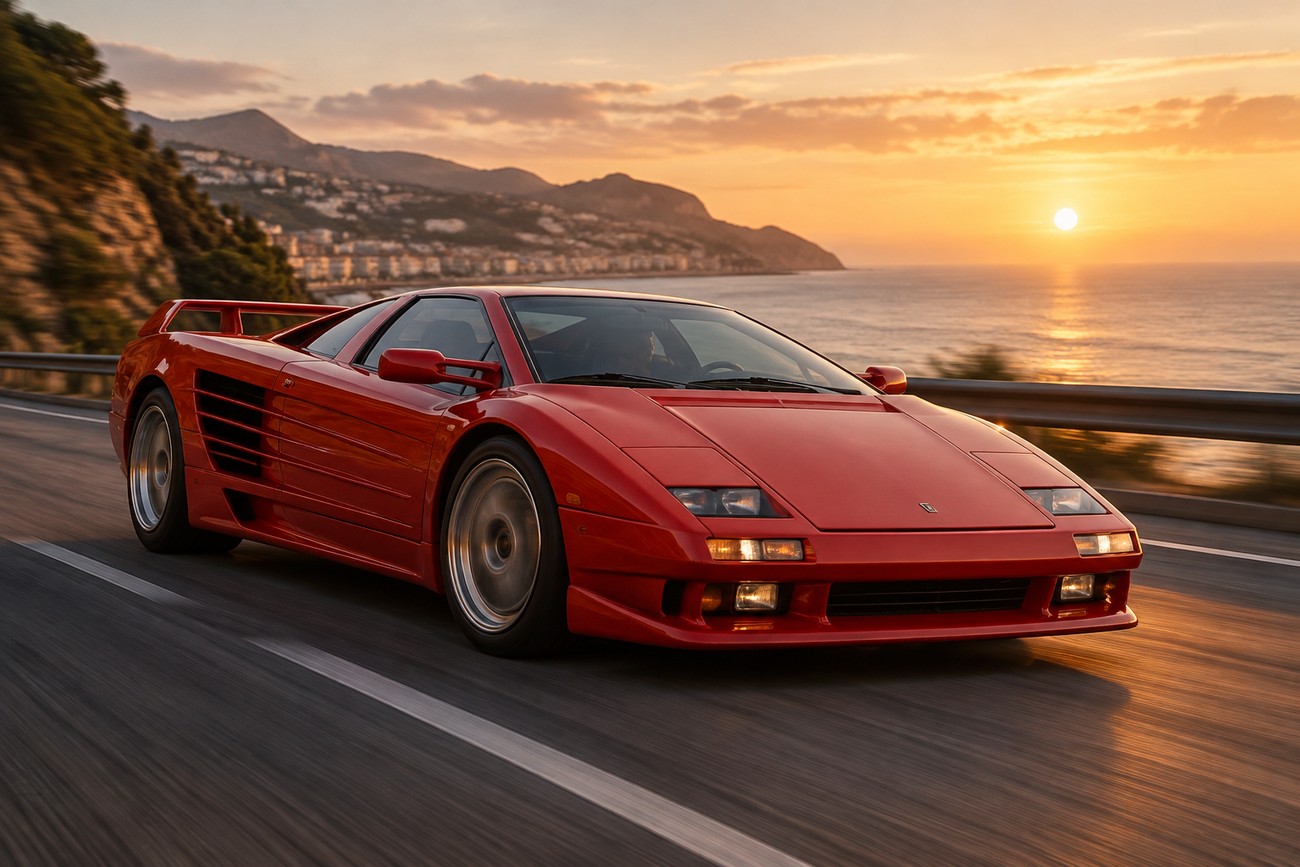
About 520 hp is the commonly quoted production figure. Other accounts give 540–560 hp, especially when discussing early cars or prototypes. Those numbers should remain attached to their source and vehicle context; presenting 560 hp as the universal output of every production V16T turns a disputed figure into a false specification.
The commonly quoted top speed is 328 km/h. Other published figures sit around 327–330 km/h, which is close enough to describe the same performance ambition but too broad for a claim that every surviving car has achieved one definitive number. Engine condition, injection calibration, gearing, tires, and test conditions all matter when the figures come from a very small fleet.
Published 0–100 km/h claims commonly fall around 4.4–4.5 seconds. Some articles state 4.0 seconds and attach a Guinness record or a claim that the Cizeta was the first production car to reach 100 km/h within that performance bracket. The available evidence does not firmly substantiate that story, so it belongs in the history of the car’s mythology rather than in a settled specification.
The sensible way to describe the V16T is to separate quoted specifications from independently demonstrated results. A car with a tired engine, poorly adjusted Bosch K-Jetronic system, old tires, or a drivetrain issue may perform far below an ideal test example. Collectors evaluating a particular car should therefore treat dyno results and condition reports as more useful than the highest number repeated in promotional material.
What rarity means for the surviving cars
The original-run Cizeta-Moroder V16T production is best described as a single-digit number of cars. Published totals can differ when prototypes or later builds are counted, and that distinction matters to collectors. A prototype, a converted development car, and an original production example may share the same broad design while carrying very different historical and financial significance.
For that reason, provenance is central to any surviving car. Chassis documentation, factory correspondence, ownership records, evidence of repairs, and a clear account of modifications can matter as much as paint quality. A damaged or heavily altered example may retain enormous interest as an object, yet its value and usability will depend on whether the work is documented and technically correct.
Rarity creates collector appeal, but it does not establish a uniform price. Condition, authenticity, mechanical health, and the quality of the supporting paperwork can move an individual car far away from another example’s valuation. A striking appearance alone cannot compensate for an undocumented engine rebuild or uncertain prototype status.
The market is also thin. The potential buyer pool is narrow, and a sale may require contact with specialist brokers, marque networks, or collectors already familiar with unusual Italian machinery. A rare car can attract attention while remaining difficult to sell quickly, so owners should treat liquidity as a separate question from desirability.
The ownership costs hidden by the legend
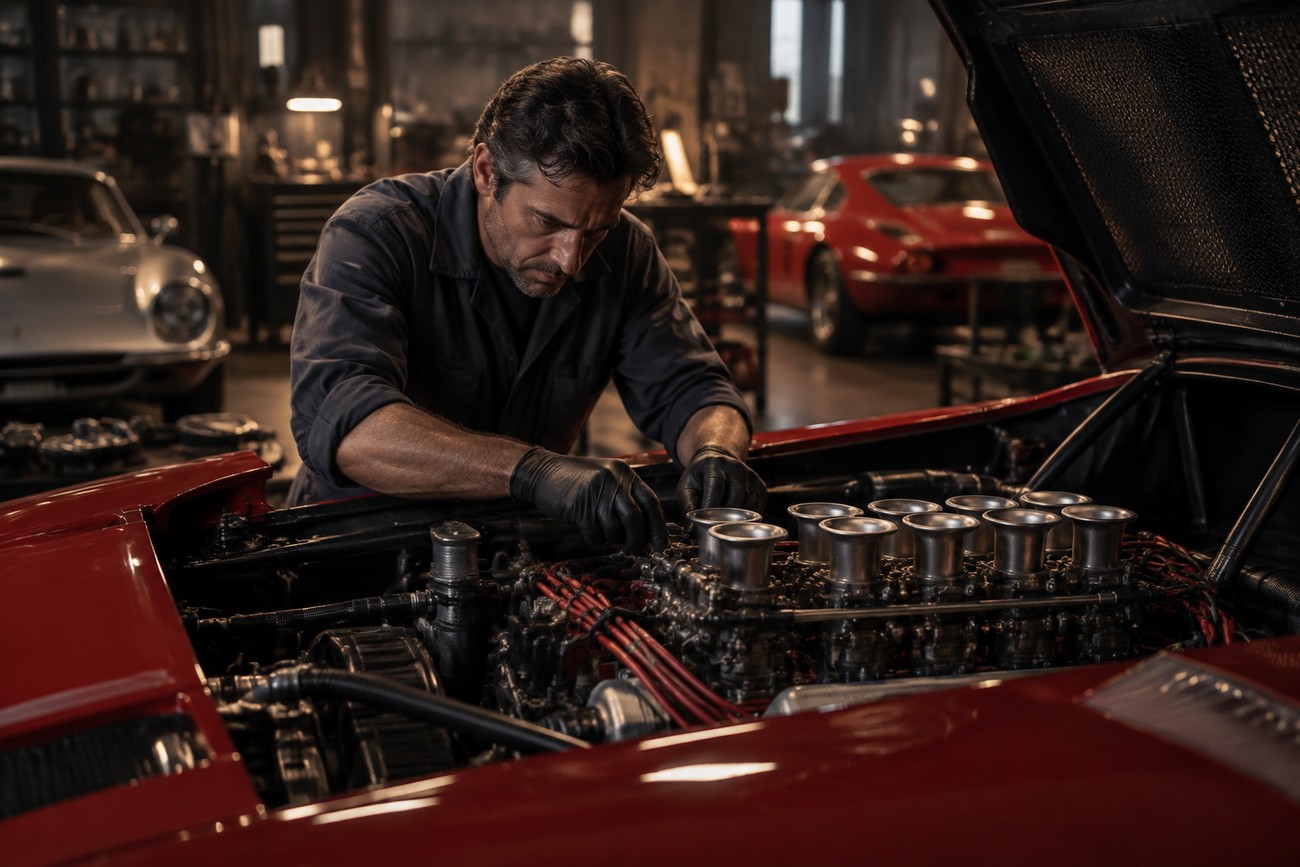
The first practical issue is finding the right expertise. Specialist knowledge of the V16, its transmission, and its period systems is scarce outside a few established contacts in Italy, the circles. Body and engine parts are rarely available through ordinary catalogs, which means that repairs may involve restoration, remanufacture, or locating components through former project connections.
Dense packaging increases labor time. Reaching a component can require removal of surrounding systems, and a job that looks small on paper may become a lengthy workshop exercise. Cooling systems, hoses, seals, wiring, and the condition of the engine bay deserve inspection because heat and restricted access can turn deferred maintenance into a much larger intervention.
Injection calibration and parts provenance should be checked before a poorly running V16 is assumed to need a rebuild. A similar-looking V8 component may fit physically while being wrong for the V16’s load, dimensions, or operating requirements.
Bosch K-Jetronic setup can materially affect the way an individual car starts, idles, responds, and produces power. The engine’s real condition should be established through systematic testing, service records, and inspection of the correct V16-specific components. There is no reliable fleet-wide basis for stating a definitive engine lifespan, and isolated expensive failures cannot provide one.
A purchase inspection should also verify whether the car is an original production example, a prototype, or a later build; whether accident repairs changed the spaceframe or suspension geometry; and whether undocumented modifications have replaced scarce original parts. A cheap substitute can create a future reliability problem even when it appears to solve an immediate maintenance task.
Insurance and registration add separate jurisdictional risks. A specialist insurer may require an agreed-value appraisal, while some providers may decline a car with such limited market evidence. Registration can also depend on emissions, safety equipment, import documents, and the vehicle’s legal history, so a buyer should confirm requirements before moving the car across a border.
Frequently asked questions
The V16T’s unusual history encourages simple answers that become misleading once prototypes, later builds, and different national records are included. These distinctions are especially important because the car’s small population leaves little room for comparing one example with a large fleet.
How many Cizeta V16Ts were made?
The original production run is best described as a single-digit number of cars. Published totals can differ because one source may count only original-run production cars, while another includes a prototype or a later build completed under the Cizeta name. A credible answer therefore identifies what category is being counted instead of presenting one disputed total as definitive.
Where can I find a Cizeta-Moroder V16T for sale?
Realistic routes include specialist exotic-car brokers, major collector-car auctions, and private networks of marque specialists and established collectors. A permanent retail listing is unlikely because so few cars exist and owners may sell privately after a long period of discreet contact.
Buyers should ask for chassis identity, production or prototype status, service records, engine work, and proof that major components are correct for the V16. The car’s rarity makes an independent inspection especially valuable before money changes hands.
Was the Cizeta the first production car with a V16 engine?
No. Cadillac’s V-16 road car came earlier, so the Cizeta should not be described as the first production road car with a V16 engine. Its distinctive achievement was the transverse, mid-engine installation of a 5,995 cc V16 in a two-seat supercar.
That layout gives the Cizeta its particular place in automotive history. The historical interest lies in the packaging, the shared-crankshaft architecture, and the decision to pursue such a complex engine in a tiny production program, rather than in an unsupported absolute-first claim.







