
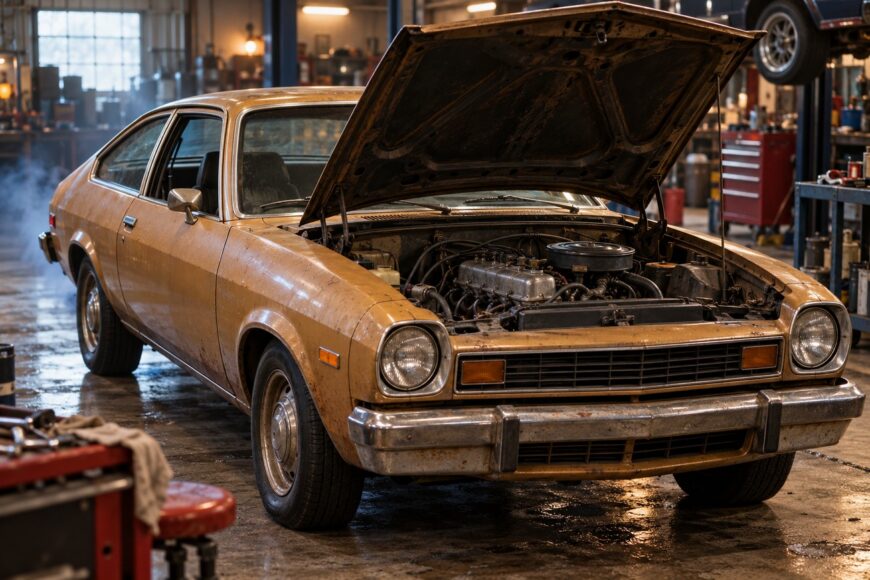
The Chevrolet Vega’s engine promised a lighter, more modern compact car. For many owners, the memorable results were rising oil consumption, blue exhaust smoke, and overheating. Those experiences damaged the engine’s reputation, yet they do not establish that an aluminum block was inherently a bad idea.
The more useful question is why this particular engine proved so vulnerable. Its linerless cylinders depended on a carefully prepared aluminum surface, while its cast-iron head and aluminum block placed different demands on the head gasket as temperatures changed. Cooling trouble, wear, and uneven durability turned an ambitious design into an expensive ownership risk.
- The lightweight engine Chevrolet put in the Vega
- How overheating turned a design compromise into engine damage
- Why oil consumption became the Vega’s defining symptom
- What the later fixes changed—and what they could not
- What a surviving Vega needs before you trust it
- Vega engine symptoms: likely causes and useful checks
- Was the aluminum block the mistake?
- Frequently asked questions
- Was the Chevrolet Vega engine GM’s worst engine?
- What is GM’s worst engine?
- How much did a Chevy Vega cost in 1971?
- What are the disadvantages of aluminum engine blocks?
- When did Chevy start using aluminum blocks?
The lightweight engine Chevrolet put in the Vega
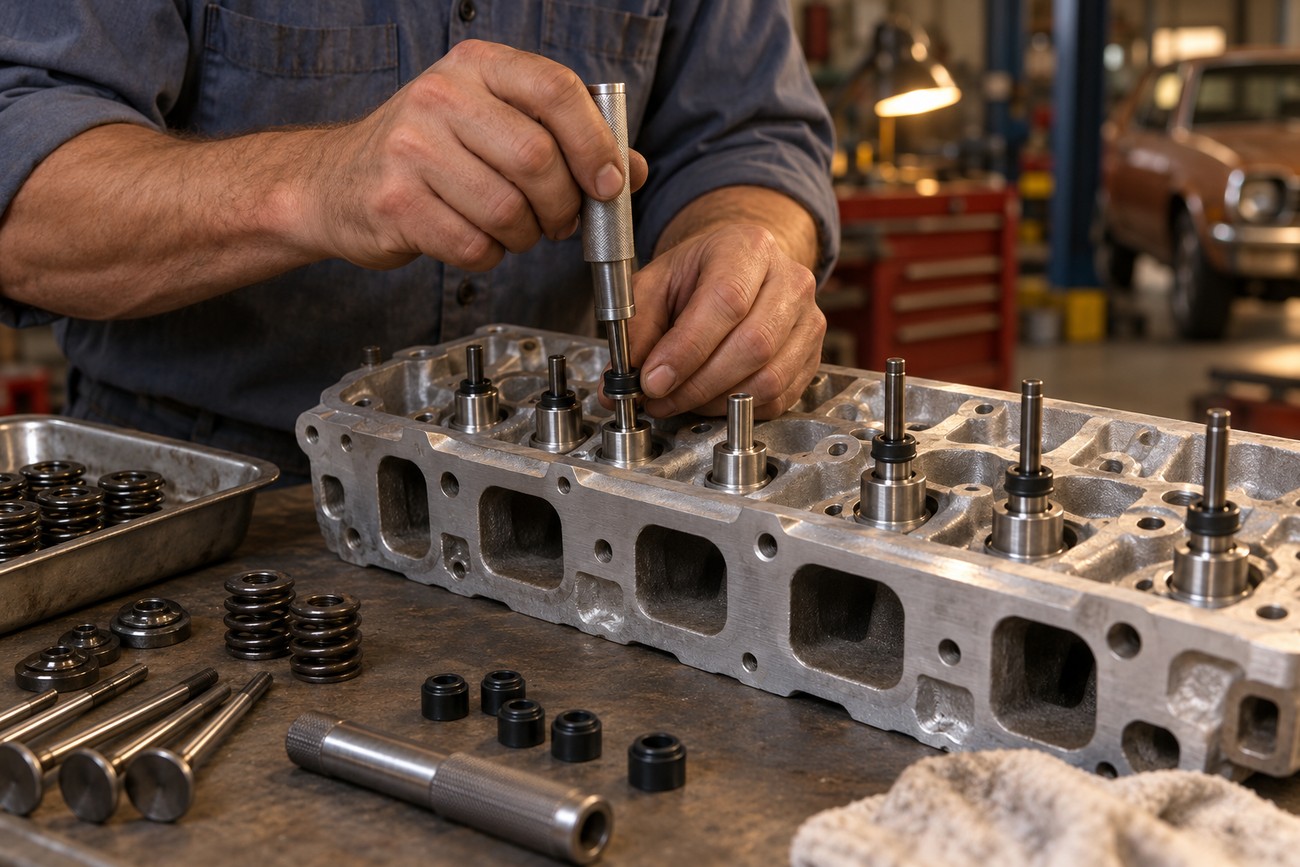
The Vega used a 2.3-liter (approximately 139.6 cubic-inch) SOHC inline-four with an aluminum block and cast-iron cylinder head. Chevrolet sought to reduce engine weight while producing a compact car that felt technically current. Removing conventional iron cylinder liners saved weight, but it also made the block’s own bore surface central to durability.
That surface was made from a high-silicon aluminum alloy. After machining, the bores were etched to expose hard, wear-resistant silicon particles. The silicon was part of the alloy, not a coating applied to the cylinders; describing Vega bore failure as a coating simply peeling away misstates how the engine was built.
The cast-iron head was a separate engineering choice with consequences of its own. Iron and aluminum respond differently to heat, so the joint between them had to maintain its seal across repeated temperature changes. Under controlled operating conditions, that challenge is manageable; it becomes harder when cooling performance deteriorates.
Nothing about a linerless aluminum cylinder makes short life inevitable. The Vega’s significance lies in the distance between a workable engineering concept and the tolerance for heat, wear, and ordinary use that buyers needed from a mass-produced engine.
How overheating turned a design compromise into engine damage
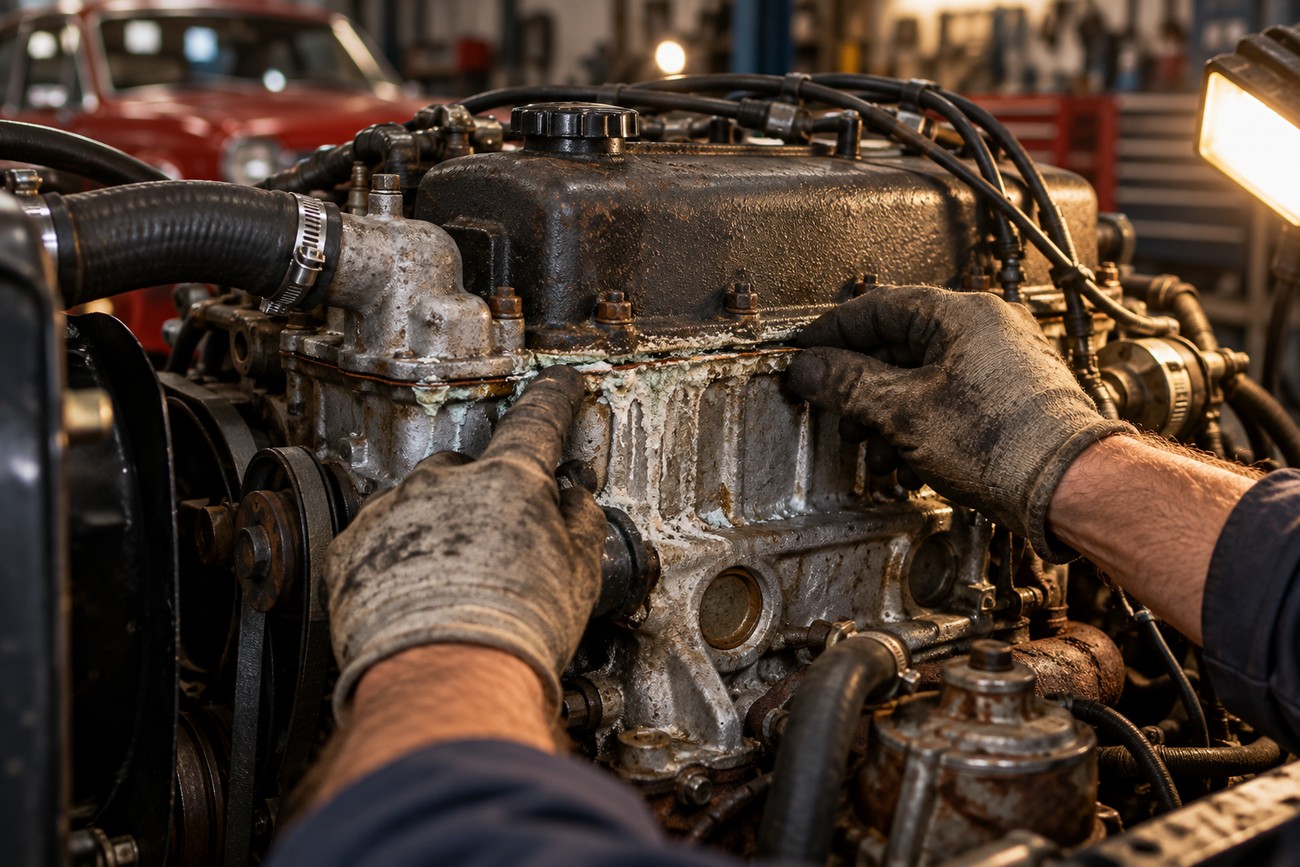
A cooling-system fault could start a costly sequence in a Vega. Low coolant, a leak, or another problem that allowed temperatures to climb increased stress throughout the engine. Checking the cause of a rising temperature gauge mattered because continued driving could turn a repairable cooling fault into internal damage.
The aluminum block and cast-iron head expand at different rates. As temperatures rise, that difference increases the demands on the head gasket, which must seal combustion pressure, oil, and coolant between the two components. The pairing did not doom every engine, but overheating made loss of that seal more likely.
The block’s open-deck construction also left the cylinders sensitive to excessive heat. Cylinder distortion could impair sealing at the bores, while a damaged head gasket could allow coolant to escape or enter places it did not belong. Either path could lead to poor running and loss of compression; the precise damage depends on the engine and the severity of the event.
Steam, recurring coolant loss, or rough running after an overheat deserves investigation rather than an automatic verdict that the block is beyond repair. Cooling-system pressure checks and tests for head-gasket leakage can narrow the cause. An overheating episode was a serious risk, not a guarantee that every affected engine was destroyed.
Maintenance therefore had unusual leverage over the outcome. A sound cooling system could help preserve an engine that might otherwise develop trouble, while an older car with an unresolved leak could deteriorate quickly. Design vulnerability explains the stakes; the condition and history of an individual Vega explain much of its present risk.
Why oil consumption became the Vega’s defining symptom
The Vega’s linerless bores relied on the exposed silicon particles and an appropriately finished cylinder surface to control wear. If bore condition deteriorated, the piston rings could lose their ability to seal and control oil. Oil reaching the combustion chamber produced the blue smoke that became one of the engine’s most recognizable complaints.
Historical accounts report serious wear and increased oil consumption in many engines by roughly 40,000–50,000 miles. That range describes a recurring reported pattern, not a universal service-life limit. Some engines lasted substantially longer, and a surviving car’s condition cannot be inferred from its odometer alone.
Bore wear was not the only route for oil into the combustion chamber. Valve-stem-seal problems could also contribute, so blue smoke by itself cannot identify the failed part. Smoke observed at different operating points, oil-use history, compression results, and further testing are more useful together than any single symptom.
This distinction matters during a repair decision. Replacing seals may address one source of oil consumption, but it will not restore a worn or distorted bore. Conversely, assuming every smoking Vega needs a replacement block risks overlooking a more limited fault.
What the later fixes changed—and what they could not
Chevrolet responded to overheating complaints with expanded repair or replacement assistance for certain engines beyond the cited five-year/50,000-mile warranty limit. That response indicates how consequential the failures had become, but it should not be read as proof that every overheated engine qualified. Eligibility and the remedy depended on the circumstances.
Later Durabuilt revisions improved cooling provisions and valve-stem seals. Those changes addressed recognizable routes to overheating damage and oil consumption. They give a later engine a different starting point for assessment, rather than a blanket certificate of durability.
The underlying engine still depended on effective cooling, a sound seal between its aluminum block and iron head, and healthy linerless bores. Revised parts could reduce particular risks without eliminating every thermal or wear sensitivity. A later badge or replacement history is therefore useful background, but present condition remains decisive.
Careful attention to coolant and oil helped some engines run well beyond the mileage commonly associated with Vega trouble. Equally, poor maintenance could defeat an improved engine. The record supports wide variation in outcomes, not a fixed point at which every Vega failed.
What a surviving Vega needs before you trust it
Begin with the cooling system. Check the coolant level, look for visible leaks and evidence of repeated topping-up, and ask about any history of overheating or head-gasket work. A clean exterior cannot tell you whether the engine has been run hot.
Next, assess how it runs and what it consumes. Watch for exhaust smoke, check the oil level and service history, and measure compression rather than relying on a smooth idle. Inspect for signs that coolant may be entering the engine, while remembering that no single stain, smell, or gauge reading settles the diagnosis.
A clean idle and acceptable compression do not close the case when the car has a credible history of coolant loss or heavy oil use. Leak-down testing or bore inspection can expose damage that a brief road test misses.
Use those deeper checks when the initial evidence conflicts. Leak-down testing can help locate a loss of cylinder sealing; bore inspection can show wear or damage that a mileage claim cannot. Reports of serious wear by roughly 40,000–50,000 miles make verification worthwhile, but neither a low nor a high reading proves an individual engine’s condition.
Inspect the body as a separate decision. Corrosion can make an otherwise promising Vega difficult to restore, while sound-looking paint says little about the engine underneath. A purchase only makes sense when the likely costs of both the body and the powertrain are understood.
Vega engine symptoms: likely causes and useful checks
These symptoms point to investigations, not definitive diagnoses.
| Visible symptom | Possible cause | Useful check | Diagnostic limitation |
|---|---|---|---|
| Blue exhaust smoke | Cylinder wear or valve-stem-seal trouble | Review oil use; test compression and, if needed, inspect the bores | Smoke alone cannot distinguish the sources of oil. |
| Coolant loss or overheating | Cooling-system fault or head-gasket damage | Pressure-check the cooling system and investigate gasket leakage | A visible leak does not establish whether internal damage followed. |
| Low compression | Loss of sealing at rings, bores, valves, or the head gasket | Repeat the measurement and perform leak-down testing | Compression alone does not prove bore damage. |
| Cold-start noise | Several possible mechanical or operating causes | Note when the noise occurs, check oil condition, and inspect further if it persists | Noise by itself cannot confirm cylinder scoring. |
Was the aluminum block the mistake?
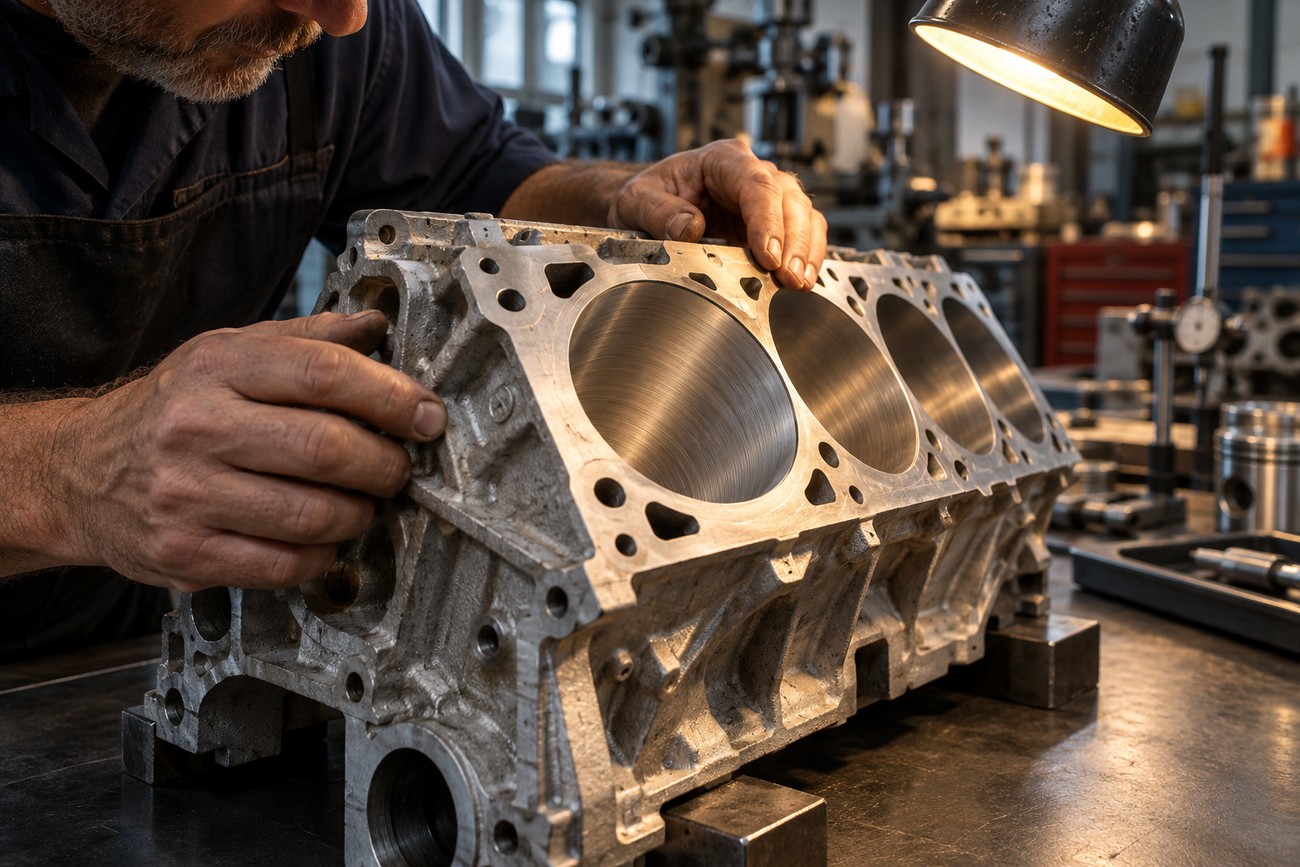
A linerless high-silicon aluminum block is a viable engineering concept. The Vega’s exposed-silicon bore surface had a clear purpose: provide a wear-resistant running surface without conventional iron liners. Its troubled record cannot be used to declare aluminum blocks generally unreliable.
The reputation came from interacting weaknesses and real ownership consequences. Cooling trouble could intensify thermal stress at the iron-head joint and threaten bore sealing; valve-stem seals could add to oil consumption. Production execution and maintenance also affected how well an individual engine survived those demands.
The Cosworth connection underscores that performance development placed additional demands on the basic architecture. It does not show that every production Vega block broke under load, and racing or high-output work is a poor substitute for judging a road engine’s ordinary service life. The production car’s widespread complaints are substantial enough without extending them into universal claims.
Chevrolet pursued a light, forward-looking engine, but many owners faced overheating, oil consumption, and disappointing durability. Body corrosion compounded the car’s reputation while remaining a separate problem. The Vega illustrates the cost of an implementation that gave ordinary drivers too little margin when cooling or wear conditions slipped.
Frequently asked questions
These answers separate the Vega’s documented problems from broader claims about GM engines and aluminum construction.
Was the Chevrolet Vega engine GM’s worst engine?
There is no objective designation of GM’s “worst” engine. The Vega is a strong candidate in discussions of disappointing durability because overheating, oil consumption, and costly repairs were consequential for owners. A useful judgment compares those documented failure modes and their ownership impact, rather than treating a ranking as a technical finding.
What is GM’s worst engine?
GM has no single, universally agreed worst engine. The answer changes with the measure used: premature wear, frequency of repairs, repair cost, or the gap between engineering promise and everyday service. Under the last measure, the Vega’s 2.3-liter inline-four is often discussed, but naming one winner would imply a comparison that a simple label cannot support.
How much did a Chevy Vega cost in 1971?
A single price cannot describe every 1971 Chevy Vega: body style, equipment, and charges affected the amount paid. An exact base list price should be checked against a period Chevrolet price sheet, and an individual car’s original window sticker is the better source for its as-sold price. Without one of those records, quoting a precise figure would risk false accuracy.
What are the disadvantages of aluminum engine blocks?
Aluminum blocks can require careful control of heat, bore wear, and sealing, particularly when paired with components made from metals that expand differently. Repair methods may also depend more heavily on the specific block design than they would for a conventional iron block. Those are engineering and service considerations, not evidence that aluminum blocks as a class are unreliable.
When did Chevy start using aluminum blocks?
Chevrolet used an aluminum crankcase in the Corvair engine introduced for the 1960 model year, before the 1971 Vega. The designs should not be conflated: the Corvair’s air-cooled engine used separate cylinders, while the Vega brought linerless high-silicon aluminum bores to a different, water-cooled inline-four. “First aluminum block” therefore needs a clear definition of the engine construction being discussed.







