
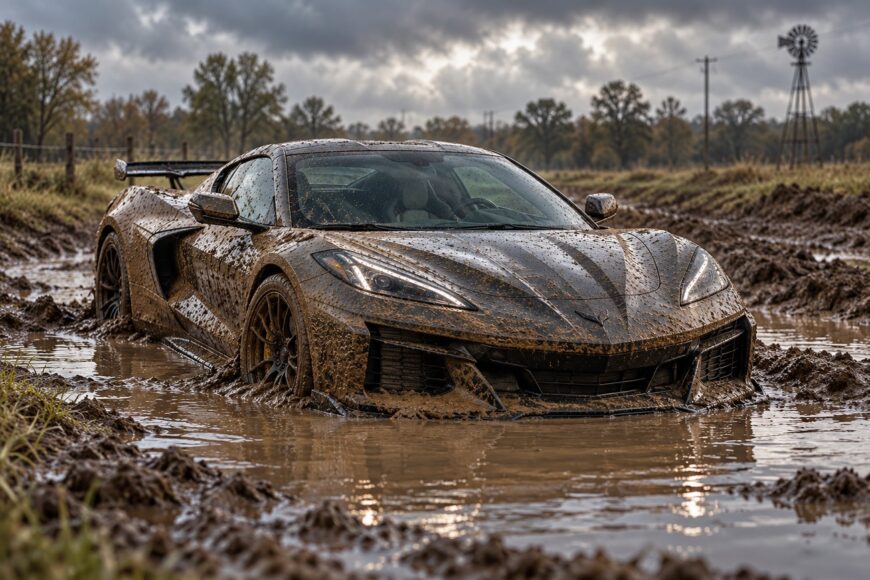
The LT6 may tolerate short bursts of demanding operation, but the Chevrolet Corvette Z06 as a complete vehicle is poorly matched to a mud bog. Its flat-plane V8 is built to rev hard under controlled track conditions. Deep mud replaces asphalt grip and sustained airflow with wheelspin, water exposure, debris, and the possibility of striking the underside.
A brief encounter with mud does not guarantee engine damage. The concern is that the driver can lose forward motion while the engine and cooling system keep working hard. For an owner considering a curiosity run, the sensible verdict is to keep the Z06 out of deep mud; its power does little to address the risks that determine whether the car gets through.
- The Short Answer: The LT6 Might Cope, but the Z06 Probably Won’t
- What the Flat-Plane LT6 and Dry Sump Actually Protect
- Why a Mud Bog Attacks the Z06’s Cooling, Intake, and Traction
- The Expensive Failure Modes Owners Underestimate
- Common Mistakes That Turn a Curiosity Run into a Repair Bill
- If the Z06 Has Already Been Through Mud
- Track Design versus Mud-Bog Demands
- Frequently asked questions
- What are the main disadvantages of a flat-plane crank in everyday ownership?
- What year of Corvette Z06 should buyers stay away from?
- Why are some Z06 models not selling quickly?
The Short Answer: The LT6 Might Cope, but the Z06 Probably Won’t
The naturally aspirated LT6 5.5-liter flat-plane V8 produces about 670 hp at 8,400 rpm and about 623 N·m at 6,300 rpm. Those figures describe an engine that rewards revs and airflow on a grippy surface. They do not tell you how far a low car can travel through a water-filled rut.
Dry-sump lubrication designed to support oil supply during high lateral acceleration is valuable during fast cornering. A mud bog presents a different set of demands: slow progress, heavy resistance, uncertain water depth, and debris near the body and cooling openings. The engine might continue to run through a short, shallow patch, while a loss of traction or ground clearance stops the car.
Chevrolet positions the Z06 as a road- and track-focused supercar. There is no official Chevrolet recommendation or approval for mud-bogging use. That is a limit on its intended operating scope, rather than proof that every muddy crossing will cause a failure.
What the Flat-Plane LT6 and Dry Sump Actually Protect
A flat-plane crankshaft has lower rotating mass and supports faster rev response, more even firing impulses, and high specific power. In the LT6, variable valve timing helps the naturally aspirated engine operate across its rev range, with a redline of about 8,600 rpm. These are useful traits when the tires can translate a precise throttle input into acceleration.
The trade-offs typically include greater vibration and sensitivity to thermal conditions, oil quality, and maintenance. That does not mean the LT6 is inherently fragile. It means that sustained high load with compromised cooling deserves more caution than the engine’s headline output might suggest.
The dry sump addresses oil control during severe cornering. It does not prevent hydrolock if water enters the intake, nor does it prevent intake contamination, radiator blockage, or overheating. Treating it as general protection against off-road conditions confuses one carefully engineered solution with protection for the whole car.
Why a Mud Bog Attacks the Z06’s Cooling, Intake, and Traction
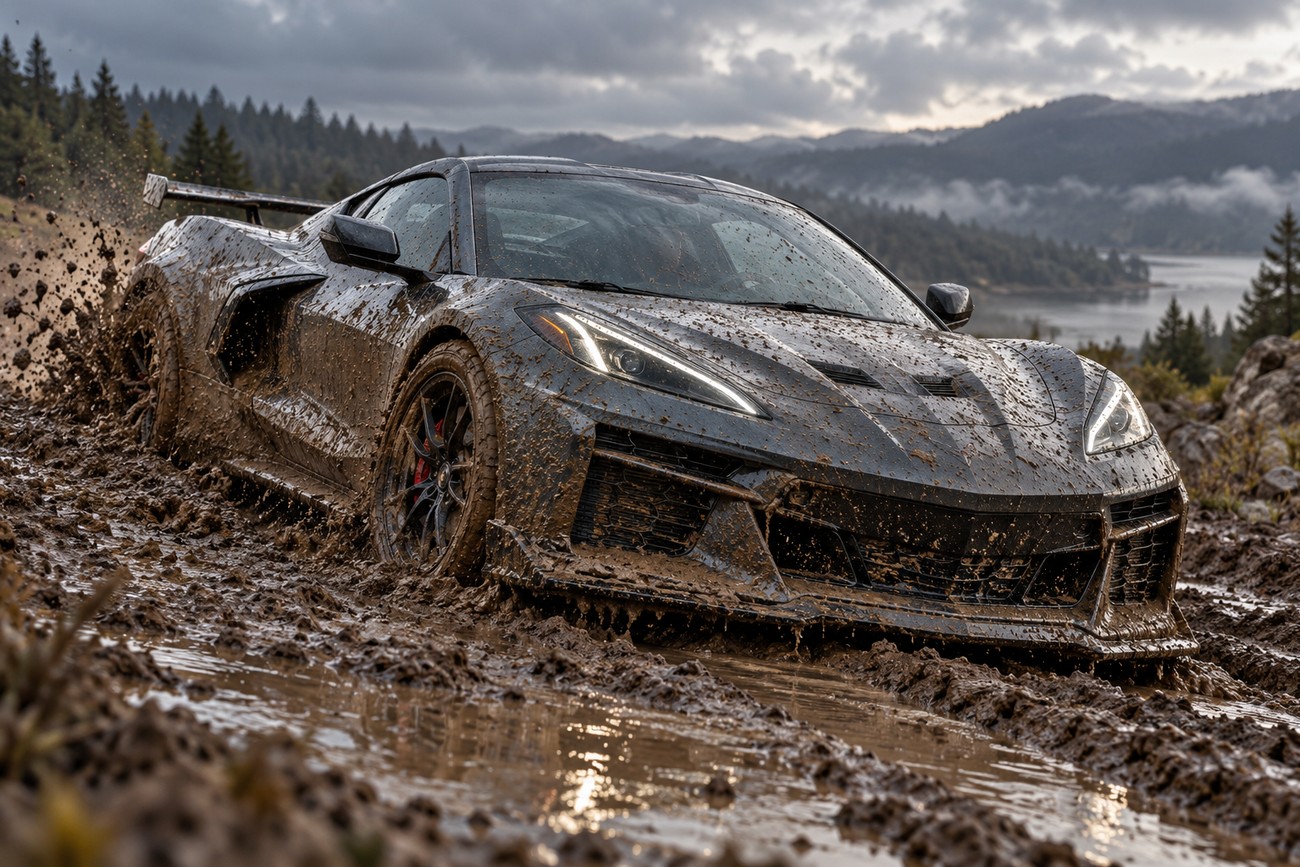
In deep mud, speed can fall while the engine continues to work against substantial resistance. Low speed reduces airflow through the cooling system, even as engine and drivetrain loads remain high. A driver who adds throttle to maintain momentum can therefore raise heat without gaining much ground.
The Z06’s low ground clearance, front splitter, side ducts, and other aerodynamic hardware serve asphalt use. Ruts and packed mud can contact parts that would remain clear on a circuit. Its underbody is not equipped for the impact and debris tolerance expected of a dedicated mud-bog vehicle.
Owner and track-forum discussions describe water or mud affecting air openings and cooling hardware. Those accounts are anecdotal, not evidence that every Z06 has the same failure point. They do, however, illustrate why visible mud on the outside of the car is an incomplete measure of what may be lodged in a duct or cooling passage.
Traction may end the attempt before engine output becomes relevant. Rear-wheel drive and asphalt-oriented tires can struggle to turn torque into forward motion on a soft surface; low-profile track-oriented tires offer little help in a deep rut. Spinning faster tends to excavate the mud beneath the driven wheels.
Water depth adds uncertainty because a moving car pushes water into openings differently from a stationary car sitting beside a puddle. Without a known safe route and verified clearance, judging the risk from the bank is unreliable. The practical limit is set by the route, tires, and exposed hardware, not by peak horsepower.
The Expensive Failure Modes Owners Underestimate
Water reaching the intake can cause hydrolock, a direct mechanical risk that dry-sump lubrication cannot address. Mud and debris can also restrict airflow through cooling hardware. Either problem calls for attention before another hard acceleration attempt; an apparently normal idle does not establish that the car is clean or undamaged.
Heat and oil condition matter once the car is stuck. Overheating, oil cavitation, or oil foaming at high rpm can sharply reduce the service life of a high-performance engine. These outcomes are risks under adverse conditions, not an inevitable result of briefly touching mud.
Cooling-system cleaning and intake inspection answer different questions: the first checks whether the car can shed heat, while the second checks whether water or debris had a path toward the engine. A normal exterior wash does not settle either question.
Ground strikes can damage the splitter, diffuser, underbody panels, or suspension. Mud around brake hardware may produce noise or uneven braking, and water or debris near wheel-speed sensors and wiring can contribute to intermittent ABS, traction-control, or suspension warnings. Reports from owners of damage, difficult cleaning, and faults after dirty use are anecdotal; they should prompt inspection, not be treated as a guaranteed Z06 defect.
The consequences can be costly even where the engine remains healthy. Accessing packed debris, replacing damaged aerodynamic parts, and diagnosing an intermittent warning may take more work than the initial drive suggested. A car intended for repeatable track performance deserves a thorough check before returning to high-speed braking or cornering.
Common Mistakes That Turn a Curiosity Run into a Repair Bill
The first mistake is using engine speed as a substitute for traction. High-rpm wheelspin mostly moves mud, adds heat, and increases drivetrain stress. If the car has stopped progressing, repeated full-throttle attempts are unlikely to improve its position.
Another is assuming a track tire will cope because it works well under demanding conditions. Low-profile, asphalt-oriented rubber is designed around a different surface; deep mud needs tread and ground clearance that the standard Z06 setup does not provide. Changing tires alone would still leave the car’s low bodywork exposed to water and debris.
Drivers also overestimate the dry sump or enter standing water without understanding the intake’s exposure. Oil supply during cornering says nothing about water ingestion. Afterward, skipping careful removal of mud from radiators, brakes, wheel wells, and the underbody can leave conditions for overheating, corrosion, noise, or binding long after the car looks clean.
If the Z06 Has Already Been Through Mud
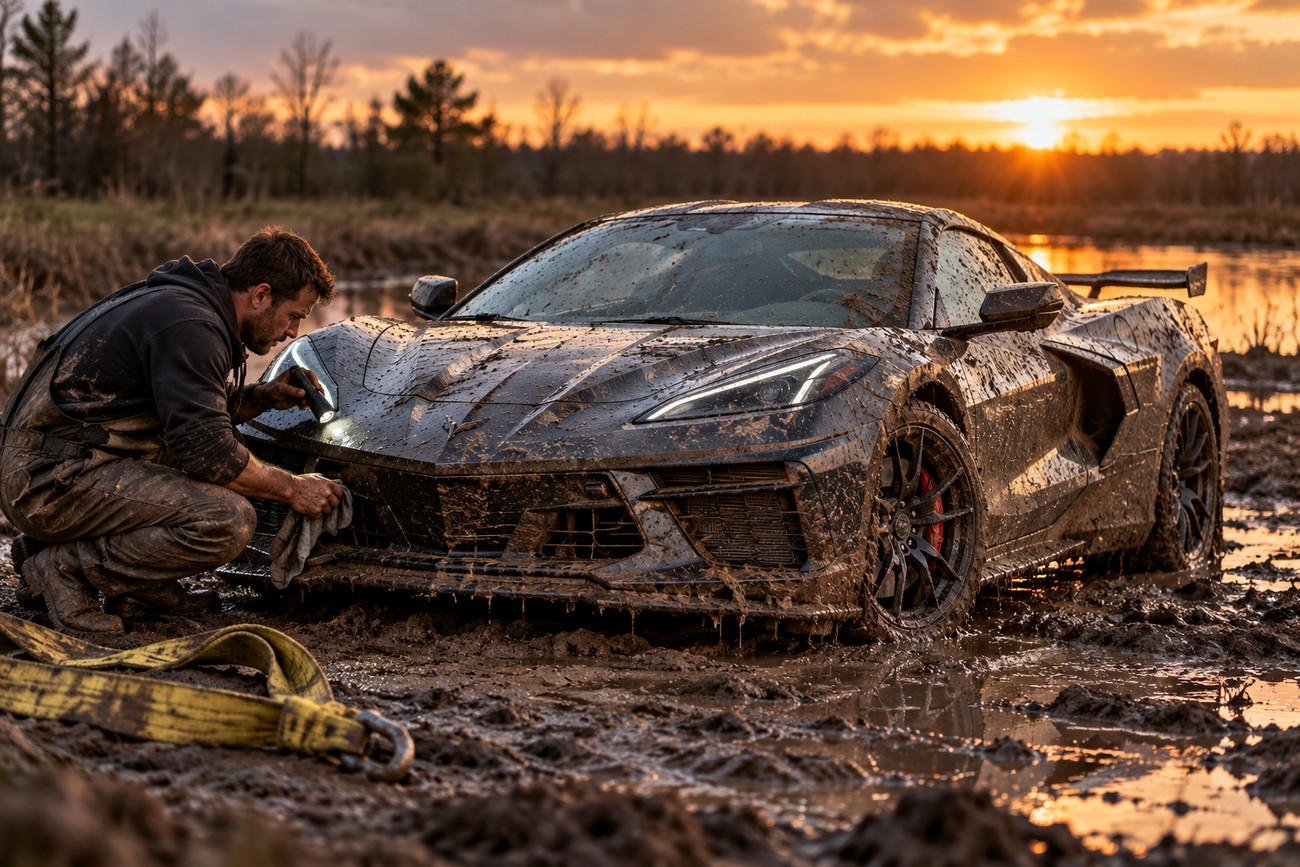
Stop repeated high-rpm escape attempts if the car is no longer moving forward. More throttle can add heat and drivetrain load while the tires dig in. Arrange recovery appropriate to a low-clearance car rather than assuming it can drive itself free.
Once recovered, check for visible impact damage and possible water exposure before treating the event as finished. Radiators, brake hardware, wheel wells, underbody panels, and sensor areas need careful cleaning and inspection. Avoid forcing water or debris deeper into openings while washing.
Rough running, temperature spikes, warning lights, abnormal noises, or signs of fluid contamination justify professional diagnosis before normal driving resumes. The same applies if braking feels uneven. With the LT6 and the Z06’s track-focused hardware, identifying a problem early is more useful than testing it under another heavy load.
Track Design versus Mud-Bog Demands
Track readiness does not equal off-road durability: the same components face different demands in mud.
| Factor | Z06 track environment | Mud-bog demand |
|---|---|---|
| Airflow | Speed supplies airflow during hard driving. | Low speed limits airflow while load can remain high. |
| Surface grip | Asphalt supports road- or track-tire traction. | Soft mud favors suitable tread and sustained traction. |
| Clearance | Low ride height supports asphalt performance. | Ruts require space beneath the car. |
| Cooling exposure | Cooling openings receive relatively clean air. | Water and debris can obstruct airflow. |
| Intake risk | Water ingestion is not a normal track demand. | Standing water makes intake exposure a concern. |
| Suspension loads | Cornering and braking loads dominate. | Hidden ruts can deliver sharp impacts. |
| Recovery needs | Runoff and paved access aid recovery. | Soft ground can complicate recovery of a low car. |
Frequently asked questions
Ownership of a flat-plane-engine car, used-car buying, and the market for a Z06 are separate questions from mud-bog suitability. Keeping them separate helps avoid turning a specific off-road risk into a claim about every car or every owner.
What are the main disadvantages of a flat-plane crank in everyday ownership?
Greater vibration and a less subdued engine character are the principal refinement trade-offs. The LT6’s quick response and high-revving delivery may be appealing on a track, while an owner who mainly drives in traffic may notice the noise and character more often than the performance benefit.
Oil quality, temperature management, and scheduled maintenance also deserve close attention. Those priorities do not make ordinary road use a mud-bog equivalent; they mean a buyer should be comfortable caring for a specialized high-performance engine.
What year of Corvette Z06 should buyers stay away from?
There is no basis here for naming a model year to avoid. A condition-based assessment is more useful: review maintenance records, investigate warning lights or rough running, and inspect the car for evidence of impacts, water exposure, or other extreme use.
For a used Z06, the quality of its history matters more than a blanket year label. An independent inspection can help establish whether a particular car needs further diagnosis before purchase.
Why are some Z06 models not selling quickly?
An individual Z06 may take longer to sell because its asking price, condition, specification, or ownership history does not match a buyer’s expectations. Specialist maintenance demands can also narrow the group of buyers willing to take on the car.
Time on the market alone does not establish a mechanical problem, and it says nothing about mud-bog capability. Buyers should assess the particular car and its records rather than infer a defect from how long an advertisement remains live.







