
The phrase “Unsafe at Any Speed” is permanently attached to the from the perspective of professional practitioners issue behind the controversy was more specific. Early Corvairs could become difficult to control at the limit because of their rear-engine weight distribution, early rear-suspension behavior, tire setup, and a driver’s response during an abrupt maneuver.
The Corvair was produced from 1960 through 1969, and those years do not describe one identical handling package. The correct assessment depends on the model year, suspension design, tire condition and pressure, alignment, loading, modifications, and driver technique. A sound later Corvair and a neglected early example may deliver very different experiences.
- Why the Corvair Became a Symbol of Automotive Danger
- What Actually Made Early Corvairs Difficult at the Limit
- Early and Late Corvairs Were Not the Same Handling Story
- The Real-World Mistakes That Make a Corvair Feel Dangerous
- How to Evaluate a Corvair Before You Trust It on the Road
- So, Was the Chevrolet Corvair Really Unsafe at Any Speed?
- Frequently asked questions
- What car was considered Unsafe at Any Speed?
- Why did Ralph Nader say the Corvair was Unsafe at Any Speed?
- Was the Corvair engine any good?
- Why are Corvairs so cheap?
Why the Corvair Became a Symbol of Automotive Danger
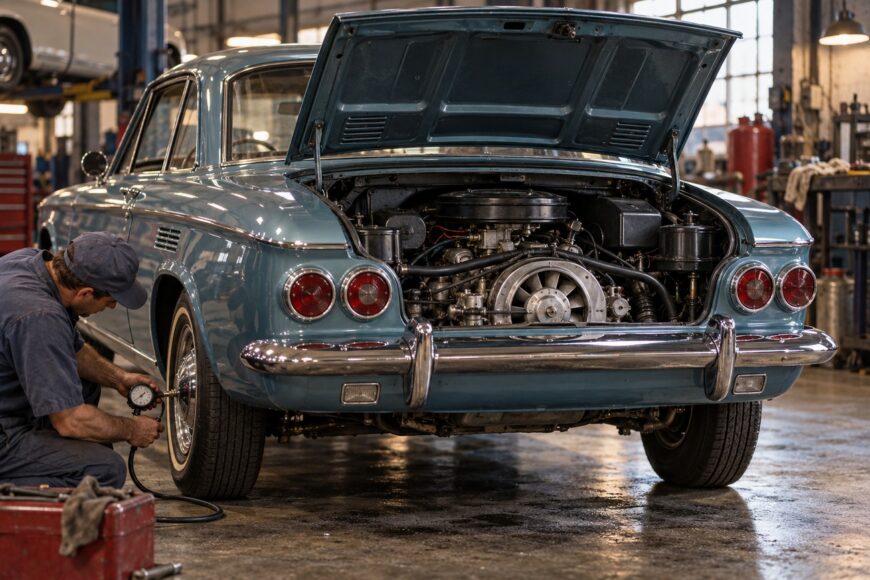
Chevrolet built the Corvair as a compact car with a rear-mounted, air-cooled, horizontally opposed six-cylinder engine. That layout placed the powertrain behind the passenger compartment and gave the car a character unlike conventional front-engine Detroit sedans. In overall concept, it was closer to a Porsche 911 than to the large American cars that dominated the market, even though the Corvair served a much broader audience.
The architecture brought genuine advantages. The flat-six engine was compact in height, the cabin could use the body efficiently, and the car had a distinctive mechanical identity. It also shifted substantial mass toward the rear axle. That distribution could influence cornering reactions, especially when the driver made a sudden steering or throttle input.
Ralph Nader’s book “Unsafe at Any Speed” made the Corvair a nationally recognized safety controversy. Its argument connected the early rear-suspension design with loss-of-control concerns and placed the car inside a broader criticism of how manufacturers approached automotive safety. Public attention then expanded the issue beyond a technical discussion of one model’s handling.
That distinction matters because public reputation, legal pressure, and engineering evidence answer different questions. The book helped expose serious safety-policy concerns and intensified scrutiny of the Corvair, yet its title is not a technical description of every car produced during the 1960–1969 run. The slogan became more durable than the details of the chassis changes that followed.
Once a model becomes associated with a famous safety claim, later versions are often judged through the same lens. Corvair owners and historians therefore tend to separate early controversial cars from later, more mature versions. That approach is more useful than treating the badge itself as a complete safety diagnosis.
What Actually Made Early Corvairs Difficult at the Limit
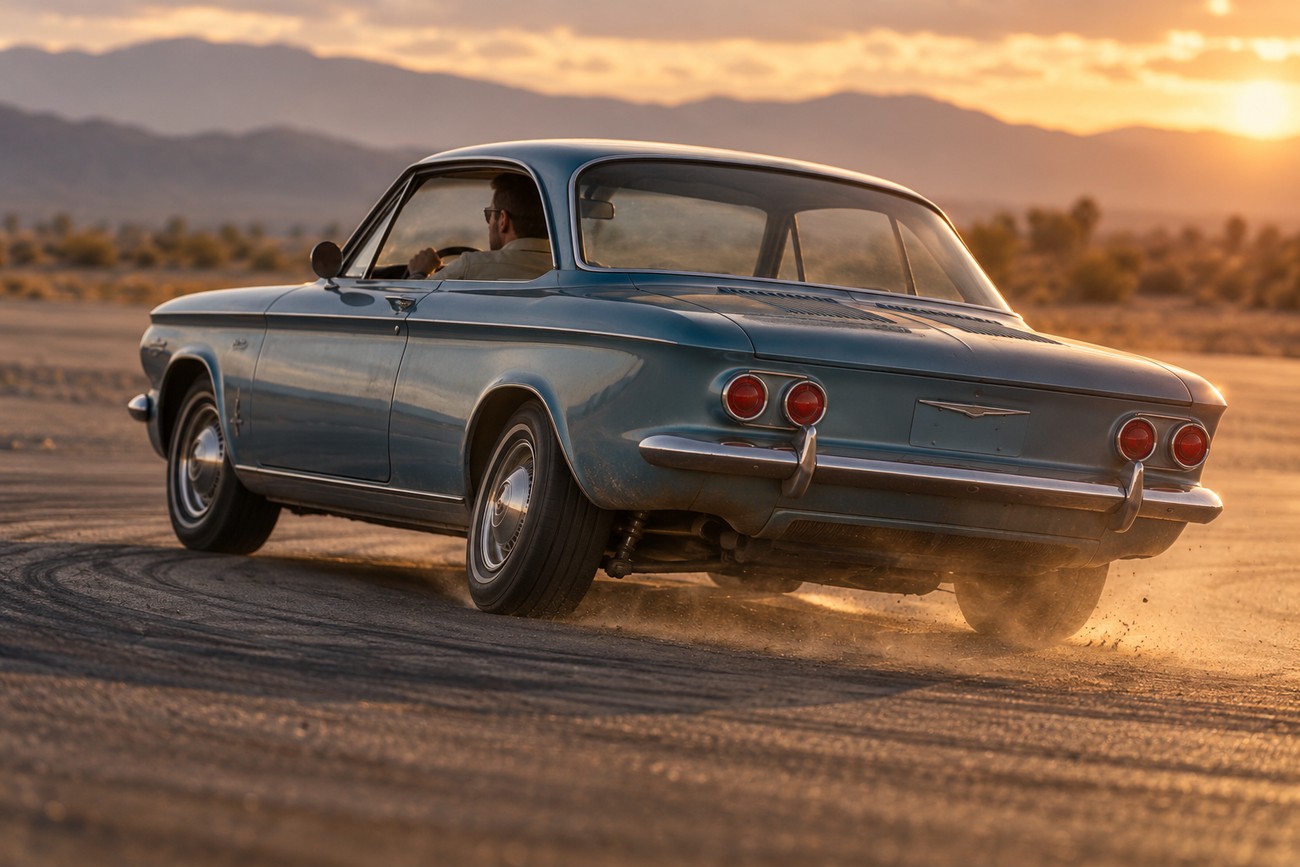
The central early concern was handling at the limit, caused by rearward weight distribution and the behavior of the early rear suspension. Early Corvairs used swing-axle-related solutions, a design that could produce significant changes in wheel geometry as the suspension moved. Under ordinary, measured driving, this did not make the car automatically uncontrollable. At the edge of adhesion, the reactions could become much sharper.
A sudden steering input or an abrupt throttle lift in a corner could promote oversteer. The rear of the car might lose grip more quickly than an inexperienced driver expected, and correcting the slide required calm, accurate steering. A driver accustomed to a front-engine car could react in a way that increased the problem, particularly by lifting off the throttle suddenly or making a second rapid steering input.
Tire pressure was part of the equation. Factory recommendations specified different pressures front and rear, reflecting the Corvair’s weight distribution. Public discussions sometimes describe the rear recommendation as excessively high, but claims about the precise pressure issue remain disputed when compared with factory data and later reconstructions. The safe conclusion is more practical: early Corvair handling depends heavily on using the correct specification and on verifying the actual condition of the tires.
The most serious tuck-under concerns are associated with early Corvairs when high load, low tire pressure, and abrupt throttle lift occur together. Heavy loading can alter the suspension’s working position, while low pressure reduces the tire’s ability to maintain a predictable shape. That combination becomes especially important during an emergency maneuver, rather than during steady cruising or a gentle turn.
Wear can make the original design harder to judge. Deteriorated tires, loose steering components, tired suspension parts, incorrect alignment, or poorly executed repairs may create nervous behavior that a driver then attributes to the Corvair in general. The real risk came from the combined effect of geometry, setup, loading, and maneuver severity, rather than from an unavoidable tendency at every speed.
Early and Late Corvairs Were Not the Same Handling Story
The 1965 redesign changed the Corvair’s rear suspension and substantially altered its handling character. The table below separates the early cars from the 1965–1969 versions so that a buyer can assess the actual chassis rather than relying on the model’s reputation.
| Area | Early Corvairs | 1965–1969 Corvairs |
|---|---|---|
| Production period | 1960–1964 | 1965–1969 |
| Rear-suspension arrangement | Swing-axle-related rear-suspension solutions | Fully independent rear suspension introduced in 1965 |
| Typical handling concern | Sharper oversteer and greater sensitivity during aggressive maneuvers, especially with incorrect pressure, heavy loading, or abrupt throttle lift | More controlled cornering behavior and a more mature overall handling character, while condition and setup still matter |
| Setup sensitivity | High sensitivity to tire pressure, tire condition, suspension geometry, loading, and driver technique | Still dependent on correct tires, alignment, suspension condition, and appropriate driving technique |
| Inspection priority | Verify the complete rear suspension, tire specifications and pressures, steering, alignment, and evidence of correct repairs | Confirm that the independent rear suspension is sound, correctly maintained, and free from poorly executed modifications |
| Practical buying implication | Potentially rewarding as a carefully prepared historic car, but it demands a more exacting evaluation and driver adaptation | Usually the more forgiving choice for regular road use, though no surviving example should be trusted without inspection |
In 1965, the Corvair received a fully independent rear suspension instead of the earlier swing-axle-related arrangement. This change noticeably improved cornering behavior and reduced the handling concern that had defined the public debate. It did not turn every later car into a modern vehicle, and it did not erase the effects of worn components or poor modifications.
The redesign also explains why two owners can describe the Corvair in sharply different terms. Someone driving a well-maintained 1965–1969 car may experience a balanced, predictable classic with unusual mechanical character. Someone recalling an early car with incorrect tires or neglected suspension may remember a vehicle that demanded constant respect at the limit.
Early examples are not automatically undriveable. They require a more disciplined approach to inspection, setup, and driving technique. Later examples are not automatically safe simply because they have the improved suspension; age has had decades to affect their tires, bushings, steering parts, alignment, and previous repairs.
The Real-World Mistakes That Make a Corvair Feel Dangerous
The most common ownership mistake is treating tire selection and pressure as routine details. A Corvair’s front and rear axles carry different loads, so an unsuitable tire, a mismatched pair, or an incorrect pressure can change steering response and stability. A car may look presentable while its tires are old, poorly matched, or inflated according to a generic assumption rather than the correct Corvair specification.
Driver adaptation matters as well. Rear-engine weight distribution changes the way the car responds when you lift off the throttle in a corner, especially on a wet or slippery surface. Gentle inputs and a clear understanding of the car’s reactions are more important than trying to reproduce the behavior of a modern front-engine vehicle.
A short test drive can conceal a serious problem. Calm acceleration and a few easy turns may reveal little about worn suspension, incorrect alignment, loose steering, or a tire that is slowly losing pressure. A car that feels merely “lively” during a brief drive may become distinctly nervous when the road surface changes or an evasive maneuver is required.
Modifications create another layer of uncertainty. A heavily modified or poorly repaired Corvair can behave worse than a correctly restored stock example, particularly when the owner cannot explain what was changed in the rear suspension or steering. “Stock” also needs careful interpretation: factory appearance does not prove that the car was restored with the correct parts or adjusted to the correct geometry.
These factors often explain complaints that a Corvair suddenly “breaks loose” or feels unpredictable. The model’s rear-engine layout sets the basic conditions, but the practical result comes from the interaction of suspension geometry, tire wear, pressure, road grip, loading, and driving style. The name on the deck lid is a poor substitute for examining those variables.
How to Evaluate a Corvair Before You Trust It on the Road
Start with the exact model year and rear-suspension configuration. A seller’s description may call a car simply “a Corvair,” although the handling implications differ substantially between an early swing-axle-related design and the fully independent rear suspension introduced in 1965. Confirm what is actually fitted to the car, especially if parts have been replaced during restoration.
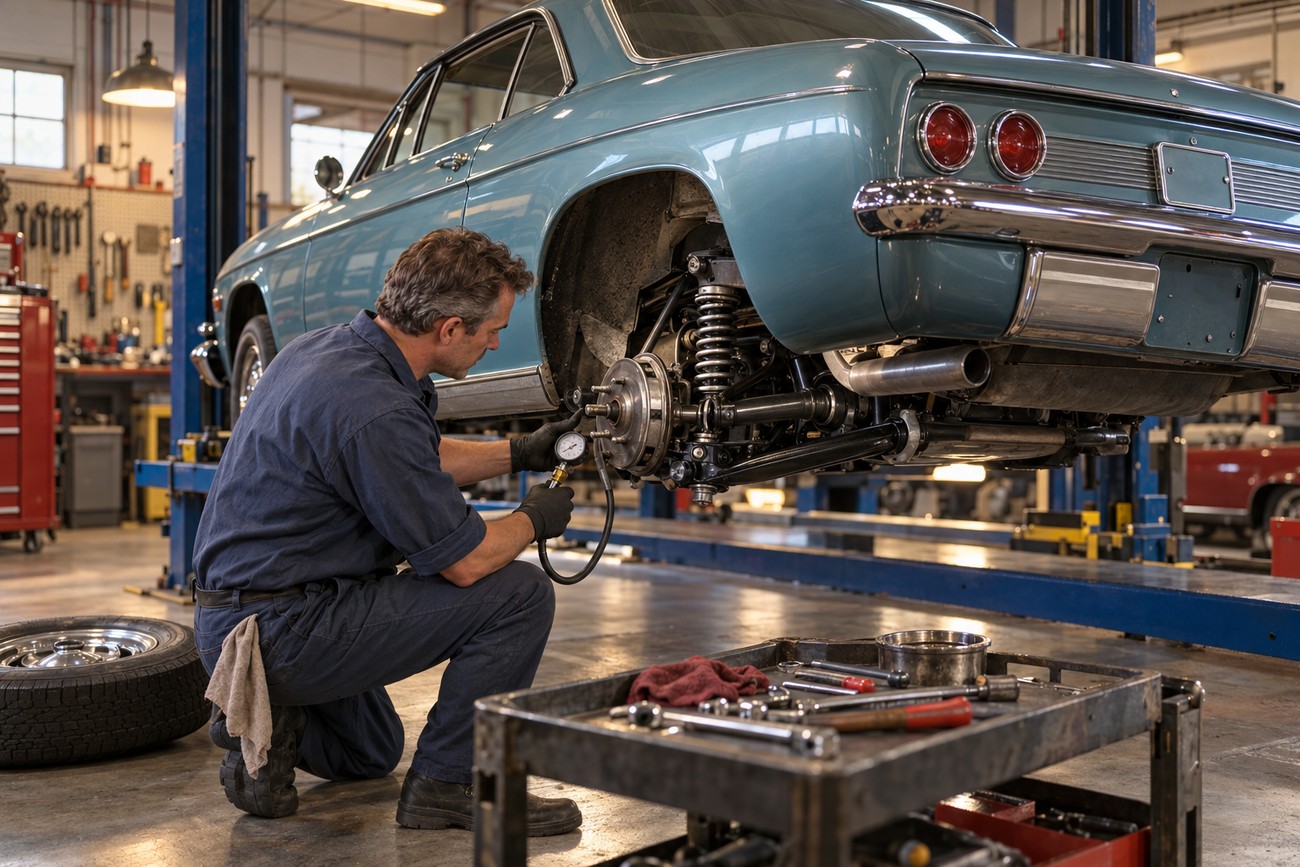
Inspect the tires as a system. Check their age and condition, look for uneven wear, and verify that the tires on each axle are properly matched. Confirm the pressures against reliable factory information for the specific car rather than using a generic pressure remembered from another vehicle. Because the Corvair carries its engine at the rear, incorrect loading or careless tire setup can have a larger effect on behavior than a casual inspection suggests.
Handling should be judged only after tire pressure, tire matching, alignment, and rear-suspension condition have been verified; otherwise, a short drive may be testing a defect rather than the Corvair’s intended behavior.
Examine the steering and suspension for wear, looseness, damaged parts, and evidence of improvised repairs. Check the alignment rather than assuming that a visually straight car is correctly set up. Long storage is especially deceptive: a vehicle may have fresh-looking paint and a clean interior while still carrying aged tires, stiff or worn suspension components, and steering parts that need attention before road use.
Ask for clear records of modifications. Changes to springs, dampers, bushings, wheels, tires, steering components, or rear-suspension parts may improve a car, leave it unchanged, or make its reactions less predictable. Without documentation, the inspection should focus on how the changes affect geometry and control, rather than on whether the parts sound modern or expensive.
Assess the car under progressively broader conditions after the basic checks are complete. Begin with straight-line braking and gentle turns on a suitable surface, then pay attention to steering weight, return, tire behavior, and any rear-end movement. Avoid deliberately provoking a slide on a public road; the purpose of evaluation is to identify soundness and predictability, not to recreate the historical controversy.
A careful inspection also protects the buyer from a common misunderstanding about restoration. Cosmetic quality and mechanical correctness are separate achievements. A car can be attractively restored, described as stock, and still require substantial work before its handling reflects the design engineers intended.
So, Was the Chevrolet Corvair Really Unsafe at Any Speed?
No simple “yes” or “no” describes the complete Corvair story. Early cars had a real handling vulnerability under specific conditions, especially when suspension behavior, incorrect tire pressure, heavy loading, and an abrupt throttle lift combined during an aggressive maneuver. That is a serious engineering concern, yet it is different from saying that every Corvair was equally dangerous during every kind of driving.
The 1965 fully independent rear suspension materially improved the car’s cornering behavior and gave later Corvairs a more mature handling character. The change is important enough that early and late cars should be assessed as distinct driving propositions. Even so, a later car with worn tires, poor alignment, tired suspension, or careless modifications can still be unsuitable for confident road use.
The phrase from Nader’s book became a powerful public symbol, and the resulting controversy caused reputational damage broader than the real-world risk of every correctly maintained individual car. The slogan captured public anxiety about automotive safety, while the engineering record requires a narrower assessment of year, suspension, setup, and driving conditions.
For a prospective owner, the sensible verdict is conditional. A correctly inspected and maintained Corvair can be an engaging classic with a distinctive rear-mounted flat-six character. An early example deserves particular care and driver adaptation, while a later example is generally the more forgiving choice. In every case, safety depends on the specific car and its preparation, not on the reputation attached to the model name.
Frequently asked questions
What car was considered Unsafe at Any Speed?
The Chevrolet Corvair was the car associated with the phrase “Unsafe at Any Speed.” The expression came from Ralph Nader’s book and became attached to a national controversy over the safety of the Corvair’s early rear-suspension design.
It became a slogan rather than a technical description of every Corvair. The production run lasted from 1960 through 1969, and the 1965 introduction of a fully independent rear suspension materially changed the car’s handling. The phrase therefore identifies the controversy and its public legacy more accurately than it describes every individual vehicle.
Why did Ralph Nader say the Corvair was Unsafe at Any Speed?
Nader’s argument linked the early Corvair’s rear-suspension design with the possibility of loss of control during demanding maneuvers. The concern centered on the interaction between rearward weight distribution, early suspension behavior, and the car’s response when a driver encountered an emergency or made an abrupt control input.
The book also criticized the wider safety policies of the automotive industry, which gave the Corvair issue a significance beyond one model’s cornering behavior. Its influence helped drive public and legal pressure, although the slogan should not be read as proof that every Corvair had the same handling risk or that normal driving was inevitably unsafe.
Was the Corvair engine any good?
The Corvair engine was a rear-mounted, air-cooled, horizontally opposed six-cylinder engine. Its mechanical layout was a defining feature of the car and is separate from the criticism aimed at the early rear suspension. A chassis and handling dispute does not amount to a verdict that the engine itself was inherently poor.
For an owner today, the engine should be assessed on its individual condition, maintenance, and restoration quality. The important distinction is that the Corvair’s unusual powertrain architecture explains its rearward weight distribution, while the historically significant handling concern involved the suspension, tires, loading, and driver inputs.
Why are Corvairs so cheap?
A Corvair’s purchase price is not a safety rating. Prices can reflect the model’s complicated reputation, the availability and condition of surviving cars, and the cost of correcting deferred maintenance. A low-priced example may need tires, suspension work, steering repairs, alignment, or substantial restoration before it is ready for dependable road use.
The real ownership cost depends on the specific car. A properly maintained later Corvair may be a more practical starting point than a cosmetically attractive early car with unknown suspension work, while a documented and carefully prepared early example can be more valuable than its reputation suggests. Inspection should come before any judgment based on price.







