
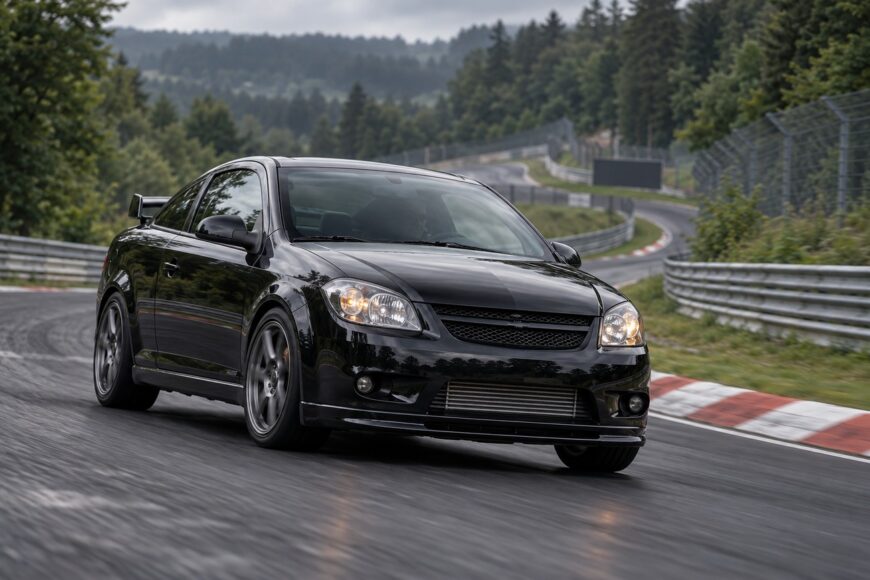
An ordinary-looking GM compact carrying an 8:22.85 Nürburgring claim is an unlikely performance story. GM presented that lap for the Chevrolet Cobalt SS Turbo as a front-wheel-drive sport-compact record at the time. The figure helps explain why the car drew attention beyond its showroom class, but it needs a narrower reading than the phrase “Nürburgring sedan” suggests.
The claimed lap belongs to a Cobalt SS Turbo, and the available claim alone does not establish that a sedan completed it. The later turbocharged sedan shares the model’s performance identity, yet body style, equipment, and condition matter when judging any individual car. For a buyer, the useful distinction is between what GM claimed, what independent tests measured, and what an aging Cobalt SS can deliver now.
- The 8:22.85 lap—and the sedan question
- Cobalt SS Supercharged vs Turbo: the cars behind the badge
- Why the Turbo was more than a big horsepower number
- Fast on a circuit, less tidy on an ordinary road
- What to check before buying a Cobalt SS
- The modified-car trap: why “Stage 2” proves little
- Frequently asked questions
- What does Cobalt SS stand for?
- How can I confirm an advertised Cobalt SS sedan is factory-built?
- Where can I check whether a Cobalt SS power-steering recall was completed?
The 8:22.85 lap—and the sedan question
GM claimed an 8:22.85 Nürburgring lap for the Cobalt SS Turbo and presented it as a front-wheel-drive sport-compact record at the time. That is a historically significant manufacturer claim, especially for a compact sold under a familiar Chevrolet name. It should still be attributed to GM rather than stated as an independently certified result.
The Nürburgring’s current official records database covers certified records beginning with the 2019 season. Its scope does not automatically certify an earlier manufacturer run, nor does it erase the period claim. Describing the Cobalt SS as the holder of a current official circuit record would overstate what that database establishes.
The word “sedan” requires equal care. A claimed lap for the Cobalt SS Turbo does not, by itself, identify the timed car’s body style; the later availability of a turbo sedan cannot fill that gap. Nor can one body style inherit anther’s lap time simply because they share an engine badge: mass, tires, and setup can affect a result over a full circuit.
The defensible conclusion is that GM used the lap to demonstrate the Turbo model’s pace. It gives context for the engineering work behind the SS, while leaving the sedan-specific lap claim unproven on the information available here. Independent acceleration and grip tests offer a separate way to assess the car, without serving as verification of the Nürburgring time.
Cobalt SS Supercharged vs Turbo: the cars behind the badge
The SS badge spans two distinct high-performance Cobalts. Comparing their hardware prevents the earlier supercharged coupe from being mistaken for the later, more powerful Turbo or its sedan derivative.
| Specification | 2005–2007 Cobalt SS Supercharged | 2008 Cobalt SS Turbo specification |
|---|---|---|
| Engine | 2.0-liter Ecotec LSJ | 2.0-liter direct-injected Ecotec LNF |
| Induction | Eaton M62 supercharger | Turbocharger |
| Factory output | 205 hp, 200 lb-ft | 260 hp, 260 lb-ft |
| Driven wheels and transmission | Front-wheel drive, five-speed manual | Front-wheel drive, five-speed manual |
| Body-style qualification | Offered as a coupe | A turbocharged sedan was later offered; the Nürburgring claim alone does not identify the timed car’s body style |
The LSJ and LNF differ in how they make boost as well as in output. A listing that says only “Cobalt SS” therefore tells you too little about the engine, likely driving character, or parts you need to inspect. Confirm the factory engine designation before treating an advertised sedan as equivalent to a particular tested car.
The early Supercharged version’s coupe-only availability matters to the naming story: there was no factory Supercharged sedan in that range. Conversely, the existence of a later Turbo sedan does not turn every Cobalt SS performance figure into a sedan result. Those boundaries are more useful than an unsupported comparison between quoted weights from different sources.
Why the Turbo was more than a big horsepower number
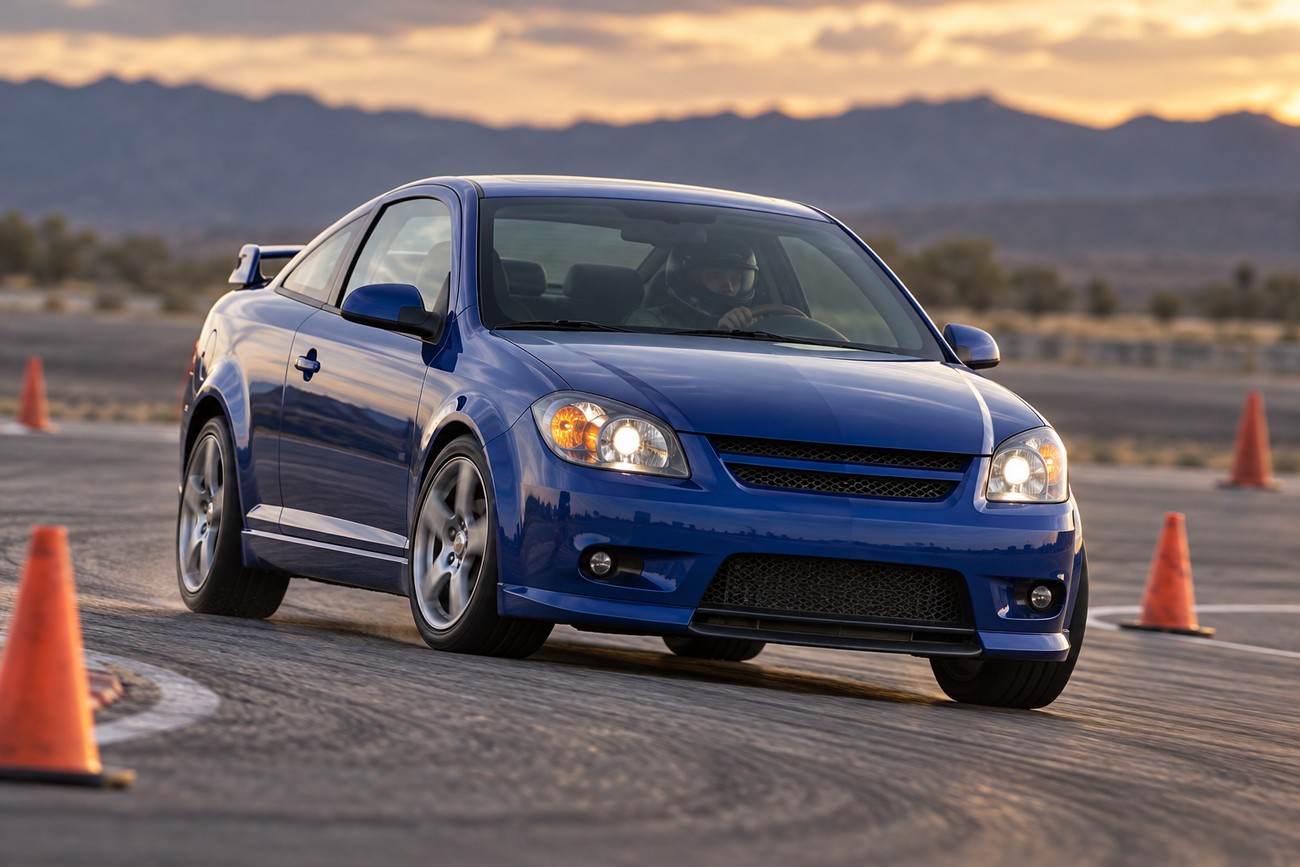
The direct-injected LNF’s 260 hp and 260 lb-ft gave the front-drive Turbo substantial straight-line ability. Motor Trend measured 0–60 mph in 5.5 seconds and a quarter-mile in 13.9 seconds at 102.5 mph. Those are independent road-test results, distinct from GM’s Nürburgring claim.
Motor Trend also recorded 0.91 g of lateral acceleration. That figure gives the lap story more engineering context: the Turbo could generate meaningful cornering grip as well as acceleration. It cannot establish how the car behaved through an entire Nürburgring lap, where tire condition, braking consistency, and setup also matter.
The earlier Supercharged car helps explain why the SS was more than an engine option. It came with 18-inch wheels, P215/45R18 Z-rated tires, and four-wheel disc brakes. Those components do not make the LSJ and LNF identical, but they show the importance of tires and stopping hardware to the range’s performance brief.
Motor Trend listed the Turbo at about 3,000 lb and EPA fuel economy at 22 mpg city / 30 mpg highway. The weight puts its acceleration in perspective without requiring a questionable comparison with an early-car figure. The fuel-economy rating, meanwhile, is a planning reference for ordinary use, not evidence that a hard-driven or modified example will meet it.
Fast on a circuit, less tidy on an ordinary road
A 260-hp, 260-lb-ft front-wheel-drive car asks its front tires to steer and transmit considerable torque at once. Hard acceleration can bring wheelspin and torque steer, particularly where the surface offers uneven grip. A favorable circuit lap says little about how composed the car will feel pulling away on a damp, worn road.
Tires are a consequential ownership choice rather than a cosmetic one. Replacing performance-rated rubber with unsuitable budget tires can reduce braking and cornering performance, even if the engine still delivers its factory output. On a used example, the tire model, condition, and matching fitment deserve attention before a spirited test drive.
The sedan adds easier access to its rear seats, giving the Turbo a practical reason to exist beyond its headline pace. It does not remove the traction limits of the front-drive layout or transform the Cobalt cabin. Owners frequently report squeaks and rattles, so a quiet-looking interior in photographs tells you little about the experience over rough pavement.
These are road-use and owner-reported considerations, not extensions of Motor Trend’s instrumented figures. A car can post convincing acceleration and grip numbers yet feel unsettled when its tires are poor or its cabin has aged. The distinction helps set a fair expectation: the SS offers measurable performance within the compromises of its compact-car platform.
What to check before buying a Cobalt SS
Begin with identity and paperwork. Match the VIN and build information to the advertised engine and body style, then review service records for cooling work, drivetrain repairs, and modifications. A car described as stock may have had hardware or software changed and later removed, so ask for evidence rather than relying on its current appearance.
Next, inspect the boost and cooling systems appropriate to the engine. On an LSJ, owners report both supercharger-clutch noise and intercooler heat-exchange pump failures. A characteristic rattle may come from the clutch without an immediate failure, but sound alone cannot rule out bearing or drive problems; it needs a diagnosis.
Check LSJ intercooler-pump operation directly. A short drive that feels normal may not reveal impaired charge-air cooling.
For either version, look for cooling leaks, signs of overheating, and evidence that boost hardware has been disturbed. Owner discussions also describe catalytic-converter restrictions on apparently stock cars as well as Stage-calibrated examples. If performance feels weak, investigate the cause rather than assuming the turbocharger, supercharger, or a past tune is responsible.
Assess clutch take-up and shifting during a careful road test, and look for signs of repeated hard launches or poorly documented repairs. Check the timing-chain pensioner’s service history instead of assuming every car has received the same updated parts. These checks matter more to future expense than the model’s best-known lap figure.
Finally, test the electric power steering and check applicable recalls by VIN. Owner complaints about steering assist are a reason to verify campaign status, not proof that every example has outstanding work. Drive over varied surfaces to listen for cabin rattles, then repeat the acceleration and braking checks only where it is safe and lawful to do so.
The modified-car trap: why “Stage 2” proves little
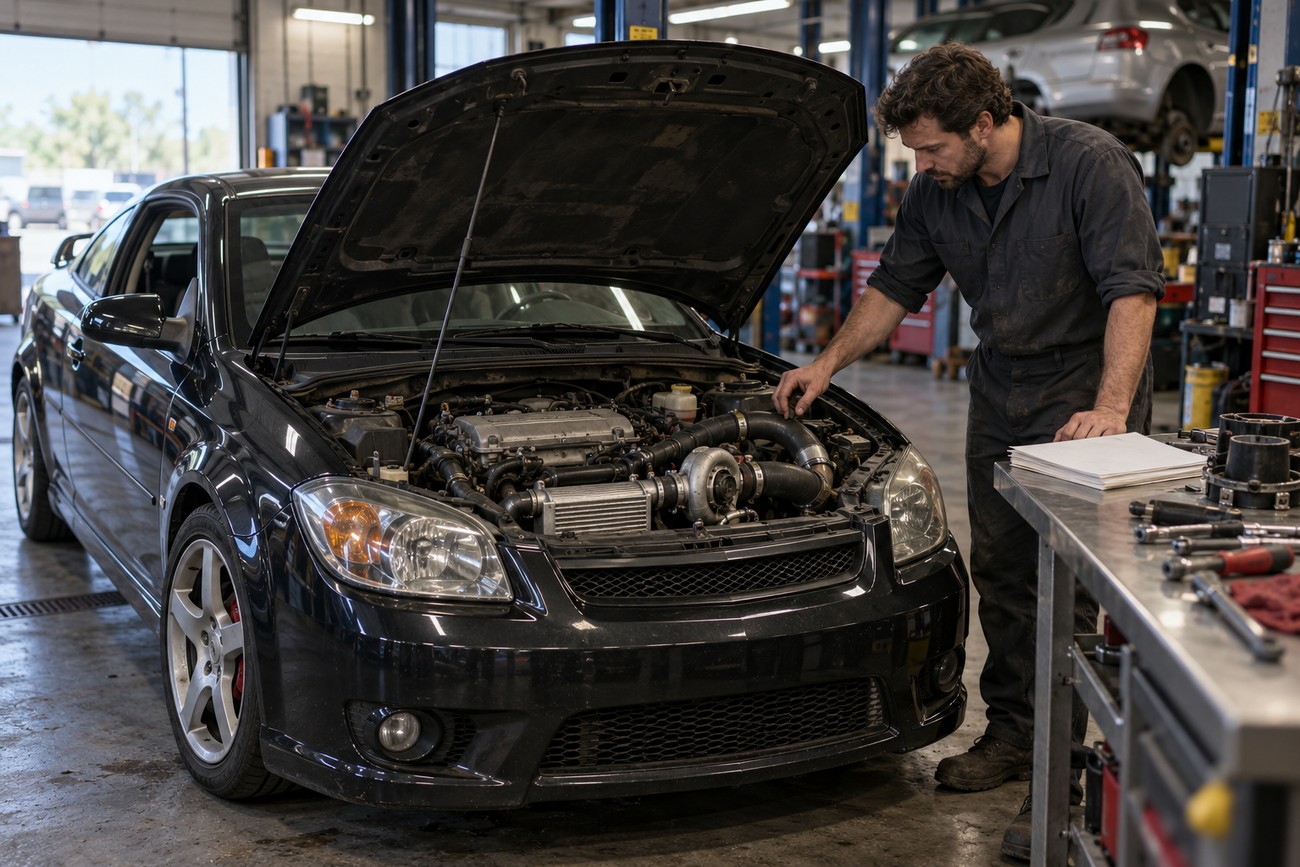
“Stage 2” is not a universal parts-and-calibration standard. The label in an advertisement does not identify the installed hardware, the software running the engine, or whether supporting components remain in place. Two cars carrying it can present different inspection needs and different mechanical risks.
Ask for invoices that identify parts and installation work, along with any available software history. Compare that record with what is on the car, and use a careful drive to check for consistent power delivery, clutch slip, abnormal temperatures, or warning lights. An advertised power claim deserves less weight when the seller cannot establish how the car was configured.
Questionable calibration or increased output can add stress to the catalyst, clutch, and cooling system, although a tune does not by itself prove damage. Owner reports of catalytic-converter restriction include both stock and Stage-calibrated cars, so the label alone cannot establish the cause of a fault. Diagnosis should follow the symptoms and the actual hardware.
The Cobalt SS Turbo’s Nürburgring figure remains GM’s 8:22.85 claim, not an inspection certificate for a surviving example. For a buyer, documented maintenance, a sound drivetrain, and verified boost and cooling operation are more valuable than either that historic lap or an unexplained Stage badge.
Frequently asked questions
The badge and the similar model names can obscure which car a listing describes. These checks help establish the vehicle’s identity and recall status before you assess its condition.
What does Cobalt SS stand for?
SS stands for Super Sport, Chevrolet’s performance badge designation. It does not specify a single engine or output: a Cobalt SS Supercharged uses the LSJ, while a Cobalt SS Turbo uses the LNF. The Chevrolet SS sedan is a separate model from the Cobalt SS.
How can I confirm an advertised Cobalt SS sedan is factory-built?
Reconcile the VIN, build information, and factory engine designation with the vehicle itself. A factory turbocharged Cobalt SS sedan should have documentation consistent with the LNF and its original configuration; badges, body panels, or a seller’s description alone cannot establish that identity. If records conflict, resolve the discrepancy before valuing it as a factory SS sedan.
Where can I check whether a Cobalt SS power-steering recall was completed?
Start with the manufacturer’s VIN-based recall lookup and the NHTSA VIN lookup for vehicles covered by its database. These can identify applicable or outstanding campaigns, while repair invoices or dealer paperwork can help establish what work was actually performed. Confirm the status for the specific VIN rather than assuming it from the car’s model year.







