
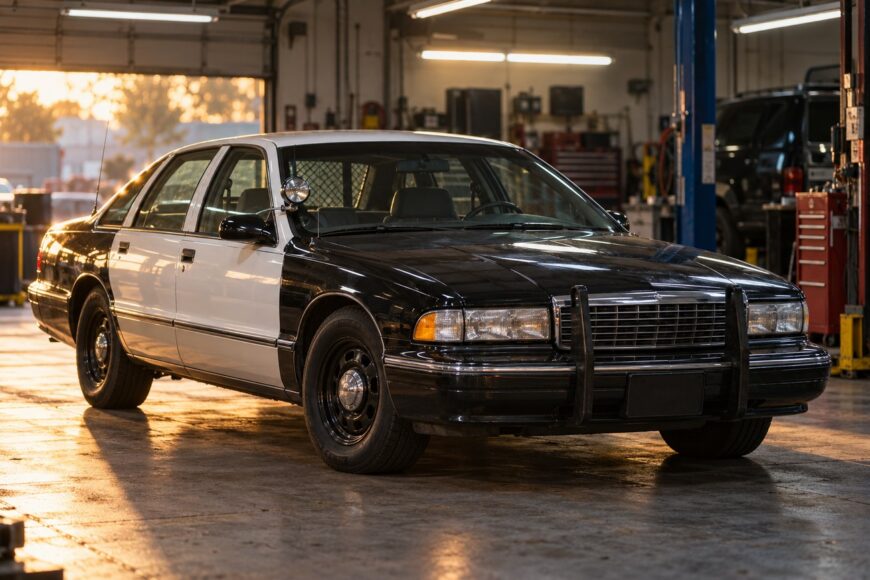
The Chevrolet Caprice 9C1 has the appeal of a real police sedan: rear-wheel drive, a 5.7-liter V8, heavy-duty equipment, and the unmistakable shape of a full-size American patrol car. Age changes the equation. Fuel consumption, corrosion, former service abuse, and scarce body and police-specific parts can make an apparently exciting purchase expensive to put right.
The 9C1 designation identifies a factory Chevrolet/GM police or emergency-service package, not a separate sports model. That distinction matters because a civilian Caprice can receive police-style wheels, push bars, trim, or graphics without being a genuine 9C1. A sound purchase therefore depends on identifying the year, engine code, drivetrain, retained package hardware, and documentation before judging the car’s performance or collector appeal.
This is a sedan to evaluate as an old working vehicle first and a piece of police-car history second. The specification explains what the car was designed to do; its surviving condition determines whether it can still do it safely and economically.
- What the Chevrolet Caprice 9C1 Actually Is
- Caprice 9C1 Specifications at a Glance
- Engines, Transmission, and the 9C1 Performance Debate
- What Police Duty Does to the Car
- Buying a Used Caprice 9C1: Inspection Priorities
- Ownership, Parts, Comfort, and Collector Value
- Frequently asked questions
- Why can a 1989 Caprice Police listing show five seats when later 9C1 data shows six?
- What does the 3.23 final drive change in everyday driving?
- How should buyers interpret a low-mileage former police Caprice?
What the Chevrolet Caprice 9C1 Actually Is
Chevrolet used 9C1 as a factory code for a police or emergency-service package. It was applied to a standard Caprice platform that received changes to the chassis, brakes, electrical system, differential, and other equipment needed for demanding fleet work. Calling it a separate performance model oversimplifies the car and can lead buyers to expect a single universal engine or specification.
The relevant cars belong to the fourth-generation Caprice context. Catalog references commonly show 1991–1996 for the generation as a whole, while the Caprice Police Sedan is often listed specifically for 1992–1993. Those ranges should be treated as a guide for identification rather than a substitute for the vehicle identification number, build documentation, and parts fitted to the individual car.
Year and engine code are especially important because references include both the 5.7-liter LO5 and LT1 V8. Power figures associated with them are different, and equipment could be changed during the car’s service life. A seller who quotes only “Caprice 9C1” has not yet established which version is being offered.
Appearance provides useful clues, but it proves little on its own. A civilian Caprice may be fitted with police wheels, a bench seat, heavy-duty springs, or a dark repaint, while a genuine former police car may have lost some of its original equipment. Documentation combined with surviving package hardware is a stronger basis for authentication than a badge or a convincing exterior.
Caprice 9C1 Specifications at a Glance
The following figures bring together commonly documented Police Sedan data while marking the areas where catalogs do not agree. Actual equipment should be checked against the car and its build records.
| Specification | Documented information |
|---|---|
| Vehicle type | Chevrolet Caprice with factory 9C1 police or emergency-service package |
| Generation and references | Fourth-generation context; 1991–1996 generation references, with 1992–1993 Police Sedan references |
| Engine family | 5.7-liter V8; LO5 and LT1 references appear in catalogs |
| Reported output | 205 hp for the LO5 reference; 265 hp for the LT1 reference, depending on engine and year |
| Transmission | 4-speed automatic |
| Drivetrain | Rear-wheel drive |
| Police final drive | 3.23 reference |
| Dimensions | 5439 × 1956 × 1440 mm |
| Wheelbase | 2945 mm |
| Listed mass | 1815 kg |
| Seating | Commonly listed as 6 seats in 2 rows; one 1989 Caprice Police listing shows 5 seats |
| Fuel consumption reference | 19.5 L/100 km city and 15.4 L/100 km combined for a 5.7-liter version |
| Police-associated equipment | Limited-slip/self-locking differential, rear disc brakes, stronger alternator and battery |
Engines, Transmission, and the 9C1 Performance Debate
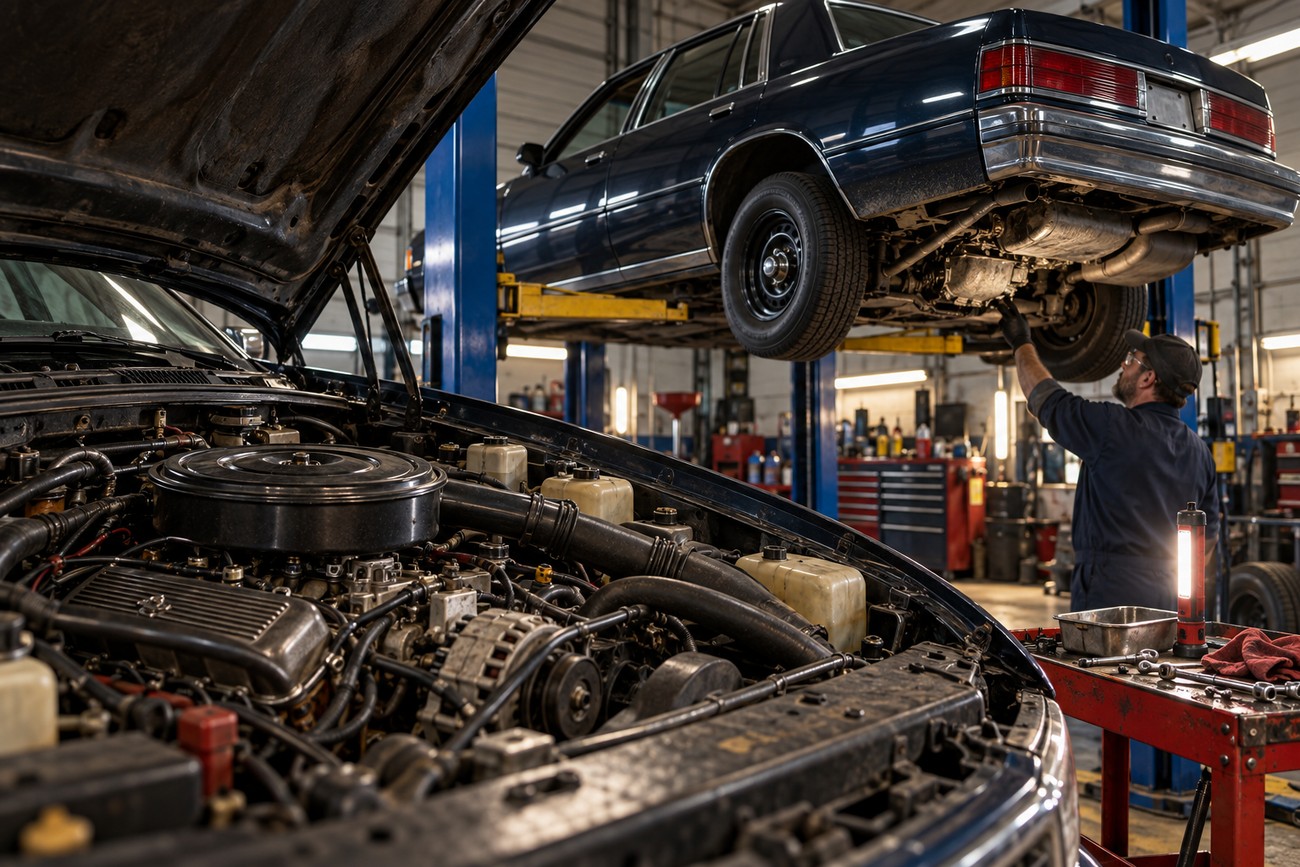
The 5.7-liter V8 is central to the Caprice 9C1’s reputation, but there is no single horsepower figure that applies to every car. References identify an LO5 version at 205 hp and an LT1 version at 265 hp. The difference reflects engine and model-year variation, so a listing that claims all 9C1 sedans make 265 hp should be treated cautiously.
Both versions use a 4-speed automatic and rear-wheel drive. That combination suits a large sedan built for sustained use, but the transmission’s condition now matters more than its original design brief. Delayed engagement, slipping, harsh shifts, or a flare between gears deserve a professional inspection rather than a promise that the unit only needs fresh fluid.
The police package is associated with a 3.23 final drive. This shorter gearing can make the heavy sedan feel more responsive from low and medium speeds, particularly when combined with a limited-slip or self-locking differential. It does not turn the Caprice into a lightweight sports car; the car’s mass remains a major part of its character.
On the highway, the same gearing can bring more engine noise and fuel use than a taller civilian setup. That is a practical ownership difference, not a minor specification detail. Compare the axle ratio, engine code, transmission behavior, and differential together instead of choosing a car solely by its quoted horsepower.
What Police Duty Does to the Car
Police-grade equipment and police-used condition are separate issues. The 9C1 package could include a limited-slip differential, rear disc brakes, a stronger alternator, and a more powerful battery, but those parts do not protect a neglected car indefinitely. Former patrol vehicles may have spent long periods idling, absorbed repeated heat cycles, and experienced hard acceleration and braking even when the odometer shows modest mileage.
Cooling deserves priority because a large V8 sedan has little tolerance for a system that is merely adequate. Inspect the radiator, hoses, fan operation, coolant condition, and evidence of past overheating. Wiring, seals, and the fuel system also age regardless of whether the car was driven regularly, and police electrical additions can leave repairs behind after radios, lights, and other equipment are removed.
The older GM V8s can remain serviceable, and the 4-speed automatic can last when maintained, but age changes the inspection priorities. Oil leaks, brittle wiring, tired sensors, transmission seepage, and cooling faults can be more important than a clean engine bay. A recently detailed engine compartment may hide the very areas that need examination.
Police suspension calibration generally favors control and durability over softness. That can help the car remain composed under load, yet it also makes poor roads feel harsher than they do in a civilian luxury Caprice. Worn springs, dampers, bushings, and steering components add expense and can disguise the original handling advantages of the package.
Buying a Used Caprice 9C1: Inspection Priorities
Start with identity and structure. Check the vehicle identification number, title and service records, and any available fleet documentation, then inspect the frame, floor, wheel arches, and the lower edges of the doors. Corrosion in these areas can cost more to repair than a tired engine, especially when replacement body panels and sound donor cars are difficult to locate.
Mileage is supporting evidence, not a condition verdict. A former patrol car may have accumulated substantial idle time and heat exposure without adding corresponding distance. Look for maintenance records, cooling-system work, transmission service, and consistent evidence of how the car left fleet service.
Test the braking system carefully. Confirm that the rear discs, calipers, lines, and parking brake operate correctly, and check for vibration, pulling, or a long pedal. The Caprice is a heavy sedan with a V8, so worn brakes become obvious in use and can turn a seemingly minor refurbishment into a substantial repair bill.
Inspect the transmission and differential under load and during low-speed maneuvers. Listen for whining, clunks, or binding, and confirm that the limited-slip or self-locking function has not been replaced by an ordinary civilian unit. A shorter final drive can be valuable, but only if the axle is quiet, properly lubricated, and matched to the rest of the drivetrain.
Finally, establish what remains of the police specification. Heavy-duty springs, rear disc equipment, electrical upgrades, the correct axle, and other package components may have been replaced with civilian parts after retirement. A visually convincing car with ordinary replacement hardware may still be enjoyable, but it should be priced and described as a modified or partially converted Caprice rather than assumed to be an untouched 9C1.
Ownership, Parts, Comfort, and Collector Value
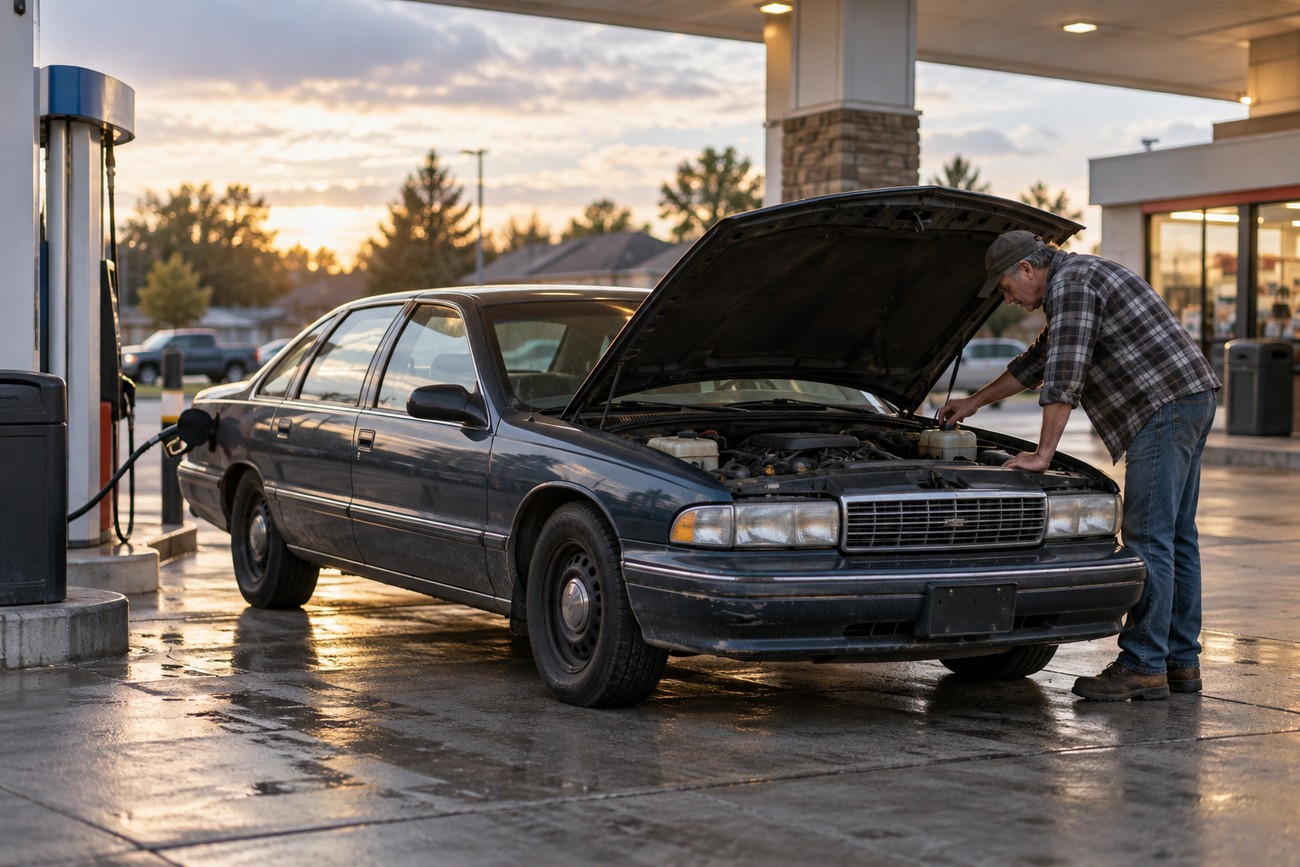
Fuel is one of the clearest daily-use costs. Catalog data for a 5.7-liter version gives 19.5 L/100 km in city driving and 15.4 L/100 km combined. Those figures are reference values rather than a promise for a decades-old car, particularly one with the 3.23 final drive, worn sensors, or a cooling and fuel system that no longer operates as intended.
The dimensions also shape ownership. At 5439 mm long and 1956 mm wide, the Caprice needs more space to park and maneuver than a modern midsize sedan. Its large cabin and traditional two-row layout are useful, but the interior is simple, and owners commonly encounter squeaks and trim wear rather than the quiet refinement associated with civilian luxury versions.
Parts availability requires planning. Mechanical components may be manageable through specialist suppliers and shared GM applications, while specific police trim, electrical parts, body panels, and good donor cars can be harder to find. This makes a complete, unmodified example more valuable to restore than a cheaper car that has already lost its distinctive equipment.
Collector and resale value follow condition, originality, configuration, and documented history. The 9C1 label alone does not guarantee a premium, especially when the car has structural rust, a civilian replacement drivetrain, incomplete police equipment, or an uncertain service history. A well-preserved, correctly identified example can justify enthusiasm; a worn former fleet car should be judged by repair needs first.
Frequently asked questions
Why can a 1989 Caprice Police listing show five seats when later 9C1 data shows six?
The difference reflects catalog and model-year variation rather than proof that one listing is automatically wrong. Later Police Sedan data commonly describes 6 seats and 2 rows, while one 1989 Caprice Police listing shows 5 seats. Fleet seating could also be affected by the exact interior configuration and the way a catalog recorded it.
Seat count should therefore support an identification rather than decide it. Verify the year, vehicle identification number, factory records, seat layout, and surviving police hardware before restoring the interior or claiming a car is an original 9C1.
What does the 3.23 final drive change in everyday driving?
A 3.23 final drive gives the engine more leverage at the wheels than a taller ratio, which can make the heavy Caprice respond more promptly in ordinary traffic. The limited-slip or self-locking differential associated with the package can also improve traction when both rear wheels need to work together.
The trade-off appears at cruising speed. Engine speed, cabin noise, and fuel use may be higher than with a taller civilian axle, so the ratio is not an automatic performance upgrade for every owner. Check the actual axle, transmission, and tire combination rather than assuming every car retains the original police gearing.
How should buyers interpret a low-mileage former police Caprice?
Use low mileage as one clue, then weigh it against service history, idle exposure, cooling evidence, and the condition of the transmission and wiring. A car that spent long periods idling or suffered repeated heat cycles can have more aggregate wear than its odometer suggests.
Inspect the structure, brakes, cooling system, differential, and suspension before assigning value. A documented, well-maintained car with modest mileage is promising; an undocumented example with replaced civilian equipment and signs of overheating remains a risk regardless of the number on the dashboard.







