
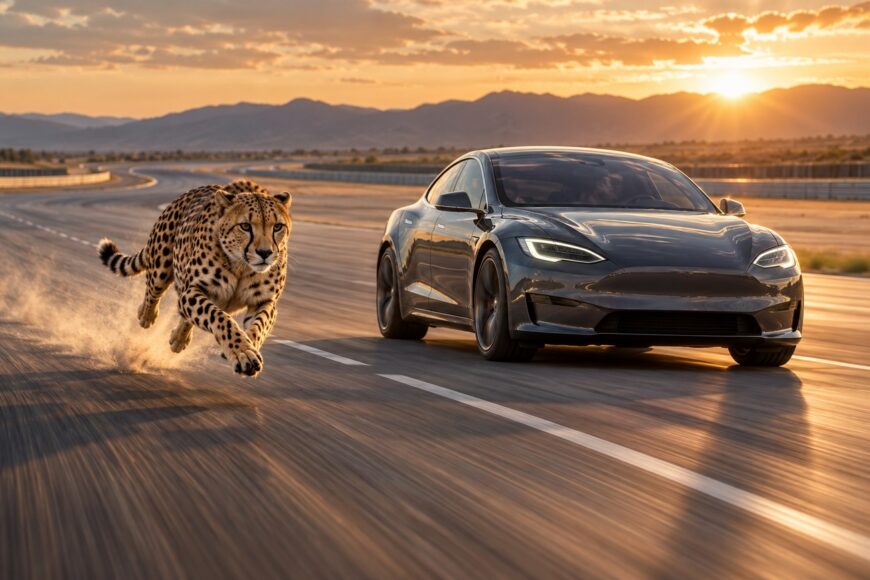
A cheetah is famous for explosive acceleration, yet a Tesla Model S Plaid is commonly credited with a quicker 0–60 mph time. That apparent contradiction comes from comparing a biological sprint with an automotive test, using different distances, methods, and definitions of performance.
The answer changes with the Tesla version, surface, tires, starting conditions, and measurement method. A cheetah’s strongest qualities include launch, braking, and rapid direction changes, while a Model S can deliver repeatable straight-line performance and a much higher top speed. There is no reliable single winner until the race itself is defined.
- What Does “Faster” Mean in This Race?
- How Quickly Can a Cheetah Accelerate?
- How Fast Is the Tesla Model S by Version?
- Cheetah vs. Tesla Model S: Key Performance Figures
- Why Distance Changes the Winner
- The Hidden Variables Behind the Numbers
- Common Myths That Distort the Cheetah-versus-Tesla Debate
- Verdict: Who Accelerates Faster?
- Frequently asked questions
- Which car accelerates faster than a Tesla Model S Plaid?
- Why can’t a cheetah’s 0–60 mph time be measured like a car’s?
- Why can a Tesla feel slower than its published acceleration time?
What Does “Faster” Mean in This Race?
Acceleration measures how quickly an object gains speed. Top speed measures the highest speed it reaches. Those figures describe different abilities: a vehicle can accelerate rapidly yet have a modest top speed, while another can build speed more slowly and ultimately travel faster.
Duration adds another distinction. A cheetah’s peak effort is a short sprint, whereas a Tesla can continue accelerating and traveling at high speed for much longer. Braking and maneuverability also matter, especially in a pursuit. The animal must slow, turn, and correct its line; a straight road removes much of that biological advantage.
The familiar claim that a cheetah reaches 0–60 mph in about 3 seconds is repeated widely, but it is not the best-supported standard for this comparison. The stronger benchmark is approximately 0–45 mph (72 km/h) in 2.5 seconds. That result cannot be treated as an automotive 0–60 mph test simply because both figures describe acceleration.
A fair contest therefore needs a fixed distance, an agreed starting condition, and a clearly identified Model S trim. Tire grip, road surface, battery temperature, and timing method can alter the car’s result. Terrain, motivation, traction, and available space affect the animal’s result. Without those controls, a headline comparison can sound precise while answering the wrong question.
How Quickly Can a Cheetah Accelerate?
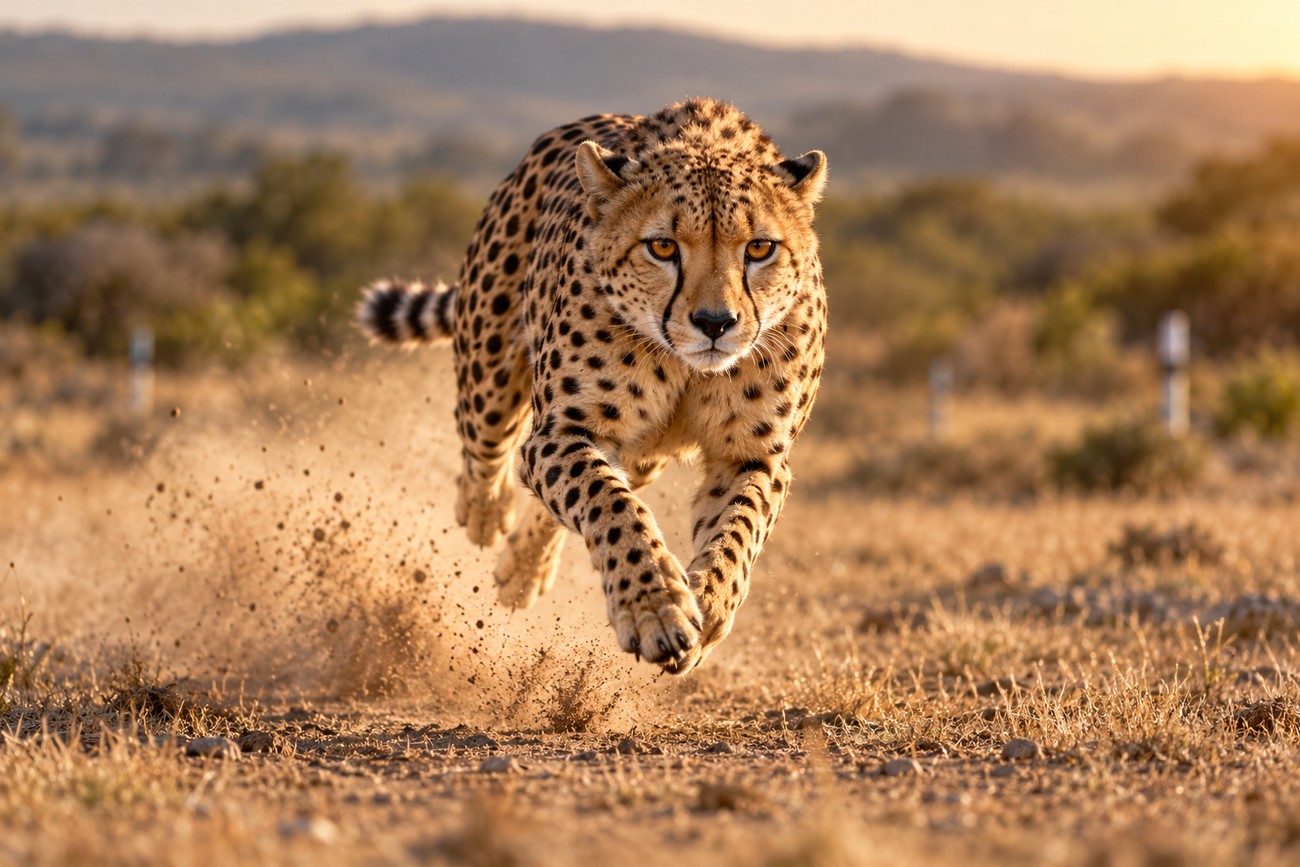
A cheetah can reach approximately 45 mph (72 km/h) from rest in about 2.5 seconds. That is an exceptional launch, but it is a 0–45 mph benchmark rather than a verified universal 0–60 mph figure. The distinction matters because the final 15 mph would require additional acceleration that the cited measurement does not establish.
Field research published in Nature recorded a maximum speed of 25.9 m/s, approximately 93.2 km/h, for one animal. The average peak speed in the cited sample was 14.9 m/s. These figures show why a single record should not be presented as the normal performance of every cheetah or every chase.
Smithsonian material gives a commonly cited top-speed range of 60–70 mph (96–112 km/h). That range describes potential peak speed, not a normal sustained pace. A cheetah’s high-speed sprint is short, with roughly 300 yards, about 274 meters, commonly cited as the limit for maintaining such an effort.
Its launch comes from a combination of traction, long flexible limbs, rapid stride turnover, and precise body control. The animal can gain speed with remarkable changes in stride, while its spine, tail, and feet help it remain stable. In a hunt, that control is as important as the speedometer number: acceleration, braking, and direction changes determine whether the prey escapes.
How Fast Is the Tesla Model S by Version?
“The Model S” does not identify one performance specification. An official brochure listed the Model S Performance AWD at 0–60 mph in 3.1 seconds, with a 155 mph top speed. Less powerful Model S versions were listed at approximately 4.4–5.4 seconds to 60 mph, showing how much trim changes the result.
Modern reviews commonly cite the Model S Plaid at 0–60 mph in 2.1 seconds, with a limited top speed of 163 mph. That figure belongs to the Plaid configuration and should not be used as a description of every Model S. Comparing a Plaid with an older or less powerful version can create a false impression of the model line as a whole.
Real-world acceleration can also differ from a published figure. Battery state, battery temperature, tire condition, road surface, and launch preparation all influence how much traction and power the car can use. A cool battery, unsuitable tires, or a dusty surface can make an advertised result difficult to reproduce.
The driver’s impression adds another layer. An electric car delivers torque with little delay, so a launch can feel abrupt even when the stopwatch result is slower than the headline figure. Some Model S owners have reported vibration, shudder, noise, or roughness during hard launches, including sensations through the accelerator pedal, steering wheel, or center console. The supplied evidence for those complaints is mainly one forum-complaint aggregator, so it should not be generalized to every Model S.
Cheetah vs. Tesla Model S: Key Performance Figures
The figures below keep the test conditions separate. The cheetah’s acceleration benchmark ends at 45 mph, while the Tesla figures use the automotive 0–60 mph standard.
| Measure | Cheetah | Tesla Model S | What the figure shows |
|---|---|---|---|
| Acceleration benchmark | Approximately 0–45 mph (72 km/h) in 2.5 seconds | Plaid: 0–60 mph in 2.1 seconds; Performance AWD: 0–60 mph in 3.1 seconds | These are different test endpoints and should not be treated as identical measurements. |
| Less powerful versions | Not applicable | Approximately 0–60 mph in 4.4–5.4 seconds | The Model S name covers substantially different performance levels. |
| Recorded or cited peak speed | 25.9 m/s, approximately 93.2 km/h, recorded for one animal; Smithsonian gives 60–70 mph (96–112 km/h) | Plaid: limited to 163 mph; older Performance AWD brochure: 155 mph | Top speed is separate from launch acceleration and hunting performance. |
| High-speed duration | A short sprint of roughly 300 yards, about 274 meters | Longer straight-line operation is possible, subject to vehicle and road conditions | The cheetah’s peak is an intense burst, not a sustained cruising speed. |
| Primary performance strength | Launch, braking, agility, and direction changes | Repeatable straight-line acceleration and much higher top speed | The winner depends on the course and the metric. |
Why Distance Changes the Winner
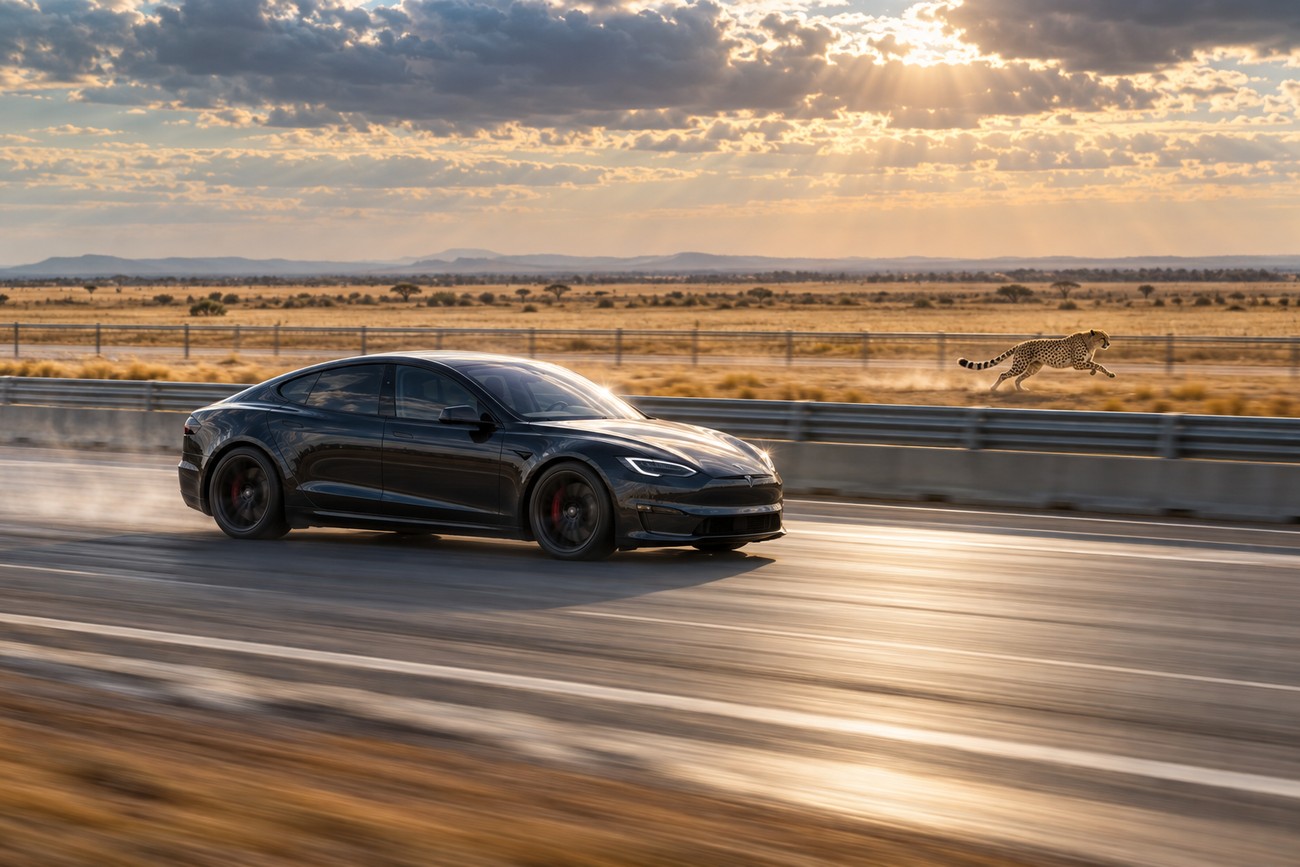
On a short launch, the cheetah’s explosive acceleration is the central fact. It can build speed rapidly while placing each foot with exceptional precision. A car’s straight-line advantage may appear quickly in a timed test, but a biological sprint cannot be judged solely by the same 0–60 mph label.
On a longer straight, the Tesla’s advantage becomes clearer. The Model S Plaid’s commonly cited 163 mph limited top speed is far above the cheetah’s commonly cited 60–70 mph range. Even older Performance AWD specifications listed a 155 mph top speed. The animal’s high-speed effort also ends after a short sprint of roughly 300 yards, about 274 meters.
A pursuit-like course changes the emphasis again. A cheetah can brake, cut direction, and adjust its body to follow prey, so its useful performance includes more than maximum velocity. The car is faster and more predictable on a suitable straight surface, but it cannot reproduce an animal’s unconstrained agility or biological response to a moving target.
That is why an exact race distance should not be invented to force a winner. A short sprint and a long straight can produce different conclusions, while a turning course tests skills that a top-speed specification does not measure. Acceleration, duration, braking, and maneuverability remain separate metrics throughout.
The Hidden Variables Behind the Numbers
A cheetah’s maximum-speed effort is energetically costly. Muscles, breathing, traction, and heat management all limit how long the animal can continue at peak output. Fatigue can arrive before the animal reaches the speed suggested by a general top-speed description, especially if the surface or chase line is unfavorable.
The Tesla also needs the right conditions for a best launch. Battery state and temperature affect available performance, while tires and surface determine whether the power reaches the road. Timing equipment and launch preparation matter as well. A brochure figure, a controlled review test, and a driver’s everyday experience may all describe the same car without producing the same time.
Launch comparisons are logged by exact trim, tire setup, battery temperature, surface, and timing method because the Model S name alone does not identify one repeatable performance condition.
Human sensation can obscure the measurement. Instant electric torque may feel more violent than an animal’s acceleration, even when the stopwatch favors one result. Conversely, reported vibration or shudder during hard launches can make a quick car feel rough rather than cleanly fast; those owner reports are limited evidence and do not establish a universal defect.
Common Myths That Distort the Cheetah-versus-Tesla Debate
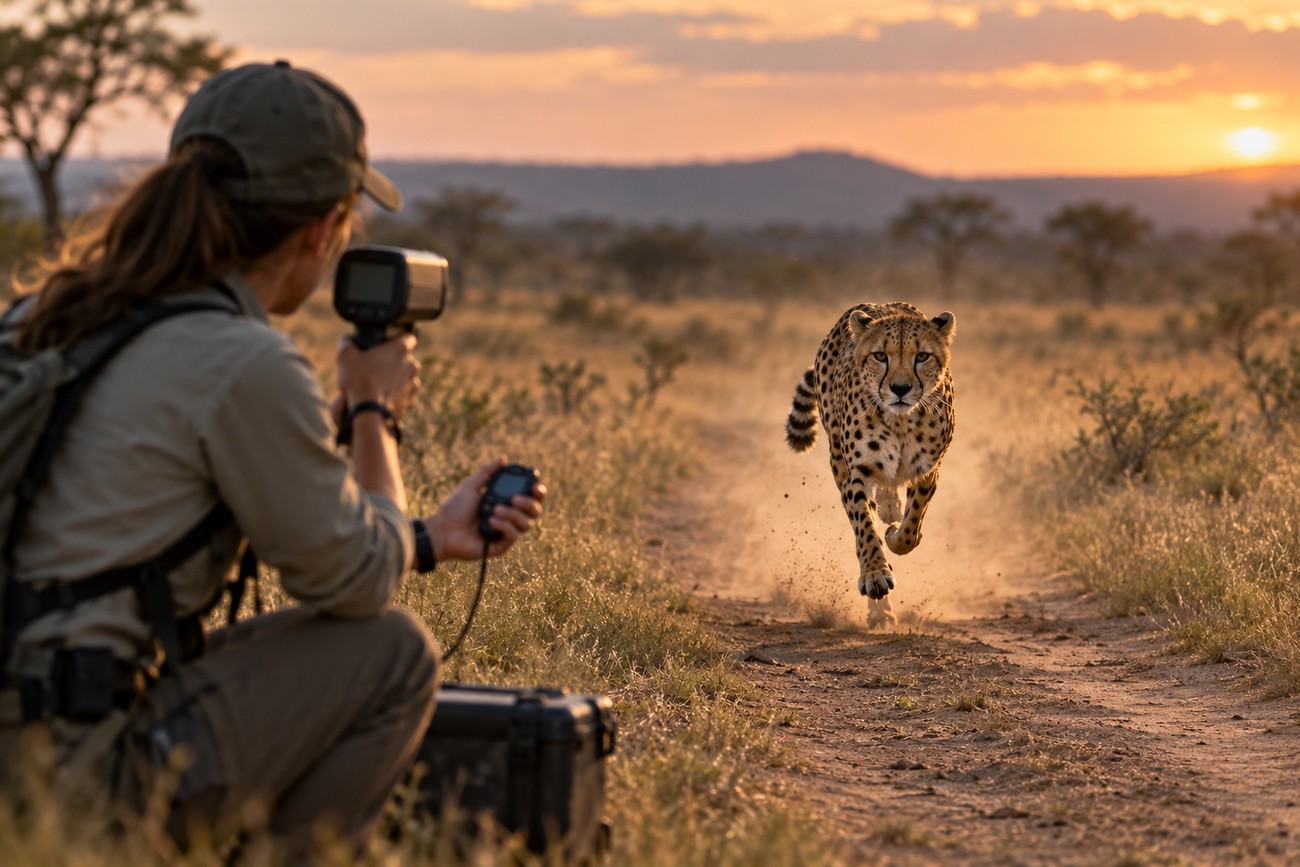
Myth: a cheetah routinely reaches 60–70 mph and holds that speed for a long time. Reality: 60–70 mph is a commonly cited top-speed range, while field research recorded 25.9 m/s, approximately 93.2 km/h, for one animal. The high-speed sprint is short, with roughly 300 yards, about 274 meters, commonly cited as the limit.
Myth: the cheetah’s standard acceleration time is 0–60 mph in about 3 seconds. Reality: the better-supported benchmark used here is approximately 0–45 mph (72 km/h) in 2.5 seconds. Repeating the 0–60 mph claim as a measured fact adds speed that the cited test did not establish.
Myth: every Model S performs like a Plaid. Reality: listed acceleration ranges from approximately 4.4–5.4 seconds for less powerful versions, to 3.1 seconds for the Performance AWD, and 2.1 seconds for the Plaid in modern reviews. Model year, trim, battery condition, tires, and temperature all matter.
Myth: top speed alone decides the contest. Reality: top speed says little about a cheetah’s ability to turn or brake during a pursuit, and it says little about how quickly a Tesla reaches that speed. The Tesla wins the cited straight-line top-speed comparison, while the cheetah’s biological advantage lies in short-burst movement and maneuverability.
Verdict: Who Accelerates Faster?
Using the published figures, the Model S Plaid has the quicker headline acceleration result: 0–60 mph in 2.1 seconds. The cheetah’s better-supported benchmark is approximately 0–45 mph (72 km/h) in 2.5 seconds, and those tests do not share the same endpoint or measurement conditions.
That does not make the cheetah an ordinary slow starter. Reaching approximately 45 mph in 2.5 seconds is extraordinary biological acceleration, especially when the animal must control traction, body position, braking, and direction. In a short pursuit, those qualities can matter more than a vehicle’s ability to continue along a straight line.
For a longer straight-line run, the Tesla is the clear winner under the cited specifications. The Plaid is commonly listed at a limited 163 mph, while the cheetah’s commonly cited range is 60–70 mph, and its high-speed sprint lasts only a short distance. Older Model S Performance AWD specifications also listed a 155 mph top speed.
The most accurate conclusion is conditional: the Plaid has the faster published automotive acceleration figure, the Tesla dominates the straight-line top-speed comparison, and the cheetah remains exceptional in short-burst acceleration, braking, and agility. “Fastest” without a distance and metric is too vague to produce a scientifically sound winner.
Frequently asked questions
The comparison depends on trim, test method, distance, and whether the subject is a vehicle launch or biological movement. These questions address the limits of the headline figures.
Which car accelerates faster than a Tesla Model S Plaid?
No universal ranking can be established from isolated advertised figures. The Plaid’s commonly cited benchmark is 0–60 mph in 2.1 seconds, but another car can only be fairly judged against it when both are independently timed with the same rollout convention, surface, tires, temperature, and launch conditions.
Small differences in timing method can change the order. A result that appears quicker in one review may not remain quicker under another method, so comparable testing matters more than a list of model names.
Why can’t a cheetah’s 0–60 mph time be measured like a car’s?
An animal does not begin from a standardized launch procedure. Its starting posture, motivation, terrain, tracking equipment, stride pattern, and available run-out all affect the measurement. Researchers can track its speed in the field but cannot control every variable as they can in a vehicle test.
That is why approximately 0–45 mph (72 km/h) in 2.5 seconds is the preferred benchmark here. It is a cited acceleration benchmark, while the often-repeated 0–60 mph claim does not provide the same level of comparable evidence.
Why can a Tesla feel slower than its published acceleration time?
A published time usually reflects a prepared launch under favorable conditions. Battery state and temperature, tire grip, road surface, and launch preparation can reduce real-world acceleration. A driver may also judge the car by how smoothly it responds rather than by a stopwatch.
Some owners have reported vibration, shudder, noise, or roughness during hard launches, although the supplied evidence is mainly from one forum-complaint aggregator and should not be generalized to every Model S. A rough-feeling launch can seem slower or less controlled even when the vehicle remains capable of strong acceleration.







