

A Chevy Bolt has a large traction battery, yet its accessory outlets can deliver only a much smaller amount of power. That apparent contradiction is the key to charging 100 phones: stored energy and usable electrical output are separate limits.
At an assumed 10 watts per phone, 100 phones represent about 1,000 watts theoretically. The safer path is a controlled external charging setup with load monitoring and suitable distribution equipment. Forcing that demand through one factory 12-volt socket can overload the outlet, wiring, plugs, or inverter, and the available information does not support promising an exact charging time.
- Can a Chevy Bolt Charge 100 Phones?
- What the Bolt’s 12-Volt Outlets Can Actually Deliver
- 100 Phones at 10 Watts: The Power-Limit Math
- Safer Ways to Distribute Charging Power
- Why 100 Phones May Charge More Slowly Than Expected
- What the Bolt’s 65 kWh Battery Does—and Does Not—Tell You
- Common Mistakes and the Marketing Claim to Question
- Frequently Asked Questions
- How many phones can you charge with a car battery?
- How many times will a 10,000 mAh power bank charge a phone?
- What should be checked before using a multi-phone charging station in a car?
Can a Chevy Bolt Charge 100 Phones?
A Chevy Bolt may be able to supply energy to a large charging setup, but 100 phones cannot be connected directly to one factory outlet safely or practically. Chevrolet’s documented limit is 200 W or 15 A maximum across all 12-volt accessory outlets combined.
Using 10 W per phone as an assumption gives a theoretical load of about 1,000 W for 100 phones. That is five times the 200 W aggregate accessory limit, before accounting for inverter, charger, and cable losses. Actual phone demand varies with the phone model, battery state, charging protocol, and temperature.
Marketing material may describe charging many devices from an electric vehicle. Such a claim does not override the documented accessory-outlet limit. Charging 100 phones requires distribution, USB charging hardware, and control of total load; it is not a direct one-outlet connection.
What the Bolt’s 12-Volt Outlets Can Actually Deliver
The electrical boundary is set by the accessory circuit, rather than by the full capacity of the traction battery. The combined load of all 12-volt accessory outlets is limited to 200 W or 15 A. That rating applies across the outlets, not separately to every socket.
The 12-volt accessory outlet operates only while the Bolt is on. Turning the vehicle off can stop charging, while leaving the vehicle on may consume energy through climate control, ventilation, electronics, and other vehicle systems.
An inverter can raise 12 volts to a higher output voltage, but it does not create additional power. If the input circuit can safely supply only the documented accessory load, an inverter connected to that circuit remains subject to the same boundary. Conversion losses reduce the power and energy reaching the chargers.
100 Phones at 10 Watts: The Power-Limit Math
The 10 W figure below is an assumption for comparison, not a guaranteed charging rate or a charging-time prediction.
| Item | Assumed or documented value | What it means |
|---|---|---|
| Power per phone | 10 W assumption | Individual phones may draw more or less depending on the model, protocol, battery state, and temperature. |
| 100 phones | About 1,000 W theoretically | This is the combined phone-side demand before conversion losses. |
| Bolt accessory outlets | 200 W or 15 A maximum across all 12-volt accessory outlets | The documented limit applies to the combined accessory load. |
| Comparison | About 1,000 W is five times 200 W | A single factory 12-volt circuit cannot safely supply the assumed direct load. |
| Conversion equipment | Losses vary | Inverter, charger, and cable losses reduce the power and energy reaching phones. |
The table shows why the limiting question is power delivery first. A phone may eventually consume modest energy during a complete charge, yet the charging station still needs to handle the simultaneous input demand without exceeding the vehicle’s outlet rating.
Phone chargers also negotiate power rather than delivering a fixed amount at all times. A group of devices may draw less than the theoretical figure, especially when batteries are nearly full, but that reduction cannot be used to justify an unprotected connection. The equipment must be suitable for the highest expected load.
Safer Ways to Distribute Charging Power
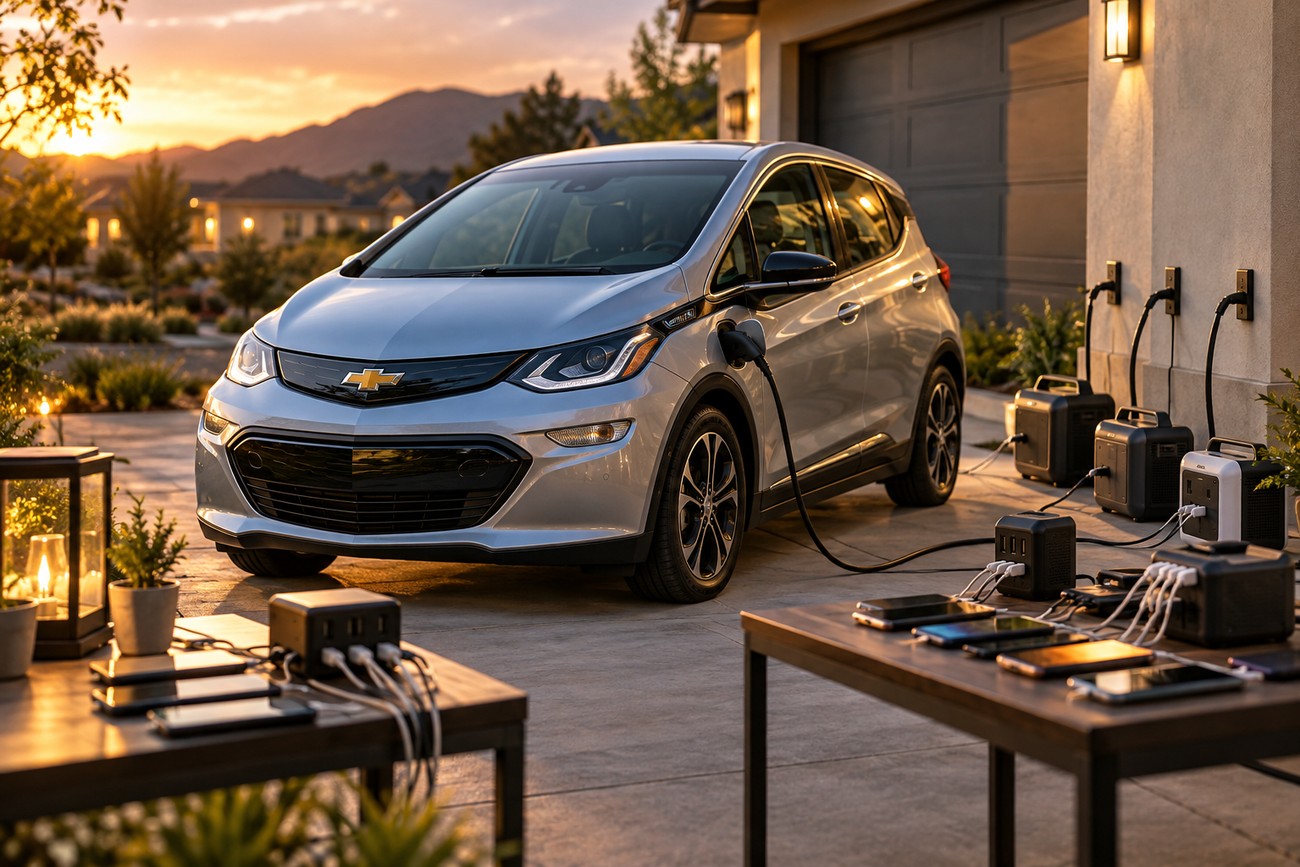
A practical architecture uses several independent, modest-power charging stations with appropriate external equipment. This spreads connectors, cables, and heat across separate units instead of forcing roughly 1,000 W through one 12-volt circuit. Splitting the load among stations does not raise the Bolt’s combined accessory-outlet limit; each station needs a suitably rated power source.
A 1,000–2,000 W inverter connected to a factory 12-volt outlet ignores the 200 W aggregate limit. The inverter’s label describes its possible output under suitable input conditions; it does not change what the Bolt’s accessory circuit, fuse, wiring, and outlet can safely provide.
Operators inspect plug condition, cable thickness, ventilation, port labels, and heat during sustained charging because advertised wattage describes a device, not the safety of the complete electrical path.
Cheap 12-volt plugs, splitters, USB hubs, thin cables, and poor contacts can become the weakest link. Sustained current creates heat at resistance points, including loose or worn connections, even when the central charging block appears to be within its rating.
Use equipment with suitable protection, clear load ratings, and adequate ventilation. Keep the setup away from conditions that can damage connectors or cables, and stop using any component that becomes unusually hot, smells of overheated plastic, or shows discoloration.
Why 100 Phones May Charge More Slowly Than Expected
Multi-port chargers often share available power among their ports. If many phones request power at once, some may receive a lower charging rate than the label suggests, particularly when the charger has a fixed total output rather than a separate full-power supply for every port.
Fast charging also depends on compatibility. Different phones may require different USB-C or Lightning cables, connector types, and charging protocols. A cable that fits physically may still support only basic charging, and a charger may reduce output when the connected device does not support its negotiated standard.
Heat is another constraint. Chargers and phones can reduce charging current when they become hot; hot cables and connectors can also indicate unsafe connections. This means a setup that appears adequate during a short test may deliver less power during sustained operation, especially in a warm vehicle or a poorly ventilated charging area.
Average demand often falls after roughly 70–80% charge. Phones commonly accept less power as they approach a fuller battery, so peak demand is not constant. That may reduce the electrical load later, while also making the final part of a mass-charging session slower than the beginning.
What the Bolt’s 65 kWh Battery Does—and Does Not—Tell You
Different Bolt generations have a traction-battery capacity of roughly 65 kWh. That figure describes stored energy in the high-voltage battery; it does not mean that 65 kWh is directly available through the 12-volt outlet.
The accessory outlet imposes a separate power limit. Energy must pass through the vehicle’s electrical systems and any external inverter and chargers before reaching phones. Inverter, charger, and cable losses reduce the power and energy reaching phones, so the phone-side total cannot be calculated from the battery label alone.
The Bolt must also remain on for the 12-volt accessory outlet to operate. Climate control, ventilation, electronics, and other vehicle systems can consume energy during that time. Their demand depends on operating conditions, so a battery-capacity estimate cannot by itself establish how many phones can be charged or how long the session will last.
Common Mistakes and the Marketing Claim to Question
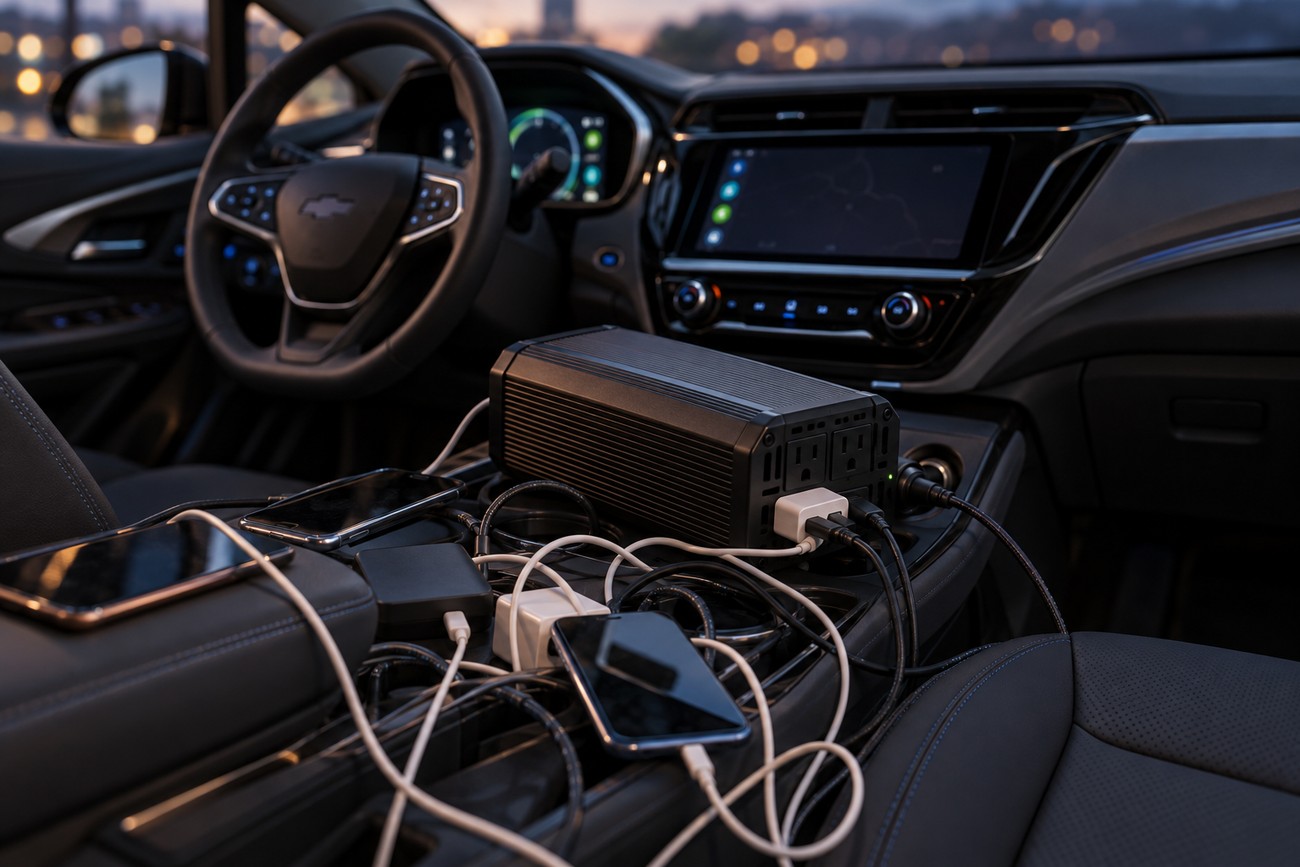
The most serious mistake is connecting a large inverter to a factory 12-volt outlet and assuming its 1,000–2,000 W label makes that output available. The documented 200 W or 15 A maximum applies to the combined accessory outlets. It is an aggregate limit, not a rating for each outlet.
Another mistake is treating the accessory outlet as a permanent power source after shutdown. The 12-volt accessory outlet operates only while the Bolt is on, so charging can stop when the vehicle is turned off. Keeping the vehicle on preserves outlet operation, while also adding vehicle-system consumption and requiring attention to the vehicle’s operating environment.
A large traction battery can create the impression that the Bolt is automatically a household power source. The supplied documentation does not establish factory vehicle-to-load or household-outlet capability for older Bolt models. A battery’s stored energy and a vehicle’s approved external-output hardware are separate questions.
Claims that a vehicle can charge hundreds of devices therefore require careful qualification. They may assume external equipment, a particular distribution design, reduced charging rates, or conditions that differ from the factory accessory outlets. Such claims require external equipment and a separate calculation; they do not override the documented accessory-outlet limit.
Frequently Asked Questions
The answer depends on both available energy and the output-power limit. The following distinctions help prevent battery-capacity estimates from being mistaken for a safe charging design.
How many phones can you charge with a car battery?
There is no universal phone count based on battery capacity alone. The result depends on the battery’s stored energy, the converter and outlet’s maximum power, conversion losses, the phones’ battery requirements, and any energy consumed by the vehicle while it remains on.
For a Chevy Bolt, the roughly 65 kWh traction-battery rating is not 65 kWh directly available through the 12-volt outlet. The documented accessory limit remains 200 W or 15 A maximum across all 12-volt accessory outlets.
How many times will a 10,000 mAh power bank charge a phone?
A 10,000 mAh label cannot provide an exact answer by itself. The power bank’s rated voltage, conversion efficiency, charging losses, and the phone’s battery requirements are needed to estimate the usable energy.
The nominal capacities may also be stated at different voltage references, so comparing the two mAh figures directly can mislead. The practical result is usually lower than a simple capacity-to-capacity division because energy is lost during voltage conversion and charging.
What should be checked before using a multi-phone charging station in a car?
Check connector condition, cable compatibility, charger ratings, ventilation, and the distribution of load across charging stations. Confirm that USB-C and Lightning cables match the devices and that the charging equipment’s total input demand is within the approved power source.
During use, monitor plugs, hubs, cables, and contact points for heat, discoloration, looseness, or damaged insulation. A short test at low demand does not prove that the complete setup will remain safe during sustained charging.







