
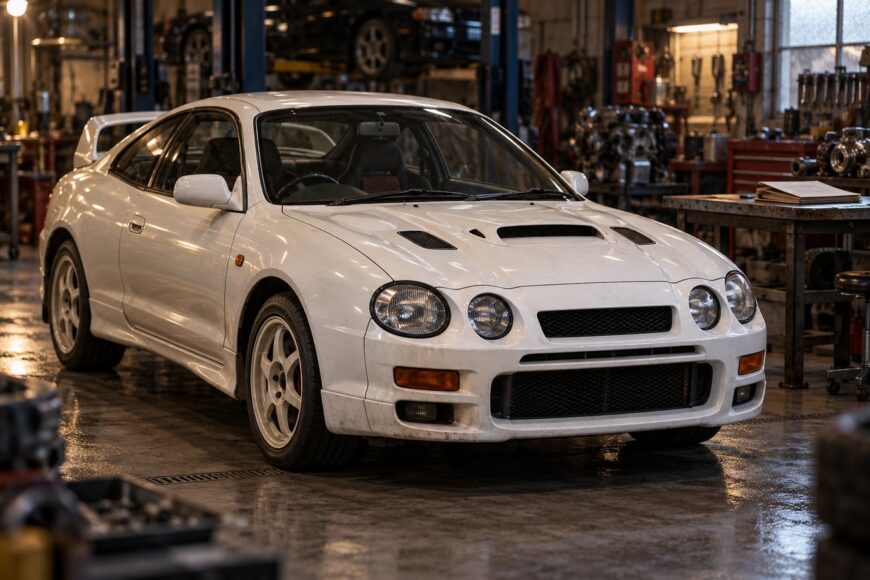
The Toyota Celica GT-Four ST205 carries a genuine Group A rally pedigree, yet that reputation can obscure the risks of buying a 30-year-old performance car with complex suspension and increasingly scarce model-specific parts. Its competition history explains the engineering, but it does not certify the condition of an individual road car.
The FIA record confirms an approved competition basis rather than automatic race readiness. A road-going ST205 may have the right engine layout, four-wheel drive, and visual identity while still requiring extensive work on its suspension, driveline, cooling system, wiring, hoses, and seals.
Any serious purchase therefore needs three checks: the car’s actual specification, its modification history, and its measured mechanical condition. Original appearance and a strong reputation provide useful context, while documented maintenance, inspection results, and parts availability determine whether the car is a sound project or an expensive repair schedule.
- What the FIA Homologation Actually Proves
- Road Celica Versus Rally Car: The Similarity Has Limits
- The 3S-GTE, Super Strut, and the Age Factor
- The Failure Points Buyers Commonly Miss
- Modification Traps: Boost, Exhaust, and the “Unbreakable” Engine Myth
- How to Judge an ST205 Beyond Its Rally Badge
- Frequently asked questions
- Why was the Celica GT-Four banned?
- How much is a Toyota Celica GT-Four ST205 worth?
- How much horsepower did the Toyota Celica GT-Four ST205 have?
What the FIA Homologation Actually Proves
The ST205 was homologated in FIA Group A under number 5521. The homologation period began on 2 May 1994 and ended on 1 January 2002, giving the model a defined place in the international competition framework.
Its base configuration used a four-cylinder engine, four-wheel drive, and a five-speed manual transmission. That combination links the road car to the technical requirements of the period and explains why the ST205 remains important to rally enthusiasts and collectors.
The FIA record also lists a broad series of homologation extensions. These covered the gearbox, final drive, suspension, brakes, steering, body, roll cage, turbocharger, and drivetrain. The scope shows that Toyota and its competition partners had approved routes for developing the car beyond its basic specification.
Those documents matter because they provide a formal reference for identifying approved competition equipment. They do not establish that every road car carried every listed component or that a surviving ST205 has retained its original specification. A buyer should use the homologation record as a technical framework, then verify the individual car against its documentation and physical parts.
Road Celica Versus Rally Car: The Similarity Has Limits
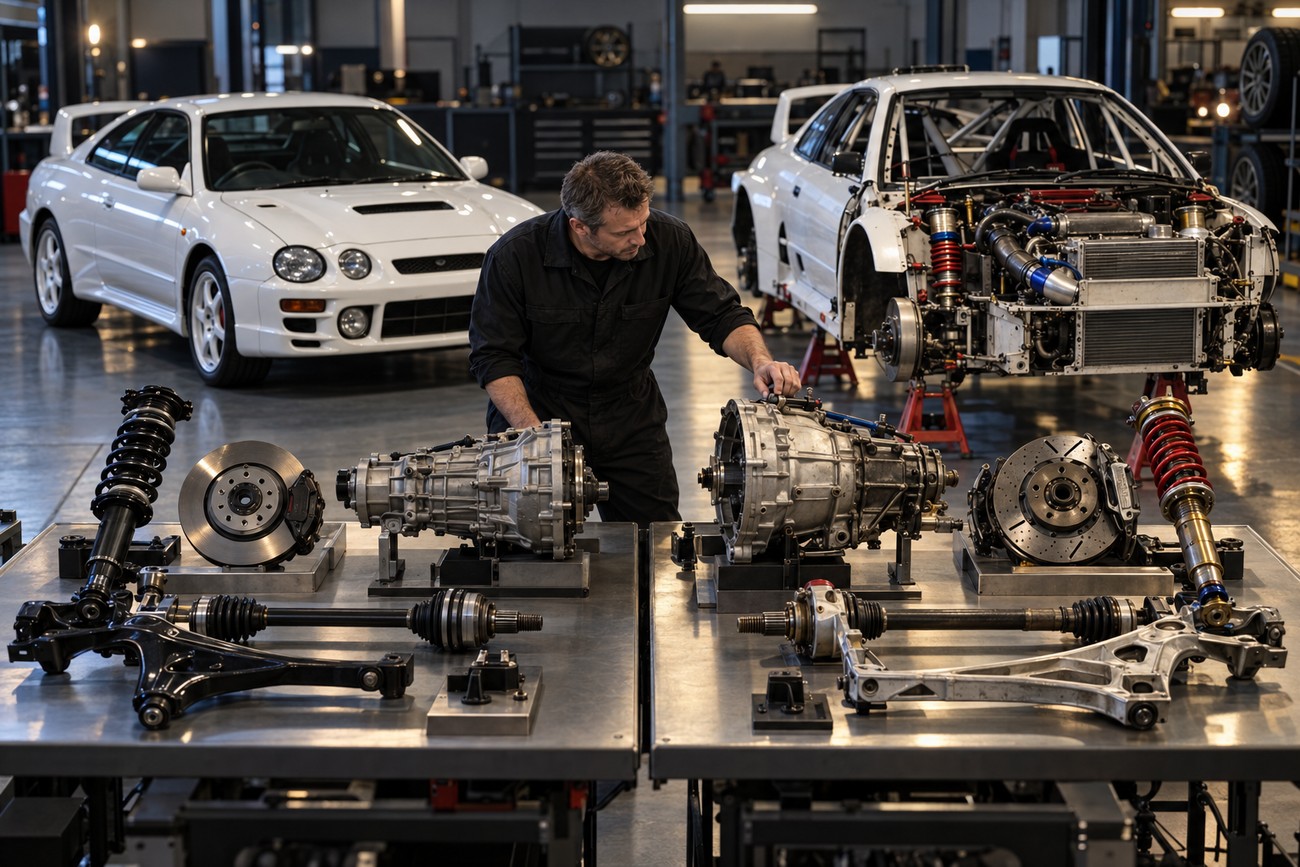
The ST205’s road-car identity and its rally-car role are connected through homologation, although they should not be treated as component-for-component equivalents. The FIA documentation confirms the basis for competition development; it does not turn every showroom car into a complete copy of a Celica WRC.
Homologation extensions, including VO and VF entries, can change which approved equipment applies to a particular version. A gearbox, final drive, suspension component, brake arrangement, steering part, or turbocharger may therefore need to be identified against the relevant document rather than assumed from the ST205 name alone.
This distinction is especially important with the suspension. The road car’s Super Strut system has its own geometry and service requirements, while a rally car could use competition solutions permitted by a specific regulation and homologation extension. Claims of total identity require verification against the exact car, period, and rule set.
The same caution applies to bodywork, safety equipment, and drivetrain components. A competition car may have carried a roll cage, altered internals, or other approved equipment that was unavailable or unsuitable for an ordinary road car. Visual resemblance offers little proof of mechanical equivalence.
For buyers, the practical result is simple: establish whether a part is standard road-car equipment, an approved extension, an aftermarket conversion, or a competition component. That classification affects legality, service methods, replacement cost, and the availability of compatible parts.
The 3S-GTE, Super Strut, and the Age Factor
The factory engine is the Toyota 3S-GTE, an inline turbocharged four-cylinder. Its durable reputation is deserved within the limits of good maintenance and sensible calibration, although age and previous use now matter as much as the engine’s original design.
An FIA card displaying 3397 cm³ conflicts with the known 3S-GTE configuration. That entry should be treated as a likely display-field or database error rather than confirmed engine displacement. It is a reason to check the source document carefully, not evidence of an unusual factory engine.
Super Strut is more complex than a conventional MacPherson strut. Its behavior depends on sound joints, bushes, crush tubes, and correct adjustment, so replacing dampers alone may leave vague steering, unwanted movement, or poor wheel control unresolved.
Age changes the inspection priority. Rubber and plastic components, hoses, seals, bushes, and mounting hardware can become urgent even when the engine starts cleanly and the car drives without obvious noise. A smooth idle therefore says little about the condition of the complete chassis and hydraulic systems.
The car’s age can also make a routine repair more involved than expected. Engine parts for the 3S-GTE are relatively accessible, while ST205-specific and Super Strut components can be harder to source. A technically correct repair may consequently require more time and planning than a similar job on a conventional suspension system.
The Failure Points Buyers Commonly Miss
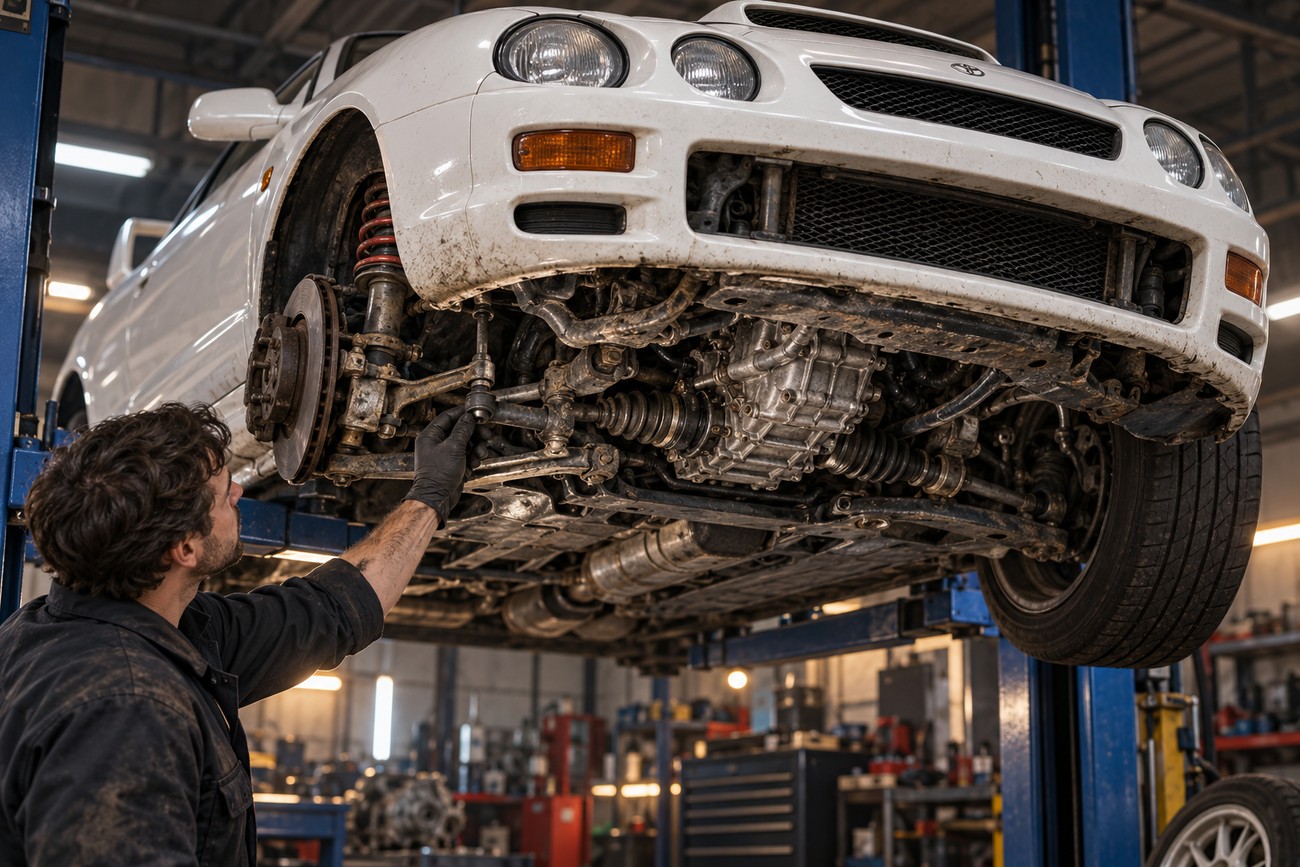
Start with the front suspension rather than the paintwork. Frequently reported wear areas include anti-roll-bar links, crush tubes, bushes, suspension joints, and other rubber and plastic parts. These components can produce looseness and imprecise responses that are easily misdiagnosed as worn dampers.
Crush tubes, joints, and bushes deserve inspection before blaming the dampers when an ST205 feels vague or develops steering play. Their wear changes how the suspension is located, so a new damper cannot restore geometry that is moving at its mounts.
The clutch and driveline need equal attention. A road test should assess clutch take-up, slip under load, gear selection, transmission noise, driveshaft condition, and differential behavior. Four-wheel drive can mask wear elsewhere in the system by continuing to deliver traction while expensive components are already deteriorating.
Inspect hoses, seals, and fluid leaks even when the engine runs evenly. On a heavily used car, piston-ring wear may appear as increased oil consumption, while a neglected cooling or lubrication system can create risks that are invisible during a short drive.
Measurements provide stronger evidence than originality alone. Compression, oil pressure, suspension play, and driveline inspection should support the seller’s claims about condition. An original-looking car without service records or measurable health may require more work than a modified car with careful documentation.
Modification Traps: Boost, Exhaust, and the “Unbreakable” Engine Myth
Increased boost and aggressive launches place substantial demands on the clutch. A car that feels strong during a brief test can still have a clutch nearing the end of its useful life, particularly if previous owners used repeated hard starts or raised boost without addressing supporting components.
A less restrictive downpipe can produce boost creep with the stock turbocharger. The result is uncontrolled or excessive boost at higher engine speed, even when the modification was intended to improve exhaust flow. After exhaust changes, the actual boost curve must be checked rather than inferred from a claimed power figure.
Power output is not a health certificate. A modified 3S-GTE may produce strong numbers while carrying ring wear, excessive oil consumption, turbocharger wear, poor calibration, or a history of overheating. Compression, oil pressure, boost control, and service records remain more informative than an advertised dyno result.
The 3S-GTE’s durable reputation does not automatically apply to an engine with unknown boost, overheating, or poor servicing. Treat tuning history as part of the mechanical inspection, including the quality of the exhaust, engine management, clutch, cooling system, and previous repair work.
How to Judge an ST205 Beyond Its Rally Badge
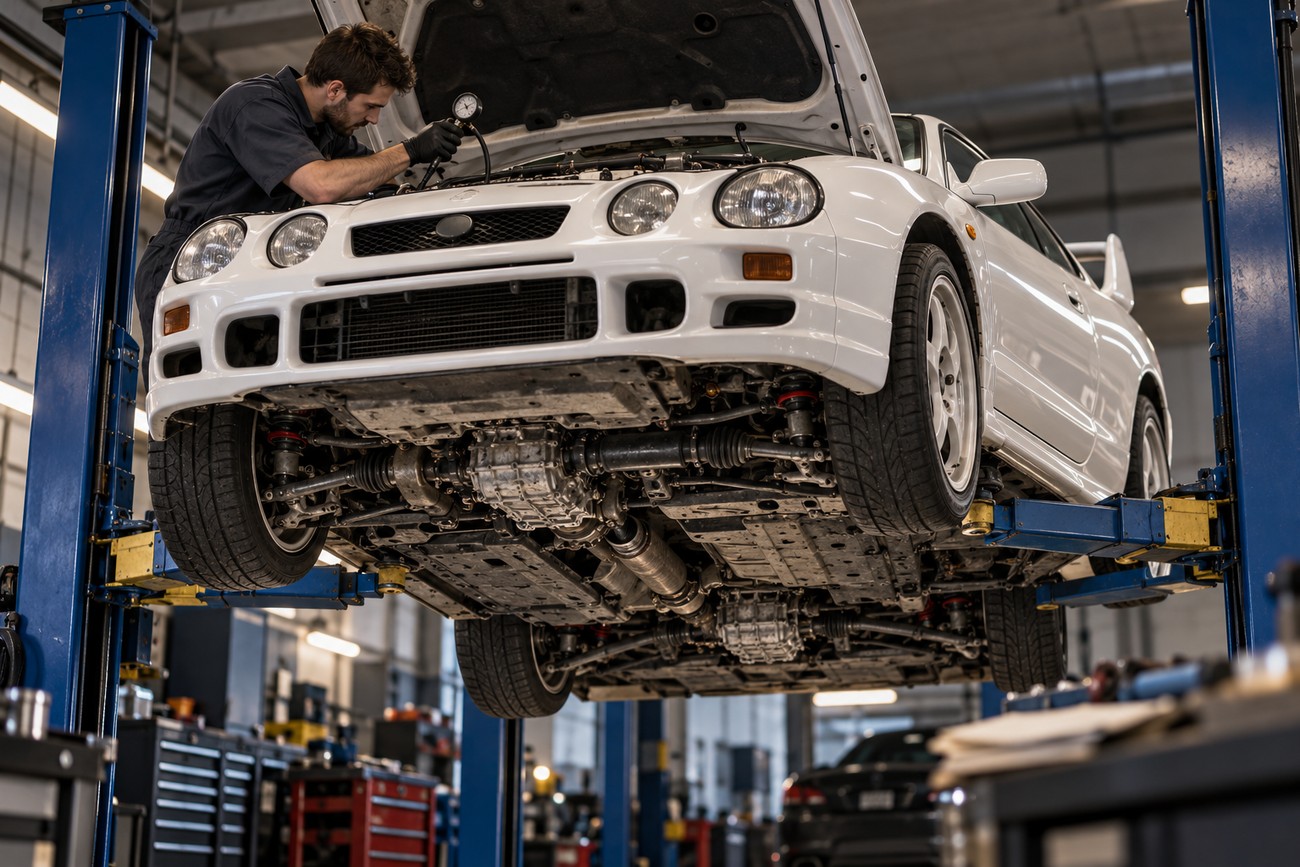
Begin with documented maintenance and repair history. Verify the Super Strut system, crush tubes, suspension joints, bushes, and previous accident or chassis repairs before assigning value to originality or cosmetic condition.
Measure engine health and inspect the entire drivetrain. The clutch, gearbox, driveshafts, differentials, and other four-wheel-drive components need examination because traction can conceal wear during an ordinary road test.
Modification quality should be judged by control and documentation rather than headline power. An exhaust change requires boost verification, while increased boost requires evidence of suitable calibration and supporting maintenance. A car with fewer modifications may still be the worse purchase if its service history is absent.
Parts availability belongs in the buying decision. Common 3S-GTE components are relatively accessible, while specific ST205 and Super Strut parts may take longer to locate and increase ownership cost. The rally homologation label adds historical significance, although age, condition, and repair history remain the decisive factors.
Frequently asked questions
The FIA record helps define the ST205’s competition status, but it does not determine the condition or value of an individual road car.
Questions about bans, pricing, and power output require the specific specification, documentation, and mechanical condition to be considered.
Those details are more useful than the rally badge alone when assessing a potential purchase.
Why was the Celica GT-Four banned?
The supplied FIA record does not establish a blanket ban on the road car. It documents the ST205’s FIA Group A homologation under number 5521, with a homologation period from 2 May 1994 to 1 January 2002.
Claims about a “ban” should therefore be checked against a specific competition rule, event, market, or regulation. They should not be used to describe the road-going ST205 generally without supporting documentation.
How much is a Toyota Celica GT-Four ST205 worth?
There is no reliable single value without inspecting the specific car. Market price depends on condition, documented maintenance, originality, specification, modification quality, rust or repair history, and the completeness of the drivetrain and Super Strut system.
Parts availability also affects the real cost of ownership. An apparently cheaper car may need difficult-to-source ST205-specific or Super Strut components, while a more expensive example with verified maintenance and measured mechanical health may represent the lower-risk purchase.
How much horsepower did the Toyota Celica GT-Four ST205 have?
No single figure should be used without identifying the market, factory specification, and modifications. Output can vary with calibration, exhaust changes, boost level, engine condition, and the method used to measure it.
A dyno figure or advertised output cannot substitute for compression, oil pressure, and boost checks. Those tests help establish whether the engine and turbocharger are healthy, while the power number only describes one result under specific conditions.







