
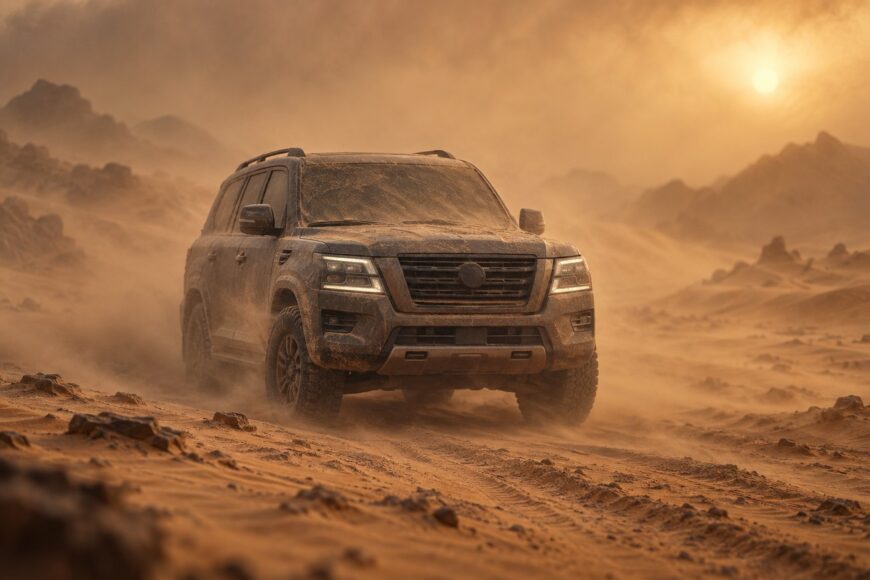
The Nissan Patrol has the weight, ground clearance, four-wheel-drive systems, and engine torque to handle deep sand. A severe sandstorm changes the problem completely. It becomes a visibility and air-filtration emergency before it becomes a test of traction, so selecting Sand mode does not make continued driving safe.
When visibility collapses, stopping in a safe position is usually more important than maintaining momentum. Dust can enter the cabin, clog the engine air filter, block the radiator, and leave enough sand around the brakes and sensors to create problems later. Recovery mistakes—especially sustained wheelspin or high-speed driving toward disappearing landmarks—can turn a capable Patrol into a buried or damaged vehicle.
- Why a Sandstorm Changes the Rules for a Nissan Patrol
- Stop or Keep Driving? The First Decision in a Sandstorm
- How to Protect the Patrol While You Wait
- If You Must Move Through Deep Sand
- The Mistakes That Bury or Damage a Patrol
- What the Sandstorm Leaves Behind
- What Nissan Patrol Marketing Does Not Tell You
- Frequently asked questions
- What should you do if your Nissan Patrol is stuck on the beach?
- How many kilometers can you get out of a Nissan Patrol in the desert?
- How far apart should Nissan Patrols travel in a sandstorm convoy?
Why a Sandstorm Changes the Rules for a Nissan Patrol
A sandstorm becomes critical for vehicles and equipment when visibility is 400 m or less and wind speeds are 40 km/h or higher. At that point, the Patrol’s ability to maintain traction says little about whether you can see a stopped vehicle, a road edge, a drop-off, or a changing dune line. The main risk is losing reliable information about the route ahead.
The Patrol is a framed SUV weighing approximately 2.7–3.0 tonnes, with approximately 275 mm of ground clearance. Those figures help it cross loose sand and reduce the chance of striking the ground, but mass also works against recovery once the tires begin to dig in. A high center of gravity increases the consequences of poor dune technique, particularly when a driver approaches a ridge at an angle or turns abruptly on a slope.
Sand in the air is also abrasive and intrusive. It can reach the engine air intake, radiator, cooling fan area, suspension components, brakes, door hardware, and electrical sensors. Slow travel through loose sand places a further load on cooling because airflow is limited while the engine and transmission are working hard.
The Patrol is not a pressurized, hermetically sealed cabin. Dust can enter through door and sunroof seals, ventilation, the steering-column area, and other gaps. Acoustic glass and improved sealing may reduce noise and ordinary dust, but they do not make the vehicle storm-proof. A clean cabin after a short drive should not be treated as proof that the vehicle is protected from fine dust.
Stop or Keep Driving? The First Decision in a Sandstorm
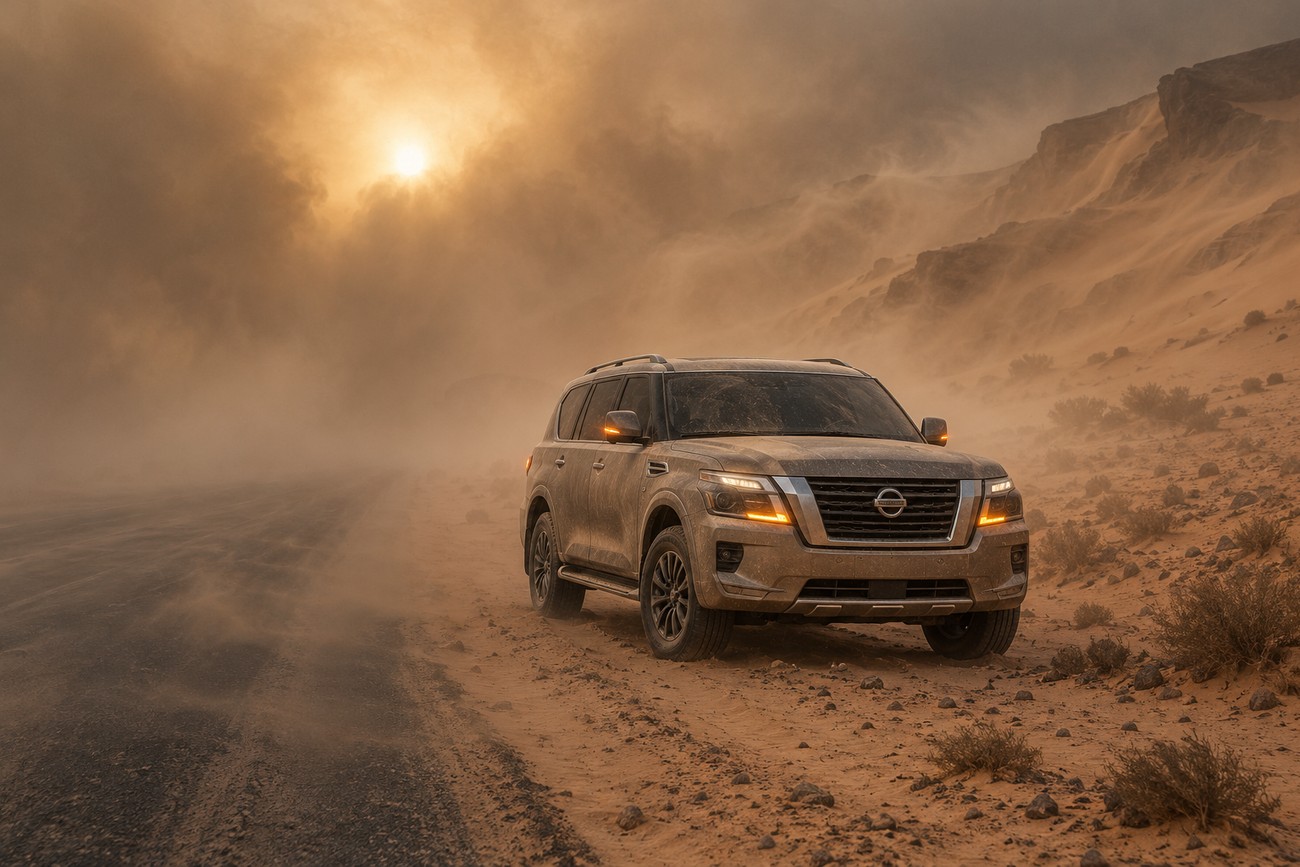
The safest default is to stop before visibility becomes unusable. Official guidance recommends pulling to the edge of the road, switching off the engine, closing windows and doors tightly, and waiting for visibility to improve. Choose the firmest safe position available, stay clear of the traffic lane and the base of dunes, and avoid stopping where another driver may expect the road to continue.
Once stationary, use hazard lights where conditions and local rules make that appropriate, and keep the vehicle visible without exposing yourself to passing traffic. Seat belts should remain fastened, and occupants should stay inside unless leaving the vehicle is clearly safer. Keep communication available, but do not assume that a GPS track can replace visual confirmation of the road, convoy, or terrain.
Continuing at high speed after visibility drops sharply is a common and serious mistake. It increases the risk of colliding with another vehicle, leaving the road, crossing an unseen shoulder, or becoming lost while still believing you are following the correct route. Braking distance and steering accuracy become much less useful when the driver cannot see hazards early enough to react.
Some desert crews stop even when GPS tracks are available because electronic navigation shows position, not the obstacle immediately ahead or the vehicle hidden in blowing dust. If movement is unavoidable, reduce speed to a level that allows a controlled stop, follow a confirmed route, and maintain contact with other vehicles. A track on a screen is not permission to drive into zero visibility.
How to Protect the Patrol While You Wait
Close every window, door, and sunroof, then switch the climate system to recirculation. Outside-air intake can fill the cabin with dust quickly and clog the cabin filter. Recirculation will not create a sealed cabin, but it reduces the amount of contaminated air entering through the ventilation system while you wait.
Monitor the engine only when it is safe to do so. Government recommendations for a vehicle caught in a storm include wrapping the engine air filter with cloth as a temporary measure to reduce dust exposure. Treat this as an emergency precaution, not a replacement for inspection: the cloth must not obstruct airflow, and the filter, airbox, and intake should be checked as soon as conditions permit.
Do not open the hood repeatedly during the storm. Every opening exposes the engine bay to more airborne sand, and a loose cloth or improvised cover can be drawn toward moving or hot components. If the engine begins to run unevenly, loses power, or shows signs of overheating, stop demanding power from it and shut it down when you can do so safely.
Dust and sand can obstruct the radiator and reduce cooling efficiency, especially when the vehicle is moving slowly through loose sand. A temperature warning may appear only after cooling capacity has already been reduced. After the storm, clean the radiator face carefully rather than forcing sand deeper into the fins with careless high-pressure washing.
If You Must Move Through Deep Sand

Move through deep sand only when visibility remains adequate and stopping would create a greater hazard. The Patrol offers Sand mode, low range, and a rear differential lock, depending on specification. Sand mode can improve traction and torque management, while low range provides more controlled gearing; the rear lock can help maintain drive when one rear wheel loses grip.
A modern Patrol’s 5.6-litre petrol V8 produces approximately 400–405 hp and about 560 N·m of torque, giving it substantial pulling ability. That reserve does not remove the need for momentum management. Use smooth throttle inputs, avoid abrupt steering, and preserve steady forward movement rather than alternating between idle speed and aggressive acceleration.
Experienced desert drivers may reduce tire pressure to approximately 0.8–1.2 bar on sand before conditions worsen. This is experienced desert practice, not a universal manufacturer instruction: the correct pressure depends on the tire, load, terrain, temperature, and sidewall design. Use a gauge, avoid sharp rocks at low pressure, and reinflate before returning to normal road speeds.
Using 2WD or a normal road setting in deep sand can increase the risk of burying the vehicle and overheating the transmission. Even with Sand mode selected, the Patrol can still sink, overheat, or ingest dust. If the surface becomes uncertain or visibility deteriorates, the correct response is to stop rather than compensate with more throttle.
The Mistakes That Bury or Damage a Patrol
Driving quickly into falling visibility is the first failure pattern. Drivers often continue because the Patrol feels stable and powerful, then discover that the road edge, convoy, or dune face has disappeared. A controlled stop made early is easier to manage than an emergency stop after the vehicle has left the route.
The second pattern is wheelspin. Aggressive throttle in compact or deep sand removes material from beneath the tires, causing the Patrol to sink further while heat builds in the transmission and drivetrain. If the vehicle loses forward motion, release the accelerator, stop the wheels, and assess the surface before trying a recovery method.
Disabling assistance systems without a clear reason can make recovery harder, especially when tire pressure has not been reduced and the tires are already digging. Settings should match the surface and the vehicle’s specification. A rear differential lock or low range is a tool for a specific traction problem, not a substitute for correct pressure, line choice, and controlled inputs.
A heavy Patrol also needs space from other vehicles. In a convoy traveling through sandy dust, maintain at least 30 m between vehicles. The separation reduces collision risk and gives the following driver cleaner air and more time to react if the lead vehicle stops or becomes stuck.
What the Sandstorm Leaves Behind
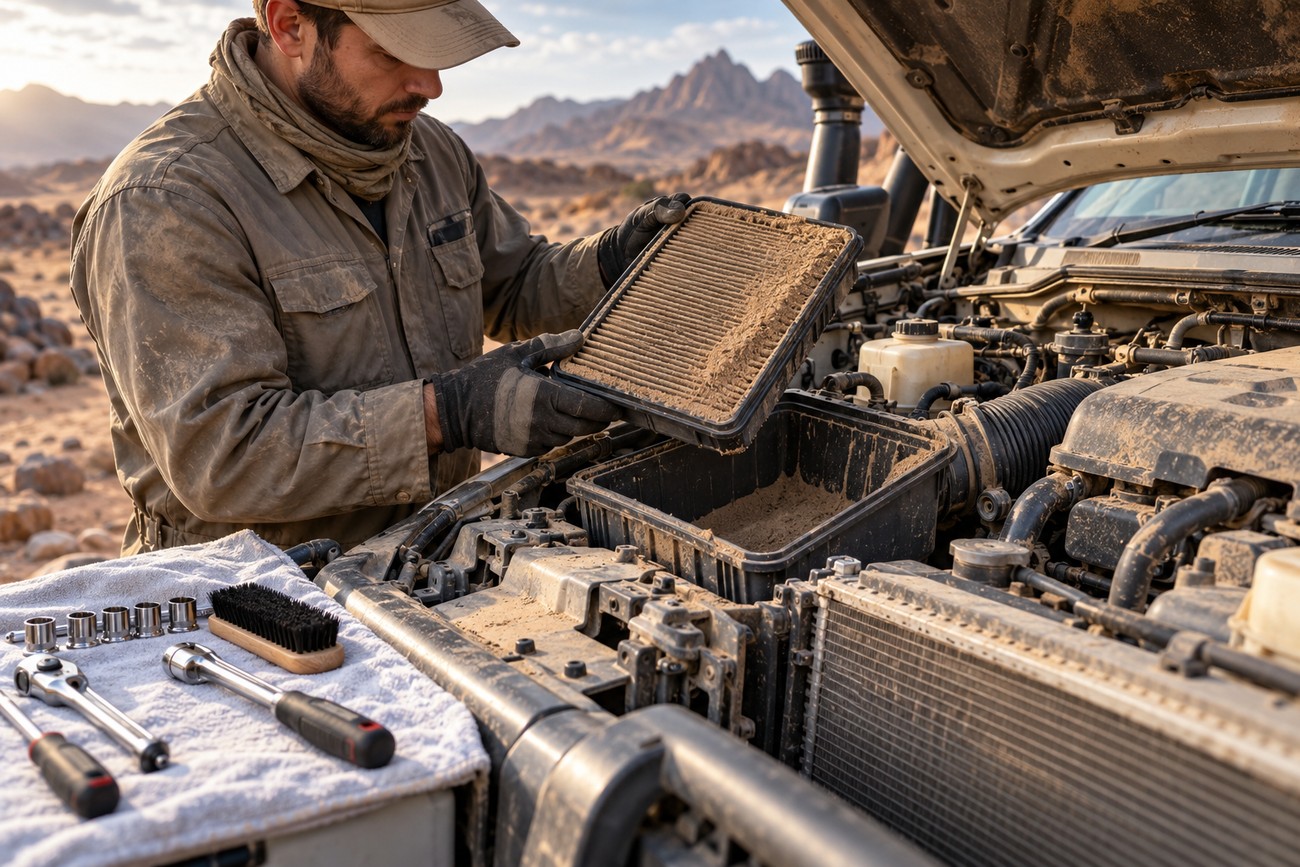
Start the post-storm inspection with the engine air filter and airbox. A clogged filter can cause a sharp loss of power and higher fuel consumption, even if the engine initially seems normal. Inspect the sealing surface, remove sand from the airbox, and replace the filter if it is loaded, damaged, or difficult to clean without releasing dust into the intake.
Post-storm servicing should include radiator and intercooler cleaning, air-filter inspection or cleaning, and checking brake assemblies for sand. Wash cooling surfaces in a way that removes contamination without bending the fins. Check for temperature warnings, unusual fan operation, reduced air-conditioning performance, or a new smell from overheated dust.
Warning lights are a late signal in desert conditions. Inspecting the radiator, airbox, brakes, and low-mounted sensors immediately can reveal contamination before it becomes a cooling fault, loss of braking performance, or an electronic warning.
Sand can jam locks, hinges, powered steps, and tailgate mechanisms. It can also contaminate low-mounted ABS, ESP, and ride-height sensors, producing false warnings or intermittent faults. Clean exposed parts carefully, then use the lubricant specified for the component; heavy grease in an exposed mechanism can trap more abrasive material.
Inspect the paint, chrome, headlights, and windshield under good light. Abrasive sand can scratch these surfaces and create a dull or hazy appearance over repeated desert use. Avoid dry-wiping a dusty windshield or body panel, since rubbing loose grit across the surface can create damage that polishing will not fully remove.
What Nissan Patrol Marketing Does Not Tell You
The Patrol’s dune capability is genuine, but it has a defined scope. Sand mode helps traction and torque management; it does not solve visibility loss, abrasive wear, overheating, or dust ingestion. Marketing can describe the vehicle’s ability to cross dunes, while safety guidance still favors stopping during a severe storm.
The cabin will not necessarily stay clean. Door and sunroof seals are designed for ordinary dusty conditions, not complete isolation during a dense sandstorm. Fine dust may reach the cabin through seals, ventilation, and other openings, and a heavily loaded cabin filter can reduce airflow or place additional strain on the climate system.
Sand is not harmless compared with mud. It works as an abrasive on paint, glass, rubber seals, bearings, joints, locks, and electronic components. The damage may accumulate quietly, then appear as a hazy lamp, stiff powered step, noisy hinge, warning light, or expensive suspension repair.
Repeated desert use also exposes the maintenance burden of independent suspension and complex kinematics. Under abrasive impacts and dune crests, these systems can require more costly attention than simpler older off-road layouts. The Patrol remains capable, but capability should be matched with shorter inspection intervals, correct recovery equipment, and the discipline to stop when the environment exceeds what the driver can see.
Frequently asked questions
The answers below focus on recovery, range planning, and convoy procedure. They do not replace local weather warnings, route information, or the operating instructions for your specific Patrol and tires.
What should you do if your Nissan Patrol is stuck on the beach?
Stop wheelspin first. Release the accelerator, select neutral or park as appropriate, and assess whether the tires are sitting on packed sand or have dug into soft material. Lower tire pressure progressively within the safe limits of the tire and load, then clear sand from in front of and beneath the tires to create a gradual exit path.
Use a controlled recovery method, such as a suitable traction board, shovel, or rated recovery connection, rather than repeated throttle. Keep people clear of recovery lines and attachment points, and stop immediately if the vehicle does not move with steady, moderate input. Repeated wheelspin usually makes the hole deeper and raises drivetrain temperature.
How many kilometers can you get out of a Nissan Patrol in the desert?
There is no single fixed distance that a Nissan Patrol can travel on one tank in desert conditions. Range changes with terrain, tire pressure, vehicle load, driving style, fuel reserve, and time spent idling. Deep sand and low-speed maneuvering can demand substantially more fuel than firm tracks.
Plan from the most demanding section of the route, keep a conservative reserve, and account for detours or a recovery. A trip that appears short on a map may consume fuel through repeated climbs, waiting in a convoy, or running the climate system while stationary. Do not use the vehicle’s road-range estimate as a guarantee for remote sand travel.
How far apart should Nissan Patrols travel in a sandstorm convoy?
Vehicles in a sandy-dust convoy should maintain at least 30 m of separation. The gap reduces the chance of rear-end collisions when the lead Patrol stops suddenly and gives the following driver more time to react.
Increase the gap when visibility, speed, surface, or traffic makes stopping harder. Keep reliable radio or visual contact where possible, and agree in advance on the signals for stopping, turning around, or dealing with a stuck vehicle. If visibility reaches zero, the convoy should prioritize safe stopping over maintaining formation.







