
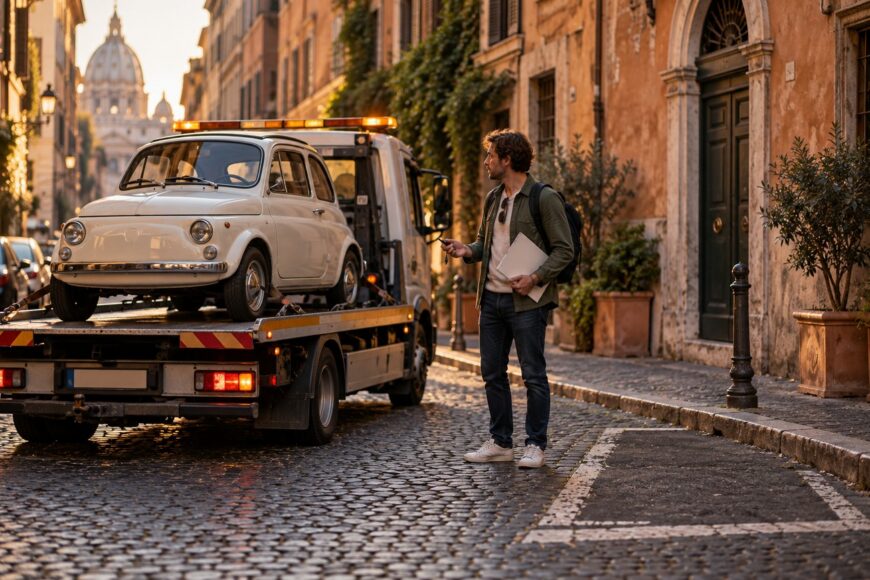
The parking space is empty where you left your rental Fiat in Rome. Before assuming it has been stolen, check that you have the right street and parking spot. The car may have been towed, or you may be in the wrong location. Note where you parked, when you last saw the car, and any signs or markings nearby.
Your next decisions are time-sensitive. Confirm whether an authority removed the car, tell the rental company, and find out what it needs you to do before collection. Keep a record from the first call onward so the incident does not become a missed return or a charge you cannot check later.
- First, confirm the Fiat was towed
- Find the impound lot and call the rental company
- Collect the car without losing your evidence
- Separate tow costs from rental charges and later tickets
- Return the Fiat without a second dispute
- Avoid another tow—or a separate ZTL fine
- Frequently asked questions
- What if my passport or rental agreement is locked inside the car?
- What if I find a nail in the rental Fiat’s tire after collecting it?
- What happens if a rental car gets towed?
- What happens if I get a traffic ticket in Italy while renting a car?
- What happens if I get a nail in my rental car tire?
First, confirm the Fiat was towed
Walk back to the exact place you parked. Check the street name, nearby landmarks, parking markings, temporary signs, and any notice left at the location. If you took a parking photo or saved a map pin, compare it with where you are standing.
Contact the relevant local police service and give the registration number, location, and approximate time the Fiat was last there. Ask whether it was removed, which authority handled it, and where it was taken. Record the reference details and the name or office you spoke with.
A physical tow and a camera-recorded ZTL entry are separate events; neither proves the other occurred. Rome’s restricted-traffic zones can generate a later notice for unauthorized entry, including when a driver was following GPS directions. That does not explain an empty parking space, and GPS directions do not override posted access or parking restrictions.
If the police cannot confirm a removal, tell them the vehicle is a rental and follow their guidance for reporting it missing. Notify the rental company promptly as well. Avoid treating an unconfirmed tow as theft—or an unconfirmed theft as a tow—when reporting what you know.
Find the impound lot and call the rental company
Once removal is confirmed, ask the authority handling it for the lot’s address, opening hours, reference number, and stated release requirements. Check whether the Fiat is already available for collection and which number to call before setting out. Do not assume one lot’s procedure applies throughout Rome.
Call the rental company using the number on your agreement or an official support channel. Give it the removal reference and ask whether it wants to arrange recovery itself or authorizes you to collect the car. Confirm who may collect it, the required documents, and any authorization with both the authority or lot and the rental company.
Check whose name must appear on a release authorization before traveling to the lot. A rental agreement in your name may not, by itself, satisfy a requirement concerning the vehicle’s owner or the person collecting it.
Ask the rental company to record the incident on your booking and explain how it wants updates if collection takes longer than expected. Keep written confirmation where possible, especially if you are told to pay a charge or change your return plan. That record gives you something specific to compare with later invoices.
Collect the car without losing your evidence
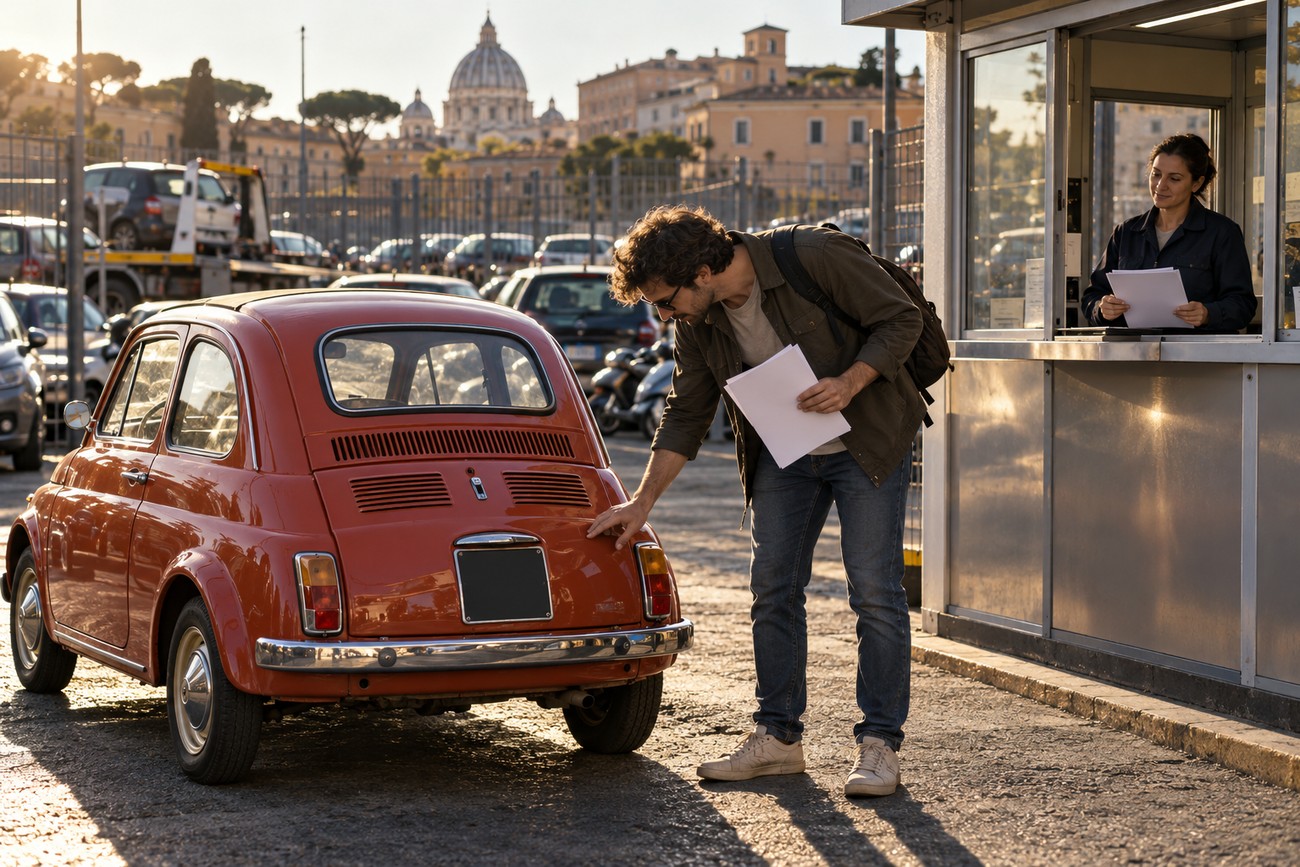
Before traveling to the lot, ask what identification, driving documents, rental records, and authorization it will accept. Bring what you have available, but do not assume there is a uniform mandatory document list. Confirm accepted payment methods and request the current itemized removal and storage charges; the information available here does not establish a fixed amount.
At collection, keep the payment receipt, release paperwork, and any notice describing why the car was removed. Check that the registration number and dates match your rental. If a charge or document is unclear, ask the issuing office for an explanation before leaving, and keep a note of the response.
Before driving away, photograph the Fiat from several angles, along with the fuel gauge and mileage. Note any new damage or mechanical concern and report it promptly to the rental company through its stated channel. Retain the photos with the collection paperwork rather than relying on a later description from memory.
If the car appears unsafe to drive, do not drive it. Ask the rental company how to proceed. Its roadside-assistance or damage procedure may affect who can arrange transport or repairs, so obtain instructions before authorizing work where possible.
Separate tow costs from rental charges and later tickets
Removal and storage charges come from the authority or lot handling the tow. Rental charges arise under your agreement and may concern matters such as damage, a late return, or administration if the relevant terms apply. Ask for an itemized invoice rather than assuming every debit is part of the tow.
A later traffic fine may be separate from tow charges, and the rental company may charge an administrative processing fee under its terms. A camera-recorded ZTL entry and a physical tow are separate events. A notice received after your trip could therefore relate to a different place or time.
For each notice or invoice, compare the registration number, date, location, description, and contractual basis with your records. If something does not match, ask the issuer or rental company for the underlying notice and an explanation of the charge. Keep separate files for the tow paperwork, rental invoices, and any later traffic correspondence.
Do not budget around an informal estimate of a ZTL fine. The available estimates conflict and do not establish the amount payable for any particular notice. Check the actual notice and its payment or challenge instructions instead.
Return the Fiat without a second dispute
Tell the rental company when you recovered the Fiat and confirm whether your agreed return time or location needs to change. A delay at the lot does not automatically amend the booking. If a different branch would help, ask about availability and any change to the agreement before driving there.
Check the return office’s hours. An after-hours drop-off is possible only if that specific rental branch permits it and you have confirmed its procedure. Leaving the Fiat and keys somewhere without that agreement may leave the return time and responsibility for the vehicle in dispute.
Review the fuel terms and return the car at the agreed level, subject to your contract. Allow time to refuel and reach the correct entrance without taking a restricted shortcut. Keep the fuel receipt if you have one.
At return, photograph the parked car’s condition, fuel gauge, and mileage, and retain any check-in record or key-drop confirmation. Keep those images alongside your recovery photos and receipts. They create a clear before-and-after record if a later fuel, damage, or late-return charge needs checking.
Avoid another tow—or a separate ZTL fine

After recovery, choose parking by reading the signs and markings at the exact space, including any time limits or temporary restrictions. Restrictions may take effect after you park. If the signs are unclear, find another place rather than relying on nearby cars as evidence that parking is allowed.
Plan the return route for the time you will actually drive it. Restrictions vary by district and time, including evening access rules in some areas, so a single published timetable is a poor substitute for current signs. GPS directions do not override posted access or parking restrictions.
ZTL cameras can record an unauthorized entry even if you are only passing through and do not intend to park. Parking restrictions present a different risk: removal of the vehicle.
If a route leads toward a restricted entrance, stop somewhere lawful and reassess rather than following it through. For a return near the center, confirm the branch’s recommended vehicle entrance and approach route in advance. The shortest route on a screen may be the one that creates another problem.
Frequently asked questions
These situations need a decision from the lot, the rental company, or both. Use the questions below to ask for a specific next step, and keep a record of the answer you receive.
What if my passport or rental agreement is locked inside the car?
Tell the lot what is inside and ask whether it permits supervised access before release. Access is not automatic, so confirm its procedure before traveling. Ask which alternative records it will accept to identify you and the rental, and have the rental company send any authorization the lot requires through an accepted channel.
What if I find a nail in the rental Fiat’s tire after collecting it?
Do not drive on a tire that appears compromised. Photograph the tire and its location. If you can, get to a safe position without driving the car, and contact the rental company’s roadside-assistance channel. Ask whether it wants to arrange an inspection, repair, or replacement before you authorize work yourself.
What happens if a rental car gets towed?
The authority handling the removal can tell you where the car went and what is required for release; the rental company can tell you who is authorized to collect its vehicle. Collection may involve removal or storage charges, while any rental-agreement charges must be assessed separately. If your return deadline is approaching, ask the company to record the delay and confirm the revised instructions in writing.
What happens if I get a traffic ticket in Italy while renting a car?
A traffic notice may reach the rental company after your trip, and the company may charge a separate processing fee if its terms allow it. Check the notice’s date, location, vehicle details, and issuing authority, then follow the instructions on the actual notice for payment or any available challenge. Do not assume a ticket is connected to the tow solely because both concern the same rental.
What happens if I get a nail in my rental car tire?
Report it to the rental company even if the tire has not visibly deflated. Ask whether the car should remain parked, what roadside help is available, and who may approve a repair. Keep photos, assistance records, and any receipts; responsibility for the cost depends on the agreement and the circumstances, rather than on the presence of the nail alone.







