
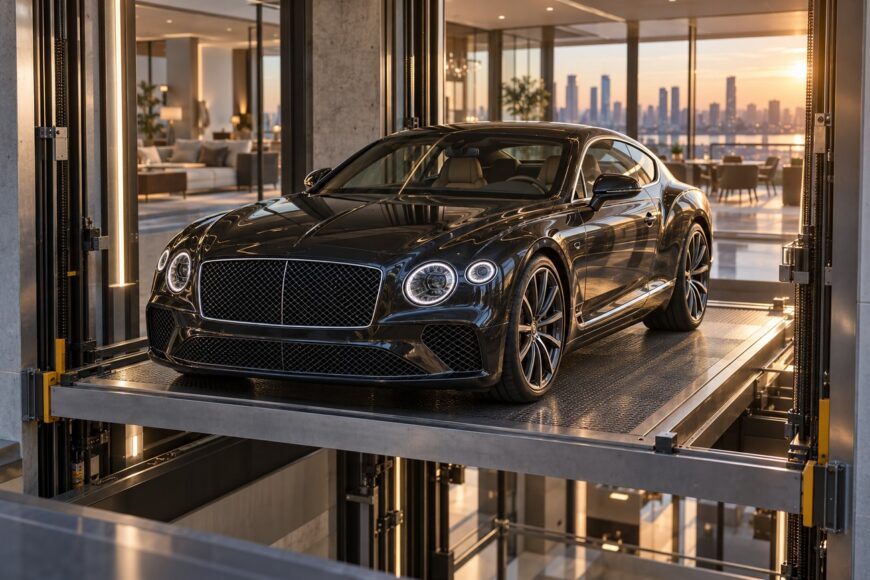
Parking a Bentley beside the penthouse living space has obvious visual appeal: the car becomes part of the architecture, protected from the street and available without a valet or basement walk. The arrangement can also preserve valuable land in dense luxury developments.
The engineering trade-off is less glamorous. Weight margins, tight approaches, fire compliance, ventilation, noise, downtime, and long-term service determine whether the feature works as daily infrastructure or remains an expensive display.
- Can a Bentley Fit in a Penthouse Car Elevator?
- Designing the Lift Around the Car—and the Building
- Daily Use: Where the Luxury Feature Creates Friction
- Is Parking a Bentley Upstairs Worth It?
- Frequently Asked Questions
- How much does a car elevator typically cost?
- What happens to the Bentley if the building loses power?
- How much does annual maintenance for a car elevator cost?
Can a Bentley Fit in a Penthouse Car Elevator?
The exact model matters more than the label “luxury car.” Residential car elevators for penthouses commonly carry 2.5–3.5 tonnes. A Bentley Continental GT weighs approximately 2.1–2.3 tonnes, while a Bentayga weighs approximately 2.4–2.6 tonnes before passengers, fuel, and luggage are considered.
A 3-tonne rating therefore does not automatically provide a comfortable operating margin. A practical design target is 30–40% above the vehicle’s maximum operating mass, including passengers, fuel, and luggage. This is a design recommendation rather than a universal statutory requirement.
Capacity should be checked against the fully loaded vehicle, while platform clearance should be checked against its real approach angle, overhang, and door opening. Brochure curb weight is an insufficient basis for the final specification.
Typical premium platforms are 2.7–3.0 m wide and 5.5–6.0 m long. A Bentley may fit within those dimensions, yet entry can remain awkward. Low clearance, a long front overhang, limited turning space, and wide doors make the landing area as important as the shaft itself. Laser guides or automatic positioning can help, provided drivers use them consistently.
Designing the Lift Around the Car—and the Building
The lift must be designed as part of the building’s fire, structural, and environmental systems. Relevant US, EU, and UAE projects generally require fire suppression and smoke extraction for the shaft and garage level. Russian and EU projects also combine lift and garage requirements, including emergency power, alarms, and protection against fuel or water leaks.
Ventilation deserves early attention. Premium installations may use a separate ventilation circuit with CO/NOx sensors, especially where the garage is close to bedrooms or living rooms. A forgotten engine warm-up can trigger alarms, while inadequate separation can carry fumes and noise into occupied areas.
Bentley geometry creates another practical constraint. A ramp with an abrupt transition may still catch the front underside or bumper, and a platform that looks generous in a rendering may leave too little room to open the doors safely. Approval should be checked before construction contracts are signed, because shaft alterations and changes in adjacent apartments can be restricted by load-bearing, fire, and safety rules.
Daily Use: Where the Luxury Feature Creates Friction

The daily routine rarely resembles a reveal video. Narrow approaches, poor visibility, and concern about touching a wheel or bumper can make entry stressful. Typical travel time to an upper level is 45–90 seconds, plus 30–60 seconds for entry or exit. That delay becomes noticeable when several residents need the lift at the same time.
Queues are common complaints in shared buildings, particularly during evenings and weekends. Operating noise and vibration can also travel into a nearby bedroom or living area. Positioning guides reduce guesswork, though they do not remove the need for careful driving and a clear landing zone.
A fault can leave the Bentley on an intermediate level or prevent access for hours while a technician is located. Major hydraulic, drive, or control repairs can cost tens of thousands of dollars and may require rare specialists. Owners should ask who responds at night, how recovery is controlled, and where the car goes during a prolonged outage.
Energy use is another ownership cost that marketing often leaves vague. The upper garage also needs planned storage for tires, detailing equipment, and accessories; without it, the parking zone quickly becomes a service cupboard. A separate ventilation and drainage strategy helps keep that space usable.
Is Parking a Bentley Upstairs Worth It?
The feature can be rational where parking land is scarce or where planning limits conventional garages. It also gives a penthouse a strong architectural identity. Its value depends on whether the owner accepts a complex building system with specialist maintenance, approvals, and failure procedures.
Installed project cost commonly ranges from $500,000–$700,000 up to $1.5–$2 million, including construction work. Annual maintenance commonly runs from $5,000 to $15,000, with continuous operation nearer the upper end. Electricity, insurance, and management charges sit outside those figures.
Some insurers require a separate policy or rider for vehicles stored in an elevated garage. Resale can also become slower when buyers fear difficult servicing or restricted access during major repairs. During a substantial lift failure, the car may need outside storage for weeks, while adjacent apartment alterations may remain tightly controlled.
Before signing, confirm the Bentley model data, reserve capacity, platform and door clearances, approvals, emergency-power provisions, service coverage, insurance treatment, and outage procedures. That checklist separates a workable private garage from an impressive feature with fragile ownership economics.
Frequently Asked Questions
Two costs are often confused: the installed system and the obligations that continue after handover. Both should appear in the ownership plan.
How much does a car elevator typically cost?
An installed project commonly costs $500,000–$700,000 up to $1.5–$2 million, including construction work. The final scope may include the lift, shaft, structural work, turning equipment, barriers, fire systems, ventilation, controls, and finishes.
That capital cost does not cover annual maintenance, energy, insurance, or specialist repairs. Obtain a separate schedule for commissioning, routine service, replacement parts, and major shutdowns.
What happens to the Bentley if the building loses power?
The owner should verify emergency-power provisions in the approved system design. The plan should explain whether the platform can be held safely, returned to a designated level, or accessed through a controlled manual recovery procedure.
Ask who authorizes recovery, how the car is removed if the lift remains unavailable, and whether the building has a secure temporary storage arrangement. A general backup generator statement is insufficient unless it specifically covers the car elevator and its safety controls.
How much does annual maintenance for a car elevator cost?
Annual maintenance commonly ranges from $5,000 to $15,000, with continuously operated systems tending toward the upper end. Electricity, insurance, management charges, specialist repairs, and major replacement work are additional ownership expenses.
Request a service schedule that identifies response times, routine inspections, replacement parts, and the expected cost of planned shutdowns.







