
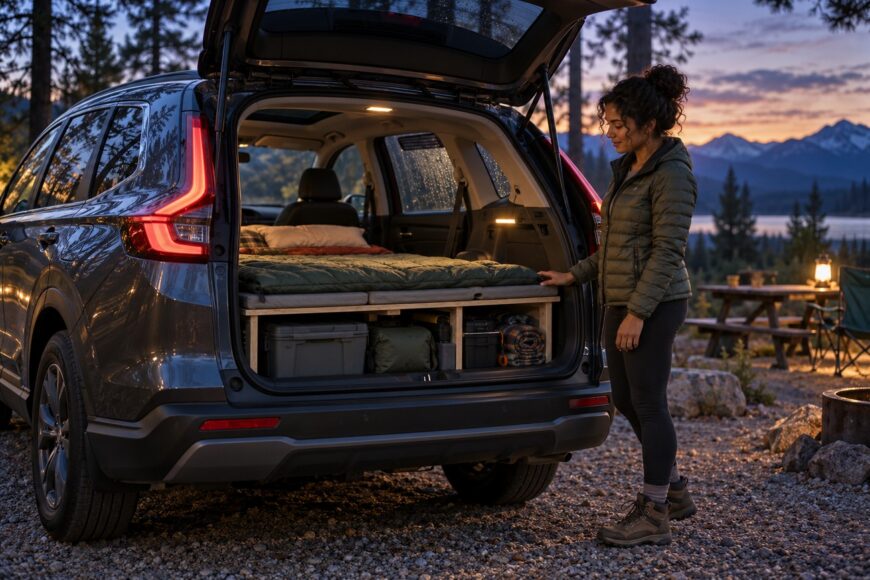
A Honda CR-V can make a useful sleeping platform for one person, and sometimes two people who accept close quarters. Its cargo area offers meaningful capacity, but the actual bed is narrower and less level than the advertised volume suggests. Wheel arches, the folded-seat transition, limited headroom, condensation, and tailgate clearance all affect whether the arrangement works overnight.
The exact year, trim, powertrain, and seat position matter. Gasoline and hybrid CR-Vs can have different underfloor storage and cargo-area layouts, while published cargo figures describe geometric volume rather than a ready-made mattress space. A safe, comfortable setup therefore starts with measurements and a clear sleeping plan rather than a mattress ordered based on the model name alone.
- Can a Honda CR-V Work for Car Camping?
- Measure the Sleeping Area Before Buying Gear
- Build a Level Sleeping Base in the CR-V
- A Practical Honda CR-V Camping Setup and Packing Plan
- Ventilation, Condensation, Privacy, and Power
- Safety Rules for Sleeping in a Parked CR-V
- Common CR-V Camping Mistakes and Misleading Assumptions
- Frequently Asked Questions
- How can I test a CR-V camping mattress before buying it?
- What should stay accessible while the CR-V is set up for sleeping?
- How do you set up a Honda CR-V for car camping?
Can a Honda CR-V Work for Car Camping?
The CR-V suits car campers who value a compact vehicle, a simple overnight setup, and weather protection over standing room. It is particularly practical for sleeping, storing moderate camping equipment, and moving between campsites without towing a trailer. The low roof and tailgate projections make prolonged sitting inside awkward, so most activities are easier outside the vehicle.
For the 2025 model, gasoline versions provide 39.3 cu. ft. behind the rear seats and 76.5 cu. ft. with the rear seats folded. Hybrid versions provide 36.3 cu. ft. behind the rear seats and 76.5 cu. ft. with the rear seats folded. Those figures describe geometric cargo volume, not a flat rectangular sleeping platform.
Wheel arches reduce usable width, and the floor transition can create pressure points under a mattress. The hybrid’s underfloor storage and cargo-area configuration also differ from gasoline versions, so a platform, storage bin, or mattress that fits one version may interfere with another. Published figures can vary by year, market, and trim.
A CR-V works best when the bed is treated as one part of the layout. Leave room for a cooler, clothing, water, and cooking equipment without placing soft bags against the tailgate. If you need to sit upright for long periods, prepare for a compromise in comfort and headroom.
Measure the Sleeping Area Before Buying Gear
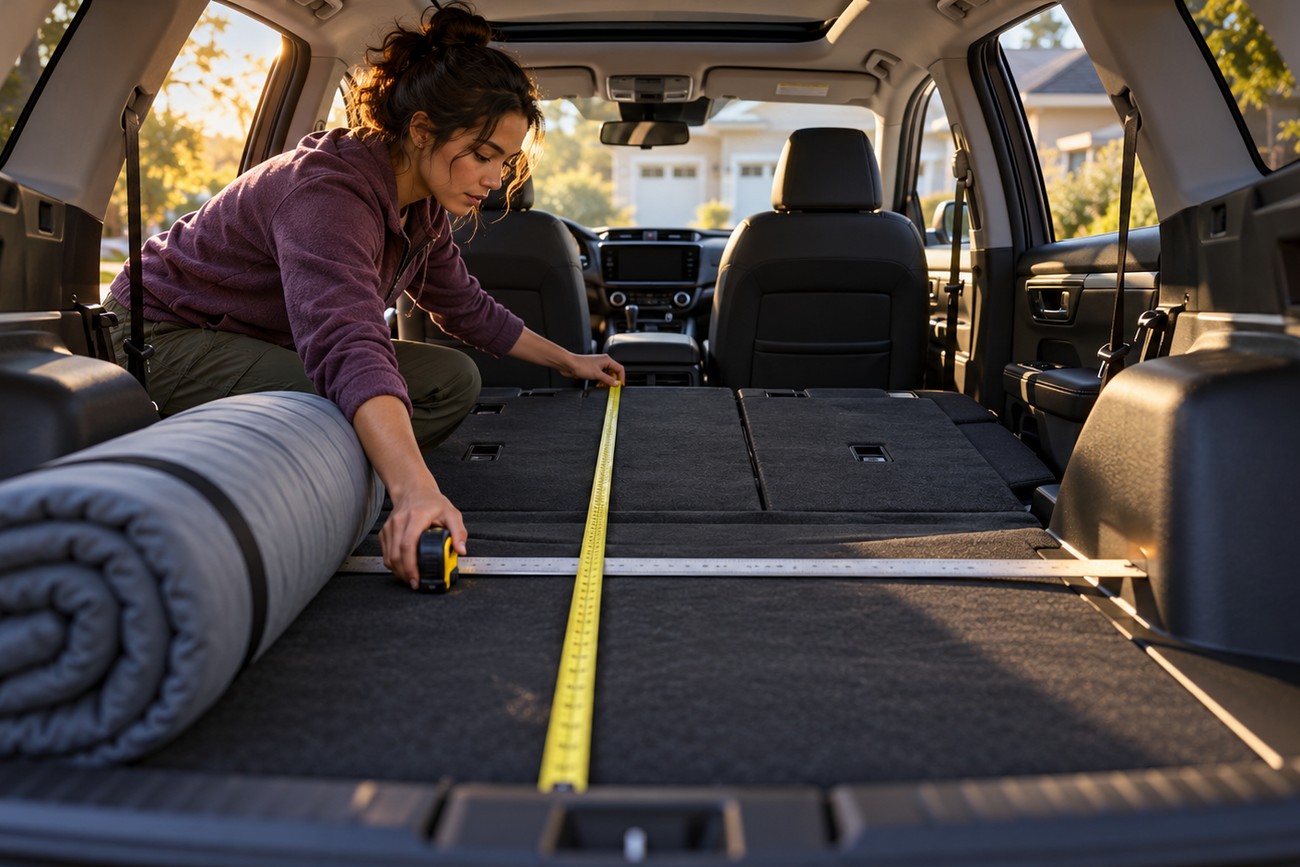
Measure the exact vehicle with the front seats set where you would drive, then record the distance from the rear of the front seats to the closed tailgate. Check the width between the wheel arches, the height of the floor transition, and the available headroom above the proposed mattress. Repeat the measurements with the rear seatbacks folded.
Honda does not publish one universal rear sleeping-length figure for the CR-V. Actual fit depends on front-seat position, seatback angle, generation, and trim. The 2025 interior hip-room figures are 55.6 inches in front and 52.6 inches in the rear, but hip room is not the width of a flat sleeping platform.
From 2024 through 2026, the rear seatbacks fold in a 60/40 split. That arrangement allows a partial sleeping area while carrying a passenger or separating equipment, although the uneven layout may complicate mattress support. Measure both sides if you plan to use only one section.
Use cardboard, removable tape, or temporary supports to mark the proposed platform and mattress outline. Close the tailgate slowly and check the full seal path, including corners and any fabric that may compress into the latch area. Four factory cargo tie-down points can help secure a platform or packed equipment, provided the attachment method is compatible with the vehicle.
Build a Level Sleeping Base in the CR-V
A purpose-built platform gives the most predictable support, especially when the folded seatbacks leave a noticeable step. A carefully supported insert can work for occasional trips if it distributes weight without pressing on trim or unsupported panels. A thick self-inflating mattress may bridge modest height changes, but a thin air mattress usually follows the contours and exposes the transition beneath it.
The 2024–2026 CR-V has a cargo floor with two height positions. The upper position can reduce the transition between the cargo floor and folded seatbacks, although it does not guarantee a perfectly horizontal sleeping surface. Raising the floor also reduces the vertical space between the bed and roof, which matters when changing clothes or sitting up.
Cardboard mock-ups and temporary supports reveal problems before permanent panels are cut. Test the closed tailgate, mattress compression, floor height, and access to the rear seats as one assembled system.
Plan around the narrowest width between the wheel arches, the height of the floor transition, the thickness of the mattress, and the tailgate clearance. A platform that fits at floor level may fail once bedding is added. Avoid universal platform dimensions unless they have been measured for the exact CR-V configuration.
Keep the structure light enough to remove when the vehicle is needed for normal cargo. Rounded edges, secure supports, and clear access to the factory tie-down points reduce rattles and prevent loose panels from shifting during travel.
A Practical Honda CR-V Camping Setup and Packing Plan
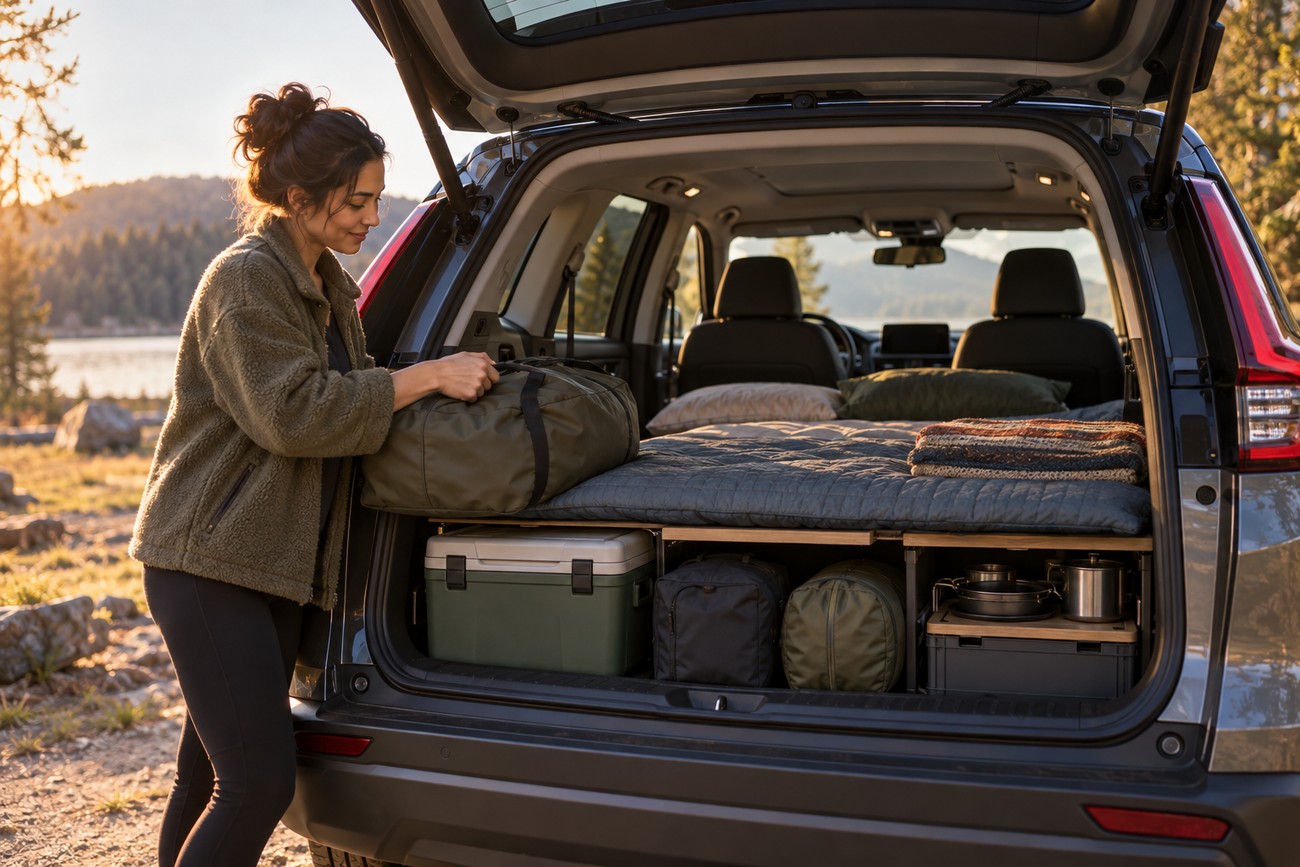
Start by removing unnecessary cargo and setting the front seats to the driving position you will use before sleeping. Fold the 60/40 rear seatbacks, install the leveling support or mattress, and check that the tailgate closes without compressing the bed. Test the complete arrangement with the cooler, baggage, bedding, and cooking equipment inside.
- Clear the footwells and cargo floor of loose items.
- Fold the required section of the rear seatbacks.
- Install the platform, insert, or supportive mattress.
- Check the floor transition, tailgate seal, and sleeping length.
- Place essential items within reach without blocking exits.
- Secure loose equipment before driving.
Use the space beside or beneath the sleeping surface for low-profile items, and place clothing in soft bags that can be moved without dismantling the bed. Keep the cooler where it can be opened without unloading the mattress. Cooking equipment should remain outside during use and should never create a route obstruction inside the vehicle.
The tailgate mechanism and emergency exit area must remain clear. Soft gear pressed against the rear door can restrict opening movement or delay an exit. The four factory cargo tie-down points are useful for securing heavier or awkward loads so they do not shift during braking.
Ventilation, Condensation, Privacy, and Power
Condensation can form with only a small temperature difference between the cabin air and the glass. Closed windows allow moisture from breathing to accumulate quickly, leaving bedding damp and reducing visibility in the morning. Drying wet clothing inside the CR-V makes the problem worse.
Window deflectors and insect screens allow limited airflow while making an open window less exposed to rain and insects. They improve privacy and help keep insects out, but rain protection remains limited, and they are not a complete ventilation solution. Check the forecast and keep a dry alternative available.
Factory lighting and outlets may be insufficient for a long stationary stay. USB lights, a charged phone, and a suitable battery pack can cover basic needs without running the vehicle. A portable power station may support more equipment, but its capacity, ventilation, and charging requirements still need to suit the trip.
Ventilation accessories should support safe parking rather than encourage idling. Keep a working carbon monoxide detector in the sleeping area, and remember that it adds protection without replacing an open, lawful parking location and a shut-off engine.
Safety Rules for Sleeping in a Parked CR-V
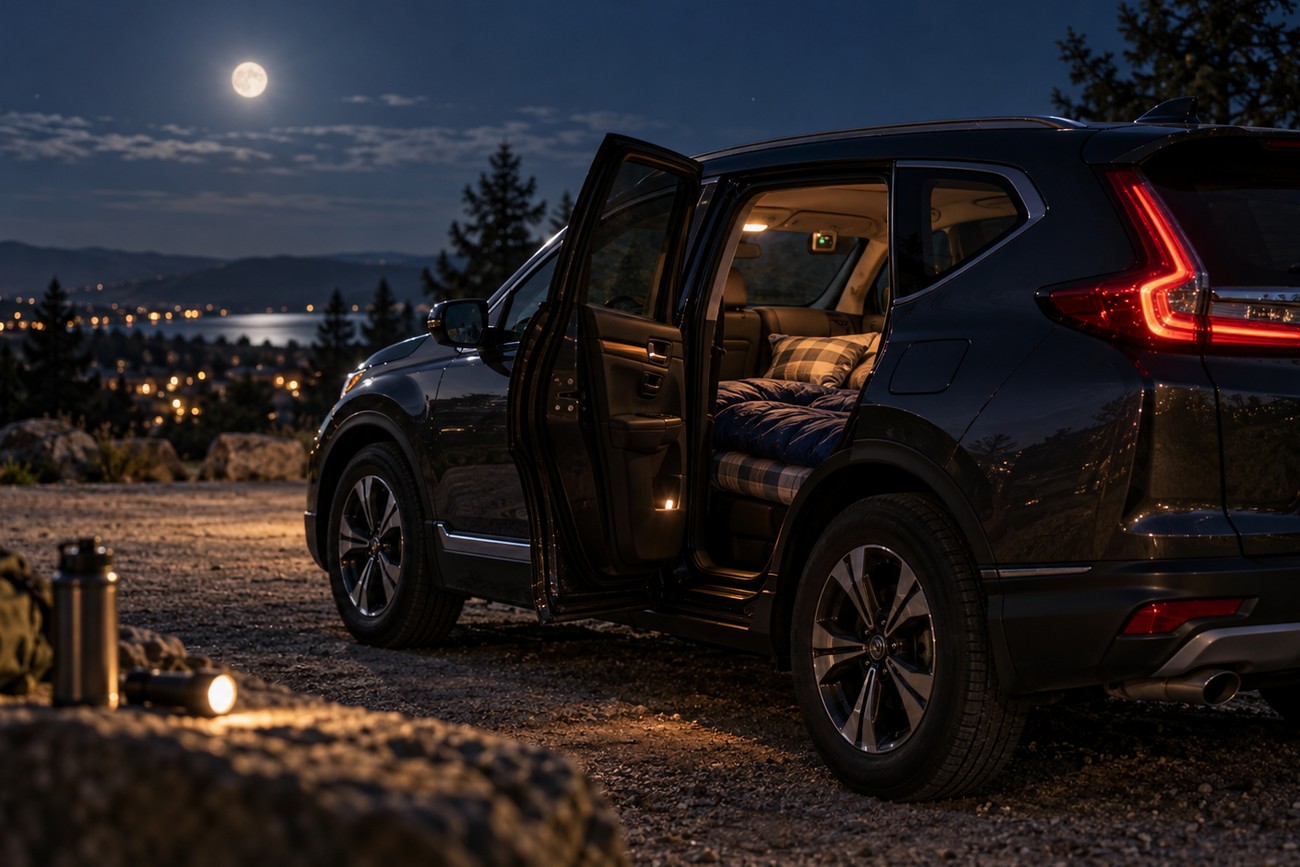
Do not sleep with the engine running in a closed or partially enclosed location. Exhaust can accumulate near walls, garages, carports, snowbanks, or other obstructions, and a cracked window does not make this safe. The safest general practice is to sleep with the engine off in an open, lawful, well-chosen location.
A working carbon monoxide detector is an additional safeguard, not permission to idle overnight. Treat any alarm, headache, dizziness, nausea, or unusual tiredness as a reason to leave the vehicle immediately and seek fresh air. Follow local emergency guidance if symptoms or an alarm occur.
Park with the tailgate and doors free of obstructions, and keep keys, a phone, footwear, water, and a light within reach. Do not pack bedding or bags into the only practical exit route. Before settling in, test that the relevant doors and tailgate can open from inside.
Stationary heating or cooling consumes fuel or traction-battery energy. Hybrid operation does not remove exhaust risk, and a battery-managed climate system may stop or change behavior as energy reserves fall. Prepare bedding and clothing for the expected temperature so climate control is not the primary overnight safety plan.
Secure equipment before driving, avoid unstable surfaces, and check weather exposure before choosing a site. AWD can help on wet or mildly rough surfaces, but it does not compensate for unsuitable tires, limited clearance, vehicle mass, or inadequate underbody protection.
Common CR-V Camping Mistakes and Misleading Assumptions
The 76.5 cu. ft. maximum is not a promise of a flat, wide, fully usable bed. It measures space to a geometric boundary, while the sleeping area is shaped by wheel arches, seatbacks, trim, and the tailgate. A mattress chosen by maximum advertised length may be too wide, too long at the corners, or impossible to close under the hatch.
Select the mattress only after measuring the actual gap between the front seats, tailgate, and wheel arches. Include its inflated thickness and the amount it compresses against supports. A thin pad may pack small, but it can transmit the floor transition directly to the hips and lower back.
AWD does not turn the CR-V into an off-road vehicle. The 2024 CR-V has approximately 198 mm of ground clearance in the base 2WD version and approximately 208 mm in several other configurations. Those figures describe clearance, not guaranteed traction, body protection, or safe passage over rocks and deep ruts.
Owner complaints also vary by generation, trim, and powertrain. Reports of a difficult floor, limited storage, or awkward access should guide your inspection rather than become assumptions about every CR-V. Measure the specific vehicle and test the complete camping load before committing to a permanent build.
Frequently Asked Questions
The most reliable CR-V camping decisions come from testing the exact vehicle and keeping the overnight setup reversible. These answers address the small planning details that often decide whether the arrangement works.
How can I test a CR-V camping mattress before buying it?
Set the front seats where you would drive, fold the rear seatbacks, and mark the proposed mattress outline on cardboard with removable tape. Place the template over the wheel arches and floor transition, then add temporary supports at the intended height. Close the tailgate slowly and check the corners, latch area, and available headroom before buying a mattress.
If possible, place a blanket or borrowed pad over the template and lie down for several minutes in your normal sleeping position. Test the arrangement with bedding and one or two storage bags beside it. This driveway test is more useful than relying on an online mattress label or a maximum cargo-length figure.
What should stay accessible while the CR-V is set up for sleeping?
Keep the keys, phone, footwear, water, light, first-aid supplies, and essential weather clothing within reach. Leave the tailgate, doors, and any practical emergency exit free of bags, bedding, and cooking equipment. Check the release handles from inside before closing the vehicle for the night.
Store heavier items low and secure them to prevent movement during travel. A cooler or battery pack may stay inside, but it should not occupy the only exit route or require unloading the bed in an emergency.
How do you set up a Honda CR-V for car camping?
Use the vehicle’s exact measurements to choose a sleeping surface, fold the required 60/40 rear-seat section, level the floor transition, and test tailgate closure with the mattress installed. Pack the cooler and personal gear around the bed, secure loose loads, and keep exits and ventilation paths clear.
Sleep with the engine off in an open, lawful location, use controlled ventilation suited to the weather, and carry a working carbon monoxide detector. Gasoline and hybrid versions should be checked separately because their cargo-area configurations are not automatically interchangeable.







