
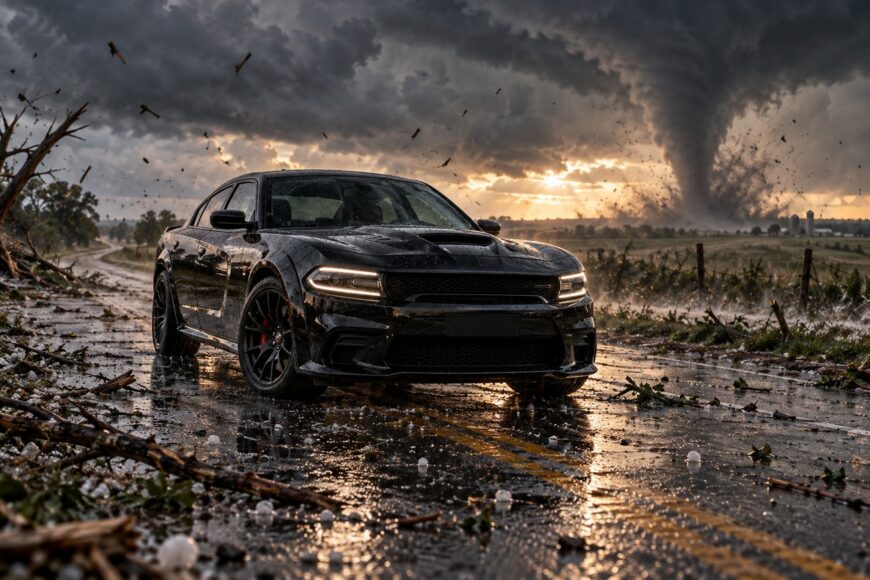
A V8 Dodge Charger can exceed 200 km/h with sufficient acceleration, while the average tornado moves across the ground at approximately 48 km/h. That comparison makes escape seem straightforward. It is also the wrong test.
A tornado may move at up to approximately 120 km/h in individual cases, and its path can change without giving a driver a reliable route away. Traffic, debris, flooding, hail, poor visibility, and sudden crosswinds can reduce a fast car to a trapped vehicle within seconds. The Charger may be faster than a tornado’s forward movement, but trying to outrun one is not a safe plan.
- The Charger Is Faster on Paper—but That Is Not the Real Test
- Why a Dodge Charger Is Not a Tornado Escape Vehicle
- What to Do When a Tornado Warning Meets the Road
- The Driving Mistakes Movies Leave Out
- Frequently asked questions
- Which car can survive a tornado?
- What should you do if a tornado warning arrives while you are already on the highway?
- What is faster, a car or a tornado?
The Charger Is Faster on Paper—but That Is Not the Real Test
A tornado’s forward speed describes how quickly the circulation travels across the ground. It does not describe the speed of the air rotating inside it. The average forward speed is approximately 48 km/h, with individual cases reaching approximately 120 km/h.
Wind inside and around a tornado is a separate hazard. Estimates range from approximately 105–137 km/h for an F0 tornado to approximately 267–322 km/h and higher for an F4 tornado. An exceptional near-surface airflow record is approximately 484 km/h, although that is a record measurement rather than a typical tornado speed.
A typical modern passenger car may reach approximately 160–200 km/h. A V8 Dodge Charger can realistically exceed 200 km/h with sufficient acceleration, based on automotive-community data rather than a formal manufacturer or testing standard. Those figures describe performance on a clear, controlled road; they say little about whether a safe route remains open.
The driver must predict the storm’s track, choose a route, avoid other vehicles, and remain upright while wind and debris affect the car. A tornado can cross roads, obscure landmarks, and change direction while the vehicle is still accelerating. Speed can shorten travel time only when the road, visibility, and destination remain dependable.
Why a Dodge Charger Is Not a Tornado Escape Vehicle
A Charger’s mass and power do not make it a storm shelter. Sideways and straight-line gusts around a tornado can reach approximately 128 km/h and may overturn vehicles. A broad sedan body also presents substantial side area to the wind, creating a serious loss-of-control risk before the main funnel reaches the road.
Wet pavement, standing water, scattered branches, and broken signs reduce tire grip and steering authority. A powerful rear-wheel-drive configuration can make an abrupt throttle input especially difficult to manage on a contaminated surface. The car’s weight may add momentum after a slide begins, increasing the consequences of a mistake.
Low ground clearance and wide tires are useful for normal road handling, yet they can become liabilities on flooded or debris-covered routes. A Charger cannot drive through a fallen tree, deep water, or a road hidden under rubble simply because its engine has reserve power.
Windows and body panels are not designed to stop flying debris. Hail can damage glass and lighting, while secondary vortices and straight-line winds can threaten the car even when the main funnel passes elsewhere. No ordinary passenger vehicle, including a heavy muscle car, is tornado-proof or guaranteed to survive tornado winds and debris.
What to Do When a Tornado Warning Meets the Road
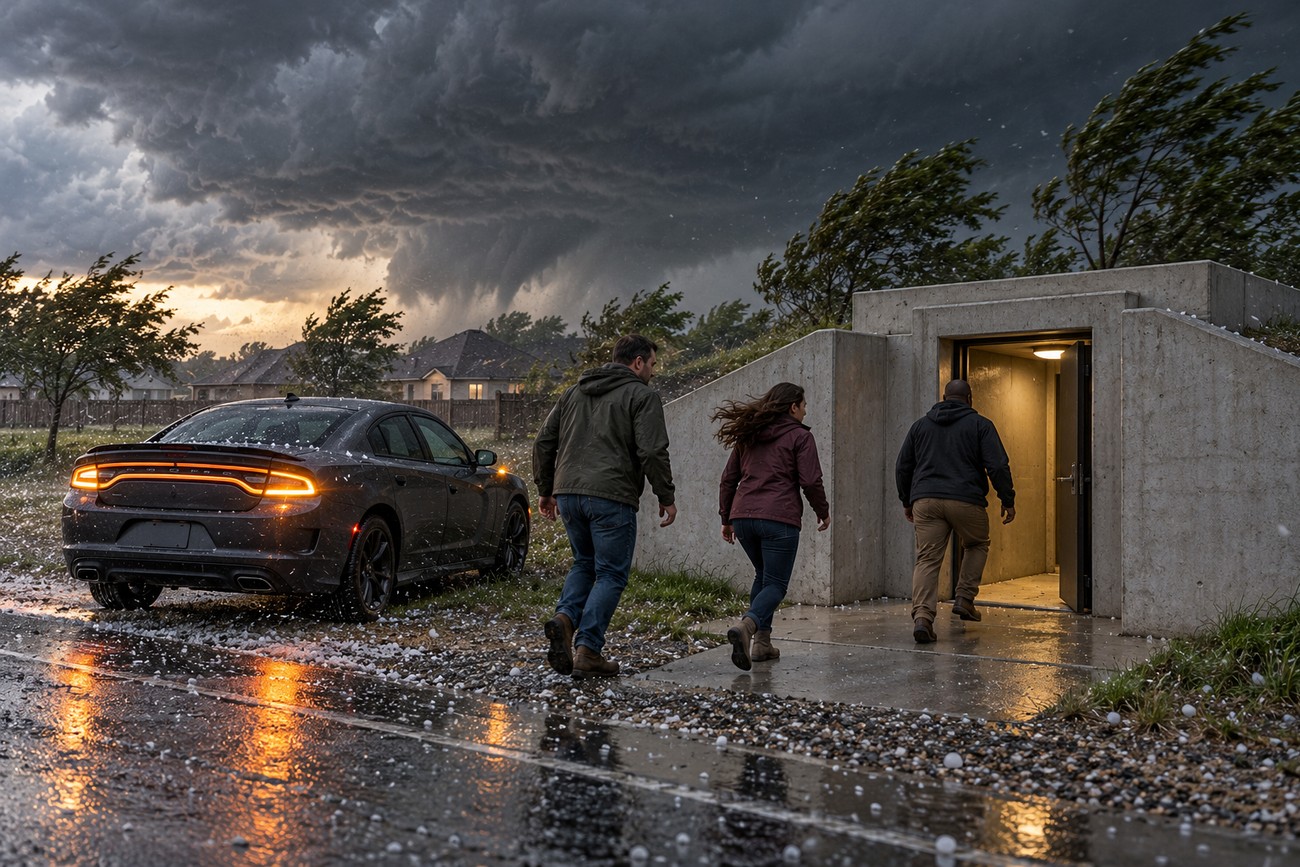
Official weather and emergency guidance advises against trying to outrun or overtake a tornado. If a substantial stationary building or another locally recommended hardened shelter is available, make that the priority. The safest decision is often made before the funnel becomes visible, while the route and entrance are still clear.
Warnings can precede a tornado by only a short period, and the storm may reach a community within minutes. Once people see the funnel, they may already be dealing with hail, blocked lanes, stopped traffic, or rapidly worsening visibility. A preplanned shelter route is more valuable than the Charger’s acceleration or top speed.
Waiting for a visible funnel can remove the only usable route. Shelter decisions work best when they are tied to warnings and familiar landmarks before traffic, hail, or debris close the road.
If the storm position and projected path are accurately understood, moving perpendicular to that path may be safer in theory than driving directly away from it. This is only an option when the route is completely open, traffic is moving, and the destination is clear. It is not a universal instruction for a driver who is already near the circulation.
Do not drive toward or alongside a tornado to gain distance. If a suitable building is nearby, enter it and move away from windows, preferably to a lower interior area. Follow local emergency instructions, and avoid treating a last-second high-speed departure as a substitute for shelter.
The Driving Mistakes Movies Leave Out
Traffic is one of the most dangerous parts of the escape calculation. A road that appears open on a map can become stationary after drivers react at once, leaving people exposed in vehicles while the storm approaches. A fast car has no useful advantage when its lane is blocked.
GPS and mobile internet may fail when navigation is most needed. Consider shelter locations, alternate roads, and fuel before severe weather arrives rather than stopping to solve those problems under warning conditions. A route remembered from a map is also more useful than relying on a signal that may disappear.
Hail can damage windshields and lighting, removing visibility before the funnel reaches the road. Rain, dust, flying material, and darkness can make the tornado’s position impossible to judge from the driver’s seat. The apparent direction of a funnel should not be used as the sole basis for choosing an escape route.
Overpasses, bridges, and similar structures are not dependable tornado shelters. They can expose people to concentrated wind, debris, and dangerous traffic, while their entrances may become blocked. The practical rule is simple: shelter beats speed.
Frequently asked questions
A tornado emergency requires a shelter decision based on the building, route, and warning information available at that moment. Vehicle performance cannot provide a safety guarantee.
Which car can survive a tornado?
No ordinary car is certified to safely withstand a tornado. Weight, size, ground clearance, and performance cannot guarantee survival when violent wind and debris strike an exposed vehicle.
A parked car inside a suitable enclosed structure may be protected by the structure around it, subject to that building’s condition and local guidance. The same car outside remains vulnerable, even if it is heavy or fitted with a powerful engine.
What should you do if a tornado warning arrives while you are already on the highway?
Slow down without creating a new crash hazard, leave the traffic stream only if a substantial shelter is clearly reachable, and follow official instructions. Never use an overpass as a substitute for shelter.
If no suitable building is reachable, follow local emergency instructions and do not attempt a high-speed escape. Decisions should account for road closures, flooding, visibility, and nearby shelter rather than relying on the vehicle’s maximum speed.
What is faster, a car or a tornado?
A car is usually faster than a tornado’s forward movement under clear-road conditions. That fact does not mean it can safely outrun the storm, because wind, debris, changing direction, traffic, and road damage determine whether an escape route remains usable.







