
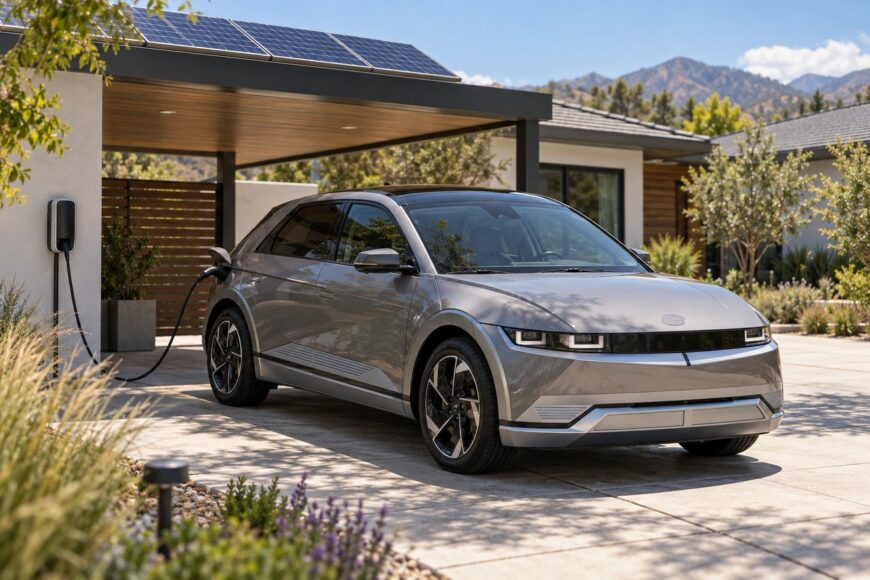
The idea of charging a Hyundai Ioniq 5 from sunlight is appealing: leave the vehicle outside, let the roof collect energy, and return to a car with more range. A roof-sized automotive solar module can produce useful electricity, but its output is limited by the available surface area and changing outdoor conditions.
The central answer is simple. Solar energy can make a small contribution to an Ioniq 5, especially during long periods of sunny outdoor parking, but it does not replace normal EV charging. Peak panel output, daily energy production, and energy delivered to the traction battery are separate figures, and confusing them is the source of most exaggerated expectations.
- Does the Hyundai Ioniq 5 Come With a Solar Roof?
- How Much Energy Can a Roof Panel Really Deliver?
- What Solar Charging Means for the Ioniq 5 Battery
- Why Weather, Parking, and Season Change the Result
- Can You Connect an External Solar Panel Directly to an Ioniq 5?
- Is Solar Charging Worth It for an Ioniq 5 Owner?
- Frequently asked questions
- What are the most common problems with the Hyundai Ioniq 5?
- How many kWh does it take to fully charge a Hyundai Ioniq 5?
- How many kWh are needed to fully charge a Hyundai Ioniq 5?
Does the Hyundai Ioniq 5 Come With a Solar Roof?
Most Hyundai Ioniq 5 configurations do not have a factory solar roof. Solar equipment was associated with earlier marketing or regional offerings rather than being a universal, mass-market option across the model range. Equipment can also vary by country, production period, and trim.
Check the exact vehicle identification, market specification, and factory equipment before estimating solar charging. A glass roof, panoramic roof, or dark roof panel is not automatically a photovoltaic system. Dealer photographs and online listings can also blur the difference between an optional roof design and a panel that actually produces electricity.
A factory-integrated system is engineered around the vehicle’s electrical architecture, cooling, sealing, and control software. An aftermarket panel is a separate engineering project. It may require its own controller and charging interface, and it can raise questions about physical fit, 12V behavior, electronics compatibility, and warranty coverage.
How Much Energy Can a Roof Panel Really Deliver?
A roof-sized automotive solar module typically produces power in the hundreds of watts at peak, not kilowatts. Peak power describes a favorable test condition with strong sunlight and an appropriate panel temperature. It does not describe the energy the vehicle will collect over a full day of mixed weather and changing sun angles.
Daily energy is measured in kilowatt-hours and depends on how long the panel receives useful sunlight. The result changes with latitude, season, sun angle, shade, cloud cover, dirt, and panel temperature. A car parked beside a building for several hours may deliver less energy than its peak rating suggests, even on a bright day.
Marketing or user claims may cite up to 1–2 kWh per day or tens of kilometers of added range. Such results are conditional rather than guaranteed. They require favorable exposure and an efficient charging path, while ordinary ownership includes partial shade, low sun, traffic, roof contamination, and days when the vehicle is indoors.
The practical calculation should therefore use seasonal or annual energy yield for your location. A single watt figure is useful for comparing hardware, but it says little about the energy a particular Ioniq 5 will receive during winter, at an office parking space, or under a hot and dusty roof. A few hours of strong sun can also produce a different result from a full day of weak, intermittent light.
What Solar Charging Means for the Ioniq 5 Battery
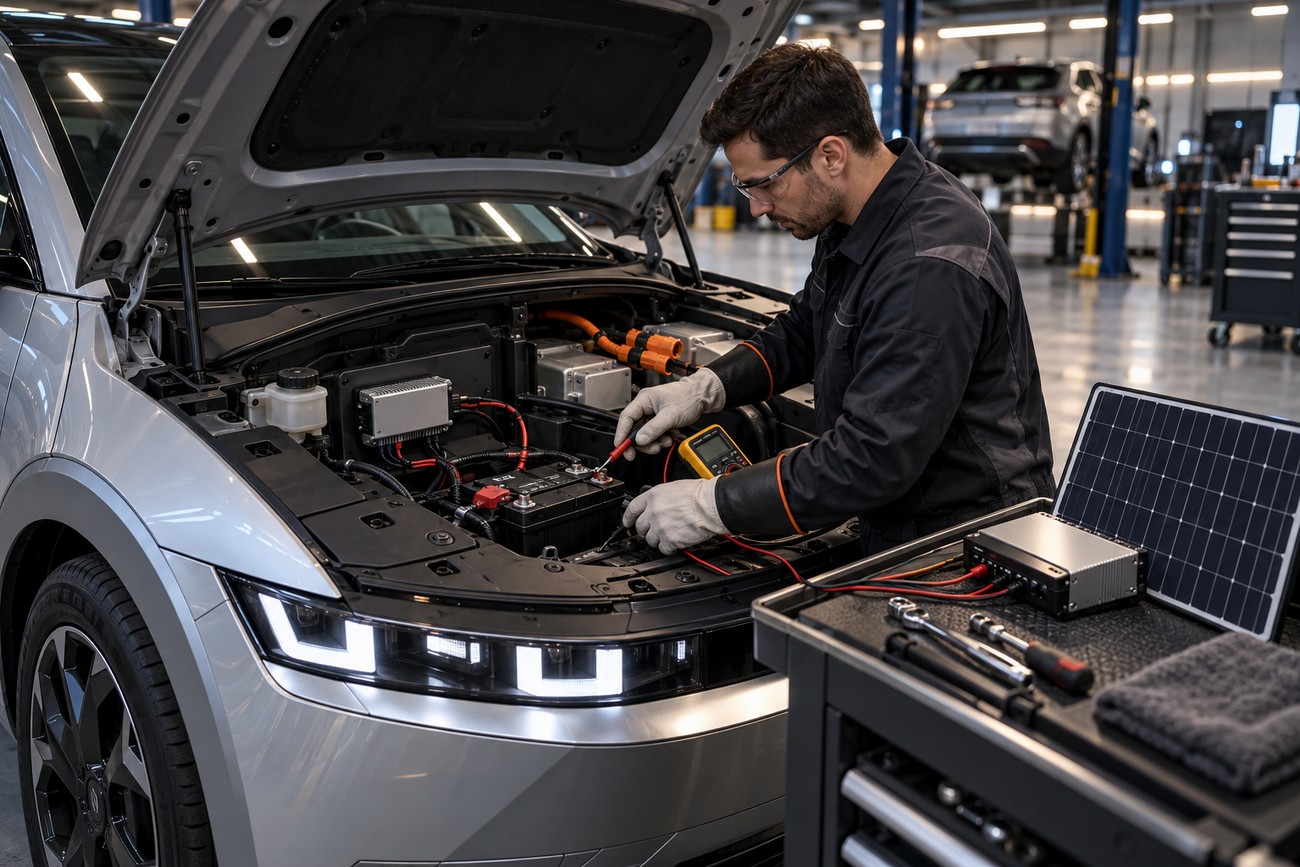
The Ioniq 5 uses a large high-voltage traction battery designed to store the energy needed for normal driving. A few hundred watts of solar generation represent only a small fraction of that demand. Even when the panel is working well, the energy contribution is modest beside the amount used on a typical journey.
That contribution may still be useful. Depending on the vehicle’s design, solar input can support 12V and other auxiliary loads, help with ventilation, or reduce some parasitic demand. These effects may be more noticeable in system monitoring than as a clear increase in the displayed driving range.
Solar power also arrives unevenly. A cloud can reduce output, and the vehicle may consume auxiliary energy while the panel is producing it. The remaining energy must pass through suitable conversion and control equipment before it can reach the traction battery, so panel output and battery charging are never identical figures.
A roof panel cannot provide the behavior of a normal fast charger or a dependable overnight charger. It can offset a small amount of energy over time, while the Ioniq 5’s main charging routine still depends on compatible EVSE, home charging equipment, or public charging infrastructure.
Why Weather, Parking, and Season Change the Result
Parking location is often more important than the panel’s brochure rating. A vehicle left outside all day in unobstructed sunlight has a meaningful opportunity to collect energy. One parked in a garage, under a carport, or beside a tall building may receive little or no useful solar generation.
Winter creates several limits at once. The sun remains lower in the sky, daylight is shorter, and cloud or snow can reduce exposure. Roof contamination from dust, road film, pollen, or leaves further reduces the light reaching the cells. A clean panel in direct sun can therefore perform very differently from the same panel during ordinary winter parking.
Heat is another overlooked factor. Solar modules generally produce less power as their temperature rises, so a hot roof does not necessarily deliver the strongest output. Driving also makes the roof’s exposure less predictable because the vehicle moves through shade, tunnels, tree cover, and changing orientations.
For ownership decisions, seasonal and regional energy yield matters more than rated peak watts alone. Review how many hours the car normally spends outside, whether that parking is shaded, and whether the vehicle is usually driven during the strongest daylight. A small roof panel makes the most practical sense during long daytime parking in open sunlight.
Can You Connect an External Solar Panel Directly to an Ioniq 5?
A loose solar panel must not be connected directly to the Ioniq 5 high-voltage battery. The battery requires controlled voltage and current, isolation, protection, monitoring, and a charging path that matches the vehicle’s electrical architecture. A panel’s raw output changes with sunlight and cannot safely substitute for those functions.
A workable system requires suitable control electronics, voltage compatibility, protection against faults, and a coordinated AC/DC charging path. EV charging is designed around compatible EVSE and CCS charging systems, rather than an unregulated connection from a single panel. The interface must also account for how the vehicle authorizes and manages charging.
Installers first map the 12V supply, CAN/BCM communication, controller behavior, and protective devices before treating solar equipment as part of the vehicle. The Ioniq 5 is a managed electrical system, not a battery that accepts raw panel output.
Aftermarket integration can involve the 12V system, CAN/BCM communication, charging detection, thermal management, and fault handling. Poorly chosen equipment may create warning messages, drain the 12V battery, interfere with vehicle functions, or fail to deliver energy even when the panel is in sunlight.
Warranty and service implications also deserve attention. A system that changes factory wiring or connects to vehicle electronics may complicate diagnosis and coverage. Anyone considering such a conversion should obtain a design from a qualified EV electrical specialist, with documented protection and compatibility, rather than relying on a generic solar controller.
Is Solar Charging Worth It for an Ioniq 5 Owner?
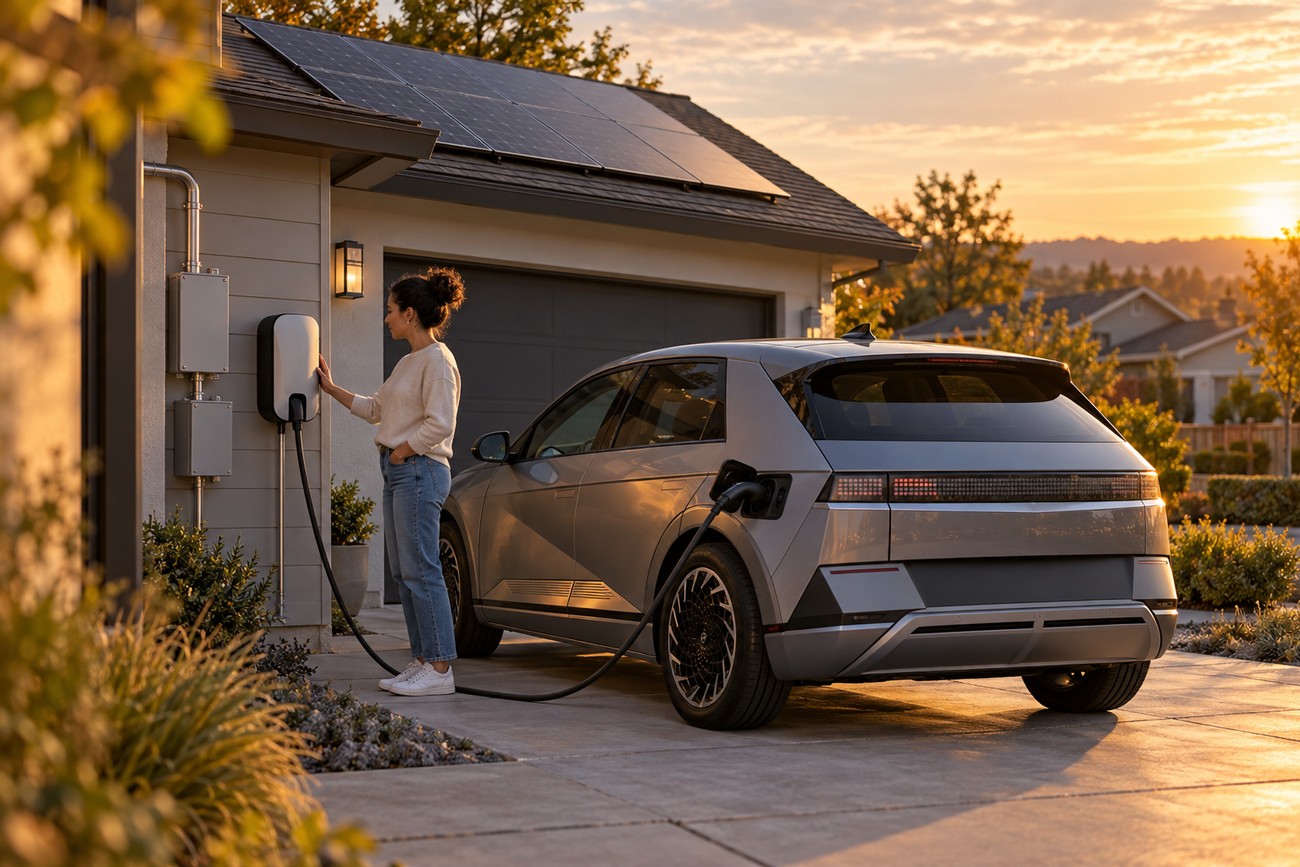
Solar generation is usually a small supplement rather than a replacement for grid charging. Its value can be reasonable when the vehicle spends many daylight hours in unobstructed sun and the system is factory-integrated or professionally engineered. The benefit becomes close to zero when the car is commonly parked indoors or in shade.
Home charging, scheduled overnight charging, and appropriate EVSE use are more dependable ways to replenish the traction battery. They provide predictable energy at a known time and avoid the large variation caused by weather and parking. For many owners, a charging schedule delivers more practical benefit than adding a small panel to the vehicle.
The common myth is that several sunny hours will charge an Ioniq 5 like a household outlet. The reality is a modest energy offset whose size depends on conditions and conversion losses. A second myth treats any reported daily range gain as a standard result; the same vehicle can produce very different results across regions and seasons.
Solar equipment can still have a valid purpose if expectations are set correctly. It may support auxiliary systems, reduce a small amount of stationary energy demand, and add some traction-battery energy over time. It should be evaluated using local seasonal yield, installation complexity, and actual parking conditions, rather than a headline peak-output claim.
Frequently asked questions
The solar-panel question is separate from several ordinary Ioniq 5 ownership and charging issues. The answers below distinguish vehicle troubleshooting from the amount of energy a solar system can contribute.
What are the most common problems with the Hyundai Ioniq 5?
Common ownership concerns can include charging-system troubleshooting, 12V-related faults, software behavior, and problems associated with the vehicle’s charging equipment. The exact issue depends on the model year, market, usage, and maintenance history, so a warning message or charging interruption should be diagnosed through the vehicle’s own systems and approved service procedures.
Those concerns do not prove that solar energy is reaching the traction battery. A 12V system that appears supported, cabin ventilation that operates, or an auxiliary load that remains powered can coexist with little or no meaningful traction-battery charging. Confirm the actual charging path and energy flow separately.
How many kWh does it take to fully charge a Hyundai Ioniq 5?
Use the specified capacity for the particular Ioniq 5 battery version, then allow for charging losses. There is no single universal kWh figure for every Ioniq 5 because battery versions and charging conditions differ.
The energy measured at the wall can exceed the energy stored in the battery. Losses occur in the onboard charger, wiring, battery conditioning, and other vehicle systems. A solar estimate should therefore compare usable delivered energy with the vehicle’s specified battery capacity, rather than comparing a panel’s peak watts directly with a full-charge figure.
How many kWh are needed to fully charge a Hyundai Ioniq 5?
Start with the battery capacity listed for the vehicle’s exact version and add the charging energy lost between the source and the battery. The final amount depends on the battery specification, charging equipment, temperature, and starting state of charge.
A small roof panel cannot be used to infer a full-charge time from peak output alone. Its daily energy changes with sunlight and parking conditions, while a full charge requires a controlled charging system and enough delivered energy for the selected battery version.







