
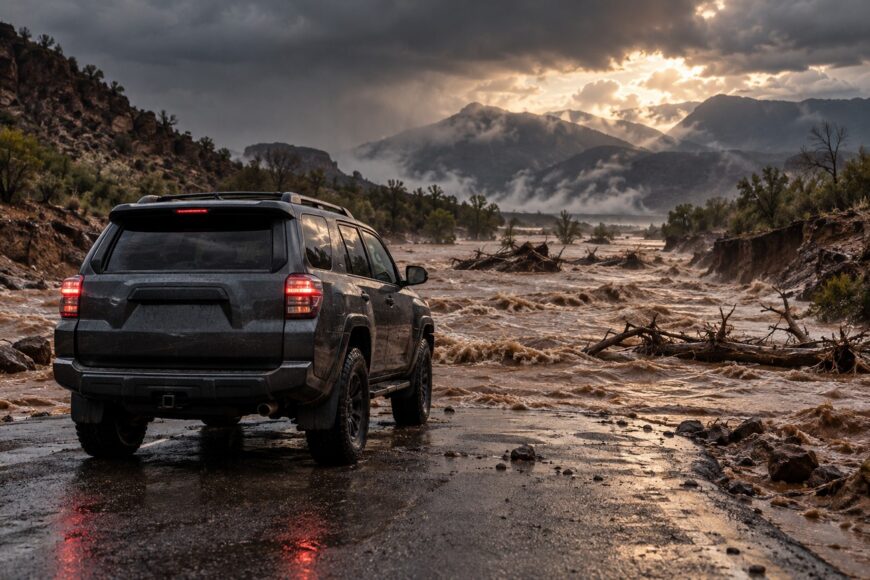
A Toyota 4Runner may handle carefully selected, slow-moving water, but a flash flood is not a legitimate crossing challenge for any SUV. Its approximately 240–250 mm of ground clearance, four-wheel drive, and body-on-frame construction help with some off-road conditions; they do not overcome current, unstable surfaces, debris, or water entering the intake.
Fast-moving floodwater only 15–30 cm (6–12 inches) deep can remove vehicle traction. A 4Runner may still look stable while the tires lose contact with the road, and the vehicle can begin moving sideways before water reaches the hood. The safest decision is to turn around and avoid moving floodwater.
- The Short Answer: Do Not Cross a Flash Flood
- Static Wading Limits Are Not Flash-Flood Limits
- Why 4WD, Ground Clearance, and Weight Can Fail
- How a Flash Flood Damages a 4Runner
- The Mistakes That Turn a Risk Into a Recovery
- What to Do Instead—and What to Check After Water Exposure
- Frequently asked questions
- How deep can a 4Runner drive through?
- What is the best SUV to buy in a flooded area?
- What year 4Runner should you stay away from?
- How much water can move a car during a flash flood?
The Short Answer: Do Not Cross a Flash Flood
A 4Runner can cross some shallow water when the route is controlled, the water is slow, and the bottom is visible and stable. Those conditions are materially different from a flash flood, where water level and current strength can change within minutes. The vehicle’s badge and off-road equipment do not make a flooded road predictable.
Current, surface grip, road damage, and debris determine the immediate risk. A current moving at approximately 0.5–1 m/s at depths above the knee can knock a person down and shift a crossover or light SUV. Vehicle mass may delay movement, yet it cannot cancel lateral water pressure acting across the body and undercarriage.
The 4Runner’s approximately 240–250 mm of clearance helps keep the body away from obstacles in ordinary off-road terrain. Clearance measures the space beneath the vehicle; it does not measure resistance to sideways flow. A muddy road can also hide a washout, drop-off, or channel that removes support from one or more wheels.
A crossing that looked possible earlier can become impossible within minutes. Rain upstream, a blocked drainage channel, or a new debris surge can change the route after another vehicle has passed. If the water is moving, opaque, rising, or carrying material, leave the route and use a safer alternative.
Static Wading Limits Are Not Flash-Flood Limits
The often-cited maximum wading range for many SUVs, including the 4Runner, is approximately 500–700 mm of static water. This figure is commonly misunderstood as a target for real-world flood travel. It applies only under highly controlled assumptions: very low speed, little or no current, and a known, stable bottom.
Static water exerts far less sideways force than a moving flood. A slow crossing over a visible riverbed allows the driver to assess the route, maintain a steady speed, and avoid hidden holes. Floodwater removes those advantages by reducing visibility, changing the bottom, and carrying mud, rocks, branches, and other debris.
Depth numbers are useful only after current and footing have been judged on a stable, visible-bottom route. If those conditions cannot be established safely, the crossing should not be attempted.
Toyota owner guidance generally restricts wading to slow water with a visible bottom and warns against fast water. The stock intake sits higher than on many ordinary cars, yet it remains vulnerable to splashes, waves, and uneven terrain. Water around or above the center of a wheel can create intake risk on uneven ground, even without a snorkel.
A wave created by another vehicle, a submerged rut, or a sudden change in the road can send water toward the intake at a depth that initially appears manageable. A static-water figure is therefore a reference for a narrow set of conditions, rather than a flood rating. It provides no safe threshold for a flash flood.
Why 4WD, Ground Clearance, and Weight Can Fail
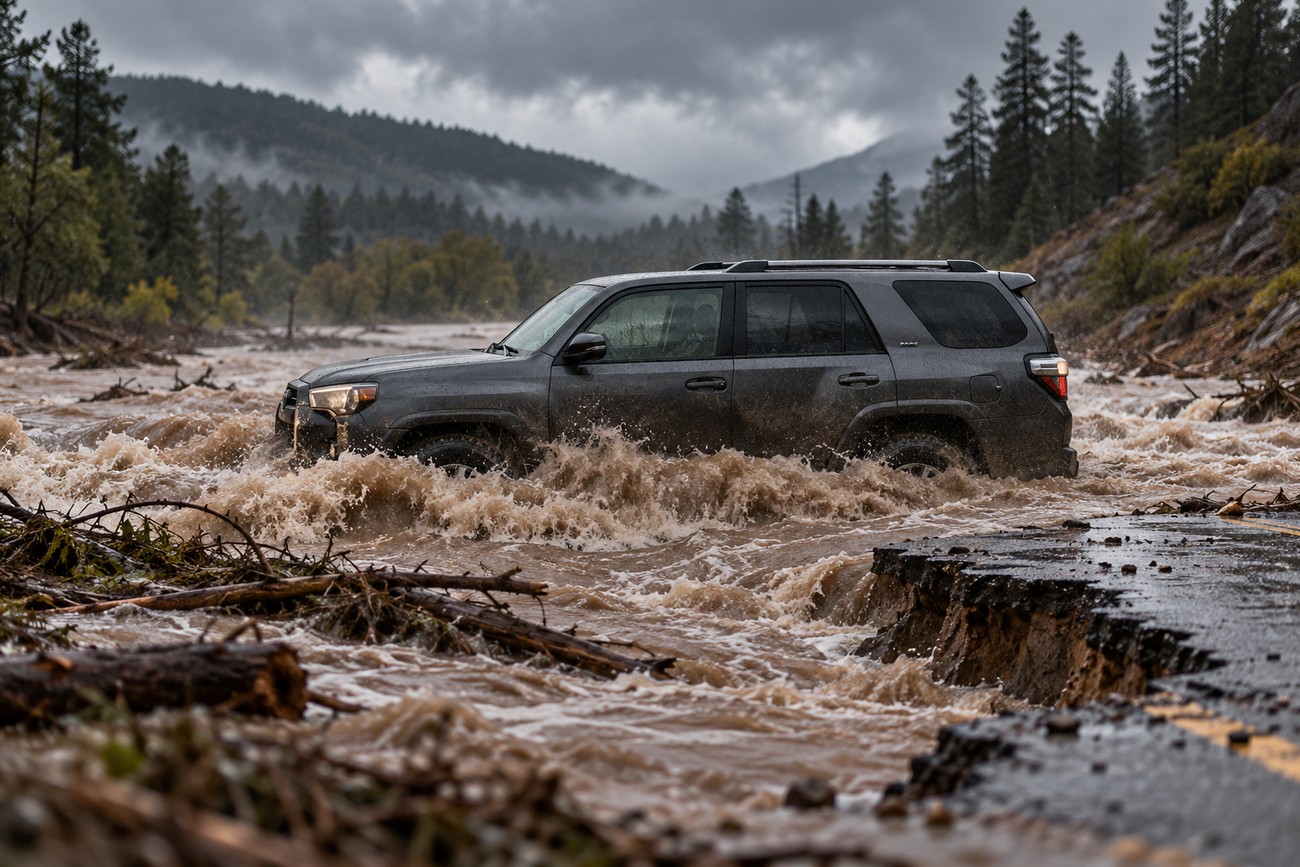
Four-wheel drive and locking differentials can improve tire traction when the tires remain firmly loaded against the ground. They cannot neutralize lateral current, slippery silt, hidden washouts, or debris impact. In floodwater, the main failure may be loss of vehicle stability rather than a lack of engine power.
At approximately 0.5–1 m/s, current at depths above the knee can knock a person down and shift a crossover or light SUV. A 4Runner is heavier than many vehicles, yet its broad side still presents an area for water to push against. Weight can increase the force required to move the vehicle while also increasing loads on tires, suspension components, and recovery points.
Ground clearance offers a similar false sense of security. Larger tires and a suspension lift may raise vulnerable components, but a lifted vehicle can also carry a higher center of gravity. Sideways flow on a sloping or damaged road increases rollover exposure, especially when one side drops into a hidden channel.
Direction matters in ordinary water crossings: facing the flow is generally more stable than exposing the vehicle broadside. Flash-flood roads rarely provide a controlled approach, and the current may change direction around vehicles, barriers, and road edges. That uncertainty is why drivetrain upgrades should never be treated as flood protection.
How a Flash Flood Damages a 4Runner
Water entering the intake can cause hydrolock, in which incompressible water prevents normal piston movement and can cause severe engine damage. The risk does not begin only when the intake is visibly submerged. A wave, splash, or uneven section of road can send water into the stock intake while the apparent water depth still seems manageable.
Debris creates a second failure path. Rocks and branches can puncture the radiator, damage suspension arms, cut a tire sidewall, or strike underbody components. Mud can pack around brakes and wheel assemblies, while a hidden hole can impose a sharp load on a control arm or other suspension part.
Floodwater also reaches components that appear protected from the driver’s seat. ABS and stability-control sensors, electrical connectors, and control modules may fail immediately or develop corrosion later. Dirty water is especially troublesome because mud and contaminants remain in connectors, bearings, and underbody cavities after the visible water has gone.
A vehicle may drive away and still carry substantial damage. Wet carpets can retain odor, wiring can corrode, and bearings or joints can begin making noise days or weeks later. A dashboard warning that appears after the event may be the first sign of a problem that started during the crossing.
Flood damage can therefore cost more than an obvious engine failure. A successful exit proves only that the vehicle reached the other side; it does not prove that the air intake, fluids, brakes, sensors, bearings, or electrical system remained unaffected.
The Mistakes That Turn a Risk Into a Recovery
Driving faster to “make a bow wave” is a common off-road technique applied in the wrong setting. Extra speed creates splash, can push water toward the intake, and reduces the time available to respond to a rut or drifting vehicle. A controlled, slow crossing is one thing; accelerating into uncertain floodwater is an escalation of risk.
Judging only depth ignores the variables that matter most. Silt-covered asphalt can provide little grip even in modest water, and a road edge may have already collapsed beneath the surface. A visible lane or apparently shallow section does not show whether the bottom is stable, whether the current is strengthening, or whether debris is approaching.
Online videos provide poor evidence for a current decision. They may show a different water level, a different bottom, or a vehicle with modifications that do not remove the underlying hazard. Even a vehicle that crossed moments earlier does not establish that the route remains safe, because flash-flood conditions can change within minutes.
If the 4Runner begins to float, drift, lose steering response, or move sideways, continuing is unlikely to restore control. Avoid abrupt inputs, and do not attempt to outrun the current. “Turn Around, Don’t Drown” applies regardless of vehicle size, tires, drivetrain, or body construction.
What to Do Instead—and What to Check After Water Exposure
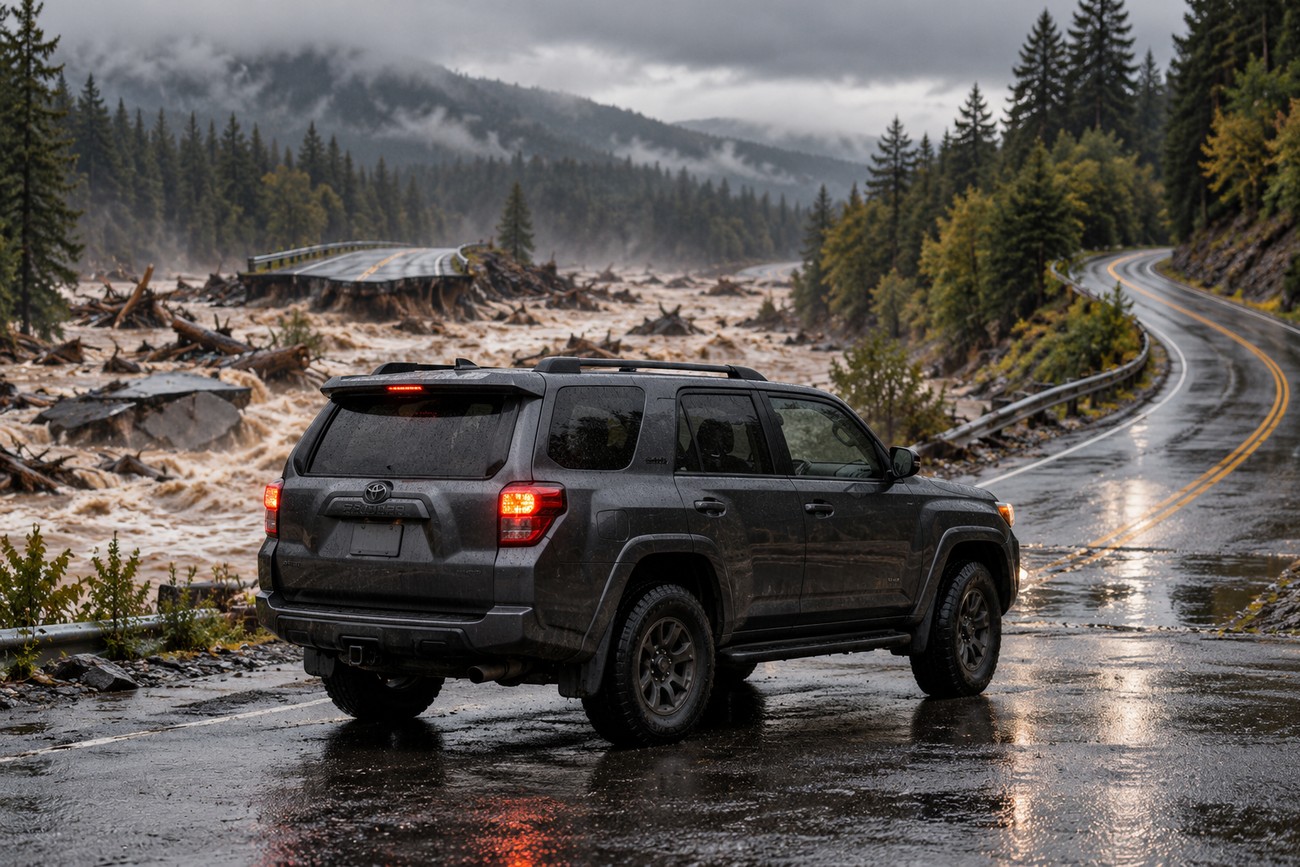
Stop before the water and assess whether a stable retreat is available. Reverse or turn around only where the surface is firm enough to support the maneuver, and avoid driving onto a soft shoulder or weakened road edge. If there is any doubt, wait in a safe location or take an alternate route rather than testing the water.
No snorkel, lift, tire, or locking differential makes a flash flood safe to cross. A snorkel may raise the intake opening, but it does not protect against lateral force, loss of traction, rollover, road collapse, or debris. Flood avoidance remains the only reliable strategy.
If water has already reached the vehicle, do not restart an engine that may have taken in water. Arrange a professional inspection of the intake and air box before starting it, and have the engine oil, transmission and axle fluids, brakes, bearings, electrical connectors, sensors, and underbody checked as appropriate.
Inspection should include mud and debris trapped behind shields, around brakes, and in suspension or bearing areas. A vehicle that feels normal immediately afterward can still develop corrosion or electrical faults later. Keep records of the exposure and any inspection, because delayed symptoms may be difficult to connect to the original event.
Insurance treatment varies by policy and circumstances. Claims can be disputed when a driver deliberately enters a flooded road, so review the relevant policy terms and contact the insurer promptly after an incident. That financial uncertainty is another reason to avoid treating a capable SUV as permission to cross.
Frequently asked questions
The key distinction in every answer is the difference between slow, shallow water with a visible, stable bottom and rapidly moving, muddy floodwater.
How deep can a 4Runner drive through?
A commonly cited static-wading range for many SUVs, including the 4Runner, is approximately 500–700 mm under very limited conditions. It assumes very low speed, little or no current, and a known, stable bottom that can be seen. It should not be used as a personal flood-crossing target or as a flash-flood safety rating.
The stock intake remains vulnerable to splashes and waves, and water around or above the center of a wheel on uneven ground can create intake risk. Toyota guidance generally favors slow water with a visible bottom and warns against fast water.
What is the best SUV to buy in a flooded area?
No SUV makes moving floodwater safe. A capable vehicle may offer useful clearance and traction on ordinary wet roads, yet route planning, flood alerts, visibility, and the willingness to avoid water matter more than drivetrain or body style.
For flood-prone areas, prioritize reliable warning information, safe alternate routes, and parking above known flood levels. Vehicle capability should help you leave a hazard early, rather than encourage entry into one.
What year 4Runner should you stay away from?
There is no single 4Runner model year that removes flash-flood risk. Flood history and vehicle condition matter more than choosing a particular year, especially because water damage can affect electrical systems and structural components across model generations.
Before buying, check for corrosion, damp or persistent odors, electrical faults, damaged connectors, aftermarket modifications, and complete maintenance records. A clean history and careful inspection are more useful indicators than the model year alone.
How much water can move a car during a flash flood?
Fast-moving water only 6–12 inches, or approximately 15–30 cm, deep can remove vehicle traction. A current of approximately 0.5–1 m/s at depths above the knee can also knock a person down and shift a crossover or light SUV.
A vehicle may begin sliding or floating before water reaches the cabin or hood because force acts on the tires, underbody, and side panels. Water level and current strength can change within minutes, so a prior successful crossing is not evidence that the route remains safe.







