
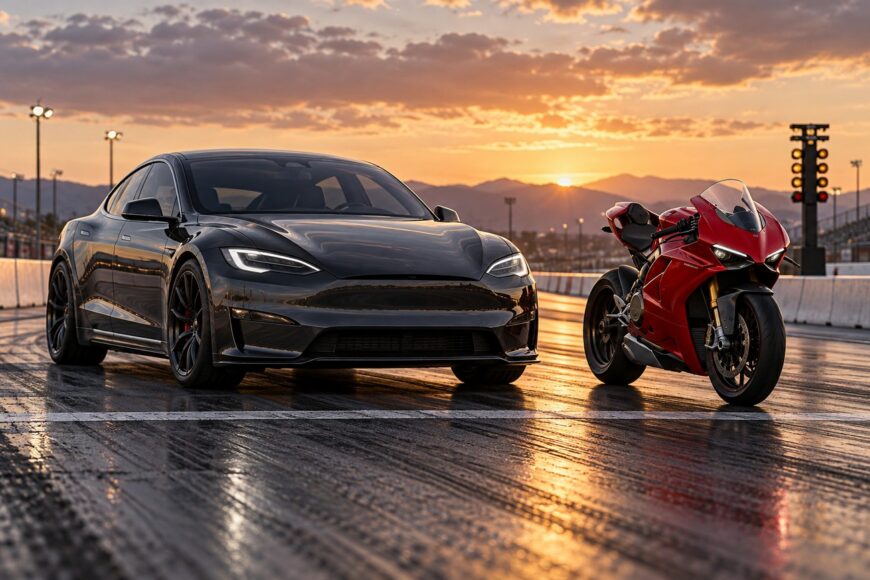
A heavy four-door Tesla Model S Plaid can challenge a lightweight Ducati because all-wheel drive and automated torque delivery change the launch. The car can apply its power through four driven contact patches with little input from the driver, while the motorcycle must manage one driven tire, a rising front wheel, clutch release, and gear changes.
The answer depends on which Ducati is involved, how far the vehicles run, and how the test is conducted. A Panigale V4, V4 S, Streetfighter V4, and V4 R are different motorcycles, while a prepared launch, a rolling start, and a circuit place different demands on each vehicle.
The useful comparison is elapsed time over an identical distance under repeatable conditions. Peak horsepower alone cannot establish a universal winner.
- Tesla Model S Plaid vs Ducati Panigale V4: The Numbers That Matter
- Who Wins the Launch?
- Why the 1.99-Second Tesla Claim Is Not Every Run
- When the Ducati’s Lower Mass Starts to Matter
- How to Run a Fair Tesla-versus-Ducati Test
- Frequently asked questions
- What can beat a Tesla Model S Plaid?
- Which Ducati should be compared with a Model S Plaid?
Tesla Model S Plaid vs Ducati Panigale V4: The Numbers That Matter
The basic specifications explain why the comparison is close at the start, although the figures come from different markets and test standards. They should be treated as reference points rather than as one unified performance test.
| Item | Tesla Model S Plaid | Ducati Panigale V4 | Qualification |
|---|---|---|---|
| Powertrain | Three electric motors, all-wheel drive | 1,103 cc internal-combustion V4 | Different methods of producing and transmitting power |
| Acceleration reference | 0–60 mph in 1.99 seconds | Approximately 3.3 seconds to 100 km/h in published measurements | Tesla figure includes rollout and favorable prepared conditions; Ducati figure is test-dependent |
| Quarter mile | Not specified here | Approximately 10.1 seconds in published measurements | Not a universal official Ducati standard |
| Engine output | Electric-motor output is not directly comparable by peak horsepower alone | 209 hp at 12,750 rpm and 121.3 Nm at 11,250 rpm for the U. S. market | European Panigale V4 output is stated at 216 hp |
| Transmission | Single-speed electric drive | Six-speed gearbox with up/down quickshifter | Gear selection and shift timing affect the motorcycle result |
| Mass | Heavy four-door sedan | Approximately 191 kg with fluids excluding fuel; V4 S approximately 187 kg | Ducati figures vary by market and equipment |
Tesla’s official reference is 0–60 mph in 1.99 seconds, with rollout and suitable conditions. That qualification matters because rollout removes part of the initial movement from the measured time, while battery temperature, charge level, and launch preparation influence whether the car can reproduce the figure.
The Panigale V4 combines a 1,103 cc engine with a six-speed gearbox and an up/down quickshifter. Its published output is 209 hp and 121.3 Nm for the U. S. market, while the European version is stated at 216 hp. The motorcycle’s approximate mass is 191 kg with fluids excluding fuel, or approximately 187 kg for the V4 S, depending on market and equipment.
Who Wins the Launch?
In a standing-start drag, the Plaid usually has the more repeatable result. All-wheel drive gives it more opportunities to use available grip, and automated torque control can manage wheel slip without requiring the driver to coordinate a clutch, throttle, and gear change. That advantage matters most over the first few seconds.
The Ducati has a narrower operating window. Its launch depends on rear-tire grip, clutch release, wheelie control, traction control, rider reaction, and the timing of each shift. Too much torque can cause spin or lift the front wheel; too much electronic intervention or an early shift can also cost time.
Testers should stabilize motorcycle tire temperature and electronics settings before repeating launches, then check whether the Tesla has reached its usable battery-temperature window. Without that preparation, the two vehicles are being compared as much on readiness as on performance.
Published Panigale V4 measurements include approximately 3.3 seconds to 100 km/h and 10.1 seconds for the quarter mile. Those figures are useful reference points, yet they are not a universal official Ducati performance standard. Version, surface, weather, rider technique, and test equipment can change the result substantially.
A clean motorcycle launch can narrow the gap or alter the outcome, especially if the Tesla is outside its preferred battery conditions. A poor motorcycle launch can decide the run before the Ducati reaches its strongest acceleration range. For a short drag from rest, the Plaid more often has the advantage because it converts available traction with less dependence on human timing.
Why the 1.99-Second Tesla Claim Is Not Every Run
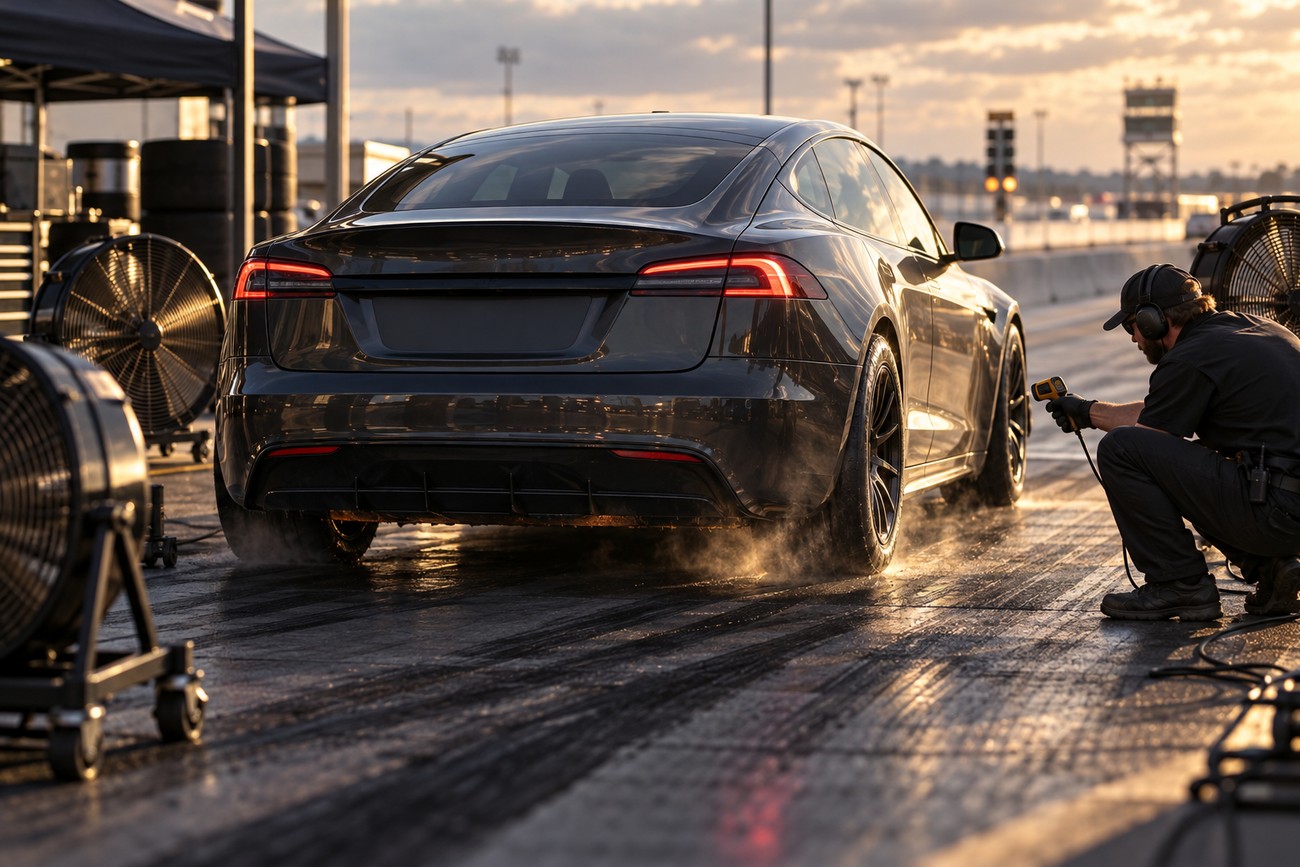
The 1.99-second Plaid figure assumes rollout and favorable prepared conditions. Battery temperature, sufficient charge, and correct launch preparation all affect the car’s ability to deliver its strongest acceleration. A car that has been driven gently in cold conditions may produce a different result from one prepared specifically for a performance run.
Repeated launches introduce another limitation: heat. The battery and power electronics can become hotter after successive runs, and acceleration can slow as thermal conditions move away from the ideal window. This gives the Tesla a repeatability advantage over a motorcycle launch in general, while also preventing the 1.99-second figure from being treated as an ordinary result for every attempt.
Launch preparation therefore belongs in the test record. The tester should note the battery’s state of charge, the preparation mode used, the surface condition, and the time between runs. Without those details, two apparently similar Plaid results may represent different operating conditions.
Full Launch Mode is also poorly suited to ordinary public roads. The surface, traffic, legal environment, and lack of controlled runoff make a public-road launch neither a reliable benchmark nor a responsible way to settle the comparison. A closed course provides safer conditions and allows both vehicles to be tested repeatedly.
When the Ducati’s Lower Mass Starts to Matter
The launch is only one part of performance. Once braking, direction changes, and corners enter the test, the Plaid’s high mass can become a disadvantage. More mass places greater demand on the brakes and tires, and it makes rapid changes of direction harder on a technical course.
A Panigale V4 carries far less mass, so a skilled rider can reduce losses under braking and through corners. The motorcycle can also change direction with less resistance, allowing it to recover time that it may have lost during the initial acceleration. That advantage depends on rider accuracy, tire condition, and a circuit that actually rewards braking and agility.
High-speed results introduce further variables. Gearing, aerodynamics, speed limiting, battery charge, fuel, tire temperature, and powertrain temperature can all affect the outcome. A short standing-start drag measures traction and launch control; a circuit race measures braking stability, corner entry, direction changes, and exit speed.
The Plaid can remain competitive over a longer straight, especially if the motorcycle rider loses time during shifts or traction management. A skilled Panigale rider can gain ground on a technical layout, but lower mass does not guarantee victory. The selected distance and course determine which vehicle’s strengths matter most.
How to Run a Fair Tesla-versus-Ducati Test
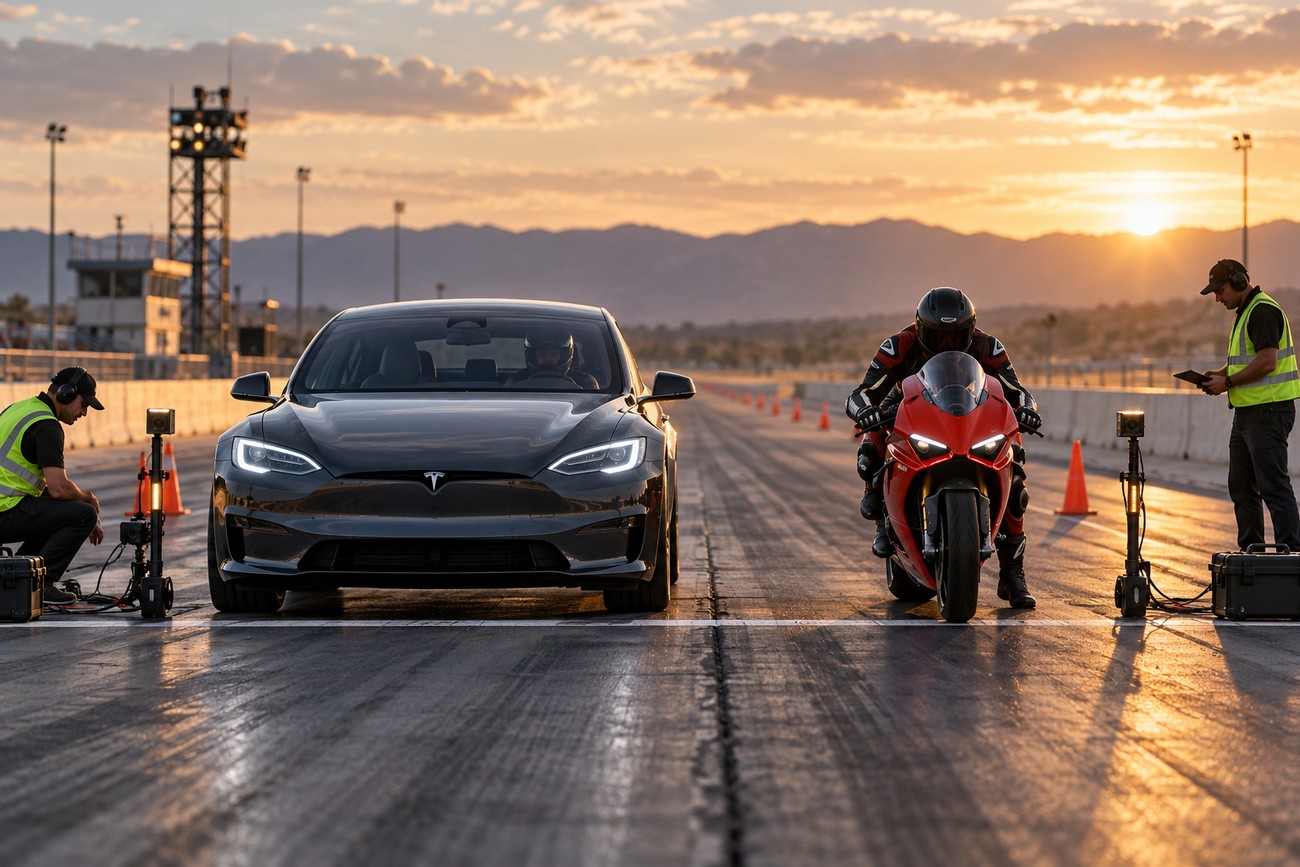
Start by identifying the exact motorcycle. Panigale V4, V4 S, Streetfighter V4, and V4 R should not be treated as interchangeable, because their specifications, equipment, and intended use differ. The Tesla should also be recorded with its battery condition and launch preparation stated clearly.
Choose one format before testing. Suitable options include 0–60 mph, 0–100 km/h, 402 meters, 1 kilometer, or a roll race from the same starting speed. A standing start favors traction management, while a roll race reduces the influence of clutch release and initial wheel lift.
Use the same surface and direction where possible, and record gradient, temperature, wind, battery charge, fuel level, tire temperature, and rider mass. The Ducati’s electronics settings and the Tesla’s preparation should remain consistent between runs. These details connect the measured time to a condition that another tester can understand.
Repeat the test rather than relying on one pass. A motorcycle launch error can decide the outcome, while repeated Plaid runs may slow as the battery and power electronics heat up. The test should take place on a closed course with suitable safety controls, rather than on a public road.
- Confirm the exact Ducati variant and equipment.
- Define the distance, start method, and timing standard.
- Bring both vehicles to consistent tire, battery, fuel, and powertrain conditions.
- Run multiple passes in each direction where the course allows it.
- Report the complete conditions alongside the best and repeatable results.
Frequently asked questions
What can beat a Tesla Model S Plaid?
A vehicle from another category, or a motorcycle in a longer or more technical test, can produce a faster result when the distance, launch method, and conditions are held constant. A standing-start sprint may favor the Plaid’s all-wheel-drive traction, while a circuit can reward lower mass, stronger braking performance, and rapid direction changes.
The comparison should therefore use elapsed time over the same distance. A faster result only has meaning when both vehicles start under the same rules and the test records battery, tire, weather, and surface conditions.
Which Ducati should be compared with a Model S Plaid?
The Panigale V4 is the clearest reference if the comparison is specifically about the Panigale V4. The V4 S, Streetfighter V4, and V4 R have different specifications and equipment, so their results cannot be transferred to the standard V4 without qualification.
The choice also depends on the test. A fully faired Panigale may suit a high-speed comparison, while a Streetfighter V4 represents a different aerodynamic and riding configuration. Naming the exact variant prevents one Ducati specification sheet from being applied to the entire range.







