
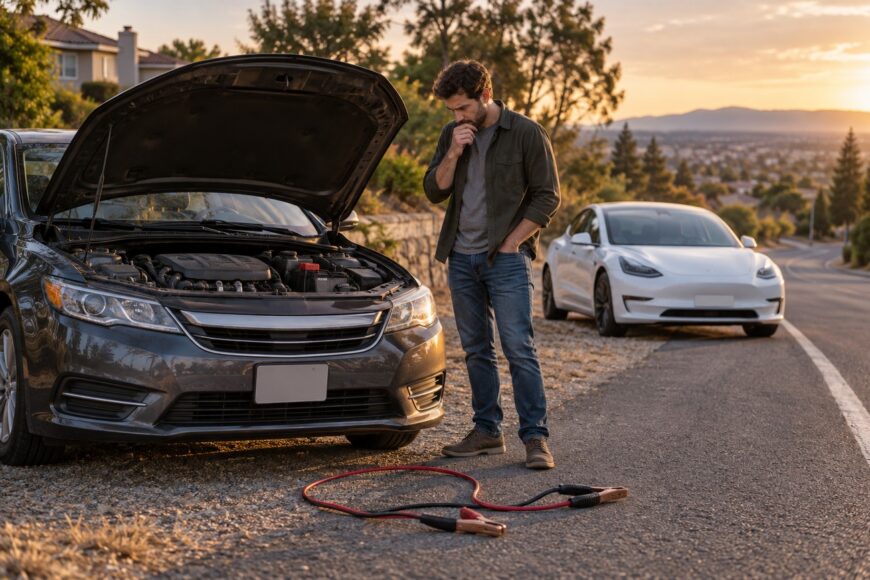
Some owners report that a gas car started through a Tesla’s low-voltage system. Tesla does not approve using its vehicles as donors and warns that doing so may cause damage. The high-voltage traction battery is not a permitted direct source for starting a gas car’s 12-volt electrical system.
That makes the practical decision straightforward: avoid using a Tesla as a jump-start vehicle when a separate portable 12-volt booster or roadside service is available. A one-time successful start does not prove that the Tesla’s low-voltage electronics, battery, or DC/DC converter were protected.
- Can a Tesla Jump-Start a Gas Car?
- Why Tesla’s High-Voltage Battery Is Not a Jump-Start Battery
- The Safer Way to Help a Gas Car With a Dead Battery
- Common Mistakes and the Damage You May Not See Immediately
- What Tesla’s Manual Does Allow in an Emergency
- Frequently asked questions
- What should I do if I already connected a Tesla to the gas car?
- Why might a gas car still not start with a proper portable jump starter?
- How do I use my Tesla to jump-start another car?
Can a Tesla Jump-Start a Gas Car?
A gas car may sometimes respond when connected through a Tesla’s low-voltage circuit. Reports of this happening describe physical possibility in a particular vehicle, with a particular battery condition, and under particular connection conditions. They do not establish a manufacturer-approved method.
Tesla warns against using the vehicle to start another vehicle because damage may result. The warning applies even if the gas car appears to need only a small amount of assistance or the Tesla’s battery seems to have ample energy available.
The high-voltage traction battery does not provide a direct, permitted jump-start source for a 12-volt gas-car system. Tesla’s accessible service connections, where provided, belong to the vehicle’s low-voltage architecture. They should not be treated as an outlet for the traction battery.
Physical success and safe use are separate conclusions. A gas engine that starts may still leave the Tesla with damage that appears later, including problems in low-voltage electronics or related power-conversion equipment. Tesla therefore provides no universal donor-start procedure for using a Tesla to start another car.
Why Tesla’s High-Voltage Battery Is Not a Jump-Start Battery
A Tesla has a high-voltage traction battery for propulsion and a separate low-voltage system for vehicle electronics and other functions. The low-voltage battery type, access points, and overall configuration vary by model and year. That variation makes general instructions from another Tesla unreliable.
The traction battery is managed through dedicated high-voltage components, protective switching, and power-conversion equipment. It is not connected directly to ordinary 12-volt terminals for donor starting. Trying to reach that energy by removing covers, probing components, or improvising cables creates a serious electrical hazard.
Some under-hood connection points may be service points for the low-voltage system rather than the battery’s direct terminals. Their presence does not authorize external jump-starting of another vehicle. Battery capacity also does not equal guaranteed starter capability: the ability to store energy says little about how a system will tolerate a starter’s demand, reverse current, or voltage transients.
High-voltage components should be left to appropriately trained technicians. A roadside jump-start is a 12-volt service task, and bypassing the Tesla’s designed electrical architecture can expose both vehicles to avoidable damage.
The Safer Way to Help a Gas Car With a Dead Battery
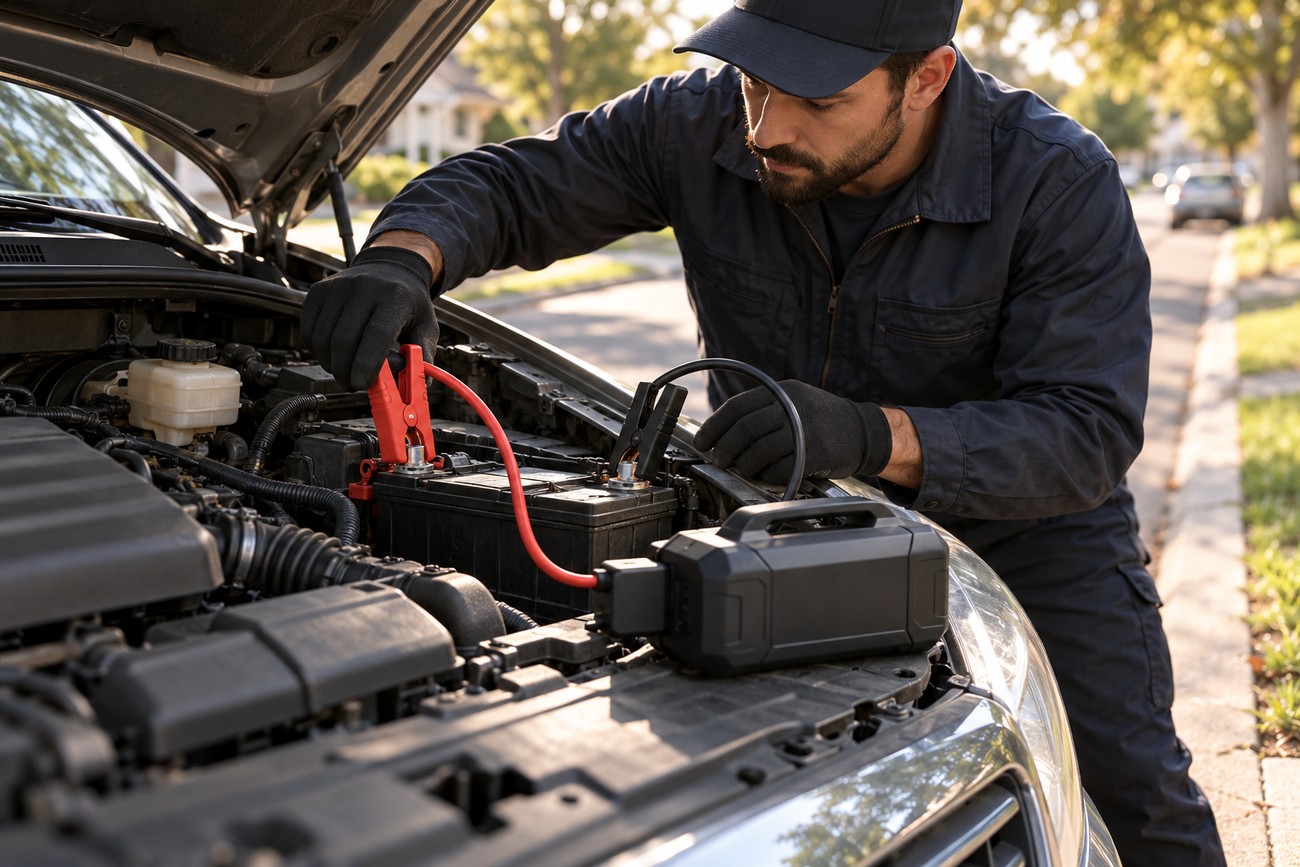
Use a dedicated portable 12-volt booster, roadside assistance, or a suitable conventional donor vehicle approved for jump-starting under its manufacturer’s instructions. These options are designed for the electrical demands of a 12-volt starting system and avoid placing the Tesla’s low-voltage hardware in an unapproved role.
Before attempting any jump, confirm that the booster matches the gas car’s system and that the connection points are clean and correctly identified. A severely discharged or damaged battery may still fail to crank the engine after an external source is connected. In that situation, waiting longer does not repair the battery or resolve another starting fault.
Repeated attempts can add electrical load without improving the result. Stop if the cables, terminals, or booster become hot, the vehicle produces unusual warnings, or the engine does not respond after a proper attempt. A technician can then test the battery, connections, starter, and charging system rather than relying on increasingly long cranking attempts.
Common Mistakes and the Damage You May Not See Immediately
The most important hidden risk is that a successful engine start does not prove that the Tesla was unharmed. Reverse current or voltage spikes can affect the Tesla’s low-voltage electronics, battery, DC/DC converter, and control systems. Symptoms may appear after the vehicles have been disconnected and driven, rather than at the roadside.
Another error is choosing a ground point by appearance. Tesla’s approved procedures for powering the Tesla itself identify a specific positive post and factory-specified ground point. Arbitrary body metal, an unsuitable fastener, or a high-voltage component is not an acceptable substitute.
Starting the gas engine while the vehicles remain connected can increase transient electrical stress. Leaving cables attached after the engine starts creates additional opportunity for an unstable electrical event. If a connection has already been made, avoid further start attempts and seek assistance rather than experimenting with longer connection times.
Online advice often recommends leaving cables connected for 20–30 minutes before trying the gas car. That is user-generated guidance, not a Tesla-approved donor-start procedure. Time does not change Tesla’s manufacturer position or remove the possibility of damage to the low-voltage system.
Do not connect to high-voltage components or try to draw propulsion-battery energy directly. The traction battery’s voltage, isolation requirements, and protective systems are outside the scope of an emergency 12-volt jump-start. A dedicated booster is a safer tool for the disabled gas car.
What Tesla’s Manual Does Allow in an Emergency
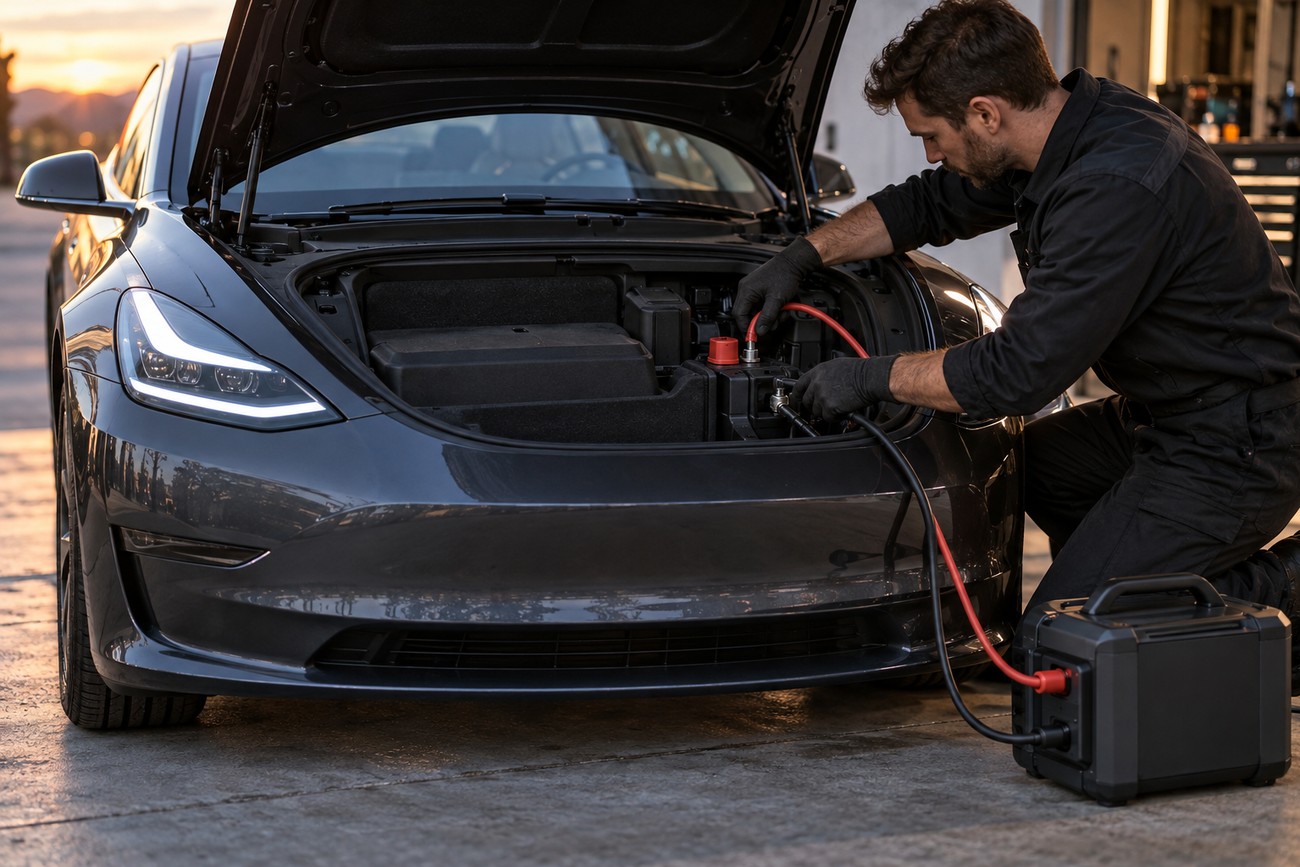
Tesla manuals provide model-specific procedures for using an external low-voltage source to help power the Tesla itself. This can be necessary when the Tesla’s low-voltage system cannot release certain vehicle functions or provide normal access. The procedure is for rescuing the Tesla, not for making it a donor vehicle.
For that task, use only the designated positive post and the factory-specified ground point described in the manual for the applicable model and year. Do not generalize the location from one Tesla to another. The battery arrangement and access method may differ, and some visible points may serve a specific service function.
Cybertruck permits an external source of at least 12 volts for its own emergency power-up. It still prohibits using the Cybertruck to start another vehicle. This illustrates the central distinction: an external source may be used in a manufacturer-described rescue procedure, while the Tesla remains unsuitable as a donor.
If the correct manual is unavailable, roadside assistance is the prudent choice. A technician can identify the proper low-voltage points without touching high-voltage components or assuming that another model’s procedure applies.
Frequently asked questions
What should I do if I already connected a Tesla to the gas car?
Stop further starting attempts and disconnect the vehicles using a safe procedure appropriate to the equipment and connection. Check both vehicles for warning messages, unusual electrical behavior, hot cables, or signs of a damaged terminal. Do not reconnect the Tesla to try a longer wait or another starting attempt.
If the Tesla shows warnings, loses normal functions, or behaves unusually, arrange professional assistance. Even without an immediate symptom, tell the technician that the Tesla was used as a donor so the low-voltage system and related electronics can be assessed.
Why might a gas car still not start with a proper portable jump starter?
A failed jump may indicate a failed or deeply discharged battery, poor terminal contact, a faulty starter, or another engine or electrical problem. The booster may also be unsuitable, incorrectly connected, or unable to provide the required support for that vehicle.
Waiting longer does not distinguish these faults reliably. Stop repeated attempts and have the battery, connections, starter circuit, and charging system tested. A jump-start can provide temporary power, but it cannot repair the underlying fault.
How do I use my Tesla to jump-start another car?
You should not use a Tesla to jump-start another car. Tesla does not provide a manufacturer-approved Tesla-to-gas-car donor procedure and warns that using the vehicle this way may cause damage.
Use a dedicated portable 12-volt booster or call roadside assistance instead. Tesla’s manual-based external-power procedures are intended to help power the Tesla itself and must not be repurposed for starting another vehicle.







