
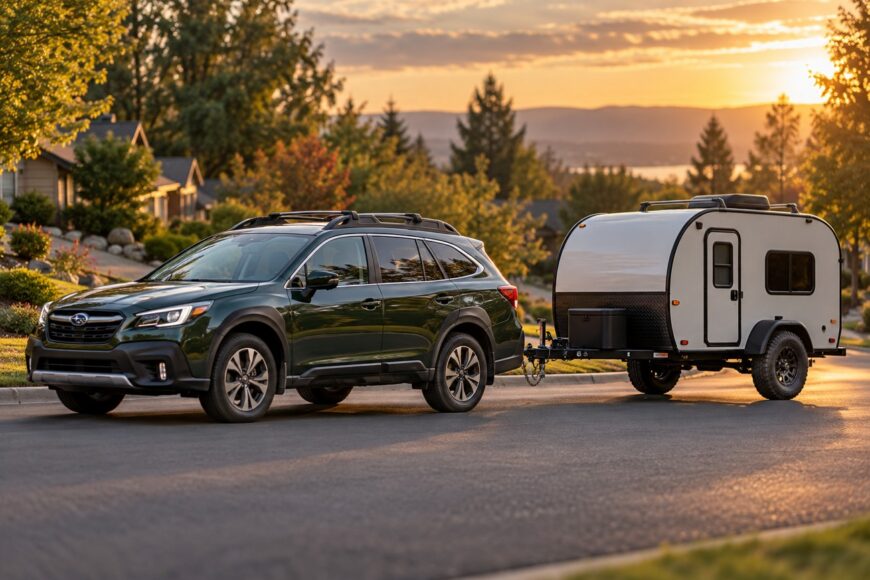
Yes, a Subaru Outback can tow a small camper, but the safe answer depends on the exact generation, market, powertrain, trailer brakes, loaded weight, and tongue load. The number printed on a hitch label or a reassuring owner anecdote cannot establish whether a particular camper is suitable.
A defensible decision starts with the vehicle’s specifications and the camper’s actual traveling mass. You also need enough allowance for braking, sway, hills, crosswinds, and overtaking, because a trailer can be legally permitted and still leave too little control or performance reserve for your route.
- Subaru Outback towing limits by version: why one number is misleading
- What size camper can a Subaru Outback really pull?
- Why a legal towing weight can still feel too heavy
- The towing setup that keeps a small camper stable
- The mistakes that make Outback towing unsafe
- A practical go-or-no-go check before buying the camper
- Frequently asked questions
- Which Subaru model is best for towing a camper?
- What size camper can a Subaru Outback pull?
- What are some small campers that are suitable for a Subaru Outback?
Subaru Outback towing limits by version: why one number is misleading
Materials for different Outback versions report braked-trailer limits of 1,200 kg, 1,500 kg, 2,000 kg, and 2,100 kg. These figures are not interchangeable: the exact owner manual, market, generation, powertrain, trailer type, and equipment determine the applicable limit.
| Reported braked-trailer limit | How to interpret it |
|---|---|
| 1,200 kg | Applies to some Outback versions and must be checked against the exact vehicle documentation. |
| 1,500 kg | Reported for some versions; additional stability requirements may apply above this weight. |
| 2,000 kg | Reported for some versions, but a hitch carrying this rating does not give every Outback the same capacity. |
| 2,100 kg | Reported for some versions and markets; it is not a universal Outback rating. |
The fully loaded trailer must not exceed the limit for the exact Outback version, model year, market, and equipment. That limit may also distinguish between braked and unbaked trailers, so a generic maximum towing claim is insufficient for a camper purchase.
What size camper can a Subaru Outback really pull?
A camper’s dry weight is only the starting point. Water, gas, luggage, batteries, cooking equipment, bicycles, spare wheels, and other accessories increase the mass before departure, and the final figure can move a seemingly suitable trailer beyond the vehicle’s permitted limit.
Use the camper’s actual traveling mass for the comparison. Weigh the trailer in the condition in which you intend to tow it, or calculate every item that will remain aboard. Around 1 tonne is commonly reported as practical by owners, but it is not a universal recommendation or certification for every Outback.
Tongue load deserves a separate check because it affects both the hitch and the vehicle’s axle loading. Depending on the Outback version and hitch kit, the permitted vertical ball load may be about 75 kg or 130 kg. A camper can meet its total trailer-weight limit while still exceeding the allowable load on the ball.
A compact, lightly equipped camper with a measured loaded mass comfortably below the vehicle limit is usually a more sensible match than a larger trailer operated at the edge of its allowance. The calculation should include the load distribution inside the camper, since adding heavy items behind the axle can reduce tongue load and encourage sway.
Why a legal towing weight can still feel too heavy
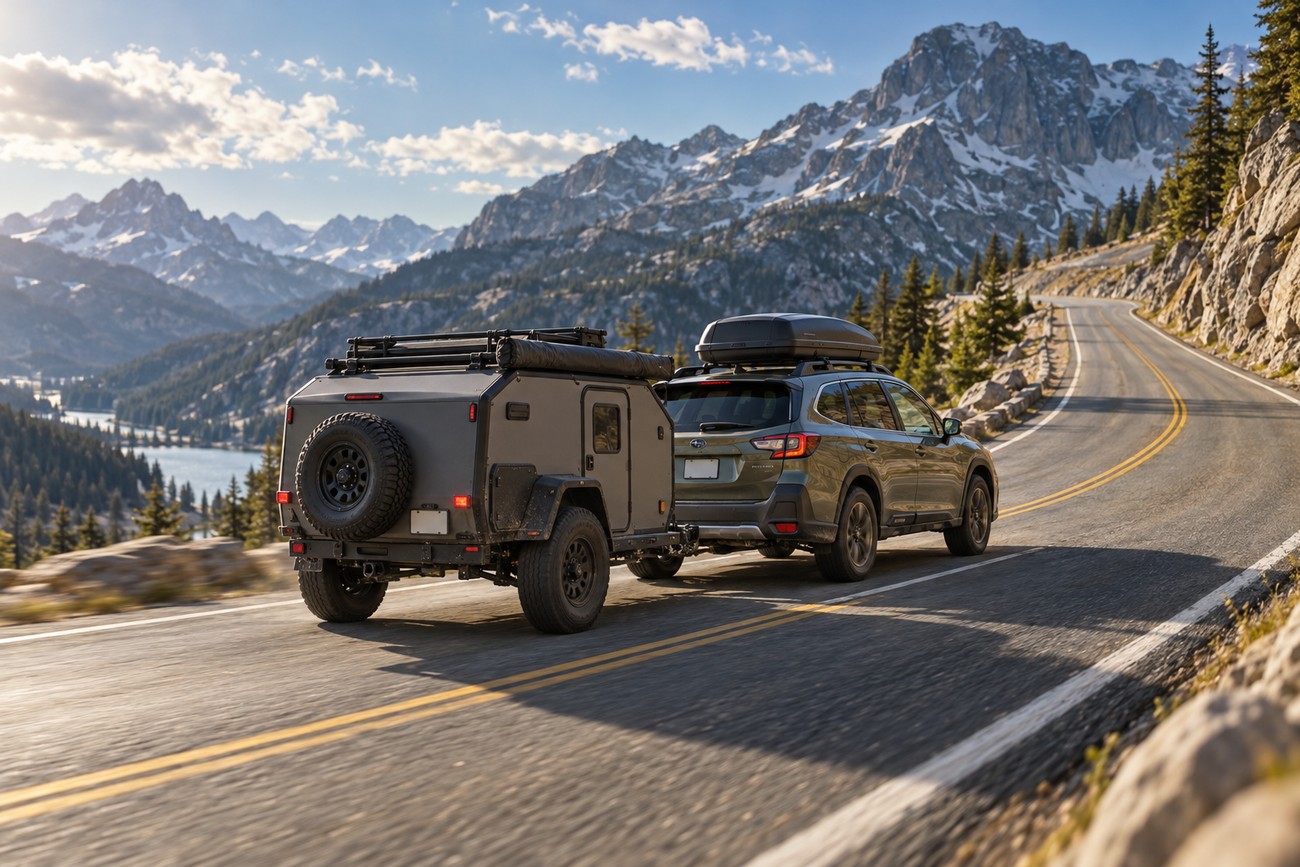
Formal capacity and comfortable towing are separate judgments. Some Russian-market Outback specifications list approximately 186–188 hp and 245–254 N·m of torque, figures that can leave a modest performance reserve with a loaded camper on long climbs or during an overtake.
Drivers commonly notice higher fuel consumption when towing, especially at highway speed and in mountainous terrain. Climbs may require earlier planning, and an overtake that feels routine without a trailer can demand more distance and a clearer speed margin with one attached.
AWD improves launch traction on slippery surfaces, which helps when moving away from a wet campsite or a loose-gravel slope. It does not increase the vehicle’s towing, braking, tongue-load, or stability limits, and it cannot prevent a heavy trailer from pushing the car during a descent.
Long downhill sections and crosswinds expose the difference between “can move it” and “can control it comfortably.” A setup near the formal limit may be workable on a calm, flat route yet tiring and less forgiving on a mountainous highway.
The towing setup that keeps a small camper stable
Trailer brakes should work correctly and be matched to the trailer and vehicle requirements. Before a trip, inspect the coupling, safety chains, electrical connection, tires, wheel fasteners, and breakaway equipment where fitted. Correct weight distribution matters because a small error can become noticeable at speed.
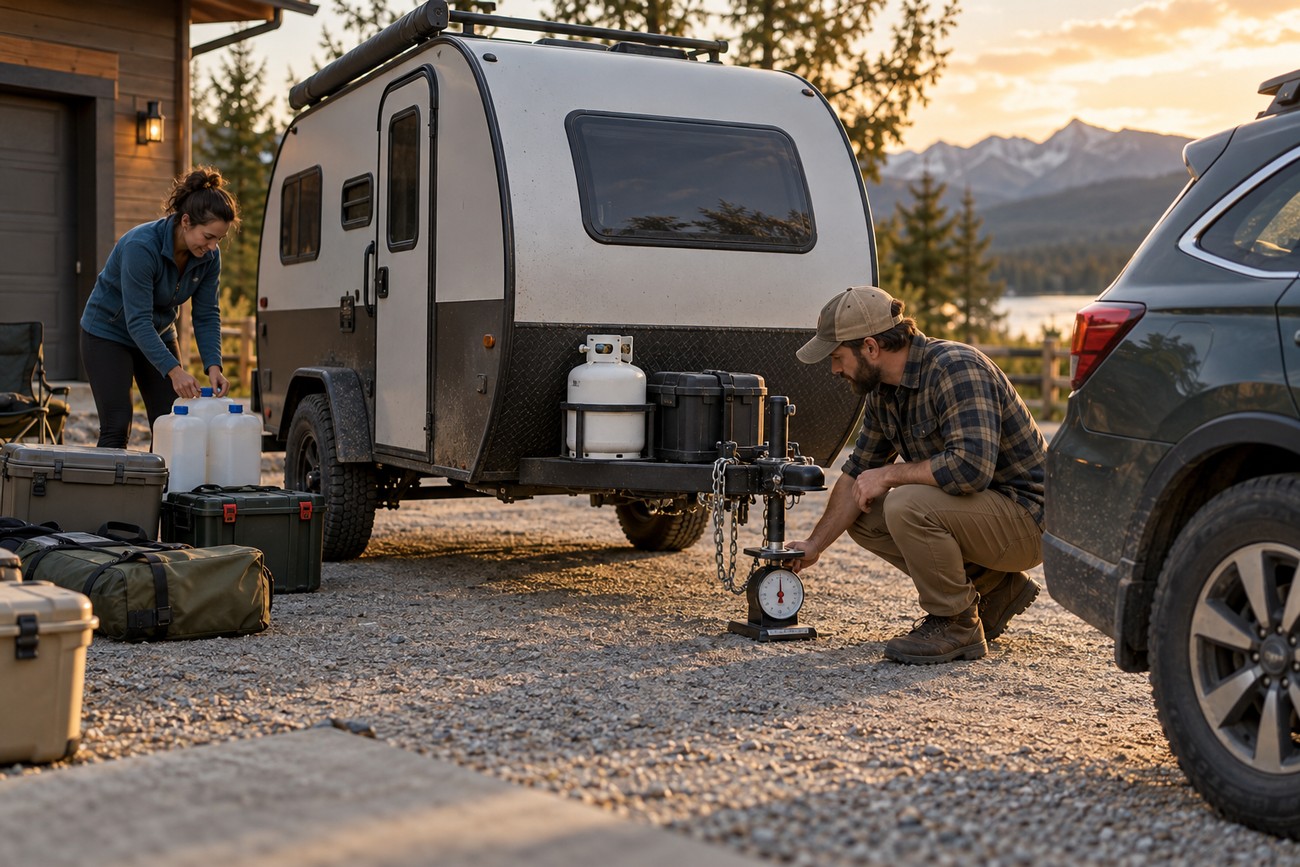
Measure the actual tongue load after the camper is packed, rather than relying on its dry specification. Keep heavy cargo low and close to the axle area, while avoiding a rear-heavy arrangement that can make the trailer yaw or sway. The measured load must remain within both the vehicle and hitch-kit limits, which may be about 75 kg or 130 kg.
Actual tongue-load measurement reveals problems that a dry-weight sheet and a hitch’s headline rating can hide. Packing changes the result, so the check belongs after loading the camper for travel.
Some Subaru manuals state that a stabilizer or anti-sway device may be required for trailers above 1,500 kg. Some versions and hitch combinations also specify a maximum train speed of 80 km/h. Treat both points as version- and equipment-specific instructions, then follow the documentation that applies to your vehicle and tow hitch combination.
Installation details affect the purchase decision as well. Some Outback hitch installations require cutting or trimming the bumper, and the wiring or mounting arrangement may vary by kit. Confirm the installation method, vertical load rating, electrical compatibility, and any speed or stability conditions before buying the camper or hitch.
The mistakes that make Outback towing unsafe
The first error is taking the hitch advertisement as the vehicle’s towing approval. A hitch rated for 2,000 kg does not automatically make every Outback a 2,000 kg tow vehicle; the owner manual and vehicle-specific specifications take priority.
The second error is comparing the vehicle limit with the camper’s empty weight. The loaded trailer mass includes water, gas, luggage, batteries, accessories, and other cargo. Tongue load must then be checked separately because it can exceed the hitch or vehicle allowance even when the total trailer mass appears acceptable.
The third error is treating “it can pull it” as proof of a safe setup. Missing or poorly adjusted trailer brakes, unsuitable weight distribution, excessive speed, or ignored sway-control requirements can allow the trailer to push, yaw, or sway, especially on descents and in crosswinds.
Owner experience can provide a useful reference, including reports of towing around 1 tonne, but it is not certification. Conditions, loading, route, speed, and vehicle specification differ, so regular towing should be based on documented limits and a controlled setup rather than anecdotal success.
A practical go-or-no-go check before buying the camper
Start by identifying the exact Outback generation, model year, market, powertrain, and equipment. Read the vehicle manual and vehicle-specific specifications for the braked-trailer capacity, tongue-load limit, speed conditions, and any requirements for trailer brakes or sway control.
Next, establish the camper’s fully loaded traveling mass. Include water, gas, luggage, batteries, accessories, and anything stored in the trailer. Confirm that this mass remains below the applicable vehicle limit, then check that the loaded tongue weight remains within the vehicle and hitch-kit allowance.
Before committing, verify the hitch’s compatibility, wiring, coupling, tires, brakes, and weight-distribution arrangement. Consider the route as part of the test: mountains, long descents, strong crosswinds, and frequent highway overtakes demand more performance and stability reserve than a short trip on level roads.
- Identify the exact Outback specification and applicable owner manual.
- Verify the braked-trailer limit rather than relying on a generic maximum towing claim.
- Calculate or weigh the camper at its real traveling mass.
- Measure tongue load after packing and confirm hitch compatibility.
- Check trailer brakes, sway control, speed restrictions, tires, and coupling equipment.
- Choose a margin below the formal limit when the route includes demanding terrain or high-speed traffic.
A small camper is a suitable match when its loaded mass and tongue load remain within the documented vehicle and hitch limits, with stability and performance reserve left for the journey. If the figures only work when the camper is nearly empty or the route is treated as ideal, choose a lighter trailer or a vehicle with greater capacity.
Frequently asked questions
Which Subaru model is best for towing a camper?
There is no universal best Subaru model without knowing the camper and route. Select the version with a documented braked-trailer limit, tongue-load allowance, and stability equipment that fit the camper’s fully loaded mass and the conditions you expect to encounter.
For an Outback comparison, prioritize the exact specification and its owner manual over engine branding or hitch marketing. A higher published limit may still be a poor match if the camper’s tongue load, braking setup, or intended mountain use leaves little reserve.
What size camper can a Subaru Outback pull?
The suitable size is determined by the camper’s loaded mass and tongue load, rather than its advertised sleeping capacity or dry weight. Around 1 tonne is commonly reported as practical, but it is not a universal rating; water, gas, luggage, batteries, and accessories must be included.
Check the exact Outback documentation first. Depending on the version, cited braked-trailer limits include 1,200 kg, 1,500 kg, 2,000 kg, and 2,100 kg, while the hitch’s vertical ball-load limit may be about 75 kg or 130 kg.
What are some small campers that are suitable for a Subaru Outback?
Suitable examples are compact, braked campers whose fully loaded traveling mass stays comfortably below the Outback’s documented limit and whose measured tongue load fits the hitch and vehicle allowance. Their layout should also permit balanced packing around the axle rather than concentrating heavy cargo at the rear.
Compare the actual weighed configuration, including supplies and equipment, with the manual for your specific Outback. A camper that looks small in a brochure may exceed the useful margin once loaded, while a simpler compact trailer may remain easier to brake, stabilize, and control on hills and in crosswinds.







