
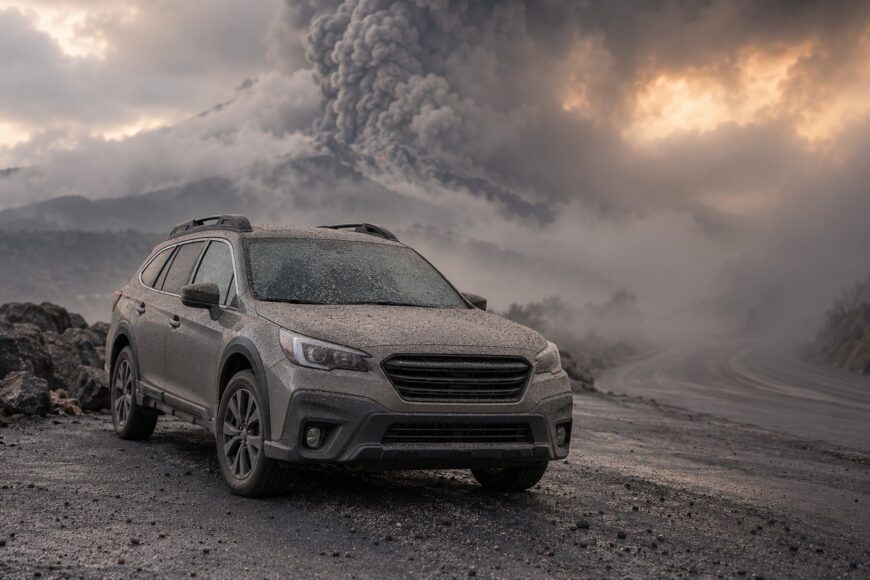
An ash-covered road may look passable from the driver’s seat of a Subaru Outback. The car may still move, but reduced visibility, lost traction, and ash entering its systems can make the trip unsafe. The first decision is whether the trip is necessary, not whether all-wheel drive can get the car moving.
Avoid driving in heavy ashfall. For any trip through settled ash, check official road guidance and conditions along the entire route before setting off. An open road and a necessary journey do not guarantee safe passage if ash is blowing across the pavement or you cannot see far enough ahead to stop.
- Can an Outback drive through volcanic ash—and should it?
- Why AWD, X-MODE, and ground clearance are not ash protection
- When an ash-covered road is a no-go
- If driving is unavoidable: speed, visibility, and cabin air
- After the drive: check filters and remove ash without grinding it in
- Frequently asked questions
- Should I start my Outback if it was parked during ashfall?
- What should I do if volcanic ash has entered the passenger cabin?
- Which Subaru Outback model years should I avoid?
- How deep can a Subaru Outback drive through water?
- How do I put my Subaru in snow mode?
Can an Outback drive through volcanic ash—and should it?
An Outback may traverse some ash-covered pavement when conditions permit, but that ability is not a recommendation to drive during ashfall. AWD can help the tires find traction; it cannot restore a clear view through airborne ash or protect the engine from dust. The CDC advises avoiding driving in heavy ashfall.
Volcanic ash is abrasive and can clog filters and the engine air intake. The USGS warns that severe contamination can contribute to overheating or engine failure. A vehicle that drives normally at the start of a trip may therefore develop problems as ash continues to enter exposed systems.
Road closures and official instructions take priority over what the Outback appears capable of doing. If travel can wait, leaving the vehicle parked avoids exposing its occupants and systems to a hazard that may change along the route. If travel is essential and permitted, assess visibility, road surface, and the vehicle’s condition rather than relying on an assumed safe ash depth.
Why AWD, X-MODE, and ground clearance are not ash protection
Subaru describes X-MODE as an aid to traction on slippery surfaces, and AWD can help the Outback move where a driven wheel has limited grip. Neither system prevents ash abrasion, filter clogging, or poor visibility. More available traction does not mean the vehicle can stop within the distance you can see.
Ground clearance is commonly 8.7 inches for the Outback and 9.5 inches for the Outback Wilderness; verify the specification for your model year. Clearance helps the underside pass over some obstacles. It does not establish how deep ash can be driven through, especially if loose material hides ruts or allows the vehicle to settle onto its underside.
The Outback Wilderness has Symmetrical AWD and standard front underbody protection. That protection can shield against some impacts from below, but it does not seal the engine air intake, filters, or moving parts against fine ash. Cabin precautions also have a separate purpose: keeping ash out of the passenger space does not protect the engine intake.
When an ash-covered road is a no-go
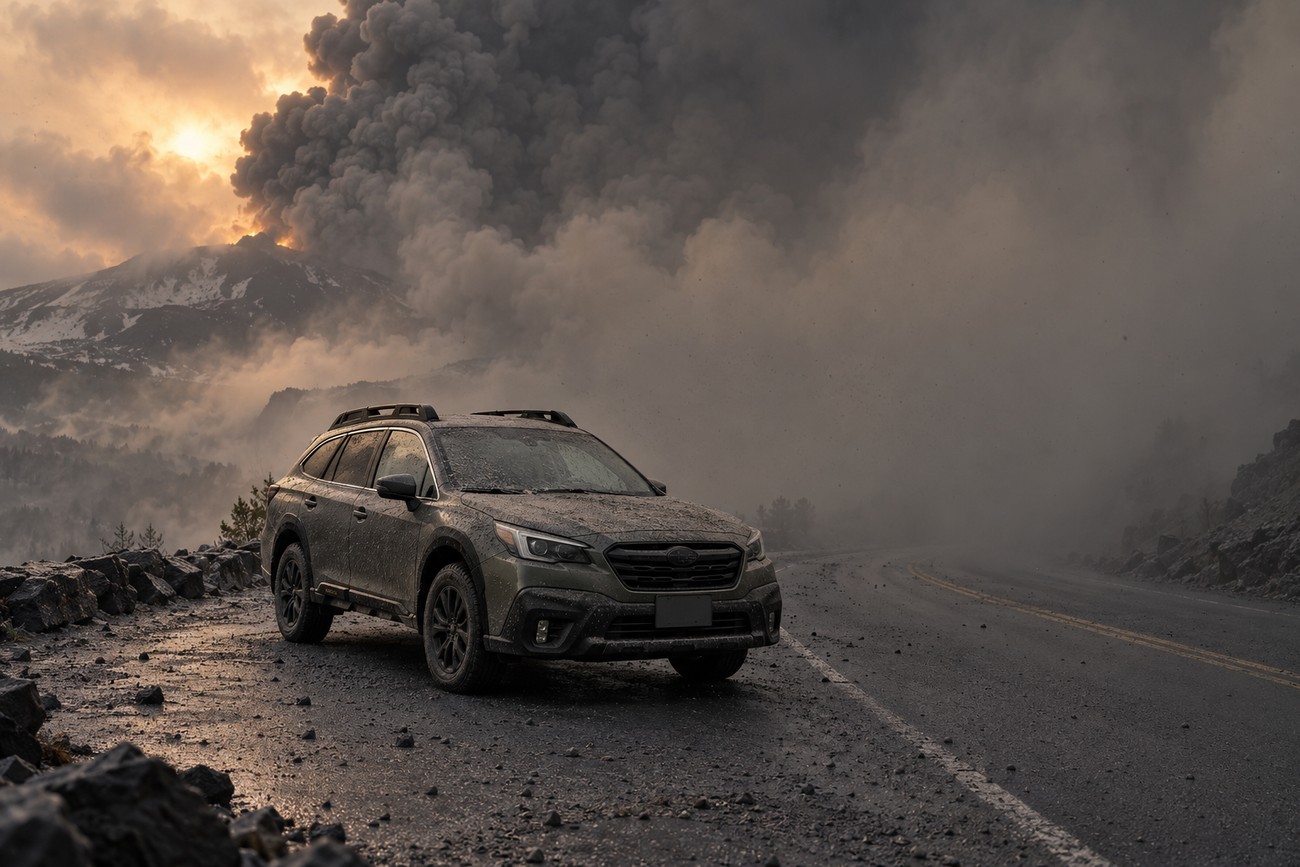
Do not proceed through a closure, active heavy ashfall, or conditions that leave too little sight distance to stop safely. Ash deep enough to conceal the road surface or impede movement is another reason to turn back where you can do so safely. A route that looks manageable at its entrance may have worse conditions farther ahead.
A thin coating deserves caution, too. Ash can reduce traction even when the pavement remains visible, while passing traffic can lift settled ash into a cloud that obscures the road for drivers behind it. After ashfall ends, traffic and wind can continue to resuspend deposits.
Dry ash produces airborne dust; wet or compacted ash can form a slippery, heavy layer. Both can change how the car steers and brakes. If you cannot distinguish the road surface or maintain a clear view, the Outback’s traction systems do not resolve the reason to stop.
The USGS reports that ash deeper than 100 mm (more than 4 inches) can make roads impassable for two-wheel-drive vehicles. That observation is not a safe-depth rating for an AWD Outback. Ash depth, moisture, and the condition of the road beneath it all matter, so the figure should never be used as permission to continue.
If driving is unavoidable: speed, visibility, and cabin air
Before an essential trip, check official road guidance and whether the route remains open. Tell someone your route, and avoid setting off if heavy ashfall or inadequate visibility is already evident. Conditions can deteriorate during the drive, so be prepared to stop in a safe place rather than press on.
The USGS recommends speeds below 55 km/h (35 mph) and low-beam headlights when driving in ash is necessary. Leave more room behind other vehicles and slow further when visibility or grip worsens; the recommended speed is a ceiling for caution, not a target. Avoid abrupt braking and steering on a surface whose traction is uncertain.
Do not operate wipers over a dry coating of ash. The grit can scratch the windshield as the blades sweep it across the glass. If ash blocks your view and you cannot keep the windshield clear, stop safely; do not continue by relying on the wipers to scrape it away.
The CDC advises keeping windows closed and not using air conditioning while driving in ash. These steps aim to limit ash entering the passenger cabin, though no cabin setting makes the trip safe. The engine draws its own intake air, so closed windows do not prevent ash from reaching its filter.
After the drive: check filters and remove ash without grinding it in
Allow settled grit to be removed gently before wiping glass, paint, or trim. Avoid dry wipers and dry brushing that drag particles across surfaces. If water is available and safe to use, rinse ash away gently before cleaning; take care around seals and crevices where grit can remain.
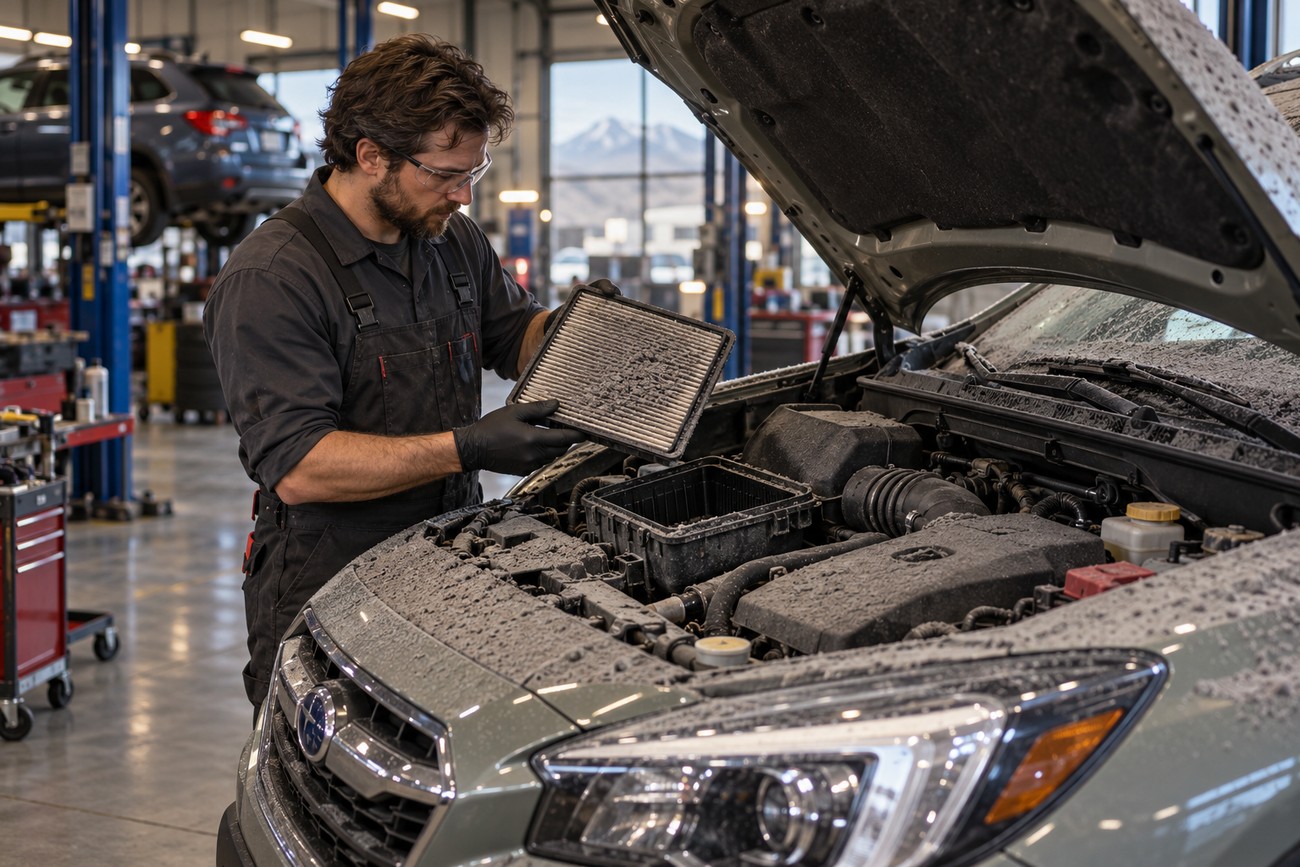
Check the engine air filter and intake area as appropriate for the vehicle, and have them inspected if deposits are substantial or access is uncertain. Check the cabin filter if ash entered the passenger space or airflow seems restricted. A clean-looking exterior does not tell you whether the intake path is clear.
Reduced power after an ash drive warrants a check of the air filter and intake sealing even if no warning light appears. Clearing an alert alone would leave any continuing source of ash entry unresolved.
If acceleration changes, unusual noises develop, the engine overheats, or a warning light appears, stop driving when it is safe and seek qualified inspection. Those symptoms do not identify a fault on their own, and continued driving may worsen a problem. Keeping the cabin closed during the trip does not rule out contamination in the engine intake.
Frequently asked questions
These situations call for checks that differ from assessing a road before a trip. The amount of ash visible outside the car may not show where it has collected. If a condition cannot be assessed safely, seek qualified help rather than assuming the vehicle is clear.
Should I start my Outback if it was parked during ashfall?
Check for heavy deposits before starting it, particularly around the engine air intake area. Avoid disturbing ash in a way that sends it toward an opening. If ash may have entered the intake or the filter appears heavily contaminated, arrange an inspection before running the engine; an apparently clear windshield is not enough to establish that the engine can safely draw air.
What should I do if volcanic ash has entered the passenger cabin?
Limit movement that stirs dry ash into the air, and clean contaminated surfaces with methods that capture or gently remove grit rather than spread it. Check the cabin filter and replace it if inspection shows contamination, following the vehicle’s service guidance. Closing the windows afterward can limit further entry, but it will not remove ash already inside.
Which Subaru Outback model years should I avoid?
There is no single Outback model year to avoid on the basis of volcanic-ash capability. If you are buying a used vehicle, evaluate its service history and condition, including any history of driving in heavy dust or ash, and consider an independent inspection. Compare reliability information for the specific model year and market rather than treating AWD equipment as evidence that the vehicle has escaped contamination.
How deep can a Subaru Outback drive through water?
Do not use the Outback’s ground-clearance figure as a water-wading limit. Water can hide a damaged road or enter components before the underside touches the surface, and flowing water adds a separate loss-of-control risk. Check the guidance for your model year and avoid crossing water when its depth, current, or the road beneath it is uncertain.
How do I put my Subaru in snow mode?
If your Outback has X-MODE, use the vehicle’s control or display to select the available setting described for snow or slippery conditions in your model-year owner’s manual. Controls and mode names vary by year and trim. A traction setting may help the vehicle move on a slippery surface, but it does not improve visibility or protect it from volcanic ash.







