
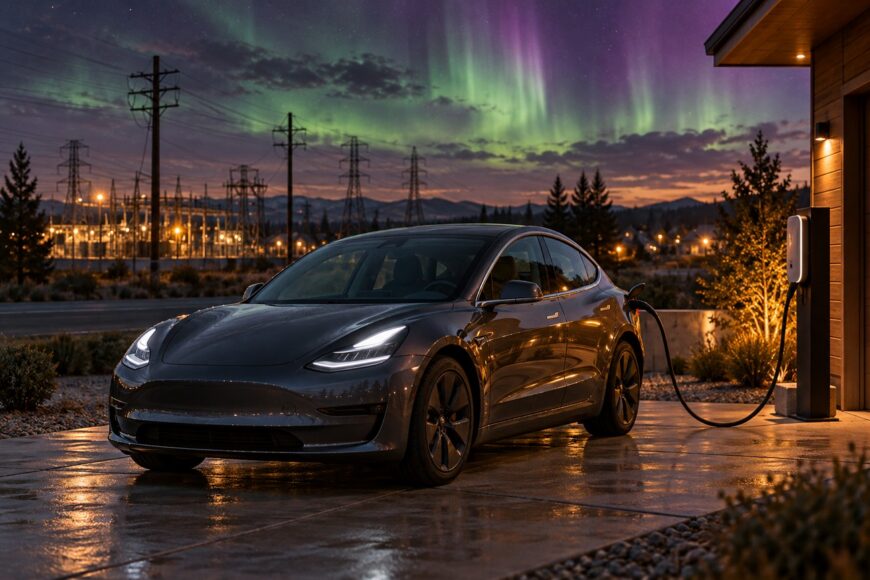
A major solar storm can sound like a natural EMP: one burst, and a Tesla’s computers go dark. That is a poor description of the most likely outcome. Direct damage to a Tesla’s onboard electronics is possible but unlikely, while degraded GPS, radio communication, cellular connectivity, charging access, and grid service are more credible problems.
The key distinction is between the car and the infrastructure around it. Geomagnetic storms primarily induce currents in long conductors, such as power-transmission lines, where grid equipment can be stressed. A Tesla’s isolated electronic modules are far less exposed to that mechanism than the grid, satellites, and communication systems connected to large external networks.
A storm can therefore leave the vehicle physically healthy while making navigation less precise, connected services unreliable, or charging temporarily unavailable. Those symptoms deserve a sensible diagnosis before they are attributed to damaged vehicle hardware.
- The Short Answer: A Solar Storm Is Unlikely to Fry a Tesla
- What Solar Storms Actually Damage
- Tesla’s Realistic Weak Points: GPS, Radio, Connectivity, and Charging
- Tesla vs. the Grid: Where the Bigger Risk Sits
- What to Do If Space Weather Disrupts Your Tesla
- What a Solar Storm Can Affect: Tesla vs. Its Infrastructure
- Frequently asked questions
- What would happen if the 1859 Carrington event happened today?
- How can you protect electronics from a solar flare or geomagnetic storm?
- How can you tell whether a Tesla’s navigation problem is caused by space weather?
The Short Answer: A Solar Storm Is Unlikely to Fry a Tesla
A solar storm is unlikely to fry a Tesla in the style of an EMP attack. Direct damage to the car’s electronics is possible but considered unlikely, especially compared with the better-supported effects on GPS, radio communications, satellites, and electrical grids.
The main physical concern is a geomagnetic-induced current in an extended conductor. A parked vehicle contains wiring, but its onboard circuits are comparatively small and isolated from the long conductors that collect the largest induced voltages. The power system supplying a charger has a much larger exposure because it connects equipment across substantial distances.
Owners are more likely to notice a storm through external services. Satellite positioning can become less reliable, radio channels can develop noise, cellular or cloud connectivity can drop, and charging may be affected if the local grid or charging equipment is disrupted.
That distinction does not make every storm harmless. A severe event can create real infrastructure failures, and a vehicle that depends on outside positioning, communications, and electricity can become less useful even when its computers remain undamaged. A navigation or connectivity fault also has many ordinary explanations, including software faults, network outages, power problems, and local radio interference.
What Solar Storms Actually Damage
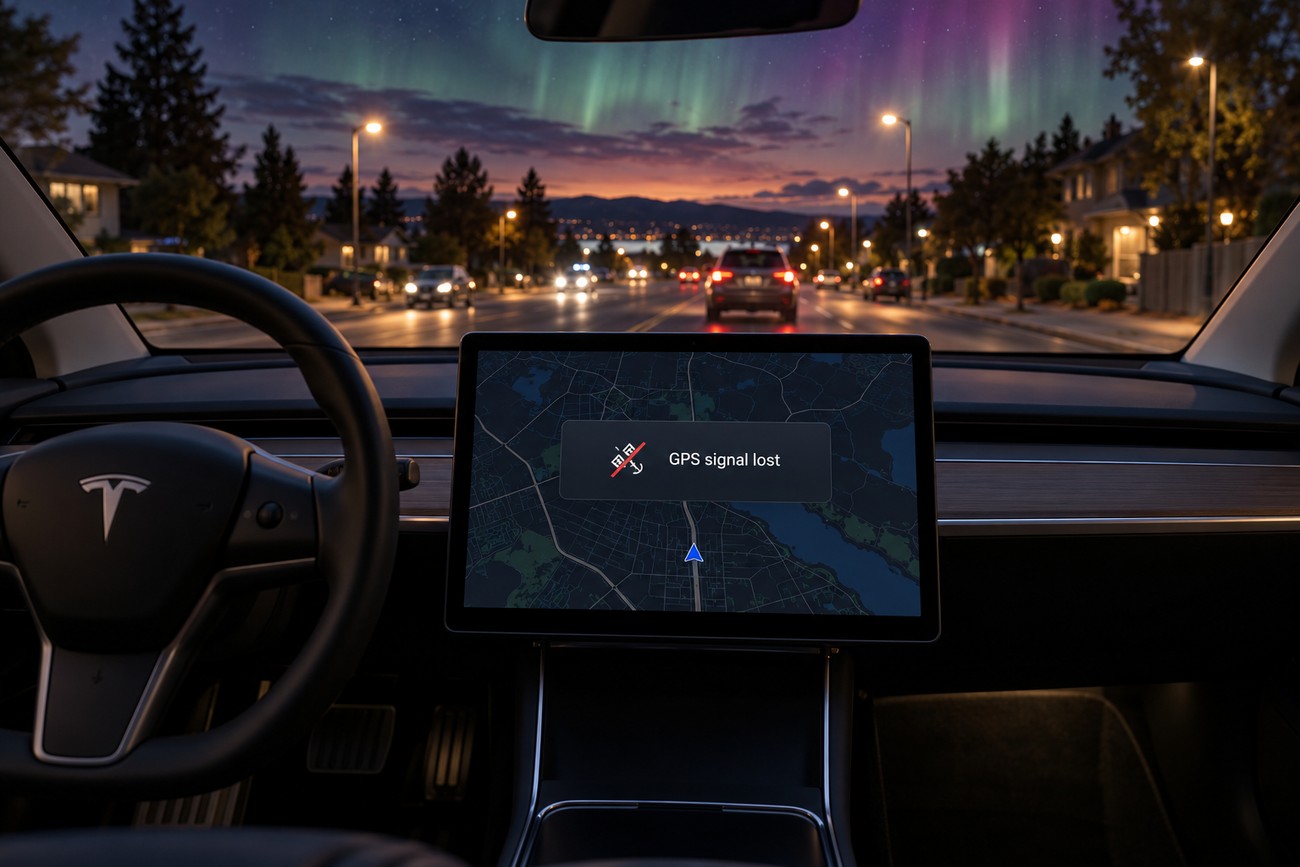
Solar weather reaches technology through several related processes. A solar flare produces radiation and can disturb the ionosphere, the electrically active region through which many radio and satellite-navigation signals travel. A coronal mass ejection, or CME, can drive a geomagnetic storm when its magnetic field interacts strongly with Earth’s magnetosphere.
Those ionospheric changes can degrade satellite-signal quality, create positioning errors, and cause temporary communication loss. The effect is closer to a disturbed transmission path than to a magnetic field directly burning every microchip. Signal timing and propagation become less predictable, which matters to navigation receivers and radio systems.
The largest ground-level electrical risk comes from geomagnetically induced currents in long conductors. Power lines, pipelines, rail systems, and other extended networks can collect these slowly changing electrical fields over large distances. During severe geomagnetic storms, currents in power-grid systems can exceed 100 A, stressing transformers, relays, sensors, and related equipment.
Geography matters because geomagnetic-storm effects are generally more pronounced at high latitudes. The same event can therefore produce different consequences in different regions, depending on latitude, grid design, grounding, network length, and the direction of the storm-driven electric field. A flare alone more often produces radiation and ionospheric effects; severe ground-level infrastructure problems are associated with a CME-driven geomagnetic storm.
Tesla’s Realistic Weak Points: GPS, Radio, Connectivity, and Charging
The most plausible Tesla-related symptom during a space-weather event is degraded navigation or connectivity. An ionospheric disturbance can make satellite signals harder for a receiver to interpret, introduce position errors, and interrupt communications temporarily. The car may continue to drive normally while its displayed location becomes less stable or connected features respond slowly.
A popular account of a severe storm reported GPS displacement of more than 10 meters (33 feet). That is a limited-source example, not a universal value for every storm, receiver, or location. Actual positioning performance depends on the disturbance, satellite geometry, receiver design, correction services, and local conditions.
Before blaming vehicle hardware, technicians separate a signal problem from an electronics failure by checking whether the symptom affects several devices, follows the timing of a wider outage, and disappears when the car’s basic functions remain normal.
That diagnostic order matters for driver-assistance systems. A position-dependent feature may become less reliable when external positioning or communications degrade, but this does not establish permanent damage to the vehicle’s sensors or computers. Drivers should follow the vehicle’s warnings and remain responsible for control rather than assuming that a temporary navigation anomaly represents a failed electronic control unit.
Charging introduces a second layer of dependence. The battery and charging hardware can remain intact while a home charger loses power, a public station becomes unavailable, or a connected payment and authorization service stops responding. A storm-related charging problem may therefore be an infrastructure or communications issue rather than a fault inside the vehicle.
Radio noise and dropped cellular service can also resemble a car malfunction. If navigation, audio reception, and connected features change at the same time across multiple devices, the external signal path deserves attention. If only one vehicle shows persistent warnings, power irregularities, or software symptoms, ordinary vehicle diagnostics are more appropriate than a space-weather explanation.
Tesla vs. the Grid: Where the Bigger Risk Sits
The vehicle, its charger, the local electrical network, cloud services, and satellite systems occupy different risk categories. A Tesla’s onboard electronics are relatively isolated, while the grid and communications networks contain long conductors and equipment exposed across wide areas. That difference is why infrastructure can suffer meaningful disruption without every connected car being electrically destroyed.
Geomagnetically induced currents can stress transformers, relays, sensors, and other grid equipment. If a utility or charging network experiences an outage, a Tesla may remain fully operational yet lose access to home charging, public charging, remote services, or reliable cellular communication. The owner experiences an infrastructure failure through the car’s normal dependencies.
Public charging adds several possible points of failure: grid power, station electronics, network connectivity, authentication, and local communications. A home installation has fewer service layers, but it still depends on the utility supply and the condition of the charger and its protective equipment.
Some specialist discussions describe regional outages lasting months in extreme scenarios. That is a scenario claim, not a normal expected outcome or a forecast for a particular storm. Sensible planning should account for temporary loss of electricity and communications without assuming that a dramatic worst-case scenario is inevitable.
What to Do If Space Weather Disrupts Your Tesla
Start with the symptom. GPS errors, radio noise, and dropped connectivity are more plausible storm-related effects than immediate physical destruction of Tesla electronics. Check whether nearby devices show similar positioning or communication problems, and look for utility, cellular, or charging-network outage information.
Next, separate external services from vehicle functions. Confirm whether the car powers on normally, whether basic controls respond, and whether warnings persist after connectivity returns. Software problems, network outages, power issues, and local radio interference are often more likely explanations for unexplained glitches than a solar storm.
Charging flexibility is more useful than speculative shielding. Keep the battery at a practical level before a forecast period of severe space weather, know more than one charging option where possible, and retain offline directions or local route information. These steps also help during ordinary grid and cellular outages.
A conventional household surge protector is not a complete solar-storm defense. It does not eliminate ionospheric disruption or geomagnetically induced currents in external infrastructure, and it cannot restore satellite, cellular, or grid service. Follow utility and charging-network guidance, and arrange professional diagnosis if the vehicle shows persistent electrical, thermal, or software warnings after outside services stabilize.
What a Solar Storm Can Affect: Tesla vs. Its Infrastructure
The table separates direct exposure from infrastructure dependence. “Direct physical damage” refers to hardware damage, while “likely effect” includes temporary service and signal problems that can occur with no permanent damage to the car.
| System | Main exposure mechanism | Likely effect | Likelihood of direct physical damage | Practical symptom |
|---|---|---|---|---|
| Onboard Tesla electronics | Limited direct exposure compared with long external conductors | Usually no immediate storm-specific effect; ordinary software or power faults remain possible | Low relative to grid infrastructure; possible but unlikely | Persistent vehicle warnings would require normal diagnostics rather than an automatic EMP assumption |
| GPS and satellite signals | Ionospheric disturbance and altered signal propagation | Reduced signal quality and positioning errors | Usually no physical damage to the car | Jumping coordinates, less precise location, or temporary navigation errors |
| Radio and cellular connectivity | Ionospheric effects, satellite disruption, or network outages | Noise, degraded reception, or temporary communication loss | Usually no physical damage to the vehicle | Dropped connectivity, delayed services, or noisy radio reception |
| Home charging | Dependence on utility power, local wiring, and charger electronics | Charging interruption or loss of connected charger functions | Depends on the condition of the local electrical system | Charging fails while the car and battery remain operational |
| Public charging | Dependence on grid supply, station hardware, communications, and authorization services | Station outage or unavailable payment and network functions | Usually an infrastructure risk rather than direct car damage | A working vehicle cannot start or complete a session at an affected site |
| Wider power grid | Geomagnetically induced currents in long conductors | Stress or damage to transformers, relays, sensors, and other grid equipment | Higher than for isolated vehicle electronics; currents can exceed 100 A in severe cases | Local or regional power outages and loss of charging access |
Frequently asked questions
The main risk to a Tesla usually comes through the systems it depends on, rather than from direct damage to its onboard electronics. Navigation, communications, charging, and grid service can be disrupted independently. The vehicle may remain operational while some external functions become unreliable.
What would happen if the 1859 Carrington event happened today?
A Carrington-scale storm today could disrupt satellites, GPS services, radio communications, and electrical grids, with effects varying by region and infrastructure design. Grid equipment connected through long conductors would face the clearest physical risk, while navigation and communications could degrade even where no hardware is damaged.
It would not follow that every Tesla would instantly be destroyed. Some vehicles could remain electrically intact but lose charging access, connected services, or reliable positioning. The historical Carrington event is a benchmark for an extreme geomagnetic storm, not proof that every modern electronic device would fail in the same way.
How can you protect electronics from a solar flare or geomagnetic storm?
Protection priorities depend on whether equipment is isolated or connected to long conductors. Keep essential disconnected electronics available, maintain charging flexibility, plan for temporary loss of grid power and communications, and use reliable offline navigation. Follow utility guidance for home charging equipment during an outage.
A basic surge protector can help with some ordinary electrical transients, but it does not eliminate ionospheric disruption or geomagnetically induced currents in external infrastructure. No household device can guarantee immunity from a broad grid or communications failure, so backup planning is more useful than products marketed as complete solar-storm protection.
How can you tell whether a Tesla’s navigation problem is caused by space weather?
Check the timing and scope first. If several devices in the same area show similar GPS errors, radio noise, or cellular problems at the same time, an external signal or network disturbance becomes more plausible. Compare the vehicle with an independent phone or navigation receiver, and check outage information where available.
A navigation error alone does not prove that Tesla hardware has been physically damaged. If basic vehicle functions work normally and the issue clears when connectivity or positioning services recover, the fault was likely external. Persistent warnings, charging faults, power symptoms, or software instability warrant ordinary vehicle troubleshooting and professional service.







