
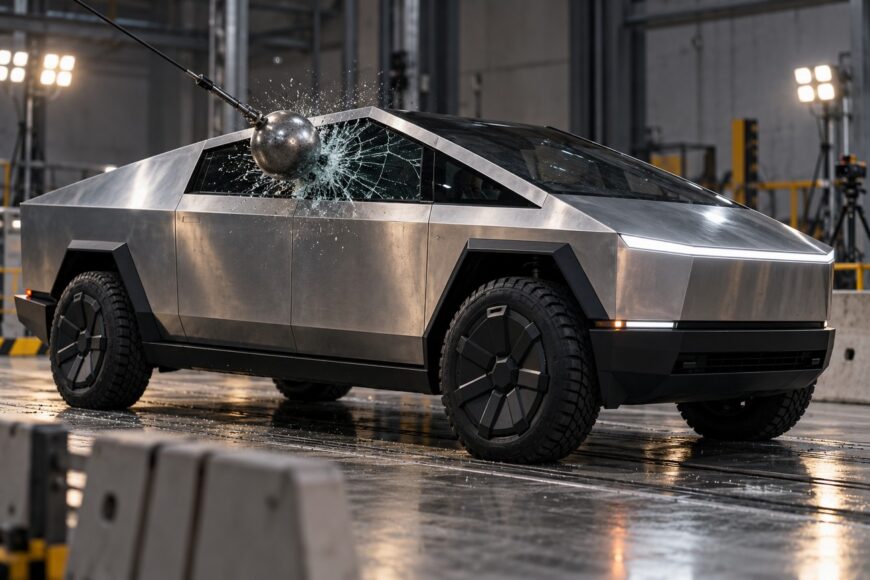
A powerful, concentrated impact can eventually damage or destroy a Tesla Cybertruck window, even though Tesla presented the vehicle’s body and glass as highly impact-resistant. Reinforced side glass can tolerate more abuse than conventional automotive glass, but it remains a material with a failure point.
The key distinction is between reinforced glass, certified bullet-resistant glazing, and ordinary expectations about a vehicle window. A public demonstration shows what happened under one set of conditions. It does not establish universal shatter resistance, immunity to a sledgehammer, or bulletproof certification.
- What Tesla’s Cybertruck Window Demonstrations Actually Showed
- Why a Sledgehammer Can Still Break Reinforced Automotive Glass
- The Impact Point Matters More Than the Tool’s Reputation
- What Failure Looks Like: Cracks, Delayed Shattering, and Lost Visibility
- The Ownership Gap: Tougher Glass Does Not Mean Cheap or Simple Repairs
- The Straight Answer: Durable, Not Sledgehammer-Proof
- Frequently asked questions
- How hard is it to break a Cybertruck window?
- What broke the Cybertruck window in Tesla’s demonstration?
What Tesla’s Cybertruck Window Demonstrations Actually Showed
Tesla publicly presented the Cybertruck body and windows as having elevated impact resistance. In the vehicle’s marketing context, the side glass was described in reinforced or armored terms, which reasonably suggests greater resistance to some impacts than a conventional side window.
The widely discussed window demonstration used a thrown metal sphere and produced visible glass failure. That event matters because it showed that the advertised toughness had limits under the test conditions. It also shows why a single demonstration cannot be treated as a universal threshold for every Cybertruck window.
A public demonstration is not, by itself, proof of bulletproof certification or universal shatter resistance. Specialized resistance standards depend on defined materials, test methods, impact conditions, and certification requirements. Surviving one type of impact does not mean the same panel will respond identically to a different object, angle, or location.
Glass durability and body durability are separate properties. A strong stainless-steel body panel may behave differently from the glazing mounted in it, and the resistance of either component does not describe the protection of the vehicle as a whole.
Why a Sledgehammer Can Still Break Reinforced Automotive Glass
Automotive side windows are commonly made from tempered glass, while windshields are typically laminated glass. Tempered glass is engineered to fragment into many small, relatively blunt pieces when it fails. That failure pattern improves occupant safety compared with large, sharp shards, but it does not make the glass unbreakable.
Tempering creates internal stresses that help the pane resist ordinary impacts and thermal changes. Once a critical defect or stress concentration develops, those stored stresses can help the glass fragment rapidly. A sledgehammer delivers substantial localized impulse, so a sufficiently strong, concentrated impact can destroy ordinary tempered side glass.
Reinforced Cybertruck glass may resist more abuse than conventional glass because its construction, shape, and mounting are designed for higher impact resistance. Increased resistance still means resistance to a wider range of conditions, rather than immunity from failure. A severe localized impact can eventually damage even unusually tough side glass.
The result should not be reduced to the tool’s name. Local energy, contact area, striker mass, speed, and impact angle all influence how much stress reaches the pane. This is why material claims must be read as performance under defined conditions, rather than as a promise that a particular object can never cause damage.
The Impact Point Matters More Than the Tool’s Reputation
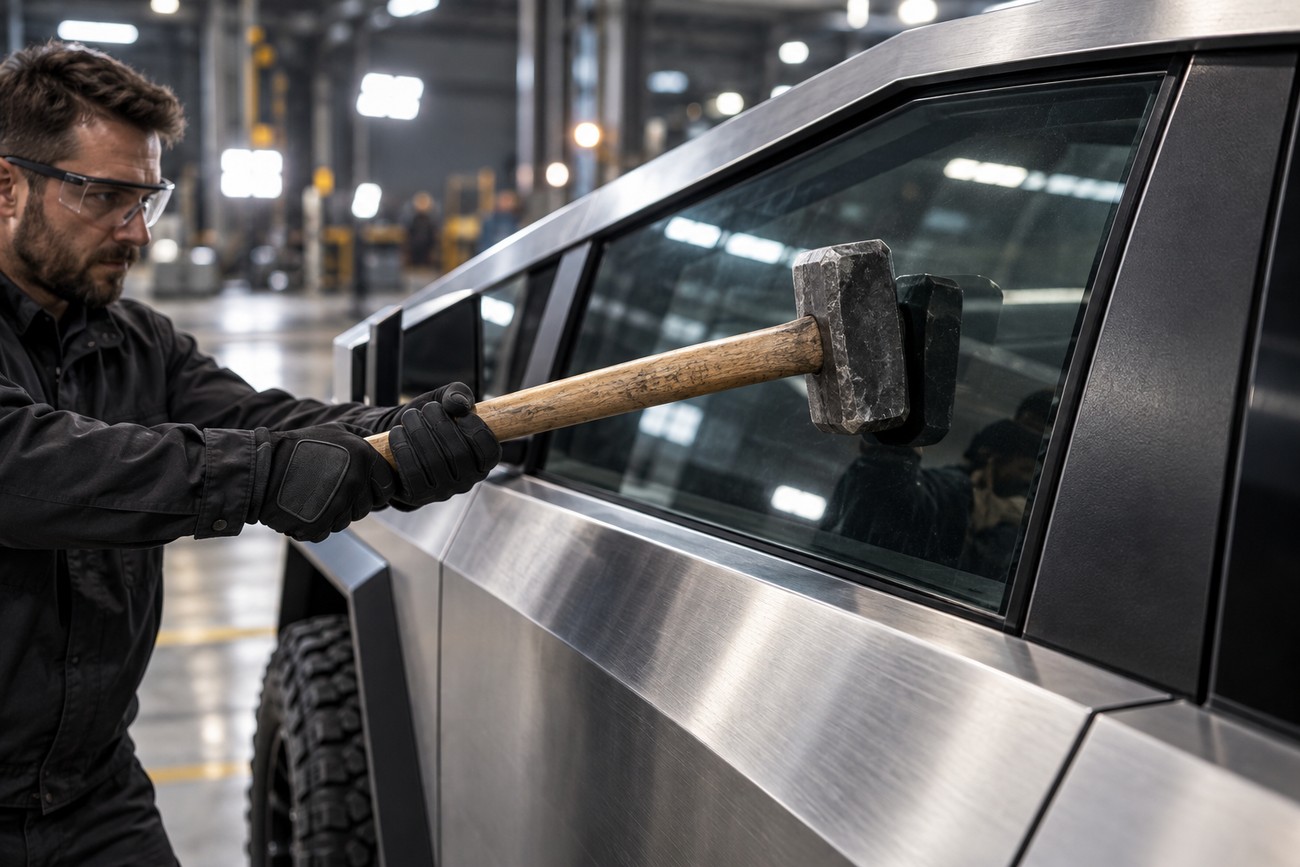
There is no useful prediction based only on calling an object a “sledgehammer.” Breakage depends on the energy delivered at the contact point and on how efficiently that energy creates stress in the glass. A heavy object with a broad contact area may behave differently from a smaller, harder impactor moving faster.
Impact location also changes the outcome. The edge, center, frame support, and mounting structure do not present identical conditions. The glass shape and the way it is held can distribute or concentrate stress, while an existing chip, crack, or manufacturing defect may reduce the remaining margin of resistance.
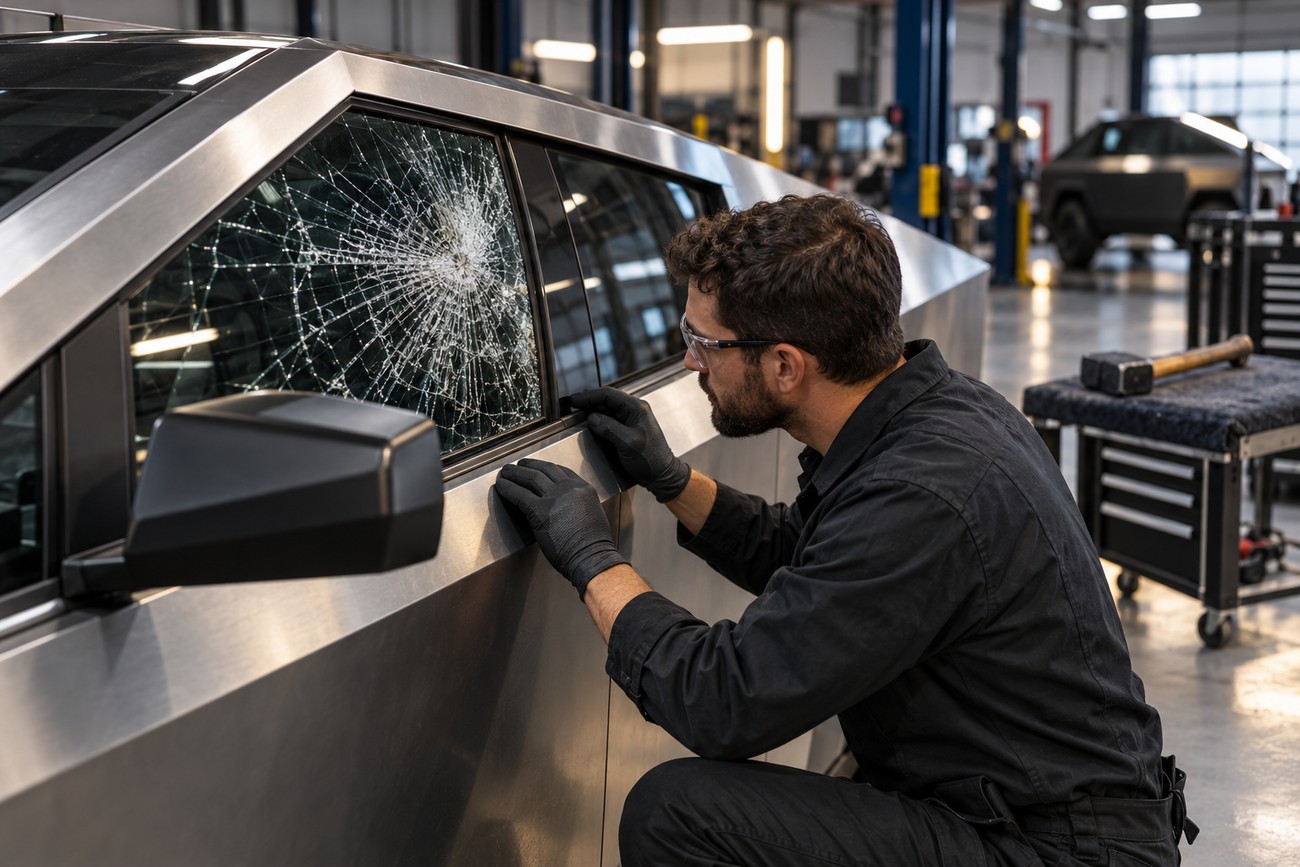
Technicians assess edge damage, mounting stress, and the crack pattern rather than judging glass strength from the object used in one impact. Those details can reveal whether the pane is stable, whether the frame is carrying hidden stress, and whether more fragmentation is likely.
Angle and previous damage matter as much as the apparent size of the tool. One panel may withstand repeated minor contact and then fail after a single severe impact that lands in a more vulnerable condition. A video captures an event, not all the variables needed to reproduce or generalize its result.
What Failure Looks Like: Cracks, Delayed Shattering, and Lost Visibility
A first impact may produce cracks or surface damage rather than an immediate, clean opening. The pane can appear to remain in place while its optical clarity deteriorates. That alone may make the vehicle unsuitable for normal use, especially if the damaged area interferes with mirrors, adjacent traffic, or the driver’s view.
Tempered glass commonly collapses into many small fragments once its failure threshold is reached. The change can appear sudden, even if the damage began earlier. Additional damage or a later impact may trigger broader fragmentation after the glass initially seemed to hold together.
Loose fragments create a separate safety concern. They can fall into the door, cabin, or window mechanism and may continue to shift as the vehicle moves. Cracks, unstable pieces, and impaired visibility should therefore be treated as reasons to stop using the window normally and arrange a professional assessment.
The Ownership Gap: Tougher Glass Does Not Mean Cheap or Simple Repairs
Specialized reinforced automotive glass can be more difficult and costly to replace than owners expect. The correct panel must match the vehicle’s shape, mounting, seals, and operating hardware. A repair decision may also involve checking the surrounding frame for stress or damage rather than replacing the visible pane alone.
Marketing language can create an unrealistic expectation that serious impact damage will never occur. That expectation becomes frustrating when a small-looking crack affects visibility or when the glass requires vehicle-specific service. The practical benefit of stronger glazing is a larger margin against some impacts, not freedom from repair risk.
A damaged window may limit safe use of the vehicle until it is assessed and repaired. Even if the glass has not fully collapsed, reduced clarity and loose fragments can affect driving conditions. Owners should follow the vehicle manufacturer’s safety guidance and use professional judgment rather than testing whether the pane can tolerate another impact.
The protective behavior of the glass should also be kept separate from protection of the entire vehicle. Strong glazing may resist one class of impact while body panels, seals, hinges, electronics, or the surrounding structure respond differently. “Armored” language describes a design intention, not a guarantee that every vehicle system shares the same resistance.
The Straight Answer: Durable, Not Sledgehammer-Proof
Yes, a strong, concentrated impact can eventually damage or destroy Cybertruck side glass despite its enhanced resistance. The likely outcome depends on the local energy, contact area, angle, impact location, frame support, and any prior damage. There is no responsible universal promise that the window will withstand every heavy impact.
Tesla’s demonstration and real-world breakage can both be genuine. The demonstration showed performance under one test condition, while a different impact can produce a different result. A glass panel surviving one event does not prove that it is unbreakable or bulletproof.
Tempered glass can withstand many minor impacts and then fail suddenly after one well-placed severe impact. Reinforcement raises the threshold for some forms of damage, but it does not remove the basic failure behavior of glass. The practical conclusion is resistance to more abuse, not guaranteed resistance to every heavy impact.
Do not recreate the test on a vehicle. A damaged pane can fragment, impair visibility, and expose occupants to loose material, while the impact can also damage the door or surrounding structure. If a Cybertruck window is struck or cracked, keep people clear of the area and have the vehicle assessed before normal driving.
Frequently asked questions
The answers below separate the public demonstration from general claims about window strength. They also reflect the practical limits of predicting glass failure from a single video or tool description.
How hard is it to break a Cybertruck window?
There is no useful universal hit count or single force threshold for a vehicle window. The result depends on impact energy, location, angle, support, contact area, and prior damage. Reinforced glass may withstand more abuse than ordinary tempered glass, yet a sufficiently strong, concentrated impact can still cause cracking or fragmentation.
What broke the Cybertruck window in Tesla’s demonstration?
The public demonstration involved a thrown metal sphere and resulted in visible glass failure. That specific event does not establish that every Cybertruck window will fail under identical conditions, because glass construction, mounting, impact location, and test circumstances all affect the result.







