

A Lamborghini Huracan can climb some steep driveways, but a steep or sharply broken transition can defeat it even with the front lift raised. The engine has enough torque to pull the car uphill; the front splitter, underbody, and floor do not have enough clearance to ignore a bad approach angle.
Most Huracan versions have approximately 100–120 mm of base ground clearance. That figure alone says little about a driveway. Approach angle, breakover shape, the approximately 2,620 mm wheelbase, front overhang, surface condition, and the transition from street to ramp determine whether the car clears safely.
- The short answer: yes, but not every steep driveway
- Why driveway geometry matters more than horsepower
- What the Huracan front lift can—and cannot—fix
- How to approach a steep driveway without scraping
- Common mistakes, hidden costs, and winter limitations
- Huracan versions and driveway practicality
- Frequently asked questions
- What height is too tall for a Lamborghini Huracan?
- What should I check before buying a Huracan for a steep driveway?
- Which car is called a “poor man’s Lamborghini”?
- What height is too tall for a Lambo?
- Which supercar has the highest ground clearance?
The short answer: yes, but not every steep driveway
A smooth, carefully graded incline may be manageable, especially with the factory front-lift system. A short driveway with a sharp step or dip at the street can be much harder. The splitter may touch before the front tires begin climbing, or the center of the car may ground as the road changes angle.
Most versions sit at approximately 100–120 mm of ground clearance in standard form. The LP580-2 is listed at 140 mm in some specifications, although that figure comes from a single source and should be treated cautiously. Either way, a clearance measurement does not describe the complete geometry of the nose and underside.
The factory lift raises the nose by approximately 40–45 mm. That provides useful extra space at the front edge, yet it cannot remove a sharp profile break or change the length of the front overhang. A driveway that catches the car beneath the nose can remain unusable with the lift active.
Torque helps the Huracan climb once the tires have a clear path and sufficient grip. Depending on the version, the V10 produces approximately 540–600 N·m. The available torque helps meet the traction demand of the slope; it cannot overcome physical contact between the body and the concrete.
Why driveway geometry matters more than horsepower
Three angles matter in practical terms. The approach angle describes how steep a surface the front of the car can meet without the nose touching. The breakover angle describes whether the underside clears when the car passes over a crest. The departure angle matters at the top or rear of a transition.
A modest-height driveway with a sharp change from street to ramp can be more dangerous than a taller driveway with a long, smooth radius. The sharp version forces the front corners and underbody to change direction quickly. The smooth version lets the tires and body follow the slope progressively.
The Huracan’s approximately 2,620 mm wheelbase increases the risk at a sharp profile break because the car spans more of the transition at once. Low overhangs help in some situations, but the low body, aerodynamic panels, and long footprint leave little tolerance for an abrupt crest or hollow.
As a general geometric inference, a car with approximately 100 mm of clearance may be limited to roughly 10–12 degrees when approaching a sharp incline without a suitable transition radius. This is not a Lamborghini specification or a universal driveway limit. Surface shape and the exact contact point can change the result substantially.
What the Huracan front lift can—and cannot—fix

The factory front-lift system is the most useful option for owners who regularly encounter ramps, curbs, or steep driveways. It raises the nose by approximately 40–45 mm and can create an estimated effective front clearance of approximately 150–180 mm, depending on the version and tires. That effective figure is a geometry-based estimate, not an official Lamborghini specification.
The system works up to approximately 70 km/h, after which the car automatically lowers. For a driveway, that operating limit is rarely the issue. The important point is to activate the lift before the transition, while there is still enough clearance to approach the ramp safely.
The lift changes the height of the nose, while the driveway still controls the angles. A car can gain useful vertical clearance and remain vulnerable to a long overhang, a sharp breakover, or a low point farther beneath the chassis.
Raising the front does not shorten the overhang, lengthen the driveway transition, or raise every part of the underbody by the same amount. If the front clears but the center of the car grounds, the lift has solved only the first part of the problem.
How to approach a steep driveway without scraping
Raise the lift before reaching the steep section, reduce speed, and use a smooth throttle input. Abrupt acceleration can load the rear suspension and alter the car’s attitude while the front is entering the ramp. A controlled approach gives you more time to stop if the splitter begins to touch.
A diagonal entry can reduce the simultaneous climb faced by the two front corners. It may allow one wheel to begin climbing before the other, reducing the effective sharpness of the transition. This technique requires adequate driveway width, clear visibility, safe wheel placement, and suitable road conditions; it is not a guarantee against scraping.
Test the exact street-to-driveway transition at walking speed before treating the route as routine. Diagonal entry is useful only when you can maintain safe clearance from traffic, edges, and obstacles while placing the wheels deliberately.
Limit passengers and luggage when testing a difficult approach. Additional load can compress the suspension and reduce available clearance, especially where the car already has little margin. Check the complete driveway rather than judging it by curb height, because the hidden profile break is often the real hazard.
A dealer’s general statement that a lift-equipped Huracan can handle steep driveways should not replace an inspection of your property. If possible, measure the street-to-ramp transition and test the actual car with the lift operating. A short video or a slow walk-through can reveal more than a specification sheet.
Common mistakes, hidden costs, and winter limitations
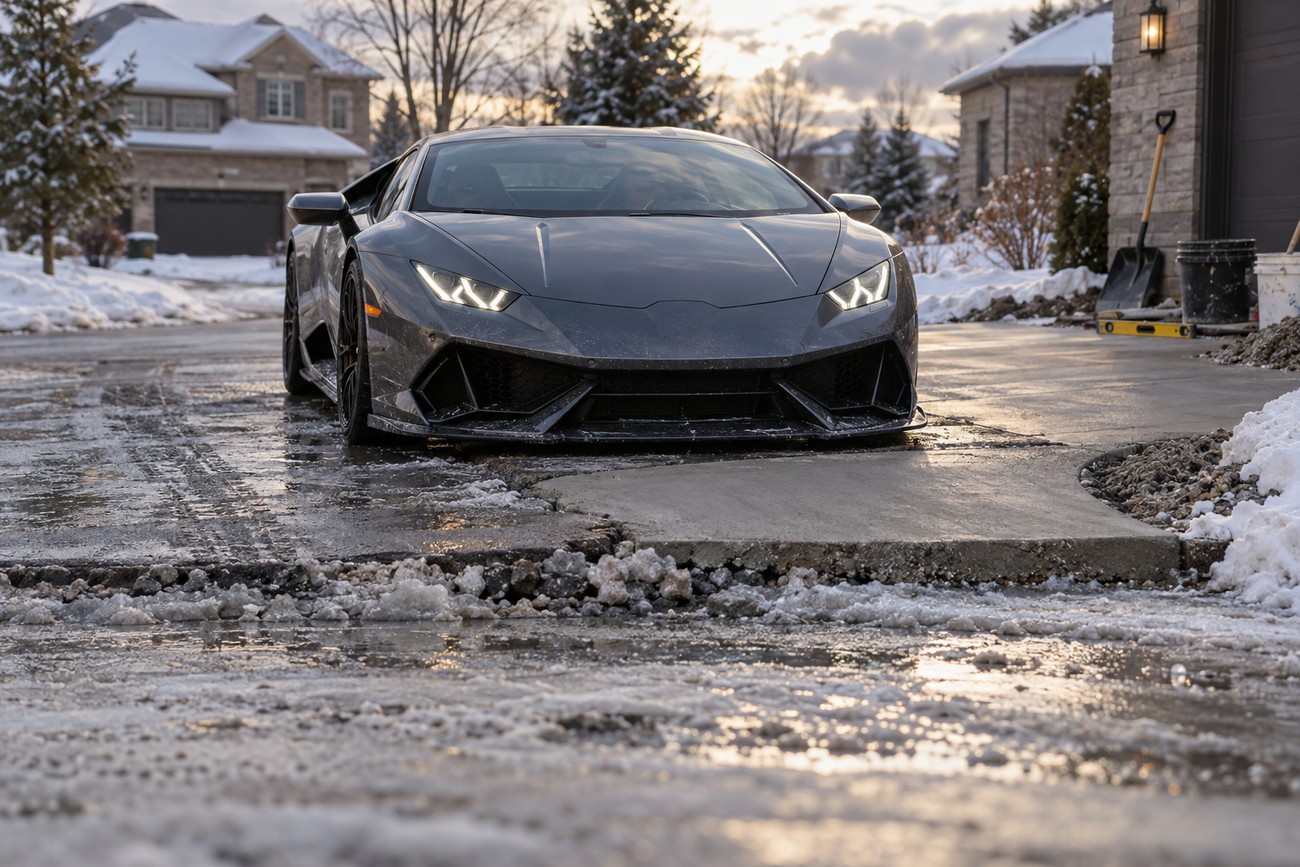
Buying a Huracan without the factory front lift increases risk on steep or broken driveways. Owners sometimes discover the problem only after delivery, when a familiar route produces repeated contact with the splitter or bumper. The absence of lift cannot be corrected by engine output or careful throttle control.
Perpendicular entry is another common mistake. It exposes both front corners to the transition at the same time and leaves fewer options if the nose begins to scrape. A driveway redesign with smoother entry radii, or a two-radius transition from street to ramp, can reduce the profile break under the nose.
Damage may involve the painted bumper, front splitter, diffuser, or carbon-fiber components. Even light contact can create expensive cosmetic or structural repair exposure, particularly when carbon parts or mounting points are involved. Protective film and skid plates can reduce damage from minor contact, but they do not increase geometric clearance or make an impossible transition passable.
Snow creates a separate limitation. Reduced grip combines with the Huracan’s low clearance and sensitive geometry, so the car may lack both traction and underbody margin on a steep driveway. A lift can address some vertical clearance, but it cannot create grip on a slippery surface.
Huracan versions and driveway practicality
The following comparison uses cautious figures because clearance varies by version and source. Suitability still depends on the actual driveway profile, tire condition, load, and surface.
| Version | Clearance situation | Geometry risk | Practical driveway suitability |
|---|---|---|---|
| Standard Huracan | Approximately 100–120 mm for most versions | High risk at sharp street-to-ramp transitions, crests, and broken surfaces | Reasonable only on smooth, carefully graded driveways with adequate approach geometry |
| Lift-equipped Huracan | Factory lift adds approximately 40–45 mm at the nose; estimated effective front clearance is approximately 150–180 mm, depending on the version and tires | Reduced front-splitter risk, while overhang and breakover risks remain | More usable for steep driveways, subject to testing the exact transition |
| Huracan Sterrato | Approximately 44 mm more clearance than the base coupe | Lower risk than a standard coupe, though sharp transitions can still cause contact | More practical on steep or broken driveways, without guaranteeing clearance everywhere |
The lift-equipped coupe is usually the sensible choice when the driveway is the main concern. The Sterrato offers a broader margin because its additional clearance addresses more of the car’s underside, although it remains a low-performance vehicle with finite approach and breakover angles.
Clearance figures should be treated as starting points rather than permission to drive onto a particular ramp. Tire specification, suspension condition, passenger load, and the shape of the concrete can change the outcome. A physical test remains more reliable than comparing catalog numbers.
Frequently asked questions
What height is too tall for a Lamborghini Huracan?
There is no universal driveway height threshold for a Huracan. A curb or vertical edge may be low enough to clear while the transition behind it creates a sharp approach or breakover problem.
Inspect the full street-to-driveway profile, especially the point where the level road becomes the ramp and any crest where the underside may pass over. The transition radius, approach angle, and available width are more informative than curb height alone.
What should I check before buying a Huracan for a steep driveway?
Confirm that the specific car has the factory front-lift system, then inspect the exact driveway from the road. Check the approach angle, the street-to-ramp transition, the crest, the driveway width, and any drainage channels or abrupt edges.
Test the actual car at low speed with the lift raised before committing to the purchase. A generic dealer assurance is less reliable than a real inspection, because two driveways with similar slope measurements can have very different profile breaks.
Which car is called a “poor man’s Lamborghini”?
The Pontiac Fiero is commonly described as a “poor man’s Lamborghini,” largely because it was used as the basis for replica conversions. The phrase is informal and usually refers to appearance or kit-car styling rather than comparable performance or engineering.
The Toyota MR2 is also sometimes given that nickname in enthusiast discussions, depending on the market and the particular replica. Neither label makes either car an equivalent substitute for a Huracan.
What height is too tall for a Lambo?
No single height applies to every Lamborghini or every driveway. The critical measurement is usually the combination of the car’s approach angle and the driveway’s transition, rather than the height of the visible curb.
A smooth ramp can be manageable where a lower but abrupt ramp causes contact. Measure and inspect the complete profile, then account for lift availability, passenger load, tire condition, and the possibility of underbody contact.
Which supercar has the highest ground clearance?
There is no universal highest-ground-clearance supercar because the answer changes with the definition of “supercar,” the model version, and whether adjustable suspension is included. Specialized high-riding models such as the Lamborghini Huracan Sterrato and Porsche 911 Dakar sit higher than their standard road-focused counterparts.
For driveway use, the highest published clearance is only one part of the answer. Approach angle, breakover geometry, tire grip, and the shape of the transition usually determine whether the car actually reaches the garage without scraping.







