
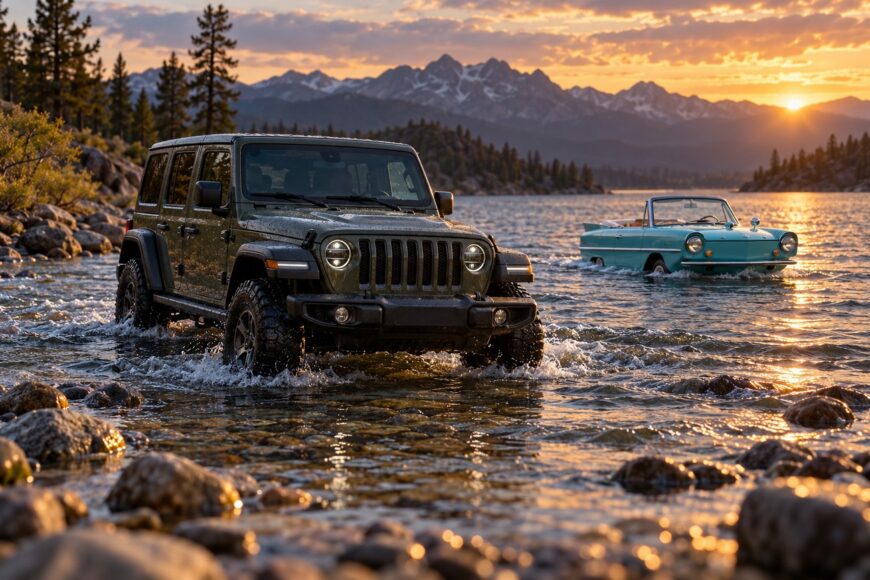
A standard Jeep Wrangler is not a floating vehicle and cannot cross open water like an Amphicar. Its capability is limited water fording: the Jeep may travel through a controlled section of water while its tires remain on the bottom. An Amphicar was engineered for a different job, with a sealed hull and propulsion designed for both land and water.
That distinction matters because a Wrangler can sometimes keep moving through surprisingly deep water while still suffering serious damage. The engine may continue running, the four-wheel-drive system may maintain traction, and the vehicle may drive out under its own power. Water can still remain inside the cabin, reach electrical connectors, contaminate driveline fluids, or cause faults that appear days later.
The central risk is mistaking temporary movement for flotation. A Wrangler’s water-fording equipment manages a limited crossing; it does not turn the body into a buoyant chamber. Once the depth, current, wave action, or bottom conditions exceed the vehicle’s real margin, recovery and inspection become more important than whether the Jeep reaches the opposite bank.
- Can a Jeep Wrangler Float Like an Amphicar?
- Why the Amphicar Floated—and the Wrangler Does Not
- Wrangler Wading Ratings, Versions, and Real-World Conditions
- What Happens When a Wrangler Goes Too Deep
- Common Water-Crossing Mistakes and Hidden Damage
- Wrangler vs. Amphicar: Purpose, Hardware, and Risk
- Frequently asked questions
- How much does an amphibious Jeep cost?
- Why did the Amphicar fail?
- What cars can float on water?
- What should I do if my Wrangler becomes submerged?
Can a Jeep Wrangler Float Like an Amphicar?
A standard Jeep Wrangler is designed for limited water fording, not for floating or crossing open water. During a proper ford, the tires support the vehicle, the drivetrain provides forward motion, and the driver follows a route with a known bottom. The water is an obstacle on the ground, rather than a surface on which the vehicle is expected to remain supported.
An Amphicar was designed as an amphibious vehicle with a sealed hull, wheel drive, and water propulsion. Its body had to keep water outside while displacing enough water to support the vehicle’s mass. It also used a dedicated system to move through water after the wheels were no longer a practical source of propulsion.
A Wrangler has no amphibious hull and no water propeller. Its cabin, doors, floor openings, and body joints are not intended to form a watertight flotation chamber. Water-resistant construction around selected components helps the vehicle manage a crossing; it does not prevent the cabin from filling if the Wrangler is submerged.
Removing the doors or roof does not change that engineering purpose. Open bodywork lets water enter more easily, while the vehicle still carries the same heavy structure, axles, suspension, engine, and drivetrain. The result is an open-top off-road vehicle exposed to flooding, with no dedicated water propulsion and no reliable buoyant reserve.
Why the Amphicar Floated—and the Wrangler Does Not
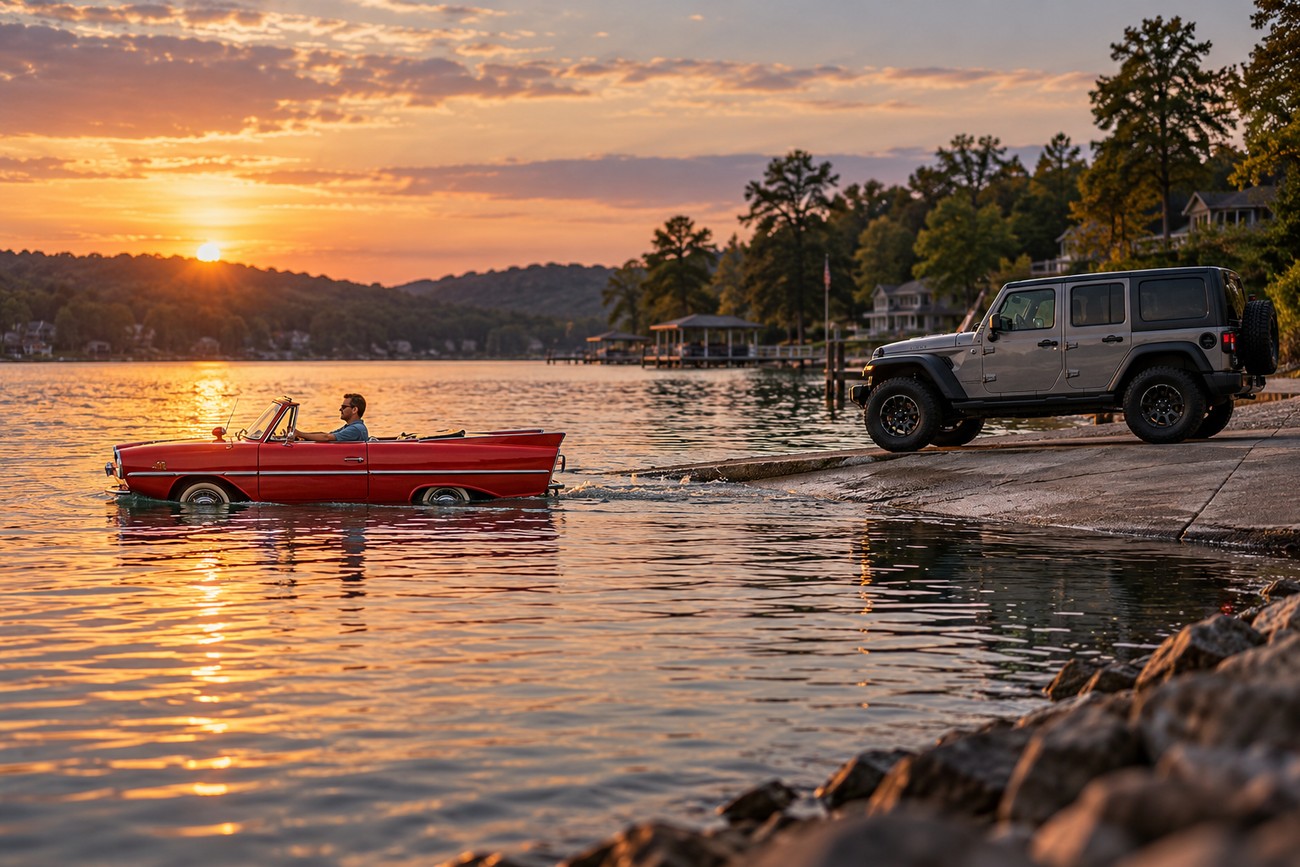
Flotation follows a simple physical rule: a vehicle floats only when it displaces a volume of water equal in weight to its mass. The body must push aside enough water to create an upward force matching the vehicle’s weight. That requires a hull or sealed volume that stays largely full of air while the vehicle is in the water.
The Amphicar’s shape and construction were developed around that requirement. Its sealed body helped retain the air volume needed for flotation, and its water propulsion allowed it to continue moving away from shore. Its compromises were built into the design from the beginning because the same structure had to work as a road vehicle and a boat.
A Wrangler’s design priorities are different. Ground clearance, suspension travel, axle strength, traction, approach angles, and underbody protection support off-road travel over terrain. A high air intake, sealed electrical connections, and water-resistant body openings help with fording, yet those features protect selected systems rather than sealing the entire vehicle.
Once water enters an unsealed Wrangler, its effective mass increases. The cabin loses useful air volume, the vehicle sits lower, and more openings become exposed to water. Marginal buoyancy therefore deteriorates as flooding continues, which can turn a vehicle that briefly appears to float into a sinking vehicle with no controlled means of movement.
Wrangler Wading Ratings, Versions, and Real-World Conditions
Official Wrangler guidance commonly specifies a maximum water-fording depth of about 30 inches (760 mm), subject to the exact vehicle and owner’s manual. Some configurations or packages are advertised at up to 34 inches, but 34 inches is not a universal rating for every Wrangler. The manual for the specific vehicle controls the applicable guidance.
These figures describe a limited operating condition, rather than a promise that the vehicle will remain undamaged at that depth. Load, tire size and condition, ground clearance, seal condition, and the shape of the bottom all affect the actual margin. A Jeep carrying extra equipment may sit lower, while a damaged seal or poorly chosen route can reduce protection before the water reaches the published limit.
Water depth also changes while the vehicle is moving. A hole can place the intake and body openings deeper than the surrounding water suggests. A loose bottom can let the tires sink, and a wave from another vehicle can briefly raise the water level around the front of the Wrangler. The visible height at the doors or wheel arches is therefore a poor substitute for checking the route itself.
Current creates a separate problem. Fast-moving water applies a sideways force to a heavy vehicle and can move it toward deeper water, a drop-off, or an obstacle. The risk remains even when the measured depth is below the nominal rating. Waves, current, holes, loose bottoms, vehicle load, tires, and seal condition can make a crossing unsafe below that figure.
Jeep guidance warns that water damage may not be covered by the vehicle warranty. That warning applies even when the Wrangler completes the crossing and drives away. A water-fording rating describes intended capability under specified conditions; it does not guarantee zero damage, safe lake crossing, or protection from every consequence of immersion.
What Happens When a Wrangler Goes Too Deep
The first failure may be loss of traction rather than engine damage. If the bottom becomes soft or uneven, the tires can spin while the current pushes the vehicle sideways. A sudden drop can also make the Wrangler settle into deeper water, reducing the driver’s options before the engine has shown any obvious problem.
Water at the air intake is especially dangerous. The intake’s protected position reduces the chance of water ingestion during a controlled ford, but it cannot eliminate the risk from a wave, a sudden stop, or suction behind the vehicle as it moves through disturbed water. If water enters the cylinders, the engine may suffer hydrolock, in which the liquid prevents normal piston movement and can cause severe mechanical damage.
Switching off the engine in deep water removes the vehicle’s driving force. Restarting can draw water farther into the intake, so a stalled or submerged Wrangler should not be treated as safe to restart simply because it was running moments earlier. The doors and cabin do not become sealed when the engine stops, and water entering the interior adds weight rather than creating useful flotation.
The damage can continue after the vehicle is back on dry ground. A Wrangler’s approximate 2026 curb-weight range without 4xe is 4,005–4,976 lb (1,817–2,257 kg); 4xe models are heavier. That mass places substantial demand on bearings, axles, seals, and recovery equipment, while water in electrical connectors can cause corrosion and faults later rather than immediately.
Common Water-Crossing Mistakes and Hidden Damage
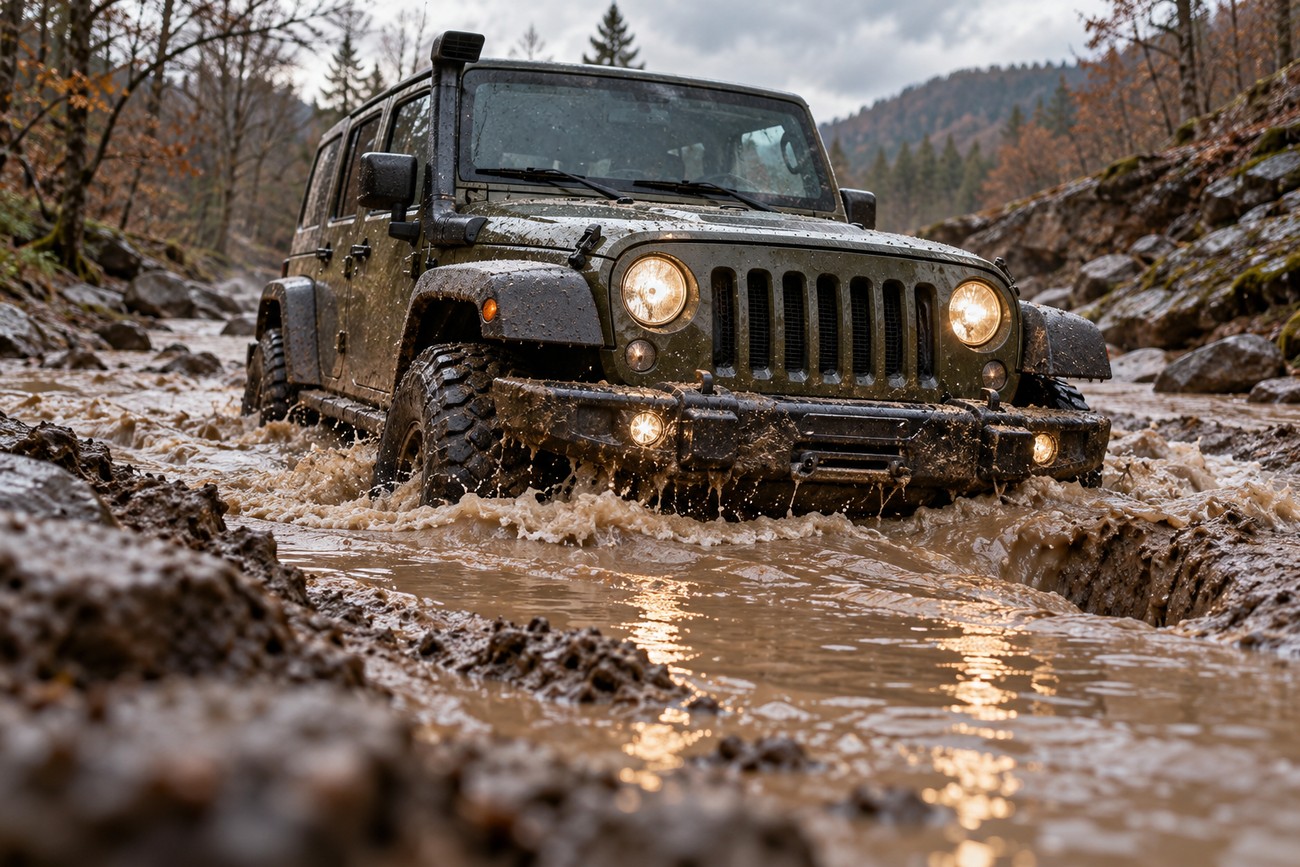
Judging a crossing by wheel or door height is a common mistake. The important level is the water around vulnerable systems, especially the intake and electrical connections, along with the depth of holes in the chosen line. A route that looks shallow from the bank can contain a depression that changes the risk within a few feet.
Entering quickly creates another hazard. The Wrangler’s front end pushes a bow wave, raising the water level around the grille and intake for a short period. The wave can also rebound from the far bank or an obstacle. A controlled approach reduces the size of that disturbance and gives the driver more time to respond if the bottom changes.
Current deserves the same attention as depth. A fast stream can push the vehicle sideways, reduce tire contact with the bottom, and carry it toward deeper water. Open doors, a removed roof, or a high suspension setup do not provide a useful safety margin against that force. A crossing that appears manageable in still water may be unsafe in a moving channel.
Breather checks matter even when the engine never stalled and the Wrangler drove away normally. Axle, transfer-case, and transmission housings can draw in water through breathers or seals, leaving contaminated fluid that causes damage later.
After deep immersion, remove wet carpets and begin drying the cabin promptly. Inspect wiring, connectors, fasteners, and low-mounted modules for trapped moisture and early corrosion. Late drying increases the chance that water remains against metal and electrical joints after the visible puddles have disappeared.
The driveline also needs attention. Water can contaminate wheel bearings, differentials, and transmission or transfer-case fluids without producing an immediate warning. Check axle and drivetrain fluids for water contamination or an emulsified appearance, and have the vehicle inspected when the depth or duration of immersion exceeded normal fording conditions.
Wrangler vs. Amphicar: Purpose, Hardware, and Risk
The key differences are engineering choices, not styling details. A Wrangler is an off-road vehicle with limited water-fording capability, while an Amphicar was built to operate as an amphibian.
| Category | Standard Jeep Wrangler | Amphicar |
|---|---|---|
| Intended use | Off-road travel with limited water fording | Road and water operation as an amphibious vehicle |
| Body design | Off-road body with water-resistant features; the cabin is not watertight | Sealed amphibious body designed to retain buoyancy |
| Propulsion | Wheel drive only; no dedicated water propulsion system | Wheel drive on land and water propulsion for travel afloat |
| Water guidance | About 30 inches (760 mm), subject to the exact vehicle and owner’s manual; up to 34 inches applies to some configurations or packages | Designed for water operation as part of its amphibious system |
| Flotation | No intended sustained flotation; flooding increases effective mass | Sealed hull intended to displace water and support the vehicle |
| Typical water risk | Loss of traction, hydrolock, cabin flooding, corrosion, and contaminated fluids | Amphibious-system limitations, water-operation hazards, and the compromises of dual-purpose design |
| Recovery implication | Requires a suitable recovery plan if depth, current, or traction becomes unsafe | Designed to transition into water, though it still requires appropriate conditions and handling |
The most important difference is the intended operating environment. The Wrangler uses its tires to cross a water-covered section of terrain, whereas the Amphicar was engineered to stay supported and propelled after leaving the road surface. Treating the Wrangler as an Amphicar removes the very assumptions on which its water-fording guidance depends.
Frequently asked questions
A Wrangler’s published wading capability applies to limited crossings over a supporting bottom. It does not indicate that the vehicle can float or operate safely in open water. Purpose-built amphibious vehicles use different body structures and propulsion systems.
After a deep crossing or submersion, hidden damage may remain even if the vehicle continues to run. Recovery, drying, and inspection are more important than simply confirming that the Wrangler reached the other side.
How much does an amphibious Jeep cost?
There is no single factory price for an amphibious Jeep because “amphibious Jeep” is not one standardized factory model or price category. A project may begin with a donor Wrangler, then require a flotation system, sealed body modifications, water propulsion, fabrication, controls, testing, and inspection work.
The cost depends on how much of the original vehicle remains, whether the hull is purpose-built or adapted, and what standards apply where the vehicle will operate. A snorkel, lift kit, sealed connectors, or other off-road upgrades do not create an amphibious conversion. They improve selected fording or off-road functions without supplying the buoyancy and propulsion required for controlled travel afloat.
Why did the Amphicar fail?
The Amphicar illustrates the broader compromise of a vehicle designed for two very different environments. A road car needs predictable handling, efficient packaging, braking, and practical everyday behavior. A boat needs buoyancy, water stability, sealing, and propulsion in a medium far denser and less predictable than a road surface.
Combining those requirements can leave compromises in both roles. The design must carry water-related structure and equipment on land, while its road systems cannot be optimized exactly like a conventional car. That broader engineering lesson explains why ordinary off-road hardware cannot be assumed to provide amphibious performance.
What cars can float on water?
Purpose-built amphibious vehicles can float because their bodies provide sufficient sealed volume and their systems support water propulsion or controlled maneuvering. Engineered conversions may also float when their hull, flotation, sealing, structural reinforcement, and propulsion have been designed and tested for that purpose.
Ordinary SUVs, pickups, and off-roaders with a published wading capability do not belong in the same category. A wading rating means the vehicle can negotiate limited water over a supporting bottom under specified conditions. It does not establish flotation, open-water control, or safe operation after the tires lose contact with the ground.
What should I do if my Wrangler becomes submerged?
Prioritize occupant safety and leave the vehicle if conditions allow it safely. Avoid restarting a potentially water-filled engine, arrange recovery rather than attempting to drive farther, and keep people clear of moving water and unstable ground. A vehicle that was still running during the incident may already have hidden damage.
After recovery, have the engine and intake, electrical system, driveline fluids, wheel bearings, axles, transfer case, and transmission inspected. Dry the cabin and remove wet floor coverings promptly, while treating delayed electrical faults and fluid contamination as possible even when the Wrangler appears to operate normally.







